

The Monthly Billing Chaos Test for Swim Clubs
Running monthly billing at your swim club shouldn't feel like chaos. Take this test to find billing mistakes before they cost you time and money.


It's the first week of the month and you're staring at a spreadsheet of failed payments. Three families are upset because they were charged twice. Two more swear they updated their card information last week but somehow the old card was charged again. Your board treasurer just sent an email asking why this month's revenue is $2,400 short of projections. And you still have 47 voicemails to return before Saturday's meet.
Sound familiar? Billing management doesn't have to feel like navigating a minefield every thirty days. The clubs that run smoothly have systems in place that catch problems early, keep families informed, and make sure every dollar gets tracked properly. Let's walk through what actually works when you're handling dues, lesson fees, and special assessments for hundreds of families.
Why Billing Goes Wrong at Member Clubs
Most swim clubs didn't start with a billing problem. You had fifty families, everyone paid on time, and tracking everything in a simple spreadsheet worked just fine. Then you grew. You added learn-to-swim programs, competitive teams, facility rentals, and guest passes. Suddenly you're managing different billing cycles, proration rules, sibling discounts, and seasonal rates.
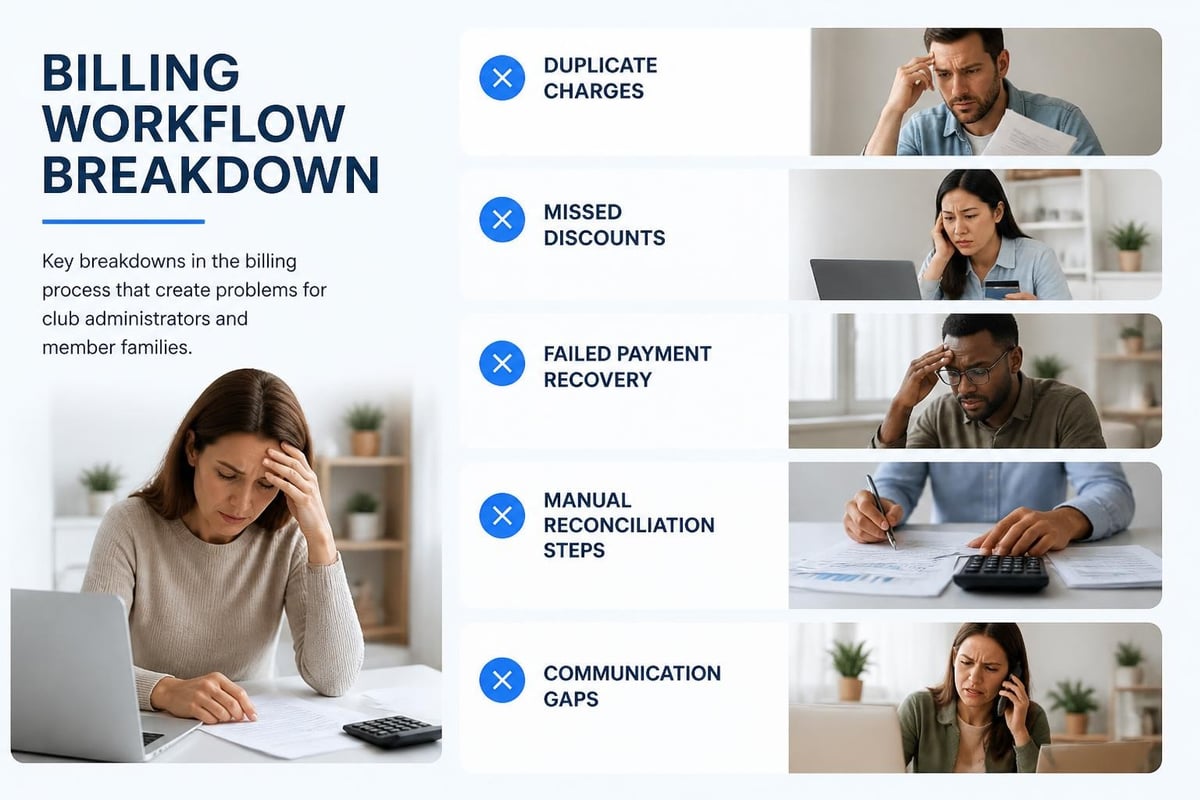
The real trouble starts when billing information lives in multiple places. Membership details sit in one system, payment methods in another, attendance records somewhere else. When it's time to bill, someone has to manually piece it all together. That's when duplicate charges happen, discounts get missed, and families end up confused about what they actually owe.
The True Cost of Manual Billing Work
Let's talk about what billing actually costs you beyond the transaction fees. Every month, someone at your club spends hours preparing invoices, processing payments, following up on failures, and answering questions. If that's taking fifteen hours at $25 per hour, you're spending $375 monthly just on labor. Multiply that over a year and you're looking at $4,500 in staff time.
Now add the hidden costs:
- Failed payments that never get collected ($200-800 monthly for a mid-sized club)
- Late fees you don't enforce because tracking is too hard
- Board members spending volunteer time reconciling accounts
- Families who leave because billing frustration outweighs the club benefits
- Staff turnover when seasonal employees can't keep up with billing questions
One club administrator told me she spent an entire Saturday morning in 2025 manually updating card information for thirty families before the monthly billing run. She missed her daughter's swim meet to do it. That's not sustainable.
The Five-Part Billing Management Framework
Good billing management comes down to five things happening reliably every single time. When any part breaks down, you end up with the chaos we talked about earlier. Let's walk through each piece.
Accurate Member Data from Day One
Everything starts with clean information when families join. You need their current payment method, correct billing address, email for notifications, and a clear understanding of what they're signing up for. This sounds obvious until you realize how many clubs collect this information on paper forms that get filed away.
Think about your current signup process. Does the family see exactly what they'll be charged and when? Do they actively confirm their payment authorization or is it buried in fine print? Are you compliant with current negative option rules that require clear disclosure and affirmative consent for recurring charges?
Modern swim club software handles this at enrollment through streamlined registration flows that collect everything you need while keeping the family informed. The goal is zero surprises when that first charge hits their account.
Automated Billing Cycles That Actually Run
Manual billing runs fail. Someone gets sick, a holiday throws off the schedule, or the person who "always handles it" is on vacation. Your billing needs to run automatically on the same day every month without anyone remembering to press a button.
But automation only works if you've set it up correctly. You need to define:
- Primary billing date (typically the 1st or 15th of each month)
- Retry schedule for failed payments (usually 3-5 days after initial failure)
- Grace periods before accounts are flagged or services suspended
- Proration rules for mid-month joins or cancellations
- Seasonal adjustments if you charge different rates during winter
| Billing Component | Manual Approach | Automated Approach |
|---|---|---|
| Monthly dues processing | 4-6 hours staff time | Runs automatically overnight |
| Failed payment follow-up | Phone calls, emails sent individually | Automated notification sequence |
| Proration calculations | Excel formulas, manual review | Rule-based engine calculates instantly |
| Account reconciliation | End-of-month marathon session | Real-time balance updates |
The clubs that never miss a billing cycle have eliminated the human bottleneck. Everything runs on schedule whether the office is staffed or not.
Smart Failed Payment Recovery
Here's a reality check: roughly 10-15% of your monthly charges will fail. Cards expire, accounts close, people forget to update their payment method after getting a new card. Failed payments aren't unusual, but how you handle them determines whether you recover that revenue or write it off.
The worst approach is doing nothing and hoping people notice. The second-worst is sending one angry email and giving up. The smart approach is a structured recovery sequence that starts friendly and gets progressively firmer.
A typical recovery workflow looks like this:
- Day 1 (failure day): Automatic retry with same payment method (catches temporary authorization issues)
- Day 2: Friendly email notification asking member to update payment information
- Day 5: Second retry attempt with updated payment method if provided
- Day 7: Direct outreach from staff with payment link
- Day 14: Account flagged for review, services potentially suspended
- Day 30: Account sent to collections or written off
Most failures get resolved in the first week if your communication is clear and updating payment information is easy. The families who genuinely can't pay will reach out during this window to arrange payment plans or discuss their situation.
Payment card networks have recognized how common "friendly fraud" disputes are when members don't recognize charges. Recent guidance from Visa emphasizes clear descriptor text and proactive communication to reduce these chargebacks. Make sure your billing descriptor clearly shows your club name as it appears on signage.
Transparent Member Communication
Nobody likes surprise charges. Yet swim clubs create surprise charges all the time without meaning to. A family signs up in March, forgets about auto-renewal, and gets charged again in September. They dispute it as fraud even though they agreed to auto-renewal six months ago.
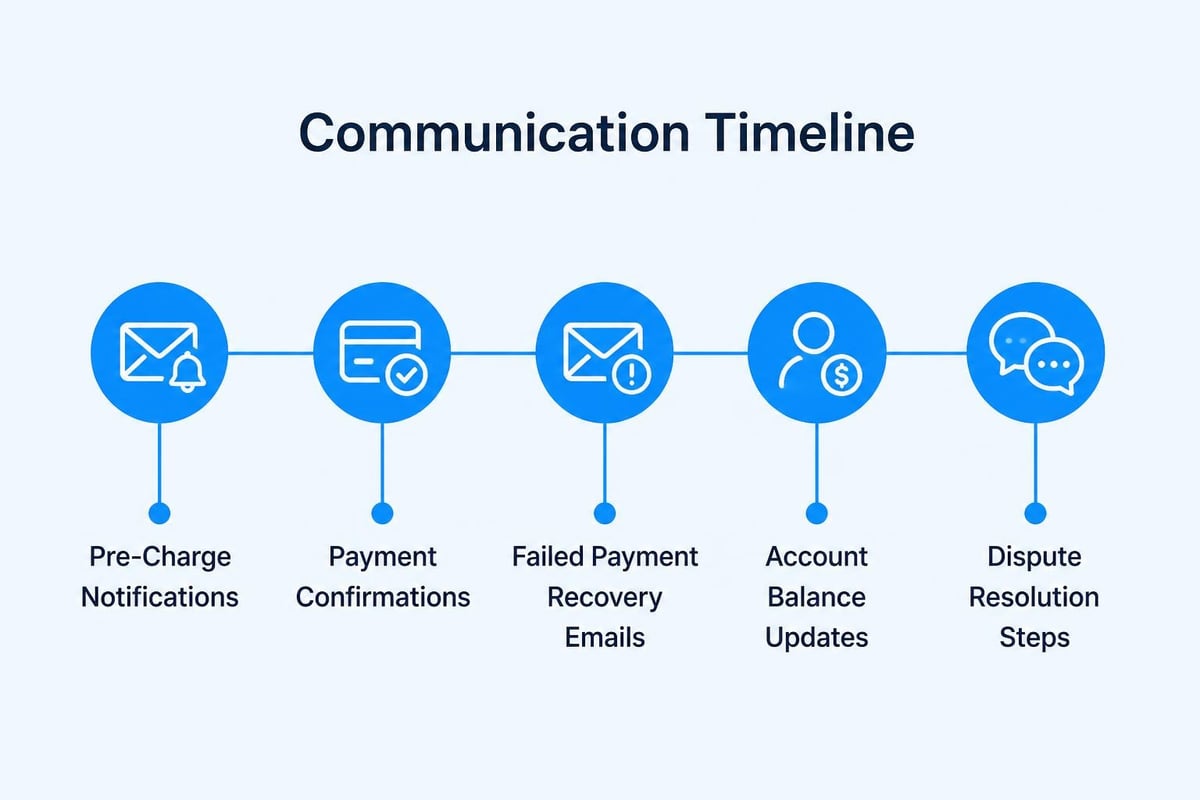
Better billing management means communicating before, during, and after each transaction:
Before charging:
- Renewal reminders 30 days before annual dues
- Upcoming charge notifications 7 days before monthly billing
- Special assessment announcements with clear timelines
- Rate change notices with sufficient advance warning
During processing:
- Immediate receipts for successful charges
- Clear failure notifications with next steps
- Real-time account balance updates families can see
After problems:
- Proactive outreach when patterns emerge (multiple family failures suggest processor issue)
- Dispute resolution that actually listens to the member
- Quick refunds when errors happen
One swim club cut their disputed charges by 60% in 2026 simply by adding a seven-day advance notification email before monthly billing. Families appreciated the heads-up and had time to update expired cards before the charge failed.
Compliance and Security You Can't Ignore
Let's talk about the serious stuff that keeps you up at night. When you're processing credit cards and bank account information for hundreds of families, you're holding sensitive financial data. Mishandle it and you're not just facing frustrated members but potential lawsuits and regulatory fines.
PCI Compliance for Payment Data
If you're storing credit card numbers in a spreadsheet, Google doc, or even a password-protected database on your computer, you're violating PCI DSS requirements. The PCI Security Standards Council sets strict rules about how payment card data must be handled, and "we're just a small swim club" isn't an exemption.
The safest approach is never storing card numbers at all. Modern payment processors use tokenization where you receive a token (random string) that represents the card without actually holding the card number. The token is useless to hackers because it only works with your specific merchant account.
If you're currently storing full card numbers anywhere, you need to:
- Delete them immediately from all systems
- Implement a payment processor that handles tokenization
- Train all staff on never writing down or photographing card information
- Review your security practices across all systems
ACH and Recurring Debit Rules
Many clubs prefer ACH bank transfers for monthly billing because the transaction fees are lower than credit cards (typically $0.25-0.50 versus 2.5-3.0% for cards). But ACH comes with its own compliance requirements under Nacha operating rules .
You must:
- Obtain clear written authorization before debiting any bank account
- Provide advance notice of debit amounts and dates (typically 10 days)
- Honor revocation of authorization promptly
- Handle returns and disputes according to Nacha timeframes
- Maintain authorization records for two years after the last debit
The biggest mistake clubs make with ACH is treating it like credit card processing. ACH authorization is a legal agreement that requires specific language and record-keeping. Using generic "I authorize payments" language won't hold up if a member disputes charges.
Data Privacy and Retention
You're required to protect member financial data and personal information under various state and federal privacy laws. This means:
- Encrypting data both in transit and at rest
- Limiting access to billing information to only staff who need it
- Having a documented data retention policy
- Secure deletion of payment information when members leave
- Breach notification procedures if data is compromised
California, Virginia, Colorado and several other states now have comprehensive consumer privacy laws that give members rights to access, correct, and delete their personal information. Even if your club isn't in one of these states, members who live there are covered.
One practical step: audit who currently has access to your billing system. If volunteers, board members, or former staff can still log in, you're creating unnecessary risk. Access should be role-based and reviewed quarterly.
The Real-World Billing Problems You Face
Theory is great, but let's talk about the actual situations you're dealing with this month.
Family Account Complexity
Your billing isn't just one person, one membership, one charge. You have families with multiple swimmers, some on the competitive team and some in lessons. Parents might be divorced with different billing arrangements. Grandparents pay for some grandkids but not others. Siblings get discounts, but only if they're in the same program.
Smart billing management handles family account structures that reflect real life:
| Family Structure | Billing Challenge | Solution Approach |
|---|---|---|
| Two parents, shared custody | Who gets charged? Who gets receipts? | Designate primary billing contact, copy receipts to both |
| Extended family memberships | Multiple billing addresses and payment methods | Link accounts but allow separate payment |
| Sibling discounts | Applying correctly when programs differ | Rule-based discounting by member relationship |
| Mid-season changes | Kid drops competitive, stays in lessons | Proration engine that handles partial-month adjustments |
The clubs that handle this well use software with flexible family linking that preserves individual member records while understanding household relationships for billing purposes.
Seasonal Rate Changes and Special Assessments
Your pool probably doesn't cost the same to run year-round. Summer is peak season with higher utility costs and staffing needs. Winter might be indoor-only with reduced hours. Your billing needs to reflect these seasonal realities without creating confusion.
The clearest approach is setting expectations at enrollment. If you charge $150 monthly June-August and $100 September-May, tell families that upfront. Put it in writing in their membership agreement. Send a reminder email two weeks before rates change.
Special assessments for facility improvements, equipment purchases, or major repairs require even more communication. Your board and management team should approve these well in advance and give members at least 60 days notice before the charge appears. Some states require member voting on assessments above certain amounts.
Guest Passes and One-Time Charges
Not everything bills monthly. You have guest passes, private lesson packages, equipment rentals, late fees, and facility rental charges. These need to appear on the right family account, charge immediately, and be tracked separately from recurring dues.
The mistake many clubs make is trying to add these charges to the next monthly billing cycle. By the time the charge actually processes, the family has forgotten what it's for and disputes it. Better to charge immediately at point of sale and send a clear receipt.
For lessons and packages, you might offer payment plans. Someone buying a twenty-lesson package for $400 should be able to split that into four monthly $100 charges. Your billing system needs to track the payment schedule, apply payments correctly, and know what to do if a payment fails mid-package.
Dispute Management and Chargebacks
Even with perfect billing management, you'll face disputes. Credit card chargebacks happen when a member contacts their bank claiming a charge is fraudulent or unauthorized. The bank reverses the charge and asks you to prove the charge was legitimate.
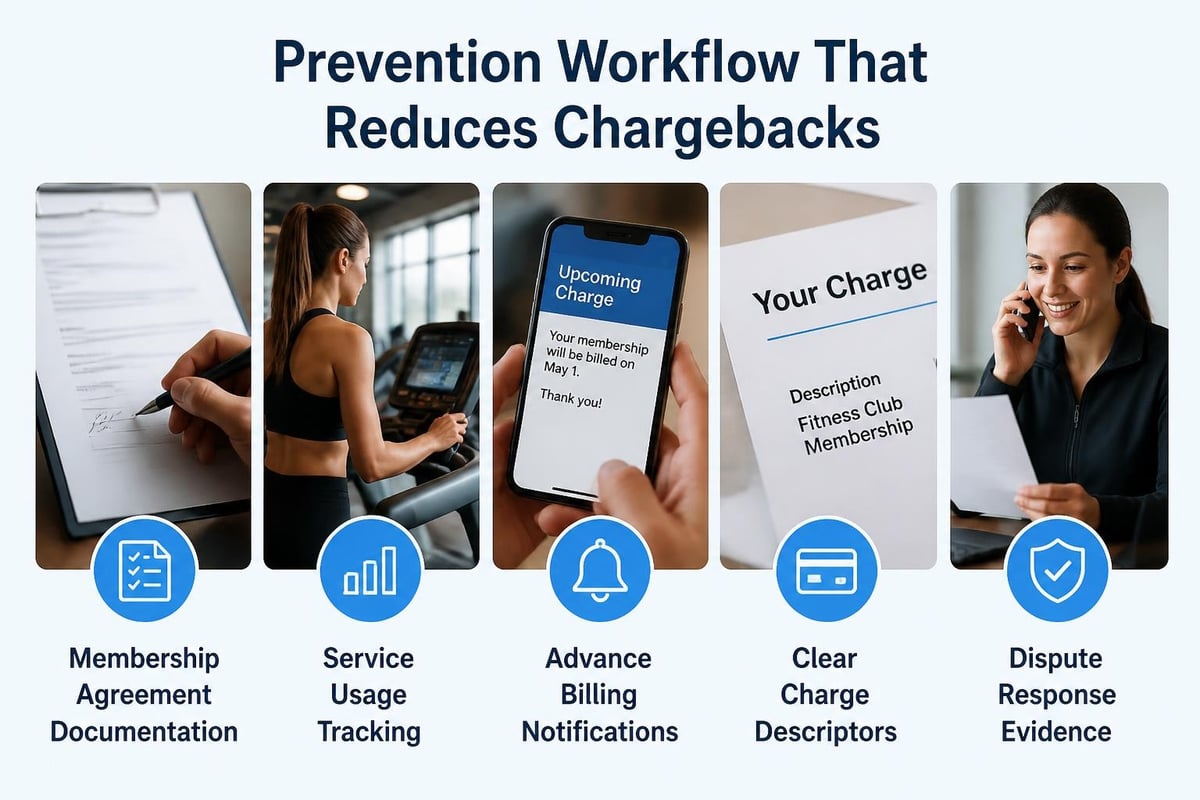
Visa's dispute management guidelines outline what evidence you need to fight chargebacks successfully. For recurring billing disputes, you typically need:
- Original membership agreement showing authorization for recurring charges
- Records of services provided (attendance logs, facility access records)
- Communication showing the member actively used the services
- Clear documentation of cancellation policy
- Proof that advance notice was provided before charges
You have a limited window (usually 7-10 days) to respond to disputes with this evidence. If you're digging through file cabinets looking for a membership agreement from two years ago, you've already lost. Digital record-keeping with automated retention is essential.
The best dispute strategy is prevention. Clear communication, recognizable billing descriptors, advance charge notifications, and easy self-service account management eliminate most disputes before they happen.
Integration with Everything Else You're Managing
Billing doesn't exist in isolation. It connects to member management, attendance tracking, facility access, waitlists, and reporting. When these systems talk to each other, billing becomes almost invisible. When they don't, you're stuck manually updating information in multiple places.
Member Status and Access Control
Here's a common scenario: A family's payment fails on the first of the month. They don't respond to emails. By the fifteenth, their account is thirty days past due. Should their kids still have access to the pool?
Your billing system needs to communicate with access control. When an account hits a certain past-due threshold, access gets restricted automatically. But you need nuance here. Maybe restricted members can still attend practices but can't bring guests. Maybe their access cards still work but they receive a notification at check-in to settle their balance.
The inverse matters too. When someone pays off a past-due balance, access should restore immediately without staff intervention. Nothing frustrates families more than paying online and still being turned away at the door because "the system hasn't updated yet."
Attendance and Usage Tracking
Billing disputes often hinge on whether services were actually used. A family claims they cancelled in March but you show they checked in seventeen times that month. Automated attendance tracking integrated with billing gives you proof of service usage.
This integration also enables usage-based billing models. Some clubs charge per visit rather than unlimited monthly access. Your check-in system needs to track visits and trigger billing automatically when thresholds are hit (for example, charge $50 after every ten visits).
For clubs offering both unlimited and pay-per-use options, the system needs to know each member's plan and bill accordingly. That's impossible without tight integration between attendance and billing.
Financial Reporting and Revenue Recognition
Your treasurer and accountant care about when revenue is recognized, not just when cash is collected. A family paying $1,200 annual dues in January doesn't mean you recognize all $1,200 in January. Proper accounting spreads that revenue across twelve months.
Your billing management system should generate reports that show:
- Cash collected (actual money received this month)
- Revenue recognized (portion of payments earned this month)
- Deferred revenue (prepayments for future services)
- Accounts receivable (money owed but not yet collected)
- Refund liabilities (prepaid amounts for members who cancelled)
These aren't the same numbers, and confusing them leads to poor financial decisions. A board that sees $50,000 collected in January might approve spending that assumes ongoing monthly revenue, not realizing much of that was annual prepayments.
Integration with accounting software (QuickBooks, Xero, or others) means financial data flows automatically without manual journal entries and reconciliation. Month-end close goes from a multi-day ordeal to clicking a few buttons.
Making the Switch to Better Billing Management
If you're reading this and realizing your current approach isn't working, you're probably wondering how to fix it without making things worse. The transition from manual or outdated billing systems to modern automation requires planning.
Audit Your Current State
Before changing anything, document exactly how billing works today. This isn't fun, but it's necessary. Map out:
- How payment information is collected and stored
- Who performs billing tasks and how long each takes
- Where member data lives and how it's updated
- What happens when payments fail
- How disputes are currently handled
- Which reports you generate and who uses them
You'll probably discover processes you didn't know existed. "Oh, Sarah manually checks these three accounts every month because they have weird payment arrangements." Those edge cases need solutions in your new system.
Choose Software That Matches Your Operations
Not all billing software works the same way. Some are designed for e-commerce and struggle with membership nuances. Others handle recurring billing but can't manage family account complexity. A few are built specifically for member-based organizations and understand your actual needs.
When evaluating options, test realistic scenarios:
- Family with three kids in different programs, each billed differently
- Mid-month membership change that requires proration
- Annual renewal with rate increase that was announced thirty days prior
- Failed payment recovery sequence for member who's been with you for years
- Special assessment split across multiple payment installments
The software should handle these without workarounds or manual intervention. If the demo requires "we'd just do that part manually," keep looking. The point is eliminating manual work.
Consider exploring modern swim club management platforms that integrate billing with everything else you're managing. Billing works better when it's part of a unified system rather than a standalone tool.
Migration Strategy That Protects Revenue
The scariest part of switching billing systems is the actual cutover. You can't afford to miss a billing cycle or lose payment information during migration.
A safe migration follows these steps:
- Run systems in parallel for one billing cycle (old system charges, new system shadows)
- Validate data accuracy by comparing reports from both systems
- Test failed payment workflows with small group before full rollout
- Migrate payment methods using secure tokenization transfer (never export/import raw card numbers)
- Communicate changes to members at least two billing cycles in advance
- Provide extra support during first month after cutover
Plan for the migration to take 60-90 days from contract signing to full cutover. Rushing this creates gaps where charges get missed or duplicate charges occur. Either one damages member trust.
Training Staff and Setting New Processes
New software only works if people know how to use it. Your staff needs training on:
- Processing payments manually for in-person transactions
- Updating member payment information
- Handling failed payment calls and emails
- Running reports for board meetings and reconciliation
- Resolving discrepancies and disputes
- Understanding what the system does automatically vs. what requires intervention
The best training isn't a three-hour session before launch. It's ongoing support, quick reference guides for common tasks, and someone designated as the internal expert who gets deeper training and can help others.
Document your new processes in writing. "How do I process a mid-month cancellation refund?" should have a clear answer that any trained staff member can follow. When seasonal staff turn over, these process documents prevent knowledge loss.
Measuring Billing Management Success
How do you know if your billing management is actually working? You need metrics that reflect both operational efficiency and member satisfaction.
Key Performance Indicators to Track
Stop measuring just total revenue. Start tracking these specific indicators:
Operational Efficiency:
- Staff hours spent on billing tasks per month
- Time from billing run to reconciliation completion
- Number of manual billing interventions required
- Failed payment recovery rate (percentage collected within 30 days)
Financial Health:
- First-attempt payment success rate (target: 85%+)
- Average days to collect on failed payments
- Dispute and chargeback rate (target: under 1%)
- Deferred revenue balance and trends
Member Experience:
- Billing-related support tickets as percentage of total tickets
- Average resolution time for billing questions
- Member survey scores on billing clarity and ease
- Voluntary cancellation rate citing billing frustration
Set baselines for where you are today, then measure monthly improvement. A 5% increase in first-attempt success rate might not sound impressive, but for a club with $50,000 in monthly billing, that's $2,500 less working capital tied up in collections.
The Questions Your Reports Should Answer
Your board and management team need billing reports that actually inform decisions. Generic revenue reports don't cut it. You should be able to answer:
- How much revenue is contractually committed but not yet collected?
- Which payment methods have the highest failure rates?
- Are failed payments concentrated in specific membership types or demographics?
- What's the true cost of processing payments when you include labor and failures?
- How does actual collected revenue compare to budget projections?
- Which members are consistently late but eventually pay vs. those who require intensive collection efforts?
Modern reporting tools with AI-powered insights can surface patterns you'd never spot manually. Maybe families who join during summer have 40% higher payment failure rates than winter joiners. That insight might change your enrollment processes or payment term options.
Common Billing Management Mistakes and How to Avoid Them
Let's finish with the mistakes that cost clubs real money and member goodwill. If you recognize yourself in these, you're not alone. The good news is they're all fixable.
Mistake 1: Treating All Failed Payments the Same
A credit card declined due to insufficient funds requires different handling than one declined because it expired. The first might need a payment plan conversation. The second just needs the member to update their card on file.
Smart billing systems categorize failure reasons and trigger appropriate responses. Expired cards get automated update requests. Insufficient funds get friendly payment arrangement offers. Suspected fraud gets immediate human attention.
Mistake 2: Making It Hard to Update Payment Information
If updating a payment method requires calling the office during business hours, filling out a form, or sending sensitive information by email, most people won't do it until they're forced to. Then you're chasing them after the payment already failed.
Members should be able to update payment information themselves 24/7 through a secure portal. The update should take effect immediately for the next billing cycle. Some clubs even send proactive reminders when cards are approaching expiration based on the expiration date on file.
Mistake 3: Poor Communication About What Charges Mean
Your monthly statement shows a $150 charge with the description "Monthly Dues - Smith Family." But the Smiths have one kid in competitive team ($100) and another in Saturday lessons ($60), and there was a $10 late fee from last month that just posted. The statement is accurate but not helpful.
Detailed itemization prevents confusion. Show exactly what each charge represents, reference the date of service or agreement, and provide context for any fees or adjustments. The extra detail takes no additional effort if your system tracks it properly but eliminates dozens of "what is this charge for?" calls.
Mistake 4: No Clear Cancellation and Refund Policy
A family moves out of state mid-season. They want a refund for unused months. Your policy says "no refunds on annual memberships." They dispute the charge with their credit card company. Now you're fighting a chargeback and dealing with negative reviews.
Clear cancellation policies prevent these situations. Spell out:
- How much advance notice is required
- Whether refunds are provided and for what portion
- How prepaid services are handled
- What happens to security deposits or enrollment fees
- The process for freezing or suspending membership vs. cancelling
Then enforce the policy consistently. Making exceptions for members you like while holding others to the letter creates legal and ethical problems. If the policy isn't working, change the policy, but don't selectively enforce it.
Mistake 5: Ignoring the Integration Between Billing and Member Experience
Billing feels like a back-office function, but it's actually a front-line member experience. How you handle payment determines whether families feel respected or nickel-and-dimed. Whether they trust your club or suspect you're running a sloppy operation.
Every billing interaction is a touchpoint. Late payment reminders can be polite and helpful or accusatory and aggressive. Failed payment notifications can make updating information easy or create friction. Refund processing can be quick and fair or drawn-out and frustrating.
The clubs with the best retention rates treat billing as member service, not just accounting. Your overall operational approach should reflect that understanding throughout every system and process.
Getting billing management right means fewer headaches, better cash flow, and members who trust that their money is being handled professionally. When payments process smoothly, families can focus on enjoying the pool instead of worrying about account issues.
PoolPulse handles all of this through an integrated platform built specifically for swim clubs, tennis clubs, and HOA pools. Our configurable billing engine automates recurring charges, manages family account complexity, and keeps members informed at every step. Book a demo to see how clubs are saving hours each month while improving collection rates and member satisfaction.

The True Cost of Messy Billing: What Your Club Loses
Manual billing costs more than you think. Learn how swim clubs lose revenue, waste staff time, and frustrate members with outdated systems.

Guest Check-In Without the Saturday Morning Chaos
Learn how to check in guest visitors at your swim club without slowing down member access or creating bottlenecks during peak hours.

Does Your Check-In Process Really Protect Your Club?
Your front desk check-in might be costing you money and exposing liability. Learn how swim clubs use check out and check in systems that work.
Want to see if PoolPulse is a good fit for your club?
Book a walkthrough and we'll show you exactly how PoolPulse can help based on your club's needs, goals, and current processes.