

HOA Billing That Actually Gets Paid: A Treasurer's Guide
Learn how to streamline HOA billing, reduce late payments, and eliminate collection headaches with automated systems and clear payment policies.


You know that feeling when it's the first week of the quarter and your inbox is already filling up with "I never got my bill" emails? Or when you're prepping for the board meeting and realize you're still chasing down three months of unpaid assessments from the same five homeowners? If you're managing an HOA pool or community amenity, billing shouldn't be the thing keeping you up at night. But for too many associations, hoa billing is a monthly scramble involving spreadsheets, manual invoices, and awkward follow-up calls.
The good news? Most billing headaches come from fixable problems, not difficult people. When you set up the right systems and communicate clearly from day one, you spend less time chasing payments and more time actually managing your facility.
Why HOA Billing Feels Harder Than It Should
Managing assessments for a homeowners association is different from running a regular business. You can't exactly fire a customer who doesn't pay on time. Your "members" didn't choose you; they bought a house that came with mandatory fees. And unlike a gym membership they can cancel, HOA dues are a legal obligation tied to property ownership.
That creates a unique dynamic. Some homeowners treat assessments like a suggestion. Others genuinely forget or don't understand what they're paying for. A few will dispute every line item. And everyone has an opinion about how you should run things.
Here's what makes hoa billing particularly tricky:
- You're dealing with the same people year after year - burning bridges over a late fee has long-term consequences
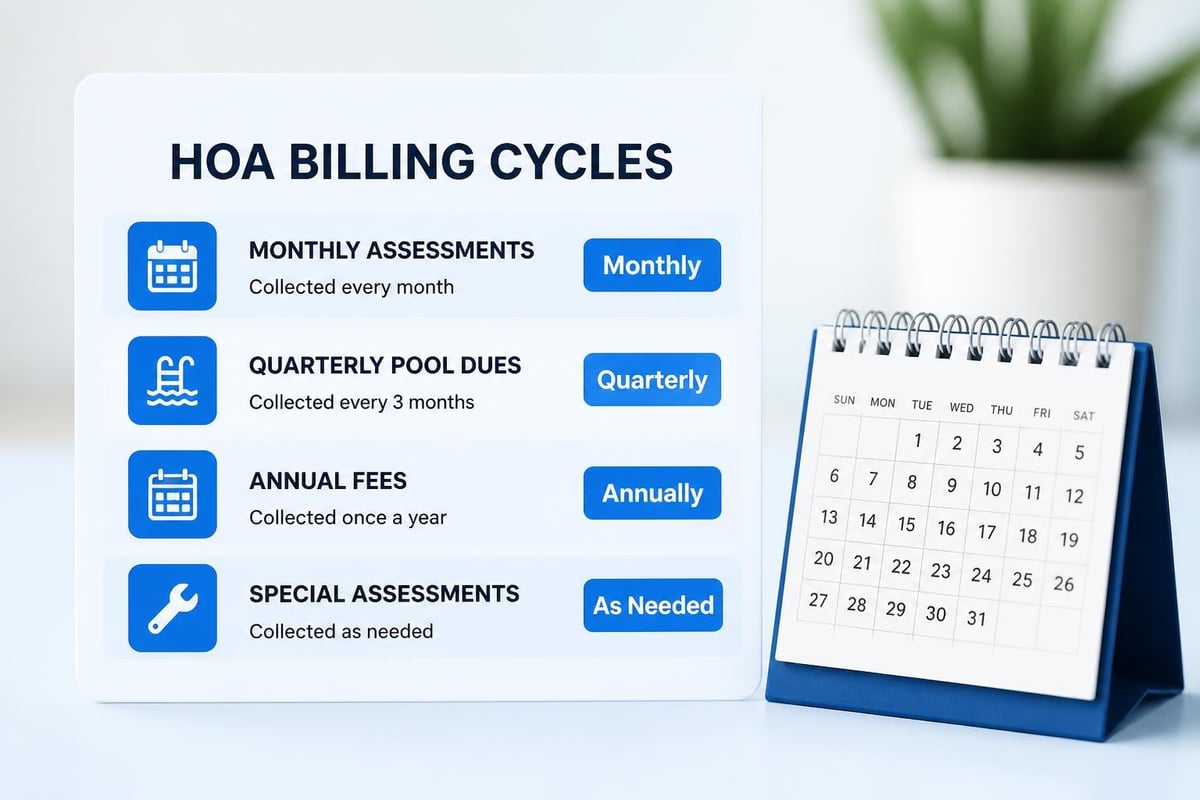
- Payment amounts and timing vary - annual assessments, monthly dues, special assessments, and amenity fees all follow different schedules
- State laws differ dramatically - what you can charge, how you collect, and your lien rights depend on where you operate
- Boards change regularly - your billing policies need to survive leadership transitions
- Homeowners expect transparency - vague invoices generate questions and complaints
The 2024 Community Association Management Industry Report found that payment automation and online billing are now standard expectations, not nice-to-have features. Homeowners want the same convenience they get from every other service provider.
Setting Up Your Billing Structure (Before You Send a Single Invoice)
The biggest billing mistakes happen before you ever charge anyone. If your fee structure is confusing or your payment policies are unclear, you're creating problems you'll be managing all year.
Start by documenting exactly what you charge and when. This sounds obvious, but you'd be surprised how many associations operate on "the way we've always done it" without written policies.
What to Include in Your Fee Schedule
Your assessment structure should answer these questions for every homeowner:
- What's the base assessment? - the annual or monthly amount every property owner pays
- Are there amenity tiers? - do pool access, tennis courts, or clubhouse use cost extra?
- How do you handle multiple properties? - investors who own several units need clear per-property pricing
- What triggers special assessments? - major repairs, capital improvements, and emergency expenses
- When are fees due? - specific dates, not "around the beginning of the month"
Create a simple rate sheet and post it where homeowners can find it. On your website. In your welcome packet. Attached to every invoice. When people know what to expect, they complain less.
Payment Methods That Actually Work
You need to accept payments the way people want to pay, not just the way that's convenient for your bookkeeper. That means offering multiple options:
| Payment Method | Convenience | Cost to Association | Processing Time |
|---|---|---|---|
| ACH/Bank transfer | High | Low ($0.25–$1) | 2-3 business days |
| Credit/debit card | High | Medium (2.5–3%) | 1-2 business days |
| Check by mail | Low | Very low | 5-7 days |
| In-person payment | Low | None | Immediate |
Most modern HOA pool management software includes payment processing with transparent fees. You can decide whether to absorb those costs or pass a convenience fee to homeowners who pay by card (just make sure that's allowed under your state's laws and your governing documents).
The NACHA meaningful modernization rules updated ACH authorization requirements in recent years, so if you're setting up automatic payments, you need proper documentation. Get written authorization that specifies the amount, frequency, and account details. Keep those records organized.
Automating HOA Billing Without Losing the Personal Touch
Here's where many associations get stuck. They know manual billing is eating up hours every month, but they worry that automation will feel impersonal or create new problems.
The reality? Good automation actually improves communication because it's consistent. Every homeowner gets their invoice at the same time. Reminders go out on schedule. Nobody gets forgotten, and nobody gets special treatment by accident.
What to Automate (and What to Keep Manual)
Automate these tasks:
- Monthly or quarterly invoice generation
- Email delivery of statements
- Payment reminders 7 days and 1 day before due date
- Late notices 5 days after missed payment
- Receipt confirmations
- Balance updates to homeowner accounts
Keep these tasks manual (at least at first):
- Responses to billing questions
- Payment plan negotiations
- Special assessment communications
- Dispute resolution
- Collection decisions
You want systems handling the predictable, repetitive work so you have time for the conversations that actually need a human. When someone emails asking why their balance is $347.82 instead of $325, you should be able to pull up their account history in seconds and give them a real answer.
Modern swim club and HOA software like PoolPulse is designed to handle these workflows while staying flexible enough to accommodate your community's specific needs. You're not forcing your association into a rigid template.
The Invoice That Explains Itself
Your invoice is not just a payment request. It's a communication tool. Every time a homeowner opens their bill, they should understand exactly what they're paying for and why.
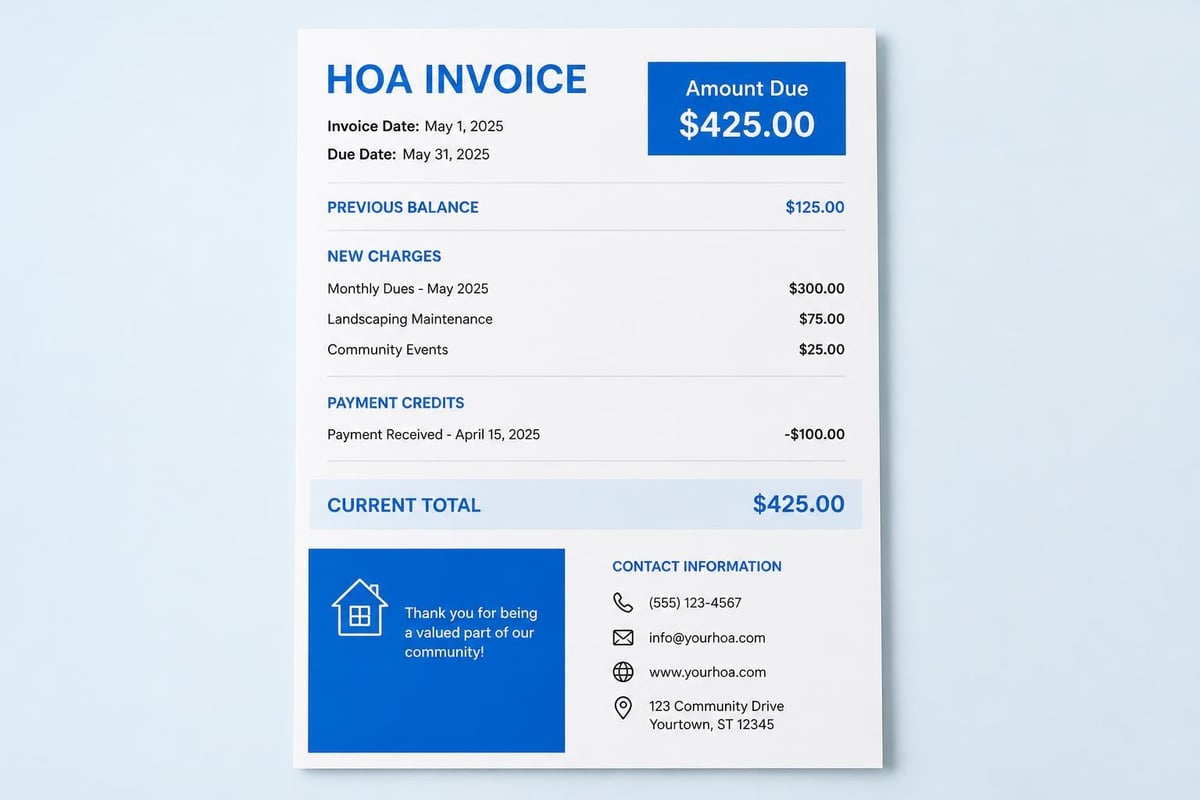
A good HOA billing statement includes:
- Previous balance - what they owed before this billing period
- New charges - itemized by category (base assessment, pool access, late fees, etc.)
- Payments received - with date and method
- Current balance - the total they owe right now
- Due date - specific day, not "net 30"
- Payment instructions - where to send check, online portal URL, or phone number
- Contact information - who to call with questions
If you charged a late fee or special assessment, include a one-sentence explanation right on the invoice. "Late fee applied per association policy" or "Special assessment for pool heater replacement approved 8/15/26." You'll prevent half your billing questions with those simple notes.
Handling Late Payments Without Creating Drama
This is where hoa billing gets uncomfortable. Someone hasn't paid in three months. You need the money to cover operating expenses. But you also need to maintain a working relationship with this person, who might serve on the board next year or chair the social committee.
The key is having a clear, written collections policy that you follow consistently. When everyone knows the rules and you apply them fairly, it's not personal. It's policy.
Your Collections Timeline
Creating a uniform collections policy protects both your association and your homeowners. Here's a reasonable escalation schedule:
- Day 1 (due date) - payment due, no action needed
- Day 8 - automated friendly reminder email
- Day 15 - late fee applied per policy, second notice
- Day 30 - personal phone call or letter from manager
- Day 45 - formal demand letter, board notification
- Day 60 - suspend amenity access (if allowed by your documents)
- Day 90 - file lien or turn over to collections
You don't want to reach day 90. Most delinquencies resolve by day 45 when homeowners realize you're serious and consistent. The ones that don't usually involve financial hardship, legal disputes, or people who've moved without updating their information.
Payment Plans That Actually Get Followed
When someone falls behind and asks for help, a payment plan is usually better than aggressive collection action. You get paid, they avoid legal consequences, and you preserve the relationship.
Set clear terms:
- No new charges can be deferred - they must stay current on new assessments while paying down the old balance
- Write it down - email or paper agreement with specific amounts and dates
- Require automatic payments - manual plans fail because people forget
- Set a realistic timeline - someone who's $1,200 behind probably can't pay it all next month
- Build in a consequence - if they miss a payment plan installment, what happens?
Most important: get board approval for any payment plan over a certain threshold (say, $500 or three months of dues). Your governing documents probably require board consent for major financial decisions.
Protecting Your Association From Payment Fraud
You're probably thinking, "We're a small HOA, nobody's targeting us." Unfortunately, that's exactly why you're a target. Community associations often have aging boards, limited financial oversight, and volunteers handling transactions. That's perfect for scammers.
The FBI's Internet Crime Complaint Center tracks business email compromise schemes that specifically target associations and nonprofits. Here's how it usually works:
A scammer spoofs your management company's email or compromises a board member's account. They send an urgent message: "We need to pay the pool contractor immediately. Wire $8,500 to this account." The treasurer, trusting the familiar email address, sends the money. By the time anyone realizes what happened, the account is empty and untraceable.
Basic Payment Security Measures
Protect your hoa billing and payment processes with these simple rules:
- Require dual authorization for any payment over $1,000
- Verify payment changes by phone using a known number, not one in the email
- Never send wire transfers based solely on email instructions
- Review bank statements weekly to catch unauthorized transactions quickly
- Limit who can process payments - fewer people with access means fewer attack vectors
If you accept credit card payments, you also need to think about PCI compliance . You don't need to become a security expert, but you do need to follow basic data protection practices. Don't store card numbers in spreadsheets. Don't email credit card details. Use payment software that handles sensitive data properly.
Tax Implications of Your HOA Billing Structure
This part isn't exciting, but it matters. How you structure your assessments and what you spend the money on affects your association's tax status.
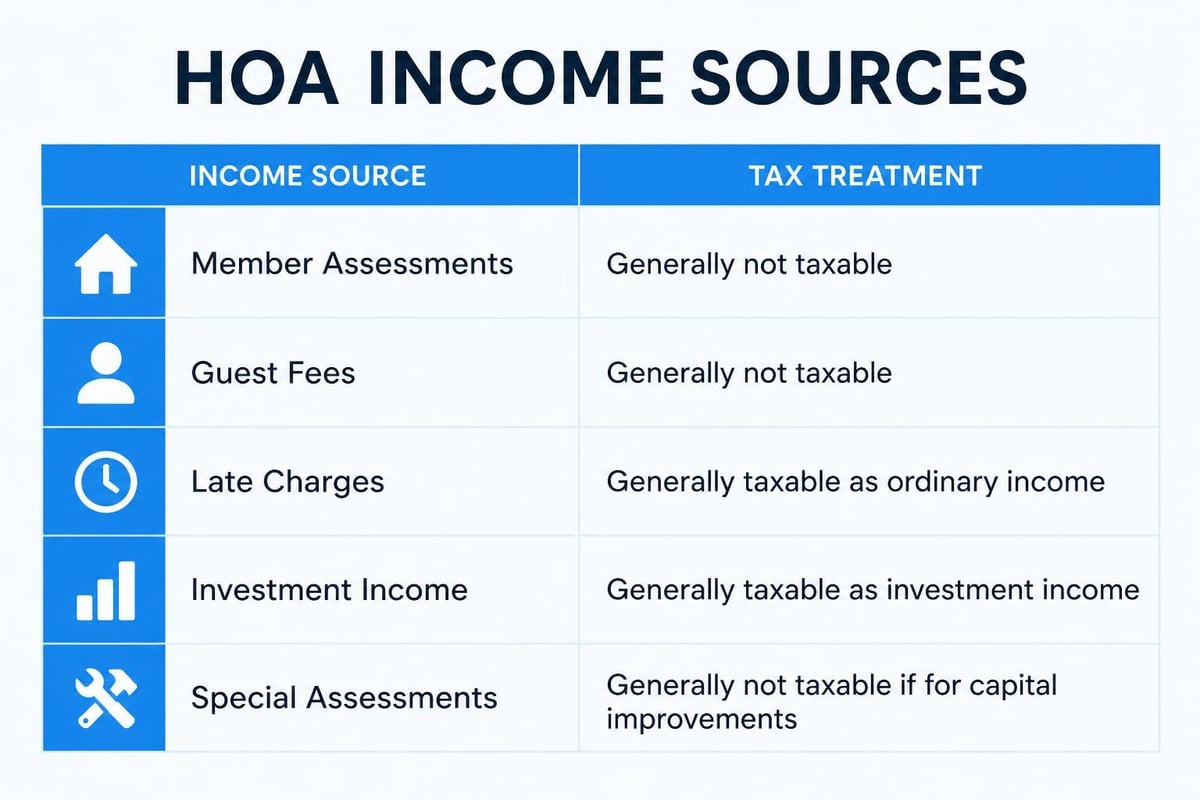
Most homeowners associations file IRS Form 1120-H , which allows them to be taxed at a flat rate on certain types of income. To qualify, at least 60% of your gross income must come from member assessments, and at least 90% of expenses must be for management, maintenance, and care of association property.
Here's where it gets tricky with hoa billing: if you generate substantial income from non-members (like renting your pool to outside groups or selling guest passes), that income gets taxed differently. Same with investment income from reserves.
What This Means for Your Billing Practices
You don't need to be a tax accountant, but you should:
- Separate member assessments from other revenue in your accounting
- Track reserve contributions separately from operating funds
- Document the purpose of special assessments for capital improvements
- Work with a CPA familiar with HOA taxation at least once a year
Your billing software should categorize income properly so your year-end reports don't require manual sorting. When assessment revenue, guest fees, late charges, and interest income are all tracked separately from the start, tax filing becomes straightforward.
Common HOA Billing Mistakes (and How to Avoid Them)
Let's talk about the mistakes that create the most work and frustration. These aren't hypothetical. They're problems real associations deal with every season.
Mistake #1: Inconsistent Enforcement
You waive late fees for one homeowner because they're friendly, but charge another one who's equally late. Word gets around. Suddenly everyone expects special treatment, and your policy means nothing.
Fix it: Apply your billing and collections policy uniformly. The only exceptions should be formal hardship programs approved by the board.
Mistake #2: Unclear Due Dates
Your documents say "assessments due quarterly," but you don't specify exact dates. Some homeowners pay in January, others in mid-February. Your cash flow is unpredictable, and you can't track who's actually late.
Fix it: Set specific due dates (January 1, April 1, July 1, October 1) and communicate them clearly. Update your governing documents if necessary.
Mistake #3: No Digital Payment Option
It's 2026, and you're still telling homeowners to mail checks. Half of them pay late because they forgot to buy stamps. The other half complain every time they have to write a check.
Fix it: Implement online payment processing. Even if you keep accepting checks, give people the option to pay electronically. Modern HOA software makes this standard, not optional.
Mistake #4: Poor Communication About Special Assessments
The board approves a $150,000 pool renovation and splits the cost among 75 homeowners. You send invoices for $2,000 with no context. Your phone rings off the hook with angry calls.
Fix it: Communicate special assessments before invoices go out. Send a letter or email explaining what the project is, why it's necessary, how the board approved it, and when payment is due. Then reference that communication on the invoice itself.
Mistake #5: Not Tracking Payment History
A homeowner claims they paid last quarter. You have no easy way to verify it. You spend an hour digging through bank statements and email receipts to prove they're wrong (or discover they're right and your records are incomplete).
Fix it: Use billing software that maintains a complete payment history for every account. You should be able to pull up any homeowner's record and see every invoice, payment, adjustment, and communication in seconds.
What Good HOA Billing Looks Like in Practice
Let's bring this together with a realistic scenario. You're managing a 120-home association with a community pool. Annual assessments are $800, due quarterly at $200. Pool access is included. You also charge a $50 annual guest pass fee and occasional late fees.
January 1: First Quarter Assessments
Your system automatically generates invoices for all 120 homeowners. Each invoice shows:
- Previous balance (should be $0 for most)
- Q1 assessment: $200
- Total due: $200
- Due date: January 15, 2026
- Payment options and online portal link
Invoices go out by email to everyone with an email address on file. Paper invoices mail to the handful of homeowners who prefer them.
January 8: First Reminder
Automated emails go to the 45 homeowners who haven't paid yet. Friendly tone: "Just a reminder that your Q1 assessment of $200 is due January 15. Pay online at [portal link] or mail check to [address]."
January 16: Late Fee Processing
Twenty homeowners still haven't paid. Per your collections policy, a $25 late fee applies. Your system adds it automatically. You send a second notice: "Your Q1 assessment is now past due. Your current balance is $225 including a $25 late fee."
January 23: Personal Outreach
Fifteen homeowners have now paid. Five are still outstanding. You or your manager make personal phone calls. Most of these resolve immediately-someone was traveling, forgot to update their bank account, or genuinely didn't receive the invoice.
February 1: Escalation Decisions
Two homeowners remain unpaid. Both have payment history issues. You review their accounts with the board. One gets a formal demand letter. The other, who contacted you about financial hardship, gets offered a payment plan: $75 per month for three months, with automatic ACH withdrawal.
That's hoa billing working the way it should. Automated where possible, personal where necessary, and consistent throughout.
Federal Consumer Protection Rules You Need to Know
When you're collecting delinquent assessments, you're subject to federal debt collection laws. Yes, even though you're a nonprofit HOA, not a commercial debt collector. The Consumer Financial Protection Bureau has made this clear in recent supervisory guidance.
The Fair Debt Collection Practices Act and Regulation F limit when and how you can contact homeowners about unpaid assessments. You can't call at 8 p.m. or 6 a.m. You can't harass or threaten. You need to provide written validation of the debt if requested.
Most importantly: if you hire a collection agency or attorney to collect for you, they must follow FDCPA rules strictly. Their violations become your legal problem. Make sure anyone you hire to collect delinquent assessments understands these requirements.
Your Rights and Remedies
The good news is that HOAs have powerful collection tools most creditors don't. In most states, you can:
- Place a lien on the property for unpaid assessments
- Foreclose on the lien if the debt becomes substantial
- Suspend amenity access while assessments are unpaid
- Charge interest and late fees per your governing documents
State laws vary significantly on these remedies. HOA lien and foreclosure processes differ in timing, notice requirements, and the priority of your lien versus mortgage lenders. Work with an attorney familiar with your state's laws before pursuing aggressive collection action.
Technology That Makes HOA Billing Easier
You don't need enterprise software to fix your billing problems. You need tools that handle the basics reliably: generating invoices, processing payments, tracking balances, and sending reminders.
Look for these features when evaluating hoa billing software:
Essential capabilities:
- Automated recurring billing on your schedule
- Multiple payment methods (ACH, card, check tracking)
- Email invoice delivery with online payment links
- Automatic late fee calculation and application
- Complete payment history and account notes
- Basic financial reporting
Nice-to-have features:
- Member portal where homeowners check their own balances
- Automatic payment reminders and receipts
- Integration with your accounting software
- Custom invoice templates with your logo
- Board access to financial reports
Advanced capabilities:
- AI-powered insights about collection trends
- Configurable billing rules for complex fee structures
- Multi-property management for investors
- Reserve fund tracking and allocation
Platforms like PoolPulse are built specifically for member-driven facilities and understand the unique needs of HOAs managing pools and amenities. Unlike generic accounting software, these systems handle both the billing and the operational side-member check-ins, guest tracking, amenity reservations, and facility management alongside financial transactions.
Making the Switch to Better Billing Systems
Maybe you're reading this and thinking, "This all sounds great, but we've been doing it the same way for ten years. Changing systems sounds like a nightmare."
Fair concern. But here's the thing: the nightmare is continuing with a system that doesn't work. Every month you spend hours on manual billing, chase down late payments, and answer the same questions over and over is time you're not spending on actual facility management.
What a Smooth Transition Looks Like
- Document your current process - write down exactly what you do now, even if it seems obvious
- Identify your pain points - where do errors happen? What takes the most time?
- Test with a small group first - migrate 10-15 accounts and work out the kinks
- Run parallel systems briefly - keep your old method running while you verify the new one works
- Communicate the change - tell homeowners what's changing, why, and how it benefits them
- Provide extra support during the first billing cycle - answer questions patiently
The PoolPulse team has helped dozens of associations migrate from spreadsheets, legacy software, and manual processes. The actual data migration usually takes days, not months. The larger effort is training your team and helping homeowners adapt to new payment methods.
Your Next Steps
You don't have to fix everything at once. Pick one area of your hoa billing process that creates the most friction and improve that first.
If you're spending hours generating invoices manually, automate that. If you're losing track of who paid, implement better payment tracking. If homeowners constantly ask about their balance, give them a portal where they can check themselves.
Small improvements compound. When you automate one task, you free up time to fix another. When you reduce one type of question, you have more capacity to handle actual problems instead of routine inquiries.
Start with the biggest headache. Then move to the second-biggest. Within a few months, your billing process will feel completely different-not because you're working harder, but because you're working smarter.
Getting HOA billing right means less time chasing payments, fewer frustrated homeowners, and more predictable cash flow for your community. When you combine clear policies, consistent enforcement, and modern technology, billing becomes a background process instead of a monthly crisis. PoolPulse brings together member management, automated billing, and facility operations in one configurable platform designed specifically for swim clubs, HOAs, and member-driven amenities-so you can spend less time on administrative work and more time creating the community experience your homeowners deserve.

What Your Billing and Invoices Are Telling You
Your swim club's billing and invoices reveal hidden patterns about late payments, refund requests, and cash flow. Here's how to read the signals.
The Swim Club Software Test Every Board Should Run
Run this simple test to see if your swim club software actually saves time or creates more work. Real scenarios, honest questions, better tools.

The Seven Signs You've Outgrown Your Club Operations
Your swim club is growing, but your tools aren't keeping up. These seven warning signs reveal when manual processes cost more than solutions.
Want to see if PoolPulse is a good fit for your club?
Book a walkthrough and we'll show you exactly how PoolPulse can help based on your club's needs, goals, and current processes.