

Snack Bar Revenue Playbook for Swim Clubs: 8 POS Metrics Boards Should Review Every Week
The POS metrics swim club boards should review weekly: snack bar revenue, inventory signals, and account risk in one clear view.

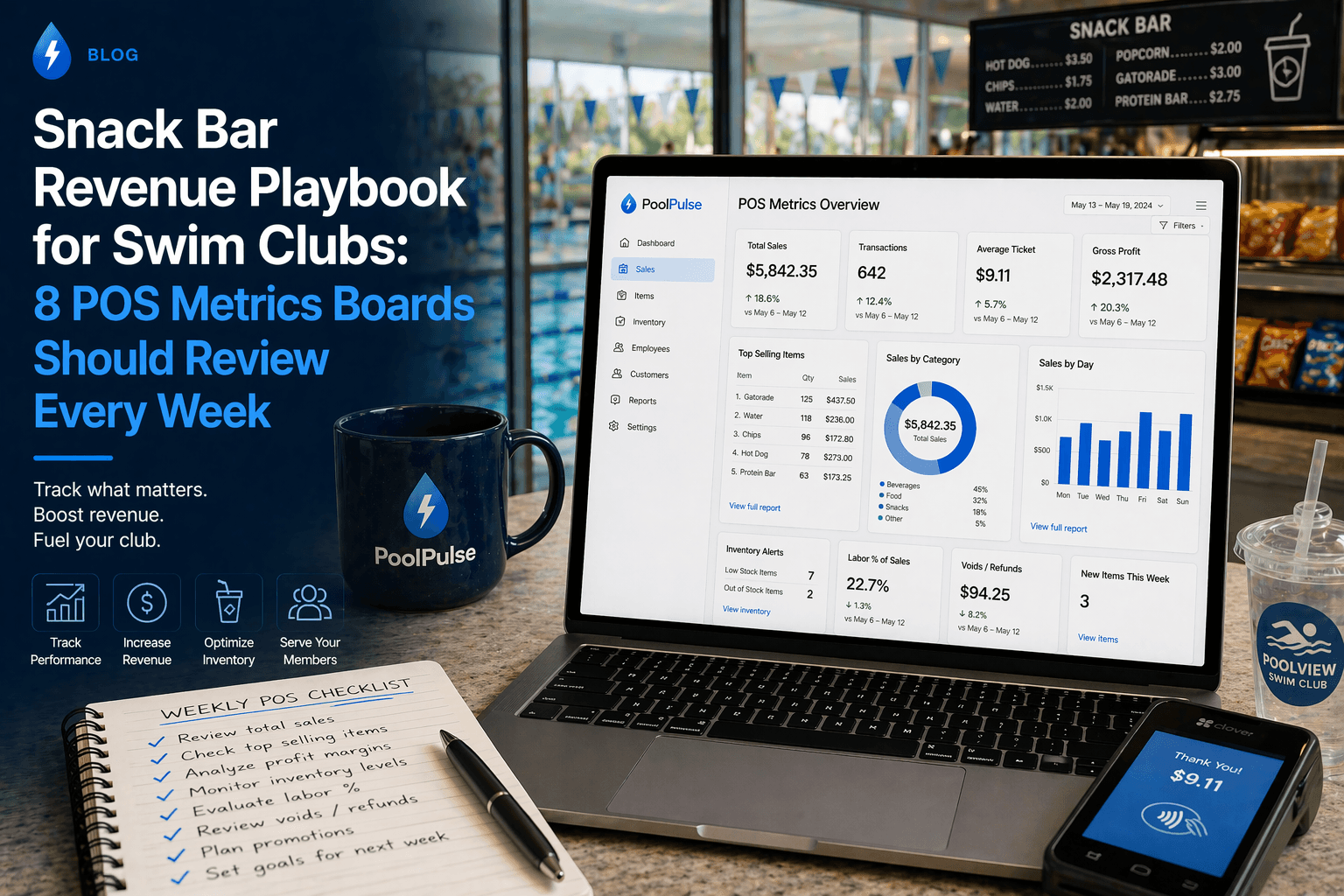
Many swim clubs talk about snack bar revenue as if it is a side business.
In practice, it is often one of the most visible weekly signals a board can review. The snack bar touches staffing, member convenience, inventory discipline, charge-to-account behavior, and the club's ability to recover small leaks before they turn into season-long frustration.
That is why boards should not look at snack bar performance only through a monthly deposit total. They need a short, repeatable POS scorecard.
PoolPulse already makes snack bar and POS a meaningful part of its product story. This post turns that story into a board-friendly operating rhythm.
Why a weekly scorecard matters
A weekly review helps clubs catch issues while they are still fixable:
- lines getting longer during peak hours
- best-sellers running out too often
- discounts or voids creeping up
- inventory reorders happening too late
- member tabs growing without clear follow-up
The goal is not to turn the board into store managers. The goal is to give the club a small set of metrics that reveal where action is needed.
The 8 POS metrics worth reviewing every week
1. Total snack bar sales
Start with the headline number, but do not stop there.
Weekly sales tell you whether the snack bar is growing, flat, or sliding relative to the same part of the season. They also give context for staffing and purchasing decisions.
Ask:
- was this week above or below expectation?
- did weather, events, or guest traffic explain the change?
- was the sales mix healthy or overly dependent on one item category?
2. Transaction count
Sales can rise because prices changed or because more members actually bought something. Transaction count tells you how much real demand is moving through the counter.
If sales are flat but transaction count is up, average tickets may be slipping. If transaction count falls sharply during busy attendance windows, the issue may be line speed or product availability.
3. Average ticket size
Average ticket is one of the clearest indicators of how well the snack bar is turning convenience into revenue.
Reviewing it weekly helps the board spot:
- strong combo or bundle performance
- weak upsell execution
- product mix changes that hurt margin
- friction in charge-to-account or prepaid workflows
A low average ticket is not always bad. It just needs explanation.
4. Top-selling items
Every club should know what moved this week.
That does not mean just the top three products by units. It means understanding:
- which items sold most often
- which items likely drove the most revenue
- which items disappeared from the top list unexpectedly
This helps clubs stock smarter, simplify menus, and spot whether their "member favorites" are actually matching reality.
5. Stockout or low-inventory pressure
Nothing slows revenue faster than popular items being unavailable during the busiest windows.
Boards do not need to micromanage reorder points, but they should know whether the club is repeatedly missing sales because inventory visibility is weak.
A simple weekly signal can show:
- the items that ran low
- when they ran low
- whether stockouts happened during peak member demand
That creates a much better operating conversation than "we think we sold out a lot."
6. Voids, discounts, and refunds
These are normal in any point-of-sale environment, but they deserve visibility.
If voids or refunds rise, it can point to:
- staff training gaps
- pricing confusion
- checkout errors
- inventory mismatch
- inconsistent manager oversight
This is not about assuming bad intent. It is about making sure the club can explain where revenue shifted.
7. Charge-to-account and prepaid balance usage
One of PoolPulse's stronger POS differentiators is club-aware checkout that stays close to the member account.
That means boards should review how often the snack bar relies on:
- charge-to-account purchases
- prepaid balances
- guest-related stored value or credits when relevant
Why it matters:
- it affects checkout speed
- it changes how families experience payment friction
- it can create follow-up work if balances are not visible and timely
If members love the convenience but staff cannot see the resulting account risk clearly, the workflow only solves half the problem.
8. Revenue by hour or peak service window
This is one of the simplest ways to connect POS data to operations.
When clubs know when the rush actually happens, they can make better decisions about:
- who works the snack bar
- when prep should happen
- what products need to be ready first
- whether mobile, kiosk, or charge-to-account options could reduce line pressure
This metric is often more actionable than a generic weekly total because it shows when the friction is happening.
What a board should ask when a metric changes
The board does not need perfect retail analytics. It needs a short list of questions:
- Is demand changing, or is execution changing?
- Are we missing sales because of lines, stock, or process?
- Are account-based purchases still easy to reconcile?
- Are we staffing the rush correctly?
- Do we know which items deserve more shelf space and which should be cut?
That turns the weekly review into a practical discussion instead of a reporting ritual.
A simple weekly snack bar scorecard
If you want a lightweight template, start here:
- Total sales
- Transaction count
- Average ticket
- Top-selling items
- Low-stock or stockout items
- Voids, discounts, and refunds
- Charge-to-account and prepaid balance usage
- Sales by hour or peak window
You can review all eight quickly if the POS data is connected and clean.
Why this belongs in a broader revenue-recovery conversation
Snack bar revenue should not live on an island.
The most useful view connects POS to:
- member behavior
- billing visibility
- inventory patterns
- staffing decisions
- weekly revenue recovery
That is where clubs move from "the snack bar did okay" to "we understand what is driving concession revenue and where the leaks are."
Where PoolPulse fits
PoolPulse positions the snack bar as part of the operating system, not a disconnected retail add-on:
- charge-to-account convenience
- item-level sales visibility
- synced reporting
- cleaner financial handoff
If that is the scorecard your board wants, start with POS & Snack Bar. If you want the broader financial angle, pair it with Does It Pay Off?.

One Family Balance or One per Child? The Snack Bar Decision to Make Before Next Season
A shared family balance and separate member balances solve different problems. Work through the spending rules, visibility, and checkout questions before choosing your club’s setup.

Five Front-Desk Tasks Your Swim POS Should Handle
Your front desk shouldn't need three systems to check in a swimmer. Here's how modern swim POS systems save time and reduce errors.

When Your Check-In Line Proves Software Is Too Slow
Discover how software timing affects your swim club's daily operations, from check-ins to billing, and why faster response times mean happier members.
Want to see if PoolPulse is a good fit for your club?
Book a walkthrough and we'll show you exactly how PoolPulse can help based on your club's needs, goals, and current processes.