
Your Club Didn’t Sign Up to Be an AI Experiment.
When AI touches your members’ information or your club’s decisions, you deserve to know who is still in control.


When AI touches your members’ information or your club’s decisions, you deserve to know who is still in control.
Imagine opening an announcement from your club’s platform provider. There’s a new AI feature. It promises faster answers, less administration and more work handled automatically.
The demonstration looks impressive.
But you have questions. What information can it access? Can it change anything? Who checks its answers? Can you turn it off?
If those questions come before excitement, that is a reasonable response. You are responsible for a community. You should expect clear answers before someone introduces new risks into the systems that community depends on.
Being cautious about AI does not mean you are behind. It means you are paying attention.
The industry is giving AI more power
AI tools increasingly go beyond generating text. Some can access connected systems, use tools and take actions on someone’s behalf.
That changes what a mistake can mean. The UK’s National Cyber Security Centre warns that greater autonomy and broader access can make AI systems harder to predict, monitor and control. Its guidance calls for careful adoption, limited access and clearly assigned human responsibility. NCSC guidance on agentic AI
For a club, the practical question is straightforward: does an AI feature help someone prepare a decision, or can it carry out that decision itself?
Drafting a renewal reminder and sending it to every household involve different responsibilities. So do suggesting an account correction and changing the account.
Those boundaries deserve attention before a feature goes live.
A confident answer can still be wrong
Generative AI can produce false information in convincing language. NIST identifies this problem, often called hallucination, alongside risks involving privacy, security and excessive reliance on AI. NIST’s generative AI risk profile
Consider a hypothetical club using an AI tool to explain its guest policy. The response sounds clear and professional, but leaves out an exception the board approved.
A staff member repeats that answer. A family makes plans around it. Someone then has to explain why the club’s answer was wrong.
The polished wording did not make the answer reliable.
Anything that represents your club’s rules should be checked against the actual policy by someone who understands it. The same principle applies to member communications and operational guidance.
A helpful shortcut can expose information
Picture a volunteer copying a membership spreadsheet into a personal AI account to help draft renewal messages.
The intention is helpful. But has anyone checked whether that service is approved to receive the information? What happens to the uploaded file? Who can access it, and how long is it retained?
In September 2026, the NCSC warned that unapproved workplace AI use can expose sensitive information and reduce an organisation’s visibility and control over its data. Depending on the service and its privacy controls, information may be retained or used to improve that service. NCSC warning about shadow AI
For a club, that information could include household details, children’s names, contact information or confidential member notes.
Good intentions do not answer the data-handling questions. Clubs need clear guidance about which tools people may use and what information they may share.
Your club can face AI risks without using AI itself
AI can also help someone impersonate a person you trust. The Federal Trade Commission has warned that scammers can clone voices using recordings and recommends independently verifying unexpected requests through a known phone number. FTC guidance on AI voice scams
Consider an urgent request that appears to come from a board member asking an administrator to change payment instructions.
A familiar voice should not replace your normal verification process. Call back using an established number and follow the club’s approval procedure.
That is a useful precaution even if your club has never enabled an AI feature.
Human oversight has to mean something
A person clicking “approve” is only useful if they have enough information, time and authority to assess what they are approving.
Imagine being shown a recommendation without the underlying records, the relevant policy or an explanation of what will change. Checking it properly becomes difficult.
A club should expect to know who reviews consequential decisions, who can stop an action and how mistakes will be investigated and corrected.
“Someone is overseeing it” deserves a practical explanation.
Five questions to ask before accepting an AI feature
Before enabling a feature—or accepting a provider’s assurances—ask:
- What information can the AI access, and where does that information go?
- What can it do without a person approving the action?
- How can staff check its answers against the original records or policies?
- What continues working if the AI is disabled or unavailable?
- Who is responsible when something goes wrong, and how can we stop it?
A useful demonstration should leave room for these questions. Clear answers are part of the product.
Your community deserves more than reassurance
You do not owe a technology provider unquestioning trust because a feature is new.
You can expect evidence of testing, understandable data practices, meaningful human oversight and clear limits on what a system can do. You can also decide that a particular use of AI has not earned a place in your club.
AI can be useful. Using it responsibly requires deliberate choices about where it belongs and where its authority ends.
Your concern is warranted when those choices are unclear.
Before accepting the next AI feature, put those five questions in front of the provider. Your members’ trust deserves answers.
Next in this series: “Worried About AI? Here’s Where PoolPulse Stands.” We explain our position on responsible AI, human judgement and protecting the community we serve.

AI’s Own Builders Are Sounding the Alarm. Clubs Should Listen.
Before an AI assistant touches membership records, clubs need to know what it can read, where information goes, and who is accountable when it gets something wrong.

Everyone's Bolting On AI. We Think That's Backwards.
The club and community management space is in the middle of an AI gold rush. Here's the road PoolPulse chose not to take — and why.
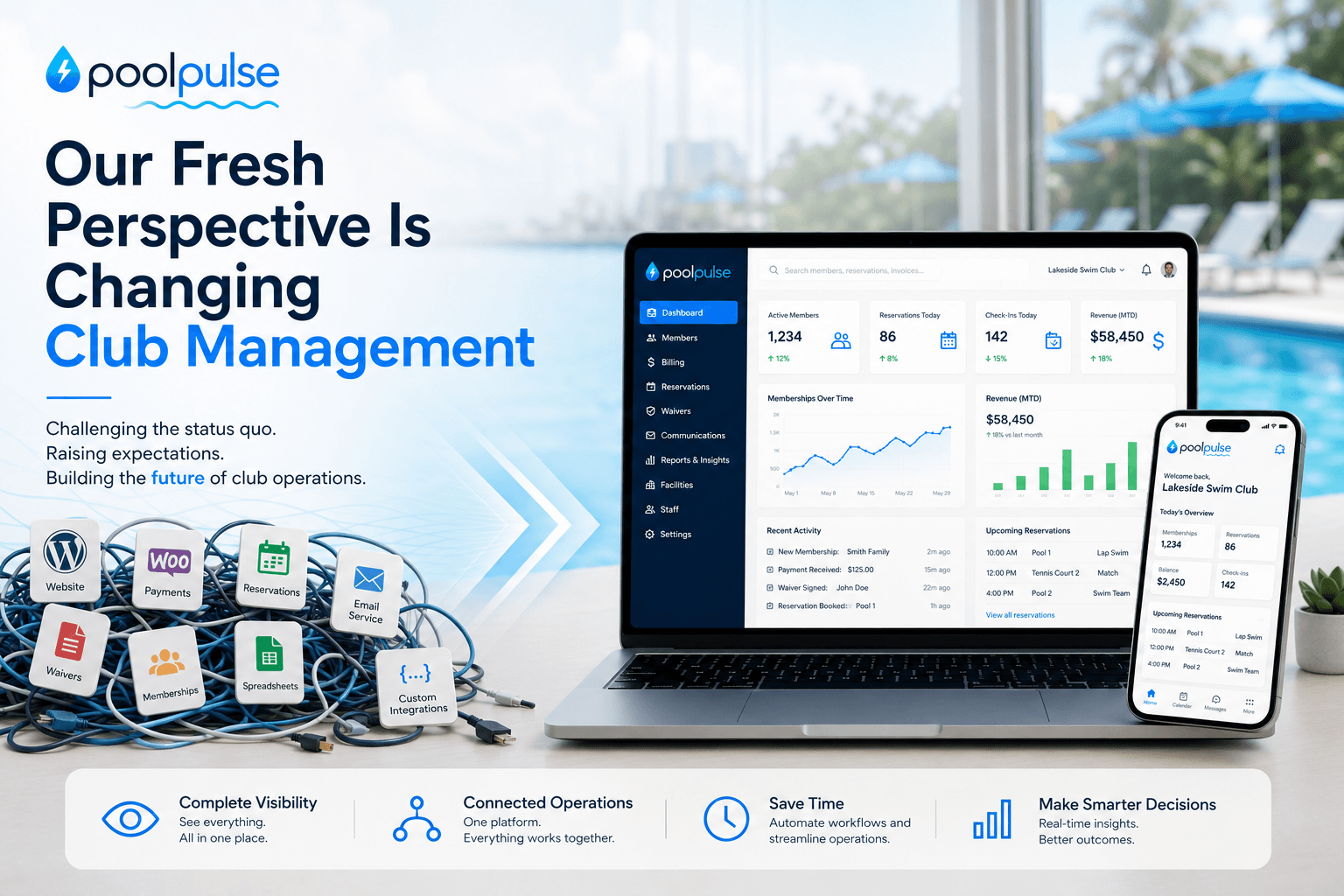
Our Fresh Perspective Is Changing Club Management
PoolPulse entered the club management industry with a simple belief: clubs deserve better than disconnected software, plugin spider webs, and operational blind spots. Here's how we're helping raise expectations across the industry.
Want to see if PoolPulse is a good fit for your club?
Book a walkthrough and we'll show you exactly how PoolPulse can help based on your club's needs, goals, and current processes.