

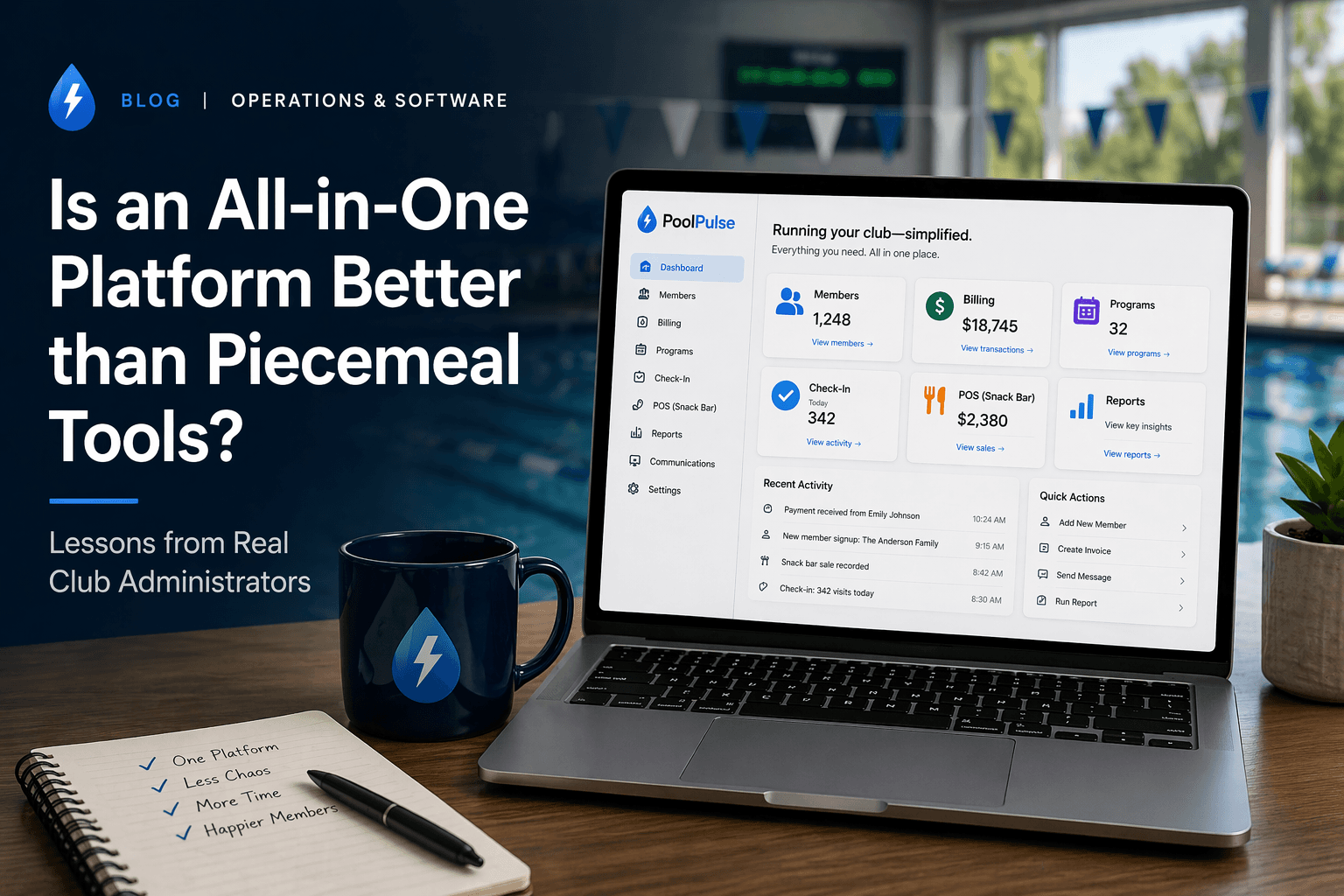
Is an All-in-One Platform Better than Piecemeal Tools? Lessons from Real Club Administrators
What club and membership administrators keep saying about fragmented tools, and when an all-in-one platform is worth it.

This question comes up in almost every software search:
Should the club buy one platform that tries to do everything, or stitch together specialized tools that each do one job well?
The honest answer is that both approaches can work. But when administrators talk candidly about what makes operations painful, the same theme keeps coming back: too many disconnected tools create too many disconnected decisions.
What real administrators keep complaining about
In one Reddit thread about membership software for a nonprofit with multiple chapters, the original poster said they needed a system that could handle the membership database, fees and renewals, and events in one workflow. A volunteer reply said spreadsheets had become messy fast and that moving to a single platform saved "dozens of volunteer hours each month."
In another Reddit thread about self-hosted membership systems for a car club, the most useful caution was not about feature gaps. It was about operational burden: renewals, reminder emails, backups, uptime, and failed payment handling quietly become their own maintenance job.
That maps closely to what swim clubs experience too. The pain is rarely one missing feature. The pain is the work between features.
Where piecemeal tools often go wrong
Piecemeal stacks usually start with good intentions:
- one tool for memberships
- one tool for payments
- one tool for event registration
- one tool for email
- one spreadsheet that "ties it all together"
At small scale, that can feel workable.
At season scale, it often creates hidden costs:
Double entry
Someone has to re-enter names, statuses, or payment results across systems.
Reporting gaps
The board asks one question that touches renewals, events, and billing, and suddenly no single tool has the answer.
Training overhead
Each volunteer or staff member needs to learn multiple interfaces, multiple exports, and multiple exceptions.
Blurry accountability
When something breaks, nobody knows whether the problem came from the registration tool, payment tool, email tool, or the spreadsheet in the middle.
Where specialized tools still make sense
An all-in-one platform is not automatically better in every case.
There are situations where a specialized tool still earns its place:
- a deep accounting stack the club is required to keep
- a league or meet-management tool the club cannot replace yet
- a donor or nonprofit system used across a larger organization
The real question is not "Can we keep one specialized tool?"
It is:
What is the system of record, and how many times do we have to reconstruct the truth by hand?
If the club keeps one niche tool but the member record, billing state, communication history, and check-in eligibility still stay connected, that can be manageable.
If every answer still requires an export and reconciliation step, it is not manageable for long.
Why all-in-one systems are usually stronger for swim clubs
Swim clubs are operationally interconnected.
Membership status affects check-in. Check-in affects staffing and facility awareness. Billing affects access. Events affect communication and follow-up. Volunteer transitions affect everything.
That is why all-in-one systems tend to perform well in club environments. They reduce handoffs in a business model where handoffs are the hidden tax.
PoolPulse is built around that principle:
- Member Management holds the household context
- Billing & Payments keeps revenue tied to the member record
- Check-Ins & Access Control makes live access decisions easier
- Events keeps registrations and follow-up connected
- Notes & Notifications reduces the "someone texted me this last week" problem
A practical decision framework
If your club is deciding between an all-in-one platform and a piecemeal stack, evaluate both options against these questions:
- Where is the single source of truth for member status?
- Can the club answer billing, check-in, and event questions without exporting data?
- How many systems must a new volunteer learn in their first week?
- If one person leaves, how much knowledge disappears with them?
- Does the stack reduce exceptions, or just move them around?
The more painful those answers are, the stronger the case for a connected platform.
The bottom line
Piecemeal tools can look cheaper and more flexible at the beginning.
But for many clubs, the hidden cost is coordination. The more often your team has to translate between systems, the more likely it is that volunteer time, board confidence, and member experience all start to erode.
That is why all-in-one platforms usually win in the long run for clubs that want cleaner operations, not just more software.
Sources referenced

Your Data Made It. Is Your Club Ready?
A successful upload proves that records arrived. This five-part readiness test shows whether household relationships, balances, waivers, access rules and real club workflows survived the move.

The Demo-to-Opening-Day Gap: Nine Questions That Reveal Whether a Vendor Can Actually Get You Live
A polished demo shows what a club platform can do. These nine questions reveal whether the vendor can migrate your records, rebuild your workflows, prepare your team and get you safely through opening day.
Management Platform Guide for Swim Clubs in 2026
Learn how a management platform can streamline your swim club operations, from member billing to check-ins. Real-world advice for club administrators.
Want to see if PoolPulse is a good fit for your club?
Book a walkthrough and we'll show you exactly how PoolPulse can help based on your club's needs, goals, and current processes.