

A Payment Dispute Is Won or Lost Before the Bank Email Arrives
Build a chronological payment record that connects the charge, policy, service, communication, and refund history.


The bank’s message may arrive weeks after the registration, renewal, lesson or guest purchase that created the charge. By then, the employee who handled the sale may be off duty and the policy page may have changed. A receipt helps, but it rarely tells the whole story.
A useful payment dispute record connects the charge to what was purchased, the terms presented, the service provided and any later adjustment. It also shows what the club does not know. Good records improve the club’s ability to explain a transaction. They do not guarantee a favorable decision.
This playbook focuses on card-payment disputes for club finance administrators and managers. Follow the instructions for your actual processor and dispute category. Other payment methods can have different procedures. Treat the examples below as operational preparation, not a substitute for your provider’s requirements or advice on a particular legal claim.
Begin with the claim, not a folder of attachments
Read the dispute notice and identify the precise allegation. A member who says a lesson never happened is making a different claim from a cardholder who says they never authorized the purchase. The fact that the household has used the pool does not answer every question about a separate lesson charge.
Stripe’s dispute category guidance distinguishes issues such as unauthorized payments, duplicate charges, service not received and refunds not processed. Use the actual reason supplied with the case to decide what to investigate. Similar-looking complaints may require different evidence depending on the network and payment circumstances.
Create a case record containing the dispute reference, original payment reference, disputed amount, currency and response deadline. Name one owner and a backup. Record whether the notice is an inquiry or a formal dispute. Save the notice itself so staff are not working from a forwarded summary that omits an important instruction.
The case owner should verify the deadline directly in the processor’s system. Set an earlier internal review target that leaves room for missing records or an unavailable approver. Do not substitute a standard number of days from an old checklist for the deadline attached to the current case.
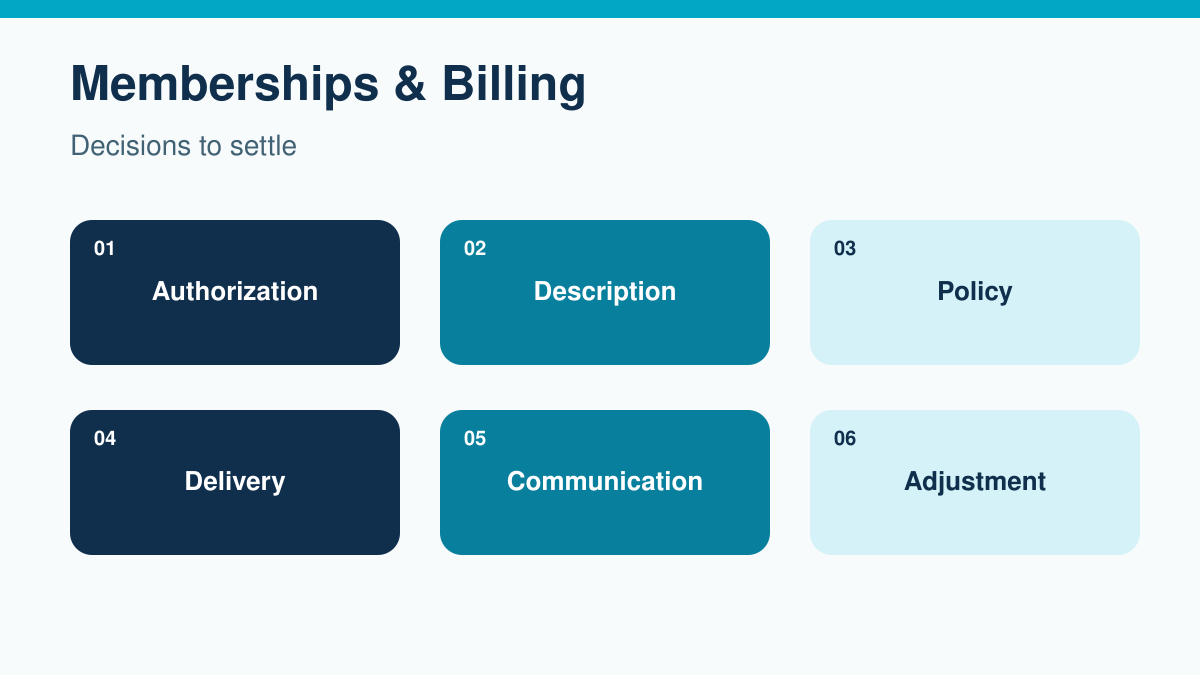
Build a record around six questions
1. Authorization: what connects the payer to this purchase?
Preserve the purchase confirmation and the transaction identifiers that link it to the processor record. Identify the payer separately from the participant. A grandparent may buy lessons for a child whose household account uses a different surname. That can be a legitimate arrangement, but the relationship should be explained with records rather than guessed from similar names.
Do not claim that a successful payment proves the cardholder approved it. Capture the relevant authorization or authentication information available through your payment provider without inventing a stronger conclusion than the record supports. Keep the original timestamp and explain any difference between purchase time and processing time.
For staff-entered sales, record who entered the transaction and how the order was received. A note written at the time can explain why the purchaser was not using the member portal. A recollection created after the dispute should be labeled as such, not presented as a contemporaneous checkout record.
2. Description: can someone outside the club understand the charge?
Use line items that identify the actual purchase. “Private swim lesson, July 12, 10 a.m.” is more useful than an internal program code alone. For dues, specify the membership term. For multiple items, preserve the itemized receipt so a reviewer can see which portion of the payment is in dispute.
Check whether the name members expect is reasonably connected to the name shown on their statement. If the processor permits a descriptor change, confirm its requirements before making one. The operational objective is recognition, not a promise that a particular descriptor will prevent disputes.
Keep discounts and adjustments visible. A purchase confirmation showing a higher list price than the final card charge should explain the difference. Otherwise, staff may spend the response window reconciling amounts that were correct from the start.
3. Policy: what terms applied when the purchase happened?
Retain the relevant version of the cancellation or refund terms and the record of how they were presented. A live webpage may now show a different deadline or fee. Save enough historical context to explain the terms that applied to the transaction under review.
Check the club’s actual conduct against those terms. If staff offered an exception, preserve the offer and any response. If a cancellation request arrived through a channel that staff overlooked, include that fact in the internal assessment. The evidence review should identify a legitimate correction just as readily as it identifies a defensible charge.
A “no refunds” sentence is not a universal answer to a dispute. It does not establish authorization or prove that a service occurred. Have appropriate advisers review policy language where needed and avoid making staff responsible for legal interpretations during a response deadline.
4. Delivery: what happened with the specific service?
Link the transaction to the relevant attendance or fulfillment record. For a lesson, that could be a dated instructor roster. For a guest pass, it could be the redemption record. For a membership, identify what access was purchased and the records relevant to the claim being made.
Distinguish a booking from attendance. A reserved place shows that a session was scheduled, not that the participant attended or that the club delivered it. Likewise, a facility check-in may show entry without establishing participation in a particular paid activity.
Include disruptions. If weather closed the facility, reconstruct the affected dates and the substitute service or adjustment offered. Do not select only the successful sessions while leaving out the cancellation that prompted the complaint. A complete internal timeline helps the manager decide whether contesting the case is appropriate.
5. Communication: what did the club and member agree?
Gather the relevant messages from the channels staff actually use. A cancellation may have reached the front desk while finance saw only the later complaint. Identify the sender, recipient and date for each material exchange. Preserve the originals in the restricted case file.
Summarize phone conversations accurately and distinguish a staff note from a recording or written acceptance. “Member requested a callback” does not mean the member agreed to the proposed refund. If the record is incomplete, say so internally and avoid filling the gap with confident language.
Keep member contact calm and factual. Ask what they believe happened and check it against the transaction. Do not pressure someone to abandon a complaint or promise that withdrawing a dispute will immediately restore funds. Continue tracking the processor’s response requirement while the conversation is underway.
6. Adjustment: where did the money go?
Reconcile the original amount, any partial refunds, account credits and the amount now disputed. These are different events. A credit available for a future program is not the same as money refunded to the original payment method. An approved refund is not necessarily a completed refund.
For each adjustment, retain its reference, amount, date and current status. Connect it to the original charge. If the club promised one amount but processed another, resolve the discrepancy rather than sending contradictory records to the reviewer.
Once a dispute is open, consult the processor before attempting a separate refund. The correct route depends on the payment and case state. An uncoordinated adjustment can complicate reconciliation or create duplicate reimbursement. Keep finance responsible for the monetary action while membership staff handle any separate access question.
Decide whether to contest or accept
The case owner should prepare a short internal recommendation. State the claim, the evidence that supports or contradicts it and any unresolved gaps. Include the disputed amount and the work needed to respond. A manager can then make an informed decision rather than automatically challenging every case.
Accepting a justified dispute may be the correct outcome. For example, a duplicate lesson charge should trigger a review of the checkout process, not a search for a general attendance record that makes both charges appear valid. Where the evidence is weak, do not transform a staff assumption into a factual assertion.
Stripe’s response instructions explain how to review a case and submit a response within its deadline. They also distinguish an inquiry from a formal dispute. If an inquiry escalates, it requires a new response. Keep the current case state visible to the owner rather than assuming an earlier reply completed the work.
Turn the timeline into a concise evidence packet
Prepare a brief factual summary that addresses the allegation directly. Identify the payment and purchased service, then explain the relevant sequence with dates. Reference the attached records so the reviewer can find the support for each assertion. Avoid character judgments about the member or descriptions of how hard the staff worked.
Stripe’s evidence guidance recommends chronological organization, readable documents and evidence relevant to the dispute reason. It also advises including the relevant policy material rather than relying on external links. Check the current file requirements in your submission interface before uploading. Those requirements should not be guessed from a previous case.
Separate the complete internal case file from the smaller submission. The internal file may contain investigation notes and records that explain why the club accepted part of a complaint. The submission should contain the material needed to address the claim, with enough context to avoid misleading excerpts.
Use a second reviewer who did not assemble the packet. Ask them to match the names, dates and amounts without help. Have them identify any statement whose supporting record is missing. If they cannot follow the explanation, a bank reviewer unfamiliar with the club is unlikely to follow it either.
Work through a partial-refund example
Consider an illustrative six-session lesson purchase for $180. Two sessions were canceled by the club and finance processed a $60 refund. The cardholder later disputes the full $180 on the basis that the service was not received.
Start by matching the $180 payment to the six-session registration. Identify the dates of the canceled sessions and the four sessions that remained. Then inspect actual attendance or service records for those four dates. A roster created before the course began is not enough to establish what happened afterward.
Retrieve the $60 refund record and confirm its status. Save the notice sent to the purchaser and any response. Build a timeline that openly acknowledges the cancellations rather than suggesting the entire course ran as originally sold. The remaining question is what the records support about the disputed amount.
Stripe’s sample evidence packets illustrate using the original transaction together with refund details and processor records for refund-related claims. Apply that narrow lesson here: show the money movement clearly. Ask the processor how the existing partial refund should be represented in this case instead of issuing another $60 payment on your own.
The internal decision might be to contest the unsupported portion, accept the claim or seek provider guidance because the documentation is incomplete. The example is a reconciliation exercise, not a prediction about what the issuer will decide.
Create the evidence before anyone needs it
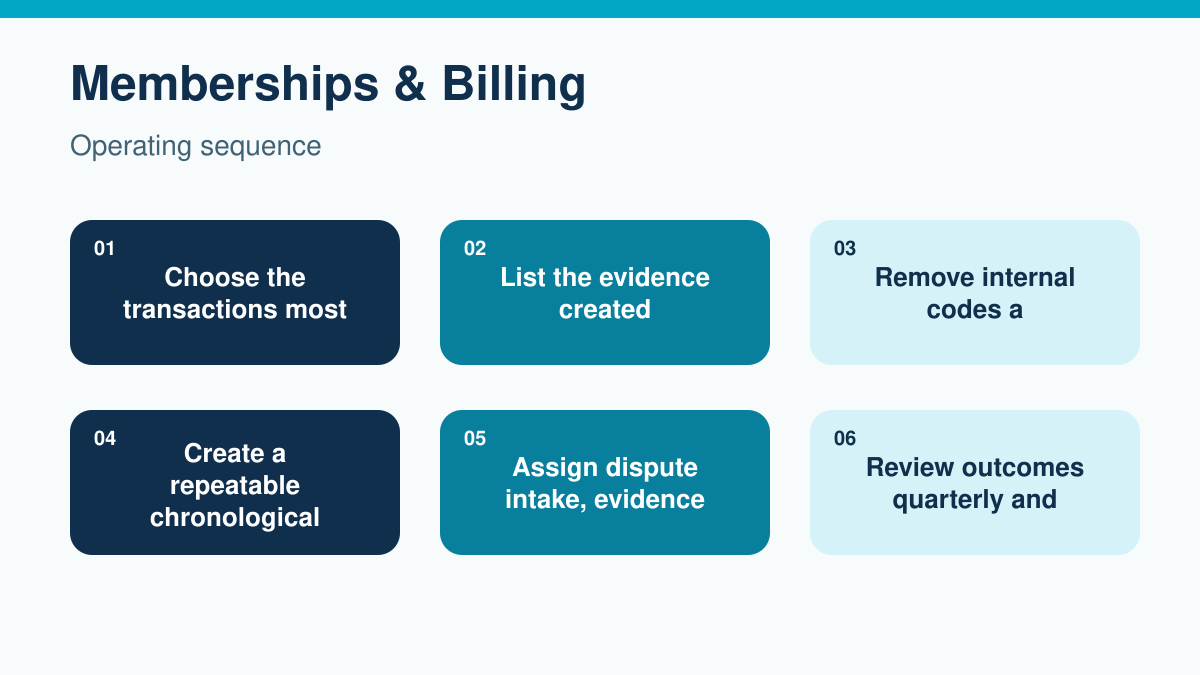
Choose several transaction types that routinely generate questions: seasonal dues, lesson packages, guest passes and event registrations. Trace where each purchase creates evidence. Identify what is captured at checkout, what staff record during delivery and what finance records after an adjustment.
Remove unexplained internal codes from member-facing receipts. Establish a consistent way to connect attendance and refunds to the original purchase. Assign intake, evidence review and final submission responsibilities before the next bank email arrives. Review outcomes quarterly to find recurring gaps rather than merely counting wins and losses.
Test the process with a closed transaction that has no active complaint. Ask a backup employee to reconstruct it from saved records. Measure where they get stuck: finding the purchase, identifying the payer, locating the policy version or explaining an adjustment. Fix the missing connection at its source instead of adding another manual reconstruction step.
Protect the file and close the case properly
Limit the internal case file to authorized staff. Club records can contain information about children, household finances or unrelated participants. Include only what the response needs and review screenshots for extraneous details before submission. Retain an accurate original internally while preparing appropriately limited copies for the case.
Agree on retention and access rules with the people responsible for the club’s records. Do not keep every participant detail indefinitely just because a dispute is possible. Where a case is active, coordinate any normal deletion process with the responsible adviser so relevant records are not removed inadvertently.
After submitting, save the submission confirmation and the exact materials sent. Track the case until the processor reports its outcome. Reconcile the resulting financial entries and record whether any separate member-service action remains open. A response being submitted is not the same as the case being resolved.
Use the result to improve one concrete part of the workflow. An unclear purchase description calls for receipt changes. A missing cancellation message calls for a better handoff. A promised refund that was never processed calls for completion tracking. Those repairs help future members even when the club cannot change the outcome of this case.
Bring a real transaction to the software conversation
If fragmented records are making this work harder, book a Clubward demo and bring a representative transaction with personal details removed. Ask how membership, payment and check-in information could support your recordkeeping. Verify the exports and historical records your process would need. Do not assume the platform assembles dispute submissions or guarantees outcomes. The useful test is whether your team can explain a purchase without rebuilding its history from scratch.

Freeze, Cancel, or Defer? Give Staff One Membership Answer
Separate membership freezes, cancellations, and deferrals with clear dates, financial treatment, access rules, approvals, and member communication.

Before Renewals Open, Decide What “Active Member” Actually Means
Build one membership-status rule that billing, check-in, renewals, and staff can apply without guessing.

Your Membership Revenue Report Is Not Reconciled Until These Four Numbers Agree
Stop treating a payment total as a revenue answer. Reconcile the full path from member charge to bank deposit with a four-number framework your board can trust.
Want to see if PoolPulse is a good fit for your club?
Book a walkthrough and we'll show you exactly how PoolPulse can help based on your club's needs, goals, and current processes.