

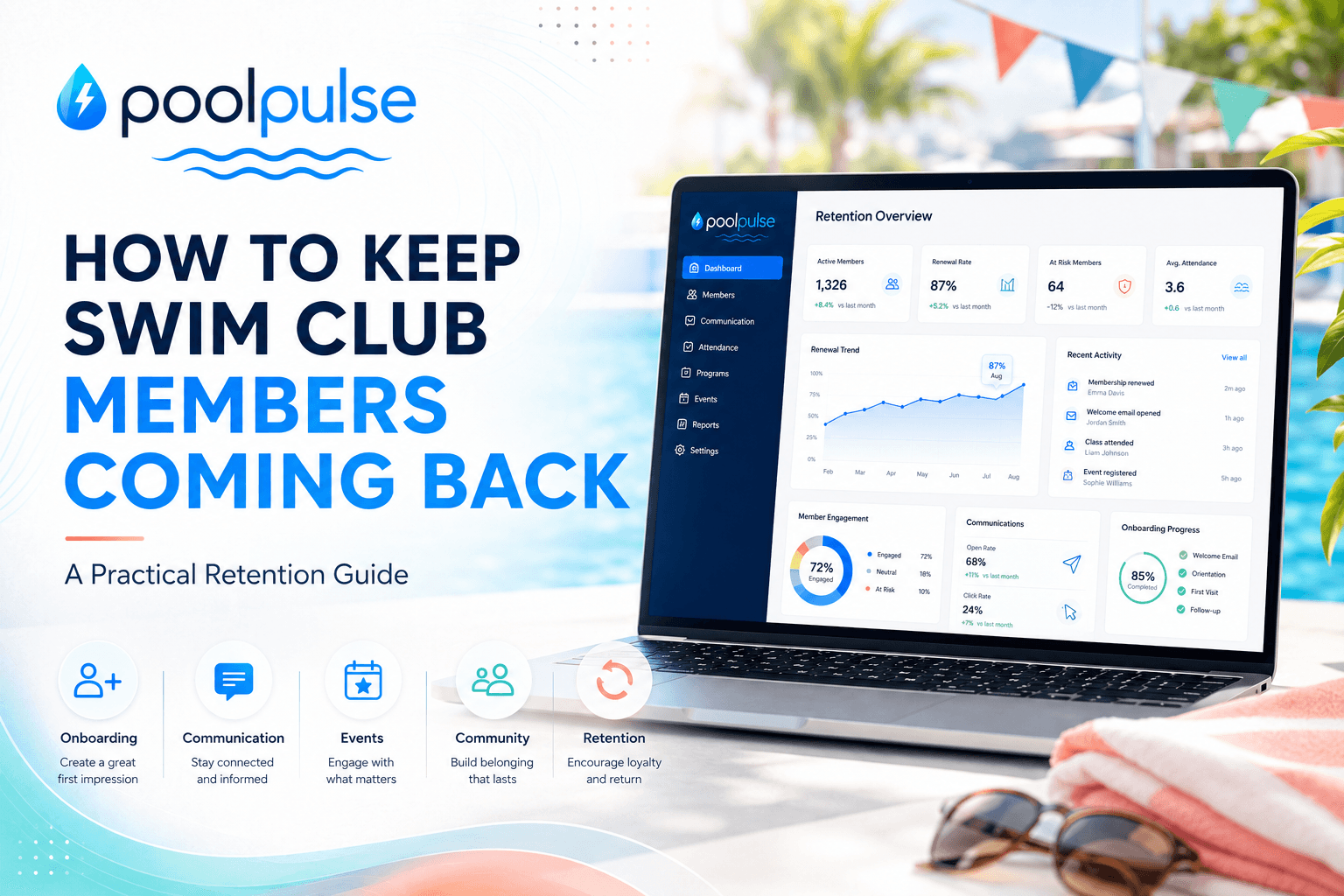
How to Keep Swim Club Members Coming Back: A Practical Retention Guide
A research-backed guide to improving member retention for swim clubs, sports clubs and community facilities with better onboarding, communication, programming, volunteer systems and early churn signals.

For most swim clubs, sports clubs and community facilities, member retention is not won at renewal time.
It is won much earlier.
It starts when a family decides whether the club feels organized enough to trust. It shows up when a new swimmer walks into their first practice and knows where to go. It shows up when parents understand the schedule, volunteers know what is expected, members feel welcomed and staff can answer questions without digging through spreadsheets, emails and memory.
The research is clear: people stay when the club consistently delivers the reason they joined.
That sounds simple, but clubs serve very different kinds of members. A competitive youth swimmer may stay because the coaching environment feels supportive and progress is visible. A family may stay because the club becomes part of their summer routine. An adult lap swimmer may stay because the facility is clean, convenient and reliable. A volunteer may stay because their work feels appreciated instead of invisible.
Retention is not one tactic. It is a system.
What the research says about why members stay
Sports clubs are not the same as gyms, but fitness and club-sport research helps explain what keeps people coming back.
A 2024 study on organized club-based sport in Australia found that the main motivations for participation were fun and enjoyment, physical health or fitness, performance or competition and social reasons. Fun and enjoyment were consistently high across age groups, while social reasons became more important for older adults and performance motives were stronger for younger participants. [1]
That is a useful reminder for swim clubs and sports clubs: members are not all buying the same thing.
Some are buying achievement. Some are buying belonging. Some are buying family routine. Some are buying health. Some are buying a safe place for their kids to grow. Some are buying convenience. Many are buying a mix of all of the above.
When clubs treat every member like they have the same motivation, retention gets harder.
Retention starts with member fit
A competitive swim program, a neighborhood summer pool and a private sports club may all use the word “member,” but the retention drivers are different.
| Club model | Why members usually stay | What causes churn |
|---|---|---|
| Community swim or sports club | Belonging, family routine, affordability, friendships, local identity | Chaotic communication, volunteer burnout, cliques, unclear expectations |
| Competitive swim or youth sports club | Coaching quality, progress, safe culture, parent trust, team identity | Pressure, lack of fun, poor coach or peer climate, unclear development path |
| Private club or recreation facility | Convenience, cleanliness, flexible access, service quality, perceived value | Price friction, poor service, inconvenient schedules, weak facility experience |
The mistake is assuming retention is only about price. Price matters, but members often leave because the club no longer fits their life, goals or expectations.
In a 2025 U.S. fitness survey, people who stayed with their gym cited affordable fees, convenient location, cleanliness, equipment variety and friendly staff or customer service as leading reasons. People who left or switched cited expensive fees, home or online alternatives, inconvenient location, unmet goals, poor customer service and cleanliness or safety concerns. [2]
Swim clubs should not copy gym strategy blindly, but the underlying pattern is relevant: members stay when the experience feels worth the effort.
The first 30 days matter more than most clubs think
New members are fragile.
They may have paid, but they have not yet formed habits. They may be excited, but they still feel uncertain. They may understand the value in theory, but they have not yet experienced belonging.
This is where many clubs lose people quietly. The member does not complain. The family does not send a dramatic email. They simply attend less, miss the first event, forget a deadline, feel confused, lose momentum and fade out.
A strong onboarding experience should answer three questions quickly:
- Where do I go?
- What should I do next?
- Do I belong here?
USA Swimming’s Block Party program is a strong swim-specific example. The program is designed to increase competition opportunities and help clubs create short, nearby, affordable, family-friendly meets. USA Swimming frames these events as a way to help athletes and families experience competition in a lower-pressure environment, because early participation helps swimmers stay connected to the sport. [3]
That principle works beyond competition. Every club should create an early milestone.
For a swim team, that may be a first low-pressure meet. For a summer club, it may be a welcome night. For a tennis or pickleball program, it may be a beginner mixer. For a private pool, it may be a first family event or guest pass experience.
The milestone matters because it turns “I signed up” into “I am part of this.”
A practical new-member retention path
Welcome within 24 hours
Send a clear message with the member’s next step, key dates, where to go, who to contact and what to expect.
Segment by member type
Separate youth families, adult members, competitive athletes, seasonal members, volunteers and social members so communication matches intent.
Create a first milestone
Give every new member a reason to show up early: orientation, first practice, welcome event, first meet, first reservation or first social activity.
Check for drift
Track attendance, incomplete waivers, unpaid balances, missed events and unanswered messages before they become renewal problems.
Fun is not fluff. It is retention strategy.
In youth sports, “fun” can sound unserious. It is not.
A major systematic review of youth sport dropout found five broad reasons young people leave organized sport: lack of enjoyment, perceptions of competence, social pressures, competing priorities and physical factors such as injury or maturation. [4]
That maps directly to what swim clubs see in real life.
A swimmer who no longer enjoys practice starts resisting attendance. A child who feels behind loses confidence. A teenager with school pressure begins choosing other activities. A family that feels socially disconnected stops volunteering. A member who never sees progress starts questioning the cost.
This is why retention should not be measured only by renewals.
By the time renewal season arrives, the emotional decision may already be made.
What clubs can do
Clubs can protect enjoyment without lowering standards.
Make beginner groups feel successful. Celebrate progress, not only podiums. Give members visible next steps. Use low-pressure events to help new families learn the culture. Make social connection part of the operating plan, not something that only happens if the right volunteer happens to organize it.
For competitive clubs, progress needs to be visible in more ways than results. Time drops are great, but members also need to see improvements in technique, confidence, attendance, effort, leadership and consistency.
For community clubs, enjoyment often comes from rhythm. Families return because the club becomes part of their life. Friday night events, opening weekend traditions, summer challenges, member spotlights and volunteer appreciation all help make the club feel like a place people would miss.
Coaching culture can make or break retention
For swim clubs and youth sports organizations, coaching is one of the strongest retention levers.
Research on youth swimming found that coach-created motivational climates differentiated between swimmers who continued and swimmers who dropped out. An empowering climate was associated with continuation, while a disempowering climate was associated with dropout. [5]
That is a big deal.
The coach is not just delivering workouts. The coach is shaping whether athletes feel competent, supported, safe and motivated enough to continue.
Peer culture matters too. A 2024 study on competitive youth sport found that a task-related peer climate was positively related to athlete wellbeing and intention to return to the team. [6]
In plain language: the people around the athlete matter.
A great facility cannot fully compensate for a negative group climate. A strong billing system cannot fix a team environment where kids feel humiliated. A beautiful website cannot overcome parent distrust if communication is inconsistent or dismissive.
Coaching retention habits
Clubs should train coaches to treat communication, group culture and retention as part of the job.
That includes explaining group placement, setting expectations, giving parents predictable updates, watching for social isolation, checking in after absences and helping athletes understand progress.
It also means clubs should not wait until complaints pile up. Review retention by coach group. Look for patterns. Are certain groups dropping faster? Are new swimmers making it through the first season? Are parents confused? Are older athletes burning out? Are beginners getting enough positive feedback?
The goal is not to turn coaches into customer service robots. It is to help coaches lead environments where athletes want to return.
Parents and volunteers are part of the membership experience
In youth swim clubs, the athlete may be in the pool, but the household is the real customer.
Parents manage the schedule, transportation, payments, volunteer duties, waivers, meet entries and emotional support. If parents feel lost, overwhelmed or unwelcome, the swimmer’s retention risk rises.
The Australian Sports Commission notes that parents are powerful role models for children’s sport participation and that families with children are especially connected to club sport volunteering. It also reports that one in three non-volunteers said they would volunteer if asked. [7]
That last point is a small sentence with a large operational lesson.
Many clubs do not have a volunteer problem only because people are unwilling. They also have an asking problem, a clarity problem and a recognition problem.
Make volunteering easier to say yes to
Volunteer roles should be specific, visible and manageable.
“Please help more” is vague. “We need two gate check-in helpers from 8:00 to 9:30 on Saturday” is actionable.
Clubs should also avoid making new families feel like they accidentally joined a second job. Parent involvement is important, but volunteer culture should be designed with empathy. New families need orientation, examples and low-pressure first roles.
A strong volunteer system includes:
- simple sign-up
- clear role descriptions
- reminders
- role-specific instructions
- recognition
- backup plans
- a way to track who has helped
- a way to avoid overloading the same few people
Volunteers who feel prepared are more likely to return. Volunteers who feel trapped or taken for granted eventually burn out.
Communication is not just marketing. It is operations.
Members rarely experience “the club” as an org chart. They experience the club through messages, schedules, reminders, invoices, check-ins, updates and how quickly someone answers when something is unclear.
That makes communication one of the most important retention systems a club has.
Swim England’s Club Health Tracker is designed to help clubs review and benchmark their development work, while its member retention campaign provided digital marketing tools for clubs to share through their own channels. [8] USA Swimming’s Safe Sport Club Recognition program also emphasizes a healthy and positive club environment, including clear reporting mechanisms, policies and training. [9]
The common thread is structure.
Strong clubs do not rely on scattered communication. They build a rhythm.
A simple communication rhythm for clubs
| Timing | Message | Purpose |
|---|---|---|
| Immediately after joining | Welcome and next steps | Reduce uncertainty |
| First week | Orientation and “what to expect” | Build confidence |
| Before first event | Event guide or checklist | Reduce anxiety |
| After first attendance | Personal check-in | Reinforce belonging |
| Monthly | Club update | Keep members connected |
| Before renewal | Value recap and next season preview | Remind members why staying matters |
| After absence | Friendly re-engagement | Catch drift early |
This does not mean flooding members with email. It means sending the right message at the right moment.
For families, clarity lowers stress. For adult members, clarity reinforces value. For volunteers, clarity reduces friction. For staff, clarity prevents repetitive questions.
Flexible membership paths help clubs earn more members
Not every prospective member is ready for the full commitment.
Some families are testing whether swimming fits their child. Some adults want a shorter seasonal option. Some members need financial assistance. Some people want programs or classes before joining fully. Some are returning after time away.
USA Swimming’s membership structure reflects this reality with multiple pathways, including premium, seasonal, flex and outreach categories. Its outreach membership is a reduced-fee category for economically disadvantaged swimmers, while flex membership offers an introductory pathway for younger athletes. [10]
The lesson for local clubs is not that every club needs the exact same categories. The lesson is that one membership type may be too rigid for a changing market.
A better membership design gives people a way to start, stay and grow.
Acquisition
Lower the first step
Introductory, trial, seasonal and program-based options can reduce commitment anxiety and help prospects experience the club before making a larger decision.
Retention
Create the next step
Entry offers should not be dead ends. They should lead toward a clear next milestone: full membership, first event, next program, family plan or renewal.
Acquisition improves when retention improves
It is tempting to separate member acquisition and member retention.
Marketing gets new people in. Operations keeps them.
In reality, they feed each other.
Members who feel proud of the club refer friends. Parents who trust the program talk to other parents. Volunteers who feel appreciated invite new families. Adult members who see value bring guests. A smooth event creates photos, stories and social proof.
That is why retention work often becomes acquisition work.
USA Swimming’s Marketing Toolkit provides customizable local materials for clubs to promote programs in their communities. [11] But promotion works better when the member experience behind the message is strong. The best campaign cannot carry a confusing onboarding flow, poor communication or a weak first visit.
Strong acquisition channels for swim and sports clubs
The most practical acquisition channels for clubs are usually local and trust-based:
- referrals from current members
- learn-to-swim or beginner program pipelines
- school and community partnerships
- family open days
- guest passes
- local social media
- summer kickoff events
- low-pressure beginner competitions
- testimonials from parents and members
- clear website pages that explain pricing, schedule and next steps
The key is to reduce ambiguity. A prospective member should not need to email three times just to understand whether the club is a fit.
Track leading indicators, not just renewals
Renewal rate matters, but it is a lagging indicator.
By the time a member chooses not to renew, the club is looking backward. Better retention comes from watching earlier signals.
The Health & Fitness Association’s 2025 benchmarking report reported a 2024 median member retention rate of 66.4% among fitness operators, along with median net membership growth of 5.5%. [12] Swim clubs should be careful about applying fitness benchmarks directly, but the measurement discipline is useful.
Clubs need to know whether members are joining, activating, attending, engaging, volunteering, referring and renewing.
Retention KPIs clubs should track
| KPI | Why it matters |
|---|---|
| New-member activation rate | Shows whether new members are actually getting started |
| First 30-day attendance | Flags early drift |
| First-event participation | Especially useful for swim and youth sports clubs |
| Renewal rate by segment | Shows which groups are healthy or at risk |
| Absence follow-up rate | Measures whether staff catch disengagement |
| Volunteer participation | Reveals parent and community investment |
| Referral source | Shows which channels produce strong-fit members |
| Churn reason | Prevents “unknown” from hiding solvable problems |
| Member satisfaction or NPS | Captures risk before cancellation |
| Support response time | Shows whether members are getting timely help |
The important part is segmentation. A club-wide retention number can hide problems. A competitive teen group, summer-only families, adult lap swimmers and new social members may all behave differently.
The operational side of retention
Retention is emotional, but it is also operational.
A member may leave because they did not feel connected. But they may also leave because billing was confusing, waivers were annoying, schedules changed without warning, reservations were hard to make or staff could not answer basic account questions.
That is where club systems matter.
PoolPulse was designed around a three-layer model: an internal platform layer for PoolPulse staff and operators, a club admin layer for organizations managing members, billing, reservations, waivers and packages and a member dashboard layer where members can view membership details, billing, waivers, schedules and personal information. [13]
That structure matters because member retention depends on both sides of the experience. Admins need clarity to operate the club. Members need simple self-service to stay informed and engaged.
When the admin side and member side are disconnected, friction leaks into the member experience.
A renewal problem becomes a support problem. A waiver problem becomes a check-in delay. A reservation issue becomes a front desk conflict. A missed message becomes a disappointed family. A spreadsheet mistake becomes a board question.
Better software does not create belonging by itself, but it can remove the friction that gets in the way.
Practical tips to keep more members
Here are the most useful retention moves clubs can make without turning the whole organization upside down.
1. Build a real welcome journey
Do not stop at a receipt.
Send a welcome email, explain the first step, link to the schedule, introduce the right contact, describe what to bring and tell members what will happen next.
For families, include parent expectations. For athletes, include group placement and first milestone. For adult members, include access instructions and program options.
2. Create a first-month milestone
Every new member should have a “first win.”
That might be attending orientation, completing a skills assessment, joining a first practice, booking a first reservation, attending a social event or participating in a low-pressure meet.
The milestone should be easy to understand and easy to celebrate.
3. Track attendance and act quickly
A member who stops showing up is already telling you something.
Set a simple rule: if a new member misses two expected sessions in a row, follow up. If a family misses the first event, check in. If a member has not used the club in 30 days, send a friendly re-engagement message.
Keep it human. No guilt. Just help.
4. Make progress visible
Members stay when they can see that the club is helping them move forward.
For swim teams, show skill progression, attendance streaks, first meet completion, time improvements or coach notes. For community clubs, show summer memories, family participation and member milestones. For private clubs, show facility improvements, program additions and member value.
5. Treat volunteers like members
Volunteer experience affects member experience.
Make volunteer roles clear, short and easy to sign up for. Thank people publicly. Rotate responsibilities. Do not rely on the same small group until they quietly burn out.
6. Segment renewal messages
A generic “renew now” message is easy to ignore.
A better renewal message reminds each segment what they got and what is coming next. Families may care about summer events, guest access and kid-friendly programs. Competitive athletes may care about meets, training groups and progression. Adult members may care about schedule, amenities and convenience.
7. Ask why people leave
Do not let churn disappear into “miscellaneous.”
Use a simple cancellation reason list: cost, schedule, moved away, injury, child lost interest, coaching fit, facility issue, communication issue, billing issue, joined another club, other.
Then review trends monthly or seasonally.
8. Make the member portal actually useful
Members should be able to answer basic questions without emailing the club.
Can they see their membership? Billing status? Waivers? Guest passes? Reservations? Family members? Schedule? Contact information? Receipts?
If not, staff will carry the burden and members will feel the friction.
The retention mindset
The strongest clubs do not wait for members to decide whether they are staying.
They build a club experience that keeps confirming the decision.
That does not mean every member will stay forever. People move. Kids change interests. Schedules shift. Budgets tighten. Competitive goals evolve.
But many losses are preventable.
A confused new family can become a loyal family with better onboarding. A disengaged member can be recovered with timely follow-up. A burned-out volunteer can stay involved if the work is clearer and appreciated. A hesitant prospect can become a member if the first step feels simple. A seasonal swimmer can become a returning swimmer if the next step is obvious.
Retention improves when clubs stop treating membership as a transaction and start treating it as a journey.
Sources
- R. Eime et al., “The motivations to play organised club-based sport in Australia,” Victoria University / Leisure Studies, 2024. https://vuir.vu.edu.au/48084/1/The%20motivations%20to%20play%20organised%20club-based%20sport%20in%20Australia.pdf
- Sogolytics, “How Gyms Can Boost Retention and Attract Members,” 2025. https://cdn.sogolytics.com/blog/wp-content/uploads/2025/03/Gym-Member-Retention-SogoStudy-Sogolytics.pdf
- USA Swimming, “Block Party.” https://www.usaswimming.org/coaches-leaders/team-leaders/block-party
- J. Crane and V. Temple, “A systematic review of dropout from organized sport among children and youth,” European Physical Education Review, 2015. https://journals.sagepub.com/doi/abs/10.1177/1356336x14555294
- K. Moulds et al., “Coach-created motivational climate ratings differentiate between dropout and continuation in youth swimming,” 2023. https://e-space.mmu.ac.uk/633178/8/moulds-et-al-2023-coach-created-motivational-climate-ratings-differentiate-between-dropout-and-continuation-in.pdf
- C. D. McLaren et al., “Peer-initiated motivational climate, mental health and adherence in competitive youth sport,” 2024. https://journals.sagepub.com/doi/10.1177/17479541231179879
- Australian Sports Commission, “Family” and “Affiliation” evidence resources. https://www.ausport.gov.au/clearinghouse/evidence/role-models-and-sport/family and https://www.ausport.gov.au/clearinghouse/evidence/volunteers-in-sport/factors/affiliation
- Swim England, “Swim England Club Health Tracker” and “Your Membership Counts.” https://www.swimming.org/swimengland/swim-england-club-health-tracker/ and https://www.swimming.org/swimengland/your-membership-counts/
- USA Swimming, “Safe Sport Club Recognition.” https://www.usaswimming.org/safe-sport/safe-sport-recognition-program
- USA Swimming, “Athlete Membership.” https://www.usaswimming.org/home/membership/athlete-membership
- USA Swimming, “Marketing Toolkit.” https://www.usaswimming.org/coaches-leaders/team-leaders/marketing-toolkit
- Health & Fitness Association, “2025 Fitness Industry Benchmarking Report.” https://www.healthandfitness.org/2025-fitness-industry-benchmarking-report/
- PoolPulse Software Topology & Server Environment Plan, internal project file.
Raising the Bar for Swim Club Software
How PoolPulse™ is helping raise expectations for swim club software with connected workflows, stronger operations, better member experiences and more modern tools.
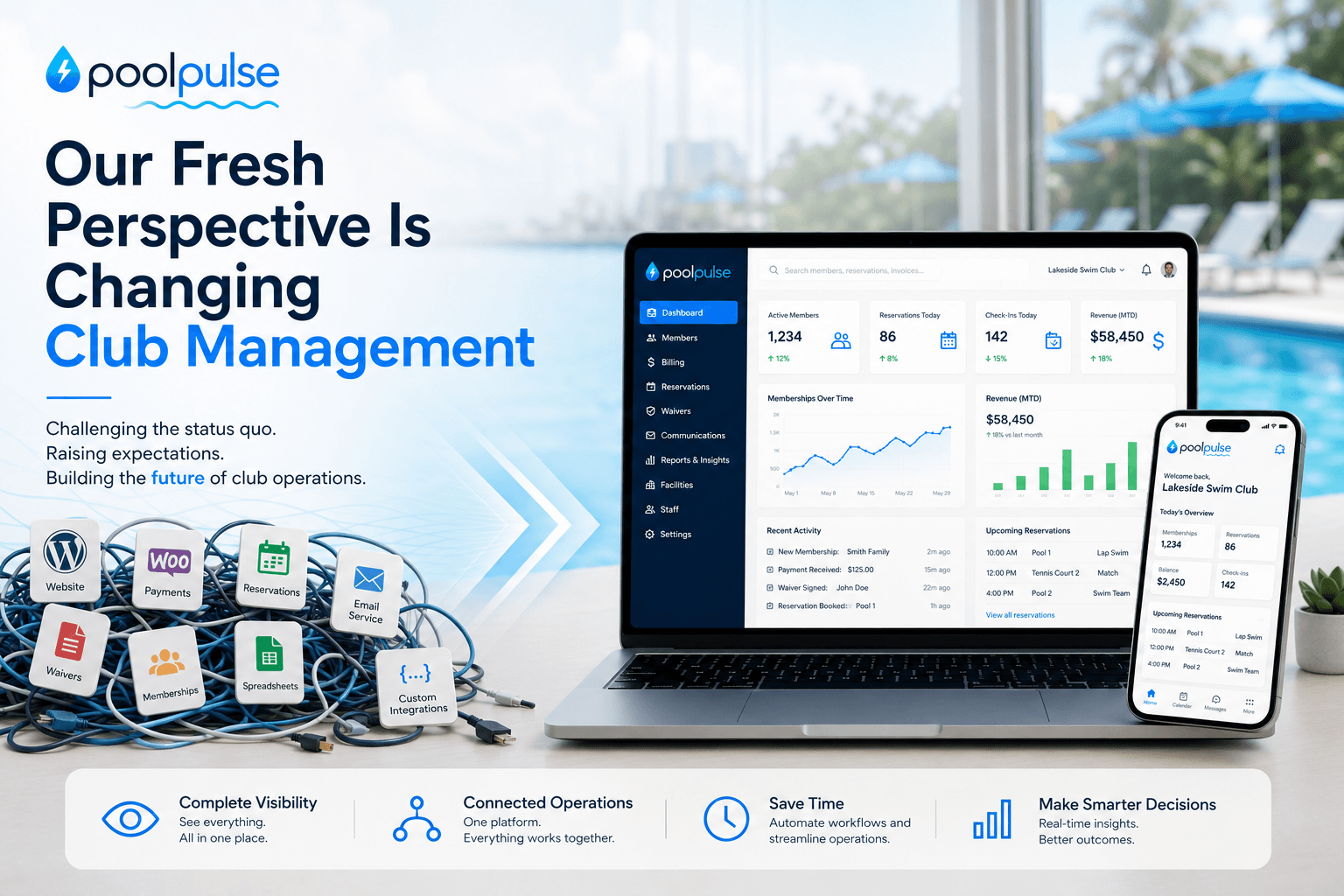
Our Fresh Perspective Is Changing Club Management
PoolPulse entered the club management industry with a simple belief: clubs deserve better than disconnected software, plugin spider webs, and operational blind spots. Here's how we're helping raise expectations across the industry.

Everyone's Bolting On AI. We Think That's Backwards.
The club and community management space is in the middle of an AI gold rush. Here's the road PoolPulse chose not to take — and why.
Want to see if PoolPulse is a good fit for your club?
Book a walkthrough and we'll show you exactly how PoolPulse can help based on your club's needs, goals, and current processes.