

Raising the Bar for Swim Club Software
How PoolPulse™ is helping raise expectations for swim club software with connected workflows, stronger operations, better member experiences and more modern tools.

For years, many swim clubs have had to adapt themselves around their software.
Boards adjusted their processes. Managers created workarounds. Volunteers rebuilt spreadsheets. Front desk staff learned where to find information even when it lived in three different places.
Members accepted clunky portals, confusing billing flows, manual forms, slow check-ins and unclear communication because that was simply how club software worked.
That expectation is changing.
Across industries, people now expect software to feel clear, responsive, connected and easy to use. Members do not compare their club portal only to another swim club portal. They compare it to every modern digital experience they use every day. They expect to pay dues without confusion, update household information without emailing a manager, sign waivers without printing forms and check in without waiting while staff search for basic account details.
That shift is not unique to swim clubs. McKinsey has reported that 71% of consumers expect personalized interactions and 76% become frustrated when those expectations are not met. [1] Salesforce has also described rising customer expectations as digital-first experiences become part of the full customer lifecycle. [2]
PoolPulse™ was built for that moment. Not because clubs need another vendor shouting for attention, but because clubs need a better standard.
The old standard was 'good enough'
For a long time, many clubs were expected to tolerate fragmented systems because the available options were limited.
One tool handled membership. Another handled payments. Another handled website content. Another handled snack bar activity. Waivers lived in PDFs. Guest passes lived in notes. Check-in information lived wherever someone remembered to put it. Board reporting often required exporting, cleaning, reconciling and explaining data after the fact.
That kind of setup can technically function, but 'technically functions' is no longer enough.
When software forces club leaders to rely on manual reconciliation, institutional memory and volunteer heroics, the burden does not disappear. It moves onto the people running the club.
A seasonal swim club has a very specific operational rhythm: offseason planning, renewals, opening day pressure, busy weekends, weather disruptions, staffing changes, guest activity, snack bar volume, board questions and end-of-season cleanup.
Software that was not designed around that rhythm can create friction at every step.
Old expectation
'Good enough' software
Clubs worked around disconnected tools, manual exports, unclear data and staff memory because there were not many better options.
New expectation
Connected club operations
Membership, billing, access, waivers, staffing, reservations and reporting should support the same operational picture.
The new standard is connected operations
The future of swim club software is not just a prettier dashboard. It is connected operations.
That means the workflows a club relies on every day should not feel like separate islands. Membership, billing, renewals, check-ins, guest access, waivers, POS, reservations, staffing, reporting and member communication should work together around the same operational truth.
PoolPulse connects billing, check-ins, POS, reservations, staffing and reporting so clubs can manage the daily details that often turn into expensive problems. [3] It also gives swim clubs a connected model for renewals, waivers, guest access, snack bar operations, staff scheduling, programs, reservations, waitlists and board reporting. [4]
That matters because connected data changes the way a club operates.
When household billing, waiver status, guest rules, member notes, balances and reservations are visible from the same workflow, staff can make faster decisions. When renewals, reminders, declined-card retries, invoices and account history are tied together, administrators spend less time chasing context. When POS and snack bar activity connects back to the household account, reporting becomes clearer.
Better club software is not just about storing information. It is about helping the club operate with more clarity.
Raising the bar does not mean attacking the past
Raising the bar does not mean every older system was built carelessly or without value.
Many legacy tools helped clubs get online, accept payments, manage members and move away from fully manual operations. That mattered. Those systems served a real purpose at a time when expectations, budgets and technology looked different.
But every market evolves.
Software that once felt modern can become limiting as user expectations rise. Features that once felt advanced can become baseline requirements. Workarounds that once felt acceptable can become unnecessary friction. That is not a criticism of history. It is how technology works.
Swim clubs are part of the broader shift toward more data-informed recreation operations. NRPA describes Park Metrics as a source of benchmarks and insights for managing operating resources and capital facilities. [5] Harvard's Data-Smart City Solutions has also highlighted how real-time data and digital tools are changing how parks leaders serve communities. [6]
A volunteer board should not need enterprise-level staffing to understand its own operations. A seasonal manager should not need to become a software detective to answer basic questions. A front desk worker should not need to memorize where every exception lives.
Modern club software should carry more of that load.
Better software changes the questions clubs ask
When a new kind of platform enters a market, the conversation changes.
Clubs begin asking better questions, and those questions move beyond whether a tool can simply store records or accept a payment.
| Old question | Better question |
|---|---|
| Can this software store our member records? | Can this software help us run the season? |
| Can members pay online? | Can billing, renewals, failed payments, credits, receipts and account history stay connected? |
| Can we collect waivers? | Can waiver status be visible at check-in when it actually matters? |
| Can we pull reports? | Can the board see useful information without rebuilding data by hand? |
| Can staff log in? | Can access match real roles and responsibilities? |
That is the real shift. A higher standard is not just a feature checklist. It is a change in what clubs believe they should be able to expect.
Member experience is now operational strategy
For a long time, member experience was often treated as a front-facing concern: the website, the emails, the portal and the payment page.
But member experience is not just what members see. It is what the club can reliably deliver.
A smooth renewal experience depends on clean billing data. A fast check-in depends on accurate household status. A good guest experience depends on clear policy enforcement. A professional response to a member question depends on accessible history. A confident board update depends on trustworthy reporting.
Operational software directly affects member experience.
Security and trust are part of the standard
As clubs modernize, trust becomes even more important.
Club software may not always be described in dramatic cybersecurity terms, but the information inside these systems matters. Membership records, household details, billing information, access records, waivers, staff permissions and operational notes all deserve thoughtful protection.
Modern software should treat security as part of the foundation, not as an afterthought.
That includes:
- Role-based access.
- Strong authentication practices.
- Secure account recovery.
- Proper session handling.
- Auditability.
- Data separation.
- Clear operational controls.
NIST's Digital Identity Guidelines cover identity proofing, authentication, federation, authenticators, management processes, authentication protocols and related technical requirements. [7] OWASP identifies broken access control as a major web application risk because access control failures can lead to unauthorized information disclosure, modification, destruction of data or actions outside a user's intended permissions. [8]
For clubs, this matters in practical ways. A seasonal employee should not have the same access as a board treasurer. A front desk worker should be able to check in members without seeing unnecessary billing administration. A billing admin should be able to manage accounts without accidentally changing unrelated operational settings.
Security is not just about stopping bad actors. It is about making sure the right people can do the right work with the right level of access.
Performance is not a luxury
Slow software is not just annoying. It has operational consequences.
At the front desk, slow screens create lines. During renewal season, slow billing workflows create staff frustration. During busy weekends, slow check-ins make the club feel disorganized. For administrators, slow reporting turns simple questions into time-consuming tasks.
PoolPulse has publicly described its performance-focused architecture, including serverless infrastructure, isolated club databases, auto-scaling technology and design choices intended to support a faster club management experience. [10]
The technical details matter, but the club-level outcome matters more.
Fast, reliable software creates confidence, and confidence changes how clubs operate.
The best software feels like less software
One of the clearest signs of mature software is that it gets out of the way.
It does not ask users to remember too much, bury critical information, force unnecessary steps or require staff to understand the vendor's internal architecture just to complete a task.
Good design reduces cognitive load. Nielsen Norman Group's usability heuristics recommend recognition rather than recall, which means interfaces should make information, actions and options visible instead of forcing users to remember them. [11]
That principle is especially important in swim club operations. Many clubs rely on seasonal staff, part-time workers, rotating volunteers and board members who may not live inside the software every day.
That is why 'modern' should not simply mean 'new.'
Modern should mean thoughtful.
Migration should not feel like punishment
One reason clubs stay with outdated systems is not loyalty. It is fear.
Changing software can feel risky because clubs worry about losing data, confusing members, disrupting billing, retraining staff and launching at the wrong moment in the season.
Those concerns are valid. A club management platform touches money, access, member communication, records, staffing and seasonal readiness. A poor migration can create real operational stress, which is why the new standard must include better migration support.
PoolPulse describes its migration approach around making the switch controlled rather than chaotic, including handled migration, imports from any system or spreadsheet, guided onboarding, no setup fee and free migration. [12]
Competition can be good for clubs
When a new company raises expectations, the market responds.
That is healthy.
If clubs begin demanding cleaner workflows, better performance, more transparent pricing, smoother migration, modern security and stronger member experiences, every vendor has a reason to improve.
That is good for clubs. It means better conversations, better demos, better roadmaps, better support and better accountability. It means vendors have to explain not only what their software does, but how it helps the club operate.
PoolPulse does not need to position itself as the only company capable of improving club management. The stronger and more sustainable message is this:
Clubs deserve better tools, and PoolPulse is helping prove what better can look like.
That is confident without being combative. Innovation is not about attacking every previous solution. It is about showing a better path forward.
That is how standards rise.
How the swim club software standard moves forward
Clubs expect clearer workflows
Boards, managers, staff and volunteers stop accepting disconnected tools as the default operating model.
Vendors compete on operational value
The conversation shifts from feature lists to whether the software actually helps the club run the season.
Members feel the improvement
Better billing, faster check-ins, cleaner communication and more reliable self-service create a more polished club experience.
The market gets better
When clubs ask better questions, every vendor has more pressure to improve, explain and deliver.
The standard is moving forward
PoolPulse emerged from a simple belief: clubs should not have to settle for disconnected software, manual workarounds and operational blind spots.
That belief is resonating because it reflects what many clubs already know. The work has become too important for outdated processes, the expectations have become too high for clunky experiences and the operational pressure has become too real for disconnected tools.
The future of swim club software will belong to platforms that help clubs operate with more clarity, confidence and control. PoolPulse is proud to be part of that future. We are still growing, still listening and still building, but the direction is clear.
Swim clubs deserve software that feels modern.
Boards deserve better visibility. Staff deserve faster workflows. Members deserve clearer experiences. Volunteers deserve less administrative burden. And the industry deserves a higher standard.
If the emergence of PoolPulse encourages the rest of the market to improve, that is not something to hide from. It is something to celebrate.
Because when software gets better, clubs get stronger. And when clubs get stronger, the families, staff, volunteers and communities they serve benefit too.
Sources
- McKinsey & Company, 'The value of getting personalization right or wrong is multiplying'
- Salesforce, 'What Are Customer Expectations?'
- PoolPulse, Swim Club Management Software
- PoolPulse, Swim Club Management Software for Billing and Check-Ins
- NRPA, Park Metrics
- Harvard Data-Smart City Solutions, 'Shaping the Future: How Digital Tools Transform Parks and Greenways'
- NIST, SP 800-63-4 Digital Identity Guidelines
- OWASP Top 10:2025, Broken Access Control
- PoolPulse, 'Why I Built PoolPulse'
- PoolPulse, 'Why PoolPulse Is So Fast'
- Nielsen Norman Group, '10 Usability Heuristics for User Interface Design'
- PoolPulse, 'Migrate to PoolPulse'
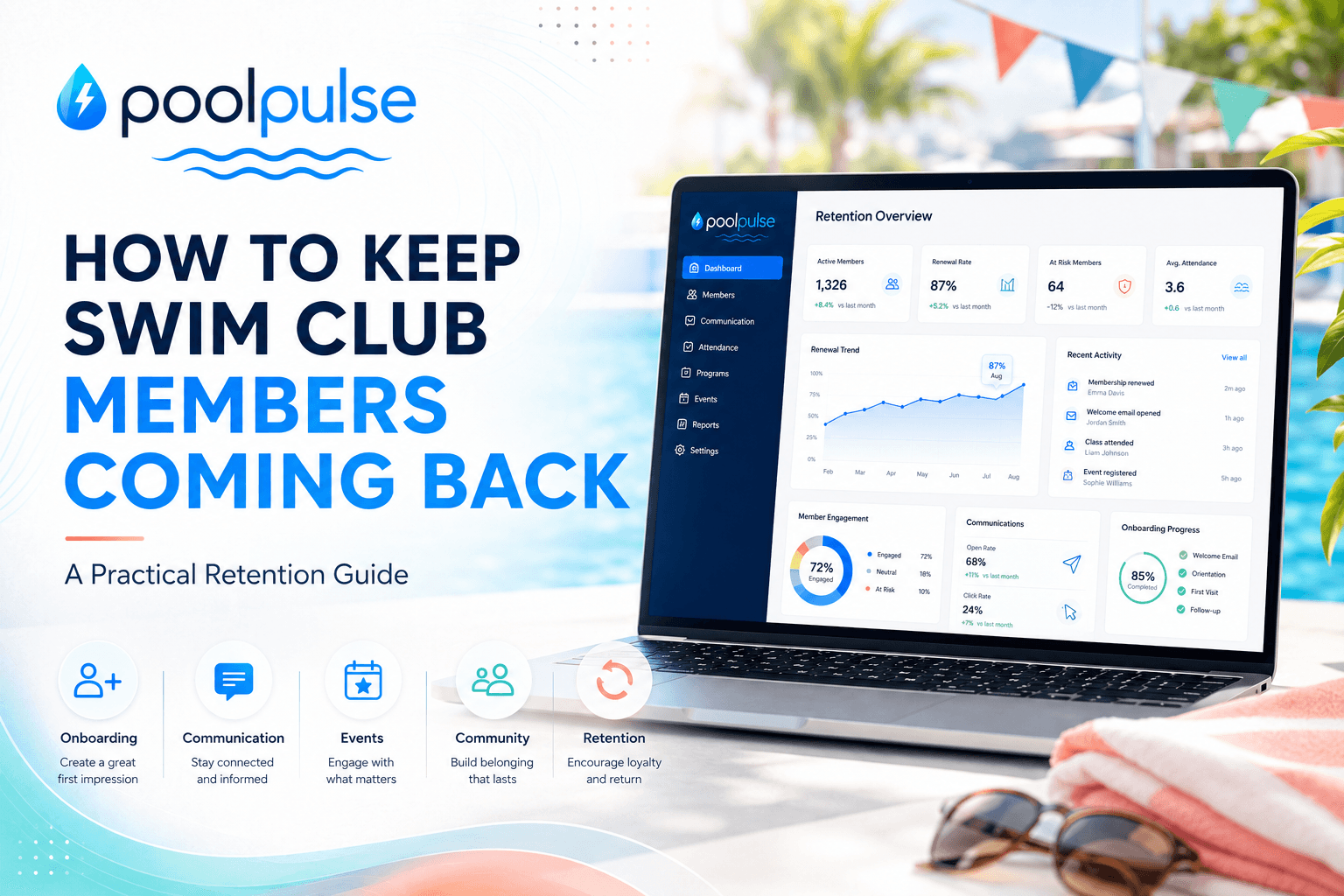
How to Keep Swim Club Members Coming Back: A Practical Retention Guide
A research-backed guide to improving member retention for swim clubs, sports clubs and community facilities with better onboarding, communication, programming, volunteer systems and early churn signals.
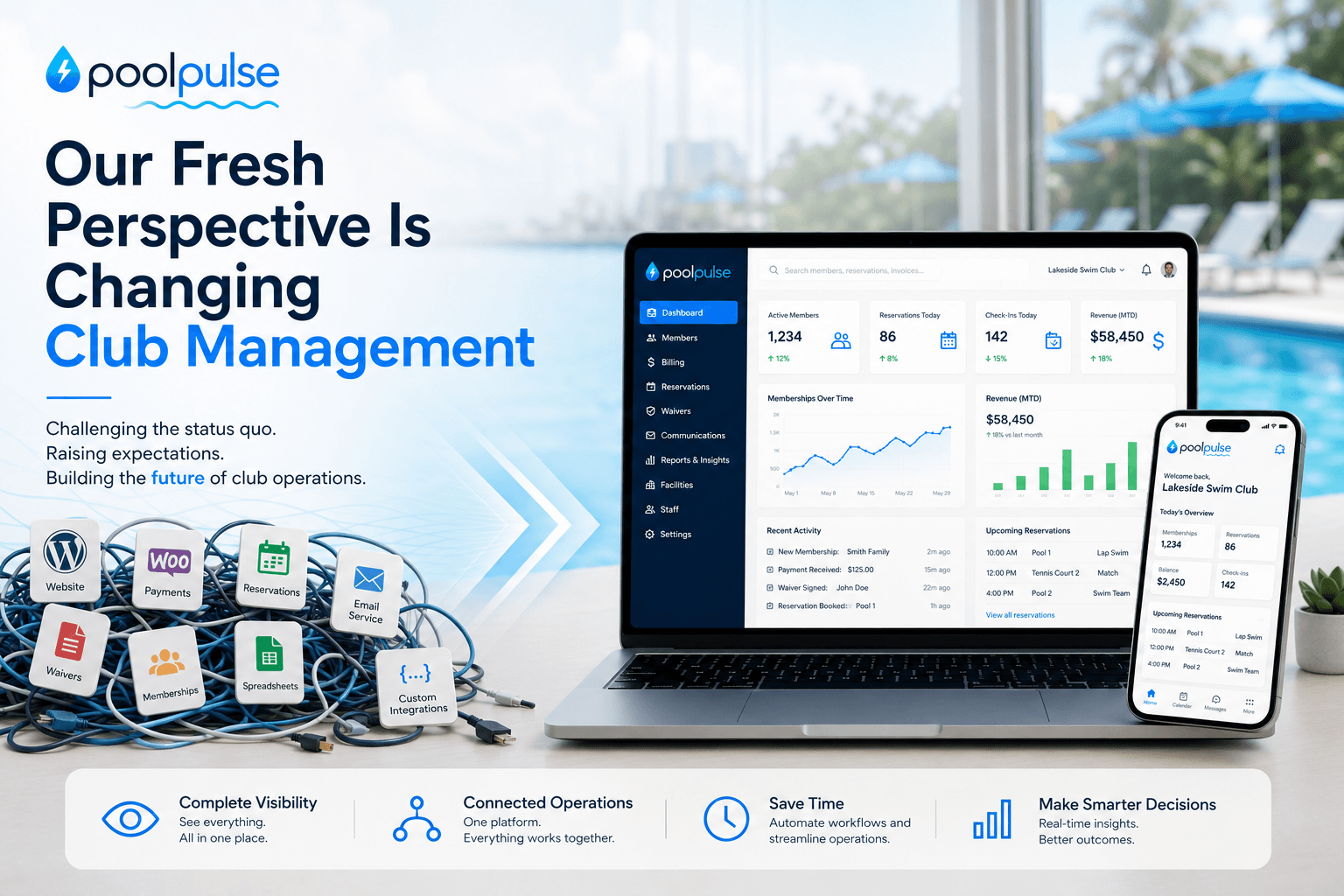
Our Fresh Perspective Is Changing Club Management
PoolPulse entered the club management industry with a simple belief: clubs deserve better than disconnected software, plugin spider webs, and operational blind spots. Here's how we're helping raise expectations across the industry.

Everyone's Bolting On AI. We Think That's Backwards.
The club and community management space is in the middle of an AI gold rush. Here's the road PoolPulse chose not to take — and why.
Want to see if PoolPulse is a good fit for your club?
Book a walkthrough and we'll show you exactly how PoolPulse can help based on your club's needs, goals, and current processes.