

The True Cost of Manual Billing at Your Swim Club
Manual billing costs swim clubs more than you think. Learn what you're really paying in time, errors, and missed revenue every month.


It's 8 PM on a Tuesday, and you're still at the club office. Your family had dinner without you. Again. The stack of printed invoices on your desk isn't getting smaller, and you've got three members who swear they already paid (but you can't find the check). The Excel spreadsheet with everyone's balance is open on one screen while you're hand-writing late notices on the other. Sound familiar? This is the real face of manual billing, and it's costing your swim club far more than you realize.
What Manual Billing Actually Means for Swim Clubs
When we talk about manual billing, we're describing any invoicing process that relies on you (or your staff) manually creating bills, tracking payments, and chasing down balances. Maybe you're typing each family's invoice in Word. Perhaps you're exporting a spreadsheet and filling in amounts by hand. Or you might be using a basic template that requires copying and pasting member names and amounts each month.
The common thread? You're doing the heavy lifting.
Here's what manual billing typically involves at most clubs:
- Pulling up each member account individually
- Calculating dues, swim team fees, guest charges, and any special assessments
- Creating an invoice document or filling out a template
- Printing or emailing each invoice separately
- Recording when payment arrives (and matching it to the right account)
- Following up with members who haven't paid
- Updating your records in multiple places
You might think this process takes an hour or two each month. Let me show you why it's actually eating up far more of your time than that.
The Hours You're Really Spending
Let's walk through a real scenario. Your swim club has 200 member families. That's pretty typical for a community pool or small competitive club. You bill monthly during the season (May through September, so five billing cycles).
Breaking Down the Time
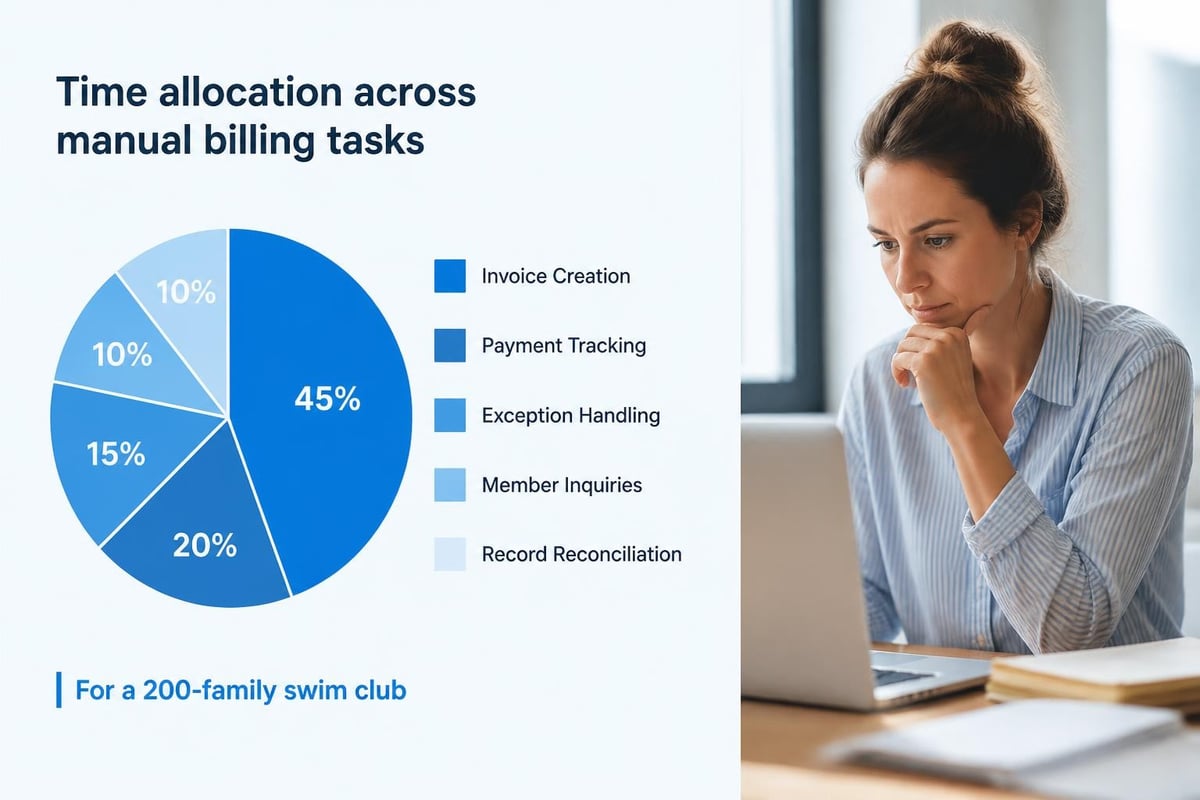
Each invoice takes about three to five minutes when you factor in looking up the account, calculating any extras beyond base dues, creating the document, and sending it. That's 200 families × 4 minutes = 800 minutes, or more than 13 hours just to generate invoices.
But that's only the beginning.
Now you need to track payments as they come in. Checks arrive in the mail. Some members pay in person. A few send Venmo or Zelle (and forget to include their name or account number). You're spending another 2-3 minutes per payment recording it, matching it to the invoice, and updating your spreadsheet. That's another 10+ hours per billing cycle.
Then come the exceptions:
- Members who claim they never received the invoice
- Families who paid the wrong amount
- Returned checks that need to be re-billed with fees
- Prorated amounts for new members who joined mid-month
- Credits that need to be applied from last season
According to research on manual invoice processing costs , exception handling accounts for 20-30% of total processing time. For your 200-family club, that's easily another 5-8 hours per month dealing with billing questions and fixes.
Total time per billing cycle: 28-31 hours. Over a five-month season, that's 140-155 hours of manual work. At $25 per hour (a conservative rate for your time or a bookkeeper's), you're spending $3,500-$3,875 each season just on billing labor.
The Money You're Losing to Mistakes
Time is expensive, but billing errors cost you actual revenue. And manual billing creates lots of opportunities for things to go wrong.
Common Manual Billing Errors
Math mistakes happen more than you'd like to admit. You're calculating dues, adding guest fees, applying family discounts, and factoring in early-bird savings. When you're doing this manually for dozens of families, you'll occasionally add wrong or forget a line item. Sometimes you undercharge (lost revenue). Sometimes you overcharge (angry members and time spent fixing it).
Missed charges add up fast. A family brings six guests over the summer, but you only caught and billed for four of them because the front desk log was messy. Another member's kid joined the swim team in June, but you forgot to add the team fee to their July invoice. These $10-$50 missed charges across your membership can easily total $2,000-$5,000 in lost revenue per season.
Late fees often don't get applied consistently. Your club policy says there's a $25 late fee after the 15th of the month. But when you're manually tracking everything, some members slip through. You forget to add it, or you decide not to charge it because you're tired of the confrontation. That inconsistency costs money and creates resentment among members who do pay on time.
| Error Type | Frequency (per season) | Average Cost | Total Impact |
|---|---|---|---|
| Math errors | 8-12 instances | $35 | $280-$420 |
| Missed charges | 40-60 instances | $45 | $1,800-$2,700 |
| Unapplied late fees | 15-25 instances | $25 | $375-$625 |
| Total estimated loss | $2,455-$3,745 |
And here's the thing: these numbers are conservative. Many clubs lose significantly more because they simply don't have good systems to catch what they're missing.
The Security Risks Nobody Talks About
When you're handling billing manually, you're also handling sensitive payment information. Member credit card numbers. Bank account details. Personal addresses and phone numbers. All of this creates security obligations you might not be thinking about.
If you're writing down credit card numbers to process later, or keeping a spreadsheet with payment details, you could be violating PCI DSS security standards . These requirements exist to protect cardholder data, and non-compliance can result in fines and liability if there's a breach.
What This Means Practically
You can't store full credit card numbers in Excel. You shouldn't be emailing payment details. Even that notebook where you jot down member credit cards "just temporarily" is a security risk.
A single data breach at a small facility can cost $50,000-$150,000 in forensics, notification, credit monitoring for affected members, and potential fines. That's not counting the reputational damage when word gets around that the club exposed member payment data.
Manual processes make security harder because:
- Paper records can be lost, stolen, or seen by unauthorized people
- Spreadsheets get saved to personal laptops or emailed without encryption
- There's no audit trail showing who accessed what information when
- Old records pile up instead of being securely destroyed
Many swim club administrators don't realize they're creating risk until something goes wrong. By then, it's too late.
The Member Experience Problem
Let's shift perspective for a moment. You're a swim club member. You're busy. You've got kids, a job, and a dozen other things competing for your attention.
Your club sends you a PDF invoice via email. It says you owe $285. You're pretty sure you already paid, but you'd need to dig through your email to find last month's invoice and your bank statement to verify. The invoice doesn't show your payment history or current balance, just this month's charges.
You have questions. What's the extra $35 charge? Is that the guest fees from when your sister visited in July? You need to call or email the club office and wait for someone to look it up and get back to you.
Meanwhile, you forget to pay by the deadline because the invoice got buried in your inbox. Now there's a late fee. You're frustrated. The administrator is frustrated. Nobody's happy.
What Members Actually Want
Modern consumers expect certain things from billing:
- To see their full payment history and current balance online
- To pay immediately when they receive an invoice (preferably with one click)
- To get automatic reminders before payments are due
- To set up autopay so they never have to think about it
- To get instant receipts they can save for their records
Manual billing makes all of this difficult or impossible. You end up fielding more phone calls and emails, which costs you even more time. Members get annoyed, which affects retention. Some leave for facilities that make billing easier, even if your pool is nicer.

When Manual Billing Might Make Sense (Rarely)
I'm going to be honest with you. There are very few situations where manual billing is actually the best choice in 2026. But let's talk about the edge cases.
Tiny clubs with under 25 families might get away with it if everyone pays on time and there are minimal variables (no swim team, no guest fees, just flat monthly dues). Even then, you're spending time you could use elsewhere.
Brand-new clubs in their first season sometimes start with manual billing while they're getting organized. That's fine as a temporary measure, but you should be planning your transition to better swim club management software from day one.
Clubs with very unusual billing structures that truly can't be automated might need manual components. But I've seen clubs insist their situation is "too unique" when really they just need configurable software that can handle their specific needs.
Here's a quick test: If you're spending more than 10 hours per month on billing, or if you're losing track of payments and balances, manual billing isn't working for you anymore.
What Automation Actually Looks Like
You might be thinking automated billing means expensive enterprise software or complex technical setup. It doesn't have to be that way.
Modern swim club management software handles the entire billing cycle with minimal input from you:
The Basic Automated Flow
- The system generates invoices automatically based on each member's account settings (membership level, family size, add-ons like swim team)
- Invoices are emailed to members on the schedule you set (1st of the month, 15th, whatever you choose)
- Members can pay instantly with a click through a secure payment link
- The system records the payment and updates the member's balance immediately
- You get notified of any failed payments or exceptions that need your attention
- Late fees are applied automatically according to your policy
- Reminders go out to members with outstanding balances
You're not eliminated from the process. You're just freed from the repetitive tasks so you can focus on exceptions and member relationships.
The Compliance Headaches
Depending on where your club operates, there are legal requirements for what your invoices must include. In the U.S., the IRS requires you to keep records of all invoices and payments for at least three years. Those records need to be accurate and complete.
If you're manually creating invoices, are you including everything required? Most jurisdictions expect invoices to show:
- A unique invoice number
- Your club's name and contact information
- The member's name and account details
- Date of issue and payment due date
- Itemized charges with descriptions
- Total amount due
- Payment terms and accepted methods
The UK government's invoice requirements provide a helpful framework even for U.S. clubs, outlining what constitutes a proper invoice.
When you're doing this manually, it's easy to miss elements or be inconsistent. That creates problems if you're ever audited or if a member disputes a charge in small claims court. You need documentation that holds up.
The Seasonal Chaos Factor
Swim clubs face a unique challenge: intense seasonality. You might have five months of heavy activity followed by seven months of minimal operations.
Manual billing amplifies the chaos during your busy season. Just when you're dealing with swim meets, facilities maintenance, new member onboarding, and peak attendance, you're also trying to process hundreds of invoices manually.
A Typical July Weekend Scenario
Friday afternoon: You're finishing up invoices for the month, but the swim team coach just told you three new kids joined this week and need to be billed.
Saturday morning: The front desk is swamped. Two families have billing questions you need to research. A member insists they paid but it's not showing in your records (turns out they sent a Zelle payment with just their first name).
Saturday afternoon: You need to prepare deposits, but you've got three different payment methods to reconcile: checks, cash from the concession stand, and online payments that came in through various channels.
Sunday: You're supposed to be off, but you're responding to emails about billing issues from Saturday.
This is exhausting. And it happens every month during the season when you're already stretched thin.
Automated systems don't take weekends off. Members can pay at 11 PM on Sunday if they want. Payments are recorded instantly. Your Saturday mornings can be about running the facility, not researching invoice questions.

The Transition Challenge
Let's address the elephant in the room. You know manual billing isn't ideal, but the thought of switching to something new feels overwhelming. You've got systems in place (however imperfect). You know how everything works. Change is scary.
I've talked to hundreds of swim club operators over the years. The ones who waited the longest to move away from manual billing all say the same thing: "I wish I'd done this sooner."
What Holds People Back
Fear of the learning curve. You're busy. Who has time to learn new software? But here's the reality: you'll spend maybe 5-10 hours getting set up and learning a new system. Then you'll save 20-30 hours every single month. That's a positive return in the first month.
Concern about cost. Manual billing feels free because you're not writing a check to a software company. But you're paying in your time, in lost revenue from errors, and in member frustration. When you factor in the true cost of manual billing , software is almost always cheaper.
Worry about data migration. Getting all your member data into a new system sounds daunting. But modern swim club platforms like PoolPulse are designed for this. Many offer migration assistance to help you transfer data smoothly.
The timing never feels right. You think you'll switch in the off-season, but then the off-season arrives and it doesn't feel urgent anymore. The best time to switch is right before your busy season so you don't have to suffer through another summer of manual chaos.
What to Look for in Billing Automation
Not all automated billing systems are created equal. If you're going to make the switch, you want software that actually solves your problems without creating new ones.
Here's what matters for swim clubs specifically:
Essential Features
Flexible membership structures. Your club probably has family memberships, individual memberships, senior rates, swim team add-ons, and guest fees. You need software that can handle all of these without forcing you into rigid categories. Look for platforms that are highly configurable rather than one-size-fits-all.
Automated recurring billing. Members should be able to set up autopay for their regular dues. This dramatically reduces late payments and saves everyone time. You get predictable cash flow, and members don't have to remember to pay each month.
Payment variety. Accept credit cards, ACH transfers, and even checks (which you record in the system). Don't force members into a single payment method.
Self-service member portals. Members should be able to log in, see their balance, view payment history, download invoices, and update their payment methods without calling you. This alone will cut your administrative inquiries in half.
Automated late fees and reminders. The system should apply late fees consistently according to your policy and send reminders before and after due dates.
Real-time reporting. You should be able to pull up a report any time showing who's paid, who hasn't, total outstanding balances, and revenue by category. This makes board meetings much easier and helps you track revenue more effectively .
| Feature | Manual Billing | Basic Automation | Full Automation |
|---|---|---|---|
| Invoice generation | Manual, hours per cycle | Semi-automated templates | Fully automated |
| Payment tracking | Manual entry | Requires verification | Real-time sync |
| Member self-service | None (phone/email only) | View-only access | Full account management |
| Late fee application | Inconsistent | Manual triggers | Automatic by policy |
| Reporting | Manual spreadsheets | Basic exports | Real-time dashboards |
| Time saved | 0 hours | 10-15 hours/month | 25-30 hours/month |
Real Costs vs. Perceived Savings
Let's do the actual math on what manual billing costs versus automated alternatives.
Annual Cost Comparison (200-Member Club)
Manual billing expenses:
- Labor (155 hours × $25/hour): $3,875
- Lost revenue from errors: $2,600 (conservative estimate)
- Member service time for billing questions: $1,200
- Late fees not collected: $500
- Total annual cost: $8,175
Automated billing with club management software:
- Software subscription: $2,400-$3,600 annually (typical range)
- Setup time (one-time, 8 hours × $25): $200
- Ongoing management (2 hours/month × 12 × $25): $600
- Total annual cost: $3,200-$4,400
Net savings: $3,775-$4,975 annually
Plus you get all the other benefits: better member experience, improved security, real-time reporting, and most importantly, your evenings and weekends back.
Some club administrators look at the software subscription price and think it's expensive. But you're already paying more than that. You're just paying in time and missed revenue instead of a transparent monthly fee.
The AI Assistance Factor
Here's something interesting that's happening in 2026: AI is starting to help with billing tasks that previously required human judgment. Recent academic research comparing AI with human invoice reviewers shows that modern language models can catch errors, identify anomalies, and even answer member questions about their bills.
For swim clubs, this means software can now:
- Flag unusual charges before invoices go out (catching your mistakes)
- Answer basic member billing questions automatically
- Predict which accounts are likely to have payment issues
- Suggest optimal payment plans for members with outstanding balances
You're not being replaced by AI. You're getting an assistant that handles the routine stuff so you can focus on the situations that need a human touch. When a longtime member is struggling financially and needs a payment plan, that's where you add value. Not in manually typing invoice amounts into a template.
The Board Conversation
Eventually, you'll need to make the case to your board for investing in automated billing. Here's how to frame it.
Start with the pain points they already know about. Bring up the member complaints about billing confusion. Mention the time you (or volunteers) spend on billing instead of on programming and member experience.
Quantify the costs. Use the numbers we discussed earlier. Show them what manual billing actually costs in labor and lost revenue. Boards respond to data.
Emphasize risk reduction. Talk about security compliance and the liability of manual payment handling. Board members are often business owners or executives who understand regulatory risk.
Show the member experience improvement. Forward them some of the frustrated member emails about billing. Then show them what the experience would be like with automated billing and a member portal.
Make the budget case. When you demonstrate that automated billing actually costs less than manual processes, this becomes an easy decision. You might even want to share resources on making your case for better software .
Most boards approve this quickly once they see the full picture. The clubs that struggle are the ones where the administrator is trying to make the case without clear data or a direct comparison.
Moving Forward
If you're still reading this, you probably know your manual billing process isn't sustainable. Maybe you've known for a while but haven't taken action yet.
Here's what I'd recommend as next steps:
-
Track your actual time for one billing cycle. Write down every minute you spend on billing tasks. You need baseline data.
-
Calculate your real costs using the framework we discussed. Include your time, errors you catch (and ones you probably miss), and member service hours.
-
Talk to a few clubs that have automated their billing. Ask them what they wish they'd known before switching and what surprised them most. Most club administrators are happy to share.
-
Try a demo of modern club management software. See what automated billing actually looks like in practice. PoolPulse offers live demos where you can see how everything works with your specific situation.
-
Set a deadline for yourself. Decide when you're going to make the transition and put it on your calendar. Don't let another season go by doing things the hard way.
The clubs that thrive are the ones that focus their energy on creating great member experiences, not on manual administrative tasks. You became a swim club administrator because you care about the facility and the community it serves. Spend your time on that, not on billing spreadsheets.
Manual billing might feel like just part of running a swim club, but it doesn't have to be. The real costs (in time, money, and stress) far exceed what most administrators realize until they actually track them. Modern club management makes billing automatic, secure, and member-friendly while giving you back dozens of hours every month. PoolPulse was built specifically for swim clubs, tennis clubs, and HOA facilities that want to spend less time on billing and more time on what actually matters. See how it works in your specific situation with a personalized demo.

Is Your Swim Club Running on Gut Feelings or Real Data?
Most swim clubs rely on instinct instead of data to make decisions. Learn how driven software helps you track what matters and run smarter.

How to Run a Billing Demo That Actually Shows Real Life
Run a billing demo that shows actual club operations. Test renewals, failed payments, proration, and edge cases swim clubs face every season.

The Saturday Morning Chaos Test: Do You Really Have Control?
When 50 families arrive at once, can your team handle check-ins without chaos? Test whether you have true streamline control this weekend.
Want to see if PoolPulse is a good fit for your club?
Book a walkthrough and we'll show you exactly how PoolPulse can help based on your club's needs, goals, and current processes.