

The Hidden Cost of Manual Billing at Your Swim Club
Stop chasing down late payments and processing bills by hand. Learn how schedule billing eliminates billing headaches at your swim club.


It's 8:30 PM on a Tuesday, and you're still at the pool office, manually creating invoices for next month's dues. You've got 247 families to bill, and about half of them have custom arrangements: one family pays quarterly, another splits their payment across two cards, and someone else always wants their invoice on the 15th instead of the 1st. Your phone buzzes with a text from a board member asking why the Johnsons were charged twice last month. You know you'll be here past 10 PM, and you'll have to do this all over again in four weeks. There has to be a better way to handle this, right?
What Schedule Billing Actually Means for Your Club
Let me explain schedule billing the way I wish someone had explained it to me when I first started managing a swim club. Think of it as setting up automatic coffee deliveries instead of driving to the store every week. You tell the system once when to charge members, how much to charge them, and which payment method to use. Then it happens automatically on those dates without you lifting a finger.
Schedule billing isn't just about automating payments, though. It's about creating predictable revenue cycles that match how your club actually operates. Your families know exactly when they'll be charged. You know exactly when money hits your account. And nobody spends three hours every month playing billing coordinator.
The Real Problems Manual Billing Creates
Here's what most clubs don't realize until they calculate the actual cost. Every hour you spend on manual billing is an hour you're not spending on member experience, facility improvements, or your own sanity. But the time cost is just the beginning.
Manual billing leads to these common headaches:
- Missed billing cycles when you're sick or on vacation
- Inconsistent charge dates that confuse members
- Payment processing errors that require refunds and corrections
- Late payments because invoices went out late
- Families who "forget" to update expired cards
- Board members questioning why revenue varies so much month to month
I've seen clubs lose thousands of dollars annually just from the timing delays of manual billing. When you process bills on the 5th instead of the 1st because you were dealing with a pool maintenance emergency, that's four days of lost interest across your entire member base.
How Automated Schedule Billing Works Behind the Scenes
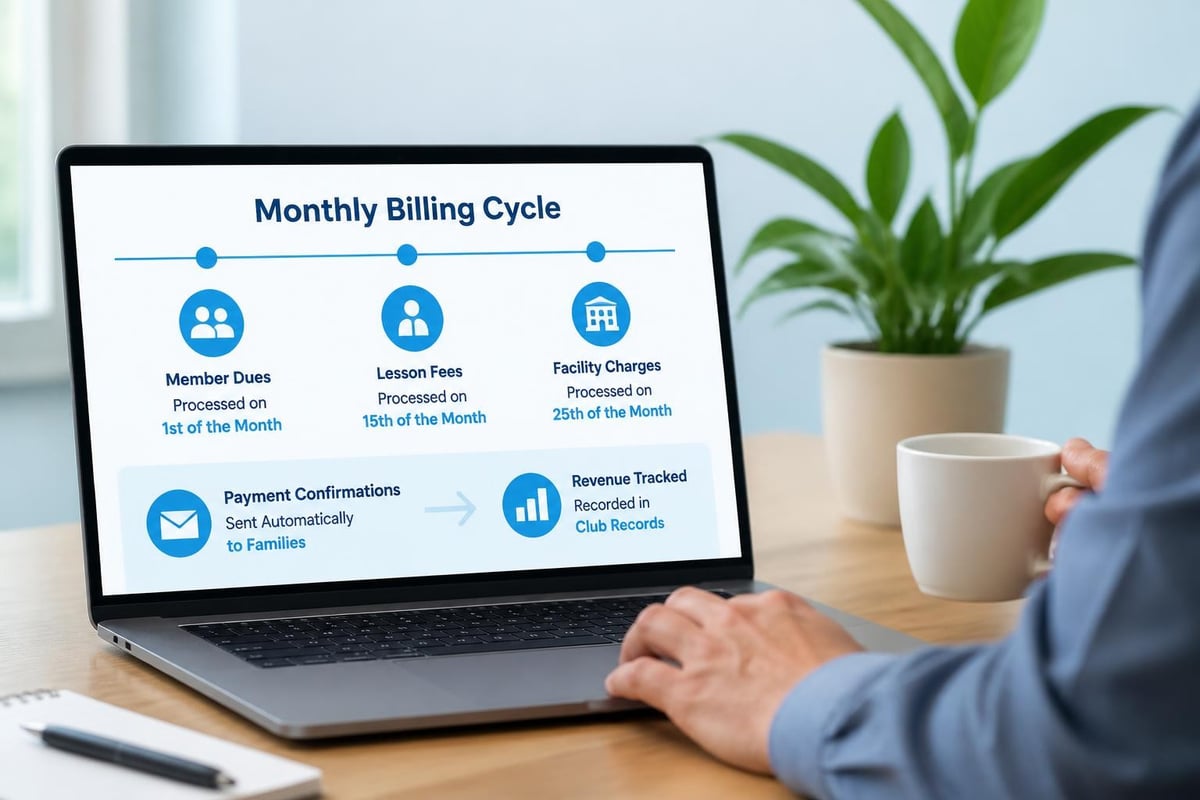
You don't need to understand the technical plumbing to benefit from schedule billing, but knowing the basics helps you make better decisions. When you set up schedule billing, you're essentially creating a set of instructions that your payment system follows without human intervention.
The system stores payment methods securely (following PCI Security Standards Council requirements for protecting cardholder data). Then on the dates you've specified, it automatically initiates charges, handles any processing issues, and updates member accounts with the results.
The Four Key Components Every Club Needs
When you're evaluating schedule billing options for your facility, you need to understand what actually makes the system work. These aren't nice-to-have features, they're the foundation.
-
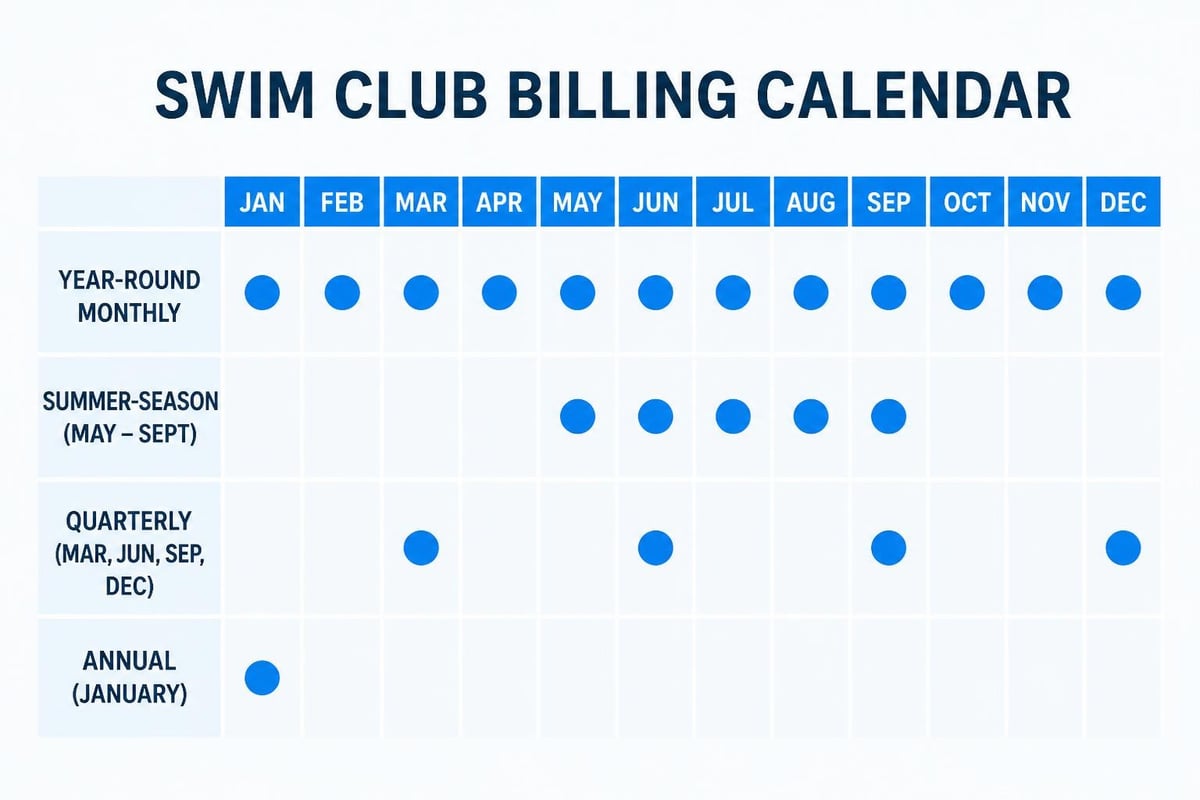
Payment schedule configuration – This is where you define when charges happen. Most clubs charge monthly on the 1st, but you need flexibility for quarterly payers, annual memberships, and custom arrangements.
-
Payment method vault – A secure storage system for credit cards and bank account information that meets industry security standards. Members enter their payment details once, and the system handles the rest.
-
Retry logic and dunning – What happens when a card declines? Good schedule billing systems automatically retry failed payments and send appropriate notifications to members.
-
Proration and adjustment handling – When someone joins mid-month or changes their membership level, the system needs to calculate and charge the correct prorated amount.
For developers implementing these systems, understanding subscription schedule configurations provides a solid foundation for handling complex billing scenarios.
Setting Up Your First Billing Schedule
Let me walk you through this like I'm sitting next to you at your desk. We'll start simple and build from there. You don't need to automate everything on day one. In fact, I recommend you don't.
Start with your most predictable billing group first. For most clubs, that's your year-round family memberships. These folks pay the same amount every month on the same day. They're perfect for testing your schedule billing setup.
Month One: Test with a Small Group
Pick 20-30 families who you know have reliable payment methods and good communication. Tell them you're testing a new automated billing system and ask for their feedback. Set up their schedule billing to charge on the 1st of next month.
Here's your pre-launch checklist:
- Verify each member's payment method is valid and current
- Confirm the billing amount in your system matches what they expect
- Send a notification email explaining the change
- Set up a calendar reminder to check results on the 2nd
- Prepare a quick response template for any questions
When the 1st arrives, the system handles the charges automatically. You check your dashboard on the 2nd to verify everything processed correctly. You'll probably have one or two declined payments (there always are), but you handle those with your standard process.
Months Two and Three: Expand and Refine
If your test group went smoothly, add another 50 families in month two. By month three, you should be ready to move your entire standard membership base to schedule billing.
This gradual approach gives you time to work out the kinks without overwhelming yourself or your members. You'll discover edge cases you didn't anticipate, like the family who always splits their payment across two cards or the member who insists on being charged on the 15th because that's when their paycheck hits.
Handling Special Billing Situations
Every club has members with unique payment arrangements. The question isn't whether schedule billing can handle them, it's how you configure it to match your specific needs. Let me show you how to tackle the most common scenarios.
Variable Monthly Charges
Swim lesson fees change based on registration. Guest passes add unexpected charges. Facility rental fees pop up irregularly. How do you schedule billing when the amount varies?
You set up a base recurring charge for membership dues, then layer additional charges on top. Modern systems like those available through PoolPulse's swim club management software let you combine scheduled base charges with ad-hoc additions that still process on your regular billing cycle.
| Billing Component | Schedule Type | Example Amount |
|---|---|---|
| Monthly Dues | Fixed recurring | $125 |
| Swim Lessons | Variable add-on | $0-$280 |
| Guest Passes | On-demand | $15 each |
| Facility Rental | One-time | $0-$500 |
The key is setting a primary billing date (like the 1st) where all charges for that member consolidate. They get one transaction instead of four separate charges throughout the month.
Multi-Family and Split Billing
Here's a situation that comes up more than you'd think: grandparents who pay for their grandkids' membership, divorced parents who split costs, or extended families who share one membership but want separate billing.
You have two solid options. First, you can set up schedule billing to charge two different payment methods on the same date for specified amounts. One card gets charged $75, the other gets charged $50, both on the 1st.
Second option: you designate one payment method as primary for schedule billing, and that person coordinates payment with their co-payer separately. This is cleaner from a system perspective but requires more trust between the families.
Seasonal and Part-Time Members
Your summer-only families don't need schedule billing twelve months a year. Configure their billing schedules to activate in April and pause in September. When you set up their schedule, you define both the start date and end date.
Some clubs prefer to keep schedule billing active year-round but adjust the amount to zero during off-months. This maintains the payment method on file and makes reactivation simpler. Either approach works as long as you're clear with members about what to expect.
The Compliance and Security Side You Can't Ignore
I know compliance sounds boring, but ignoring it can cost your club serious money. When you're processing recurring payments automatically, you're dealing with stricter rules than one-time charges. Let me break down what actually matters for your club.
What the FTC's Click-to-Cancel Rule Means for You
In October 2024, the Federal Trade Commission announced new requirements for automatic renewals and recurring billing . The short version: if members can sign up for schedule billing online, they must be able to cancel it just as easily.
You can't make members call during business hours or send a certified letter to stop automatic billing. Your system needs a clear, accessible way for members to cancel their scheduled payments themselves.
Practical compliance steps:
- Add a "Manage My Billing" section to your member portal
- Let members pause or cancel schedule billing with two clicks or less
- Send confirmation immediately when they make changes
- Keep records of all billing preferences and changes
This isn't just about following rules. It's about treating your members like adults who deserve control over their own finances.
ACH vs. Credit Card Schedule Billing
You have two main options for processing scheduled payments: ACH bank transfers or credit card charges. Each has different rules, costs, and processing timelines.
ACH transfers cost you less per transaction (usually $0.25 to $0.50) but take longer to process and settle. The ACH network operates under specific rules that govern how and when you can initiate transfers. You also need explicit authorization from members before you can debit their bank accounts.
Credit cards cost more (typically 2.5% to 3.5% per transaction) but process faster and offer members more familiar dispute processes. Most clubs find credit cards work better for schedule billing because members are more comfortable with automatic card charges than bank debits.
Some clubs offer both options and let members choose. This increases complexity on your end but gives families flexibility based on their preferences.
Troubleshooting Failed Payments and Dunning
Here's the reality nobody talks about: about 5-8% of your scheduled payments will fail each month. Cards expire. Banks flag transactions as suspicious. Members close accounts without updating their payment info. This is normal, expected, and manageable.
The difference between clubs that succeed with schedule billing and clubs that struggle comes down to how they handle these failed payments. You need a systematic approach, not a panicked scramble.
Your Three-Step Recovery Process
When a payment fails, time matters. The longer you wait to address it, the harder it becomes to collect. Set up your system to follow this sequence automatically:
Day 1 (payment fails): System sends immediate email to member explaining the failure and providing a link to update payment info. Keep the tone helpful, not accusatory. Technical issues cause most failures, not intentional non-payment.
Day 3: System retries the payment automatically. Many temporary issues (daily card limits, fraud holds) resolve within 48 hours. About 30% of failed payments succeed on the first retry.
Day 7: If retry failed, send a second notification with more urgency. Include a phone number for members who prefer to call and update their information verbally. Offer to help troubleshoot if they're having technical difficulties.
Most professional systems allow you to configure retry schedules and notification templates. For example, creating subscription schedules with specific retry behavior gives you granular control over how the system handles failures.
When to Escalate to Manual Follow-Up
If automated recovery doesn't work after two weeks, it's time for personal outreach. At this point, you're dealing with either a member who needs help but isn't getting your emails, or someone who's actively avoiding payment.
A quick phone call often resolves things immediately. Nine times out of ten, the member is embarrassed, apologizes, and updates their payment method on the spot. The tenth time, you're having a conversation about account suspension or termination.
Document everything. Note when payments failed, what notifications were sent, and what the member said when you called. If you eventually need to send an account to collections or write off the debt, this documentation proves you followed proper procedures.
Reporting and Revenue Forecasting Benefits
This is where schedule billing transforms from a time-saver into a strategic advantage. When your billing happens automatically on predictable dates, your revenue becomes predictable too. You can finally answer your board's questions with data instead of estimates.
Monthly Revenue Becomes Remarkably Stable
Look at your revenue reports from the past six months. If you're billing manually, you probably see significant variation. January shows $42,000, February drops to $38,500, March jumps to $45,200. Why? Probably because you processed bills on different dates, had a particularly good or bad month for collections, or dealt with seasonal factors.
With schedule billing, your monthly revenue smooths out. You know exactly how much will hit your account on the 1st of each month from dues alone. Variable charges still fluctuate, but your baseline becomes predictable.
Sample monthly revenue breakdown with schedule billing:
| Revenue Source | January | February | March |
|---|---|---|---|
| Scheduled Dues | $38,200 | $38,200 | $38,550 |
| Lesson Fees (variable) | $4,800 | $6,200 | $7,400 |
| Guest Passes | $850 | $620 | $1,100 |
| Total | $43,850 | $45,020 | $47,050 |
Notice how the scheduled dues line stays nearly flat? That's the power of automation. The $350 increase in March reflects three new member enrollments, but existing members process identically month to month.
Better Cash Flow Planning
When you know exactly when money arrives, you can schedule your own payments more strategically. You can set your pool maintenance contract to bill on the 5th, knowing your member dues will have cleared by then. You can schedule your insurance payment for the 3rd without worrying about insufficient funds.
This level of financial predictability makes everything easier. Your treasurer loves you because reconciliation is straightforward. Your board trusts the numbers because they're consistent. Your CPA appreciates the clean records during tax season.
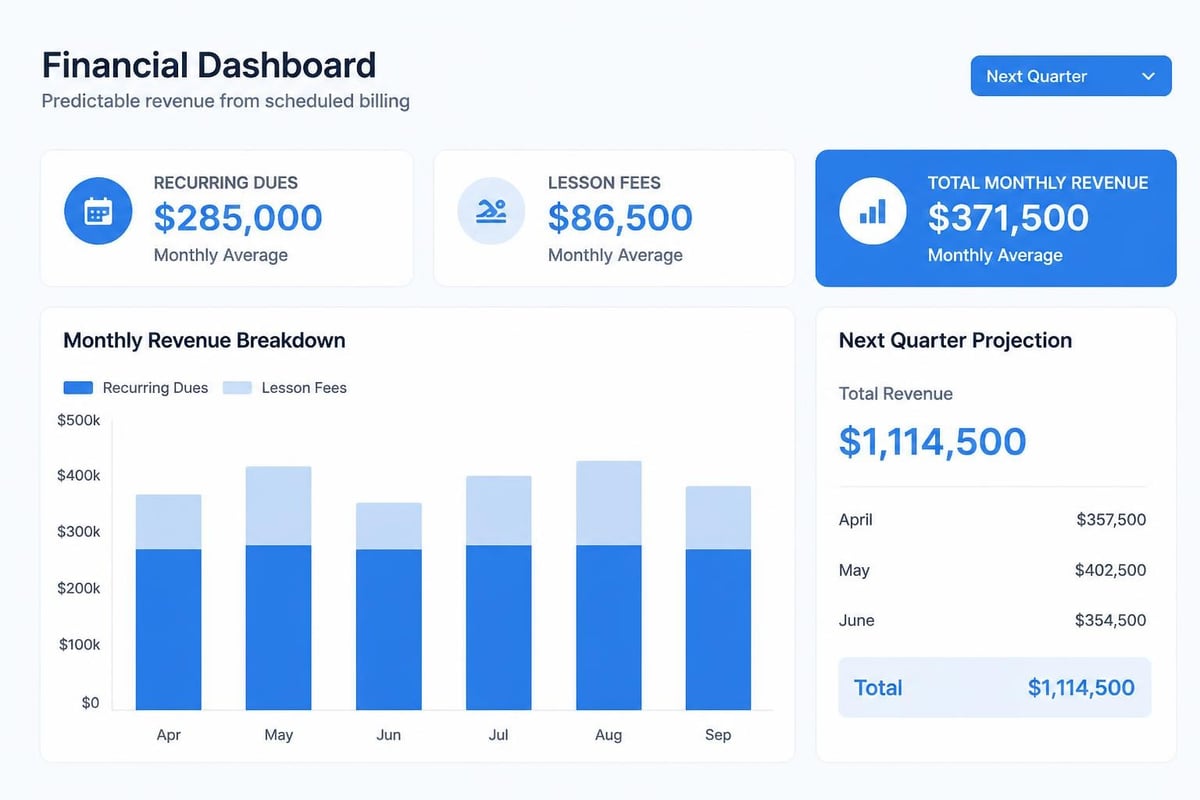
Modern platforms like PoolPulse integrate billing data directly into your financial dashboards, giving you real-time visibility into scheduled charges, processing status, and revenue projections.
Integration with Member Management Systems
Schedule billing doesn't exist in isolation. It needs to connect with your member database, registration system, attendance tracking, and accounting software. The quality of these integrations determines whether schedule billing makes your life easier or creates new headaches.
What Seamless Integration Actually Looks Like
Imagine a new family joins your swim club today. They fill out registration online, select their membership level, and enter payment information. Here's what should happen automatically:
- Member record creates in your database with all their information
- Membership level determines their billing amount and schedule
- Payment method stores securely for future charges
- Schedule billing activates with prorated charge for the partial month
- Family receives welcome email with billing details and schedule
- Your dashboard updates with the new recurring revenue
All of this happens without you touching anything. That's proper integration. The registration system talks to the billing system talks to the member database talks to the communication platform. Information flows smoothly without manual data entry.
Contrast that with poorly integrated systems: you receive a registration form, manually enter the member information into your database, separately set up their billing schedule, manually calculate the prorated amount, send a custom email with details, and update your revenue spreadsheet. One new member just cost you 20 minutes of work.
Why Single-Platform Solutions Win
You could cobble together schedule billing from separate tools. Use one platform for member management, another for payment processing, a third for email communication, and spreadsheets to tie it all together. I've seen clubs do this, and it always ends badly.
The problem isn't the individual tools. It's the gaps between them. Information doesn't sync properly. Updates in one system don't reflect in others. You spend hours manually reconciling data. And when something breaks, you're troubleshooting three different platforms to find the issue.
Unified platforms designed specifically for swim club operations, like those outlined in PoolPulse's approach to club management , eliminate these gaps. Schedule billing, member records, attendance tracking, and communication all live in one system with native integrations.
Common Schedule Billing Mistakes to Avoid
I've watched dozens of swim clubs implement schedule billing over the years. The successful ones avoid a handful of common mistakes. Learn from their experience instead of repeating these errors yourself.
Starting with Your Most Complex Members First
Don't do this. I know it's tempting to tackle your biggest headaches first, but those complicated billing situations are complicated for a reason. Start with your simplest members, learn the system, then gradually handle more complex scenarios.
Your family with three kids in different lesson programs who pays quarterly in two installments across different cards and needs custom invoices for their FSA? That's not your first schedule billing setup. That's your fiftieth, after you've mastered the basics.
Not Communicating Changes Clearly to Members
Members hate surprises with their money. When you switch to schedule billing, some families will worry about losing control or getting charged incorrectly. Over-communicate the change.
Send multiple notifications before the first scheduled charge. Explain exactly what will happen and when. Provide a clear way for members to review their billing schedule. Give them an easy opt-out if they prefer to pay manually.
The clubs with the smoothest schedule billing transitions are the ones that treated communication as seriously as the technical implementation.
Ignoring Failed Payment Patterns
If the same 15 members fail every month and you just keep retrying without investigating, you're wasting everyone's time. Look for patterns in your payment failures.
Are failures concentrated around certain membership types? Maybe your summer-only members aren't updating payment methods when they return each year. Are failures more common with certain card types? Some banks flag recurring charges more aggressively than others.
Use this data to improve your process. Send payment method verification reminders to seasonal members before their billing reactivates. Offer ACH as an alternative for members whose banks keep declining card charges.
Setting Unclear Billing Dates
"Sometime around the first of the month" isn't a schedule. Specify the exact date. If you bill on the 1st and the 1st falls on a weekend, document whether you charge on the Friday before or the Monday after. This matters for member expectations and your cash flow planning.
Some clubs default to the first business day of the month, which means billing dates vary. Others always bill on the 1st regardless of weekends, letting the payment processor handle timing. Either approach works as long as you're consistent and clear.
Advanced Schedule Billing Strategies
Once you've mastered basic schedule billing, you can leverage more sophisticated strategies to optimize revenue and member satisfaction. These aren't necessary for every club, but they solve real problems for growing facilities.
Tiered Grace Period Billing
Not all late payments should trigger the same response. A loyal member of 10 years whose payment fails once deserves different treatment than a new member who's already missed three charges.
Configure your schedule billing to apply different retry schedules and communication based on member tenure and payment history. Long-term members might get a seven-day grace period before account suspension. New members might get three days. Serial non-payers might get immediate suspension after the first failed retry.
This requires more sophisticated configuration, but it balances fairness with financial responsibility. You're not punishing good members for occasional issues while still maintaining firm boundaries for chronic problems.
Optimization for Payment Processing Costs
Schedule billing lets you control exactly when charges process, which means you can optimize for lower fees. Some payment processors offer better rates for batched transactions or off-peak processing.
If you're processing 300 charges on the 1st of every month, you might negotiate a bulk rate that's 0.3% lower than your standard rate. Across a year, that adds up to meaningful savings.
For clubs exploring cost optimization in their billing infrastructure, reviewing billing transformation strategies provides valuable context on modernizing payment operations.
Intelligent Scheduling Around Cash Flow Needs
Most clubs default to billing on the 1st because it's clean and simple. But what if your biggest expenses come due on the 15th? You could schedule member billing for the 10th instead, ensuring funds are available when you need them most.
Or split your billing into two cycles: half your members on the 1st, half on the 15th. This smooths your cash flow throughout the month and reduces the processing load on any single day. Some payment systems handle high-volume days better than others, and spreading the load prevents bottlenecks.
You can also align billing with your fiscal calendar. If your club's fiscal year starts in June, you might schedule annual memberships to renew in May, giving you clean year-end financials.
Measuring Success with Schedule Billing
How do you know if schedule billing is actually working? You need specific metrics to track, not just a vague sense that things are easier. Here's what successful clubs measure.
Key Performance Indicators to Track
Collection rate: What percentage of scheduled charges succeed on the first attempt? Healthy clubs see 92-95% success rates. If you're below 90%, you have either payment method quality issues or member satisfaction problems.
Time to resolution for failed payments: How long does it take from a failed charge to successful collection? Target under seven days. Anything longer suggests your dunning process needs improvement.
Administrative time spent on billing: Track how many hours you spend on billing-related tasks each month. This should drop by 60-80% after implementing schedule billing. If it doesn't, your system isn't properly configured or you're still doing manual work that should be automated.
Member complaints related to billing: Count how many billing questions, disputes, or complaints you receive monthly. This might initially increase as members adjust to the new system, but should settle below your pre-automation baseline within three months.
| Metric | Before Schedule Billing | After 3 Months | Target |
|---|---|---|---|
| Collection rate | 87% | 94% | >92% |
| Time to resolution | 14 days | 6 days | <7 days |
| Admin hours/month | 18 hours | 6 hours | <8 hours |
| Billing complaints | 12/month | 4/month | <5/month |
The Questions Your Board Will Ask
When you present schedule billing results to your board, they'll want to know three things: Did it save money? Did it improve cash flow? And did members complain?
Prepare answers with actual data. Show your time savings converted to dollar value. If you spent 18 hours monthly on billing and now spend 6, that's 12 hours saved. At $30 per hour, that's $360 monthly or $4,320 annually.
Show your collection rate improvement. If you were collecting 87% of dues on time and now collect 94%, calculate the revenue impact. On $40,000 in monthly dues, that 7% improvement means an extra $2,800 collected on schedule instead of chased down later.
Show member satisfaction data. Survey your members about the billing experience. Most clubs find that once members get comfortable with schedule billing, they prefer it overwhelmingly. Nobody actually enjoys remembering to pay bills manually.
Planning Your Schedule Billing Implementation
You're convinced schedule billing makes sense for your club. Now what? Let's map out a realistic implementation timeline that doesn't disrupt your operations or overwhelm your members.
The 90-Day Rollout Plan
Days 1-30: Preparation and Planning
Choose your platform, configure your settings, and prepare your communication materials. If you're working with a comprehensive system like PoolPulse's swim club management software , this phase includes training on the billing features and setting up your payment processor integration.
Import member payment methods or set up a process for members to add them. Clean up your member database so billing amounts are accurate. Draft email templates for notifications, failures, and confirmations.
Days 31-60: Pilot Launch
Start with 20-30 friendly families who'll provide honest feedback. Process their first scheduled billing cycle. Monitor closely for issues. Collect feedback and adjust your configuration.
Use this phase to refine your communication approach and troubleshoot technical issues in a low-risk environment. It's much better to discover problems with 30 members than with 300.
Days 61-90: Full Rollout
Migrate the rest of your standard membership base to schedule billing. Process one full billing cycle with your complete member base. By day 90, you should have your entire club on automated billing with clean processes for handling exceptions.
Budget Considerations
Schedule billing typically costs less than you think, especially when you factor in time savings. Most payment processors charge the same rate whether you process payments manually or automatically, so your per-transaction costs don't change.
Your main investment is the platform subscription if you're using dedicated club management software. For context, clubs can review PoolPulse's pricing to understand typical cost structures for comprehensive solutions that include schedule billing.
Budget about 20 hours of your time for the initial setup and rollout. That includes configuration, member communication, troubleshooting, and training. After the first 90 days, ongoing maintenance should require less than 2 hours monthly.
Getting Staff and Board Buy-In
Your front desk staff and board members need to understand why you're making this change. Frame it in terms of benefits they care about.
For staff: "You'll stop fielding calls from members asking why they haven't been billed yet" and "You won't spend Friday afternoons processing 247 charges manually."
For board members: "We'll improve cash flow predictability and reduce administrative overhead by 60%" and "Members will experience more professional, consistent billing."
Address concerns directly. Yes, there's a learning curve. Yes, some members will initially resist. But the long-term benefits far outweigh the short-term adjustment period.
Schedule billing transforms how swim clubs handle one of their most time-consuming administrative tasks, turning hours of manual work into minutes of oversight while improving both cash flow and member satisfaction. When you're ready to modernize your club's billing operations with a platform designed specifically for swim clubs, PoolPulse offers the configurability and automation you need to eliminate billing headaches while maintaining the flexibility your unique membership structure requires.

Five Front-Desk Tasks Your Swim POS Should Handle
Your front desk shouldn't need three systems to check in a swimmer. Here's how modern swim POS systems save time and reduce errors.

What Your Billing and Invoices Are Telling You
Your swim club's billing and invoices reveal hidden patterns about late payments, refund requests, and cash flow. Here's how to read the signals.

The Swim Club Software Test Every Board Should Run
Run this simple test to see if your swim club software actually saves time or creates more work. Real scenarios, honest questions, better tools.
Want to see if PoolPulse is a good fit for your club?
Book a walkthrough and we'll show you exactly how PoolPulse can help based on your club's needs, goals, and current processes.