

Who Should Actually Work This Saturday?
Smart staffing decisions separate thriving swim clubs from overwhelmed ones. Learn practical ways to schedule, train and keep the right people.


You walk into the clubhouse on Saturday morning. Two lifeguards didn't show up. The front desk person is new and already buried in questions about guest passes. A member is upset because nobody renewed their family before auto-billing kicked in. Your phone won't stop buzzing with shift-swap texts. Sound familiar? That chaos isn't bad luck. It's what happens when staffing and management fall behind the actual needs of your operation.
Running a swim club means juggling people who work ten hours a week alongside people who need benefits and year-round schedules. You're managing teenagers in their first job and experienced staff who've seen five board presidents come and go. The decisions you make about who works when, how you train them, and what tools they use directly shape whether your summer feels manageable or like a three-month emergency.
The Real Cost of Winging Your Schedule
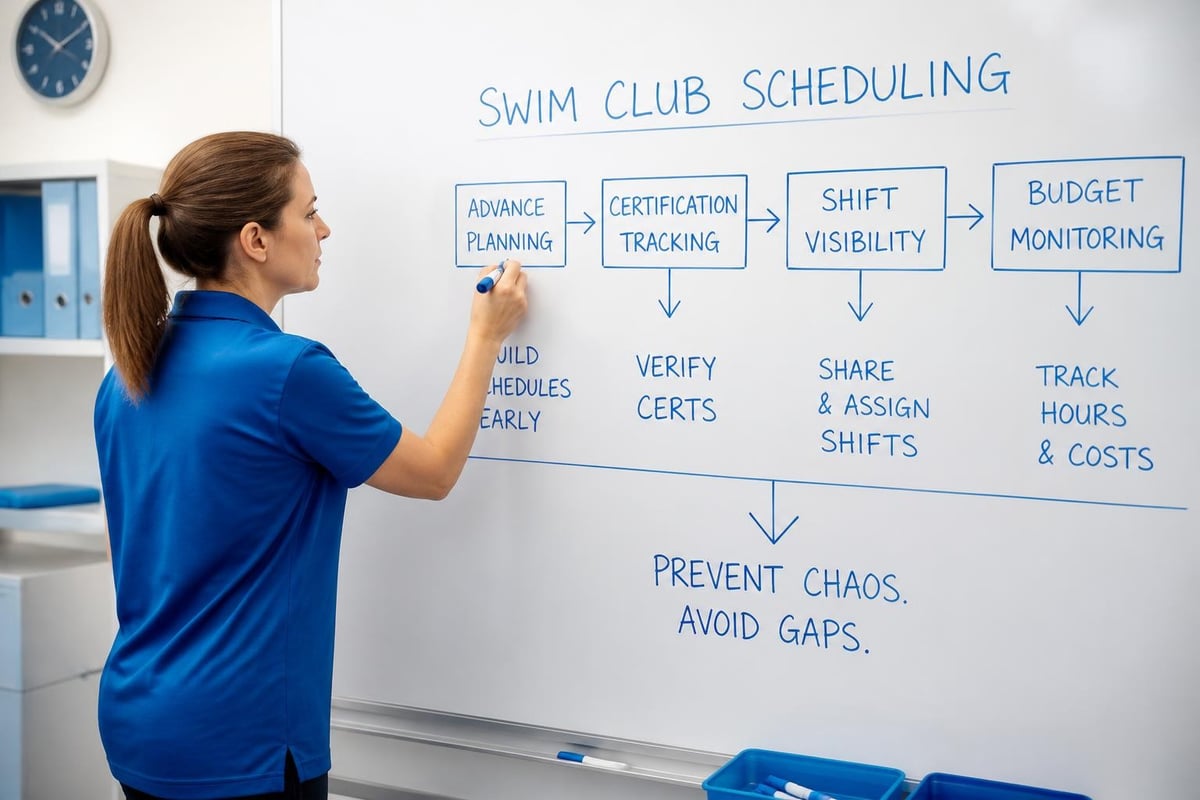
Most swim clubs handle scheduling the same way every year. Someone (usually a board member or facility manager) builds a spreadsheet in April, emails it around, collects responses, makes changes in red text, emails it again, and hopes everyone checks their spam folder. By June, that spreadsheet is a mess of crossed-out names and question marks.
This approach costs you more than time. When staff don't know their schedule until the week before, your best people find other jobs. When coverage gaps appear at the last minute, you're stuck begging someone to cover or doing it yourself. When you can't see staffing costs in real time, you blow through your labor budget before July ends.
Here's what actually works:
- Build schedules four weeks out and stick to a consistent posting day
- Let staff request time off through one system instead of texts, emails, and sticky notes
- Track who's certified for what so you're not guessing who can lifeguard versus who can only work the desk
- Show your labor spend week by week so you can adjust before the budget breaks
Think of scheduling as infrastructure, not a task you knock out once. The clubs that feel calm during peak season built that calm in March by setting up systems that flex when life happens.
What About Seasonal vs Year-Round Staff?
Your staffing and management approach needs to account for two completely different groups. Year-round staff (your manager, head guard, maybe front desk lead) need predictable hours, benefits conversations, and clear advancement paths. Seasonal staff need fast onboarding, simple tools, and flexibility around school schedules.
The mistake most clubs make? Treating everyone the same. Your college student working June through August doesn't need a performance review plan. But your facility manager who's been with you three years absolutely does.
| Staff Type | What They Need | What Kills Retention |
|---|---|---|
| Year-round manager | Clear authority, budget visibility, off-season projects | Micromanagement from the board, scope creep without pay adjustment |
| Seasonal lifeguards | Quick training, flexible swaps, clear rules | Chaotic scheduling, being blamed for policy they didn't write |
| Front desk (part-time) | Simple check-in tools, member issue scripts | Complex software they use twice a week, no backup when systems fail |
Ask yourself: could your front desk person explain your guest policy to an angry member without calling someone? If not, you haven't given them the training or tools to succeed. That's a management gap, not a people problem.
Training That Actually Sticks
Every spring, swim clubs run the same training day. Someone reads through the handbook. You watch an outdated safety video. Maybe you practice CPR on a dummy. Then everyone goes home, and on opening day, half of them can't remember how to process a guest pass.
Training fails when it's a one-day event instead of an ongoing process. Your staffing and management strategy should assume that people forget, systems change, and questions pop up in the moment when nobody's around to ask.
Build training that works in real conditions:
- Run through actual scenarios - not just policies. Have someone role-play the angry member whose kid got kicked out of the pool. Practice what to do when the payment system is down.
- Create a reference guide they can check on their phone - one page per common task. How to add a guest. How to handle a lost key card. How to reach a manager.
- Schedule working interviews - bring candidates in for a paid two-hour shift during a quiet time. See how they handle real members before you commit to a summer.
- Record short video walkthroughs - screen recordings of your actual software doing actual tasks. Five minutes showing how to process a membership beats a twenty-page PDF nobody reads.
The World Economic Forum's latest jobs research shows that on-the-job training and peer learning are now the top methods organizations use to close skill gaps. Your sixteen-year-old lifeguard learns better from shadowing your lead guard for a shift than from reading a binder.
The First-Week Experience Matters
Here's a test: think about your newest staff member. Did they spend their first shift feeling confident or confused? Did they know where to find answers, or did they interrupt someone every ten minutes?
Most staffing problems that show up in July actually started in May when someone's first experience was chaos. They didn't know the Wi-Fi password. Nobody introduced them to the team. The login credentials were wrong. They left that shift wondering if they made a mistake taking the job.
Your onboarding should answer these questions before they're asked:
- Where do I park?
- What do I wear?
- Who do I ask when I don't know something?
- What happens if I'm sick?
- How do I get paid?
Clubs that retain good people treat the first shift like it matters. Better onboarding processes reduce the questions that pull managers away from actual management.
When to Do It Yourself vs Hire It Out
Small swim clubs live in constant tension between "we can't afford to hire that" and "I can't keep doing this myself." Board members end up running the front desk. Volunteers process payments. The vice president spends fifteen hours a week on tasks that aren't really volunteer work anymore.
This isn't sustainable, and deep down, you know it. But how do you decide what's worth paying someone to handle?
Here's a simple framework:
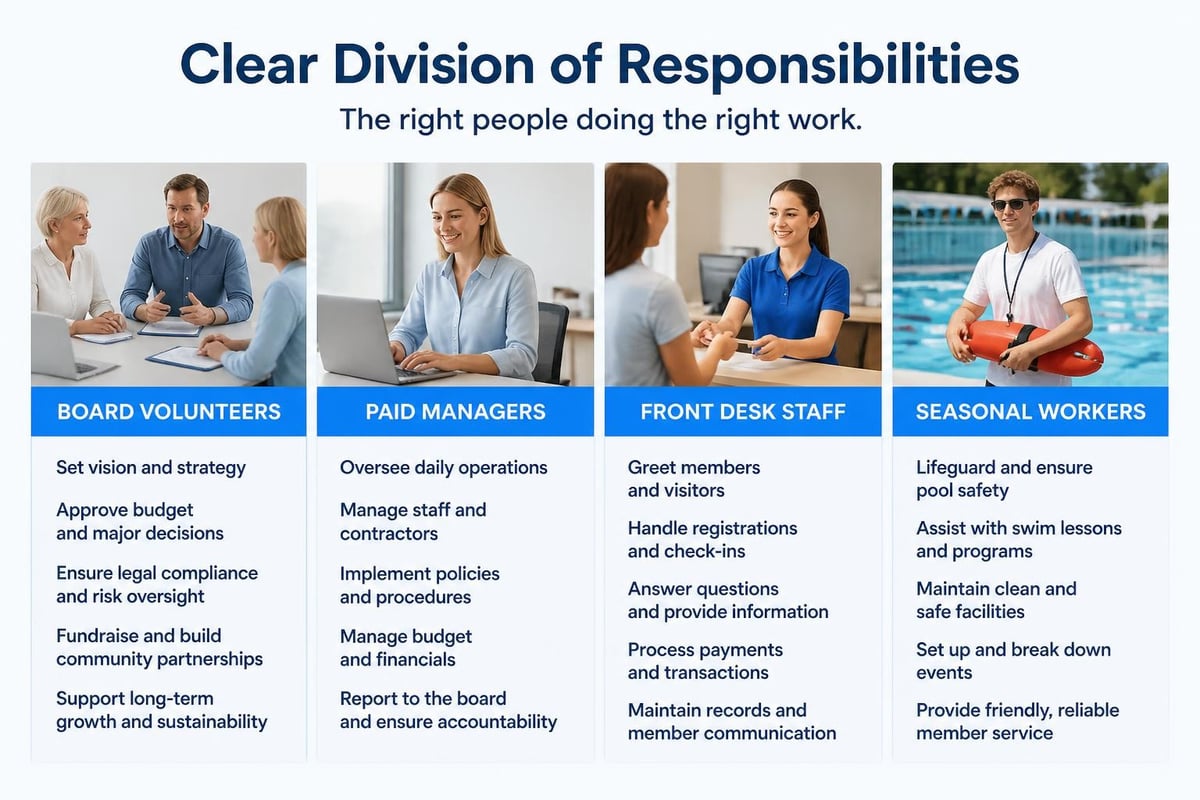
- Hire for repeated tasks that need consistency - membership processing, daily check-ins, billing follow-up
- Hire for expertise you don't have - pool maintenance, accounting, legal compliance
- Keep volunteer for governance and strategy - setting policies, planning improvements, member relations
You don't need a full-time employee for everything. But you probably need someone who shows up reliably and owns the operational details. Even ten hours a week of paid help in the right areas transforms how the volunteer board functions.
The Part-Time Manager Sweet Spot
Many clubs have found success with a part-time facility manager working twenty to thirty hours a week year-round. This person handles member questions, coordinates maintenance, manages schedules, runs reports, and serves as the face of the club when the board isn't around.
That role costs maybe $20,000 to $35,000 a year depending on your market. Compare that to what you're losing when renewals fall through the cracks, billing errors go unnoticed for months, or your volunteer treasurer quits because it became a part-time job.
The return on investment isn't just financial. It's the board meeting where you discuss strategy instead of arguing about who forgot to order chlorine. It's the peace of mind knowing someone's watching the operation during the week. Strategic HR benchmarking from SHRM shows that small organizations often understaff administrative support, leading to burnout and turnover in leadership volunteers.
Technology That Makes Staffing Easier
Let's be honest. Most swim club software was built twenty years ago and feels like it. Your staff logs into three different systems to do one task. The mobile app crashes. Nobody can generate a simple report without calling support.
When your tools fight against your team instead of helping them, staffing and management becomes harder than it needs to be. You can hire great people and train them well, but if they're battling software all day, they'll leave for jobs with better tools.
What your team actually needs:
- Single login for everything - check-ins, member lookup, guest passes, waivers, all in one place
- Mobile access that works - most of your summer staff lives on their phone; your tools should too
- AI-powered help - instant answers to common questions without hunting through menus or calling anyone
- Automated routine tasks - billing, renewals, late notices, access updates should happen without manual work
Modern swim club management platforms handle the repetitive stuff so your staff can focus on members. When someone renews online, their access updates automatically. When a payment fails, the system sends reminders. When a new family joins, everything gets set up in one workflow.
This isn't about being fancy. It's about respecting your team's time. The front desk person working Saturday morning shouldn't spend twenty minutes figuring out why someone's card isn't scanning when the software should just tell them instantly.
The Hidden Cost of Bad Software
Think about how much time your team spends working around your current system. The manual steps. The workarounds. The "just call me and I'll fix it" patches that never got properly solved.
Now multiply that wasted time by everyone on your team, across a whole season. That's not just annoying. It's payroll you're spending on fighting tools instead of serving members. It's the reason good people get frustrated and stop picking up shifts.
PoolPulse's features were designed specifically to eliminate those workarounds. The configurability means your software adapts to how your club actually operates, not the other way around. The AI assistance means staff get answers in seconds instead of interrupting managers. The unified platform means everything connects without manual data entry.
Managing Across Generations and Expectations
Your swim club probably employs everyone from high school students to retirees. Managing that range of experience and expectations requires flexibility most clubs don't plan for.
Your sixty-year-old front desk coordinator wants detailed instructions, written procedures, and consistency. Your nineteen-year-old lifeguard wants to text their questions, prefers video to reading, and will quit if the schedule isn't posted digitally. Both are good employees. They just need different approaches.
Staffing and management that works across ages:
- Offer multiple communication paths - some people want email, some want text, some want Slack
- Respect different learning styles - written guides for some, video for others, hands-on for the rest
- Be clear about non-negotiables - safety rules, member privacy, showing up on time matter for everyone
- Flex on the rest - does it really matter if someone prefers to check the schedule on their phone versus a printed copy?
The mental health workplace guidelines from WHO emphasize that supportive management practices reduce stress and improve retention. For swim clubs, that means recognizing that your college student juggling two jobs has different needs than your retired member working the desk for social connection.
The Hybrid Work Question for Club Management
If you employ a year-round manager or administrative staff, you've probably wrestled with the remote work question. Can your facility manager work from home on admin days? Should they be on-site every day even during the off-season when the pool is closed?
There's no single right answer, but hybrid work research from Harvard Business Review suggests that clarity and consistency matter more than the specific policy. If Tuesdays are office days and Thursdays are remote days, stick to that. If certain tasks require on-site presence (member meetings, contractor coordination, facility walkthroughs), make that clear.
For smaller clubs, most management roles will be primarily on-site during season and more flexible in the off-months. The key is setting expectations up front rather than letting it become a source of tension.
Legal Basics You Can't Ignore
Employment law isn't exciting, but getting it wrong costs real money and creates real problems. You need to understand the basics even if you're a volunteer board running a small operation.
Core areas to get right:
- Classification - Are your workers employees or independent contractors? Most swim club staff are employees, which means you're handling payroll taxes.
- Wage and hour - Lifeguards must be paid for training time. Breaks matter. Overtime rules apply when someone crosses forty hours.
- Safety and certification - Proper certifications aren't optional. Document everything.
- Hiring practices - The EEOC's current enforcement priorities include fair hiring and recruitment. Your job posts and interview questions need to avoid discrimination.
Many clubs work with a PEO (professional employer organization) or payroll service that handles compliance. This isn't an area to cheap out on. One wage claim or safety incident can cost more than years of proper HR support.
When to Call a Lawyer
You don't need an attorney on retainer, but you should know when to ask for help. Terminating a long-term employee, handling a safety incident with potential liability, responding to a discrimination complaint, or navigating workers' comp claims all warrant a quick legal consultation.
Your insurance agent and state hospitality association can often point you toward employment lawyers who work with small recreational facilities. Budget for at least one annual conversation to review your practices.
Building a Team That Stays
The swim clubs that feel easy to run aren't lucky. They've built teams where people actually want to work. How do you become one of those clubs?
Start with basics that matter:
- Pay fairly - not top of market necessarily, but competitive enough that good people don't leave for an extra dollar an hour at the ice cream shop
- Create a good vibe - the manager sets the tone; if they're stressed and snippy, everyone else will be too
- Recognize effort - a simple "great job handling that tough member situation" goes further than you think
- Fix problems quickly - when someone raises an issue with scheduling, software, or safety, address it or explain why you can't
- Give people a path - can a lifeguard become a lead? Can front desk staff take on scheduling? Show them what's possible.
Retention matters because every person who quits in June means scrambling to hire, train, and onboard someone new during your busiest month. The cost isn't just HR time. It's the service quality drop while the new person gets up to speed.
Exit Interviews Are Worth Doing
When someone leaves, take fifteen minutes to ask why. You'll hear things the board never considered. Maybe your scheduling tool is terrible. Maybe one manager creates all your turnover. Maybe the pay really is too low for your market.
Sometimes people leave for reasons you can't control (moving, graduating, changing careers). But often, you'll spot patterns that point to fixable problems. Track what you hear and address themes, not one-off complaints.

Delegation and Empowerment
Here's a common swim club trap: the board (or a key volunteer) makes every single decision. Staff can't authorize a refund without an email chain. They can't resolve a complaint without checking with someone. They can't adjust a schedule without board approval.
This breaks staffing and management in two ways. First, it bottlenecks everything. Second, it tells your team you don't trust them. Good people don't stick around when they're treated like they can't think.
Empower staff to make decisions within clear boundaries:
- Front desk can waive a $5 late fee but needs approval for anything over $25
- Managers can hire and schedule seasonal staff but should involve the board in creating year-round positions
- Lead guards can enforce pool rules and eject problem guests without asking permission
- Administrative staff can answer routine member questions without forwarding everything to the board
You're not giving up control. You're setting guardrails and trusting people to work within them. When issues arise, you coach rather than punish. Over time, you'll spend less time in the weeds and more time on actual governance.
What Does Good Oversight Look Like?
Empowerment doesn't mean disappearing. You still need visibility into what's happening. But instead of approving every action, you're reviewing outcomes and patterns.
Run a monthly staffing report that shows:
- Hours worked by category (management, front desk, lifeguards)
- Labor cost vs. budget
- Schedule gaps or problem weeks
- Turnover and hiring needs
This takes ten minutes to review and tells you everything you need to know. When you see costs creeping up or turnover spiking, you dig in. Otherwise, you trust your team to operate.
Technology Integration for Your Team
Your staff shouldn't need a degree in computer science to do their job. Yet many swim clubs cobble together tools that barely talk to each other. Membership in one system. Billing in another. Access control in a third. Reporting in a spreadsheet someone emails around.
Every disconnected system creates work for your team. They're manually copying data, reconciling conflicts, and fixing errors that shouldn't exist in the first place.
Integration matters for staffing because it:
- Reduces training complexity (fewer systems to learn)
- Cuts down on errors (data flows automatically)
- Frees up time (no manual data entry)
- Improves member experience (staff have instant access to full member history)
When someone at the front desk can see a member's billing status, access history, and guest usage in one glance, they solve problems faster. When managers can pull a report showing who's behind on payments without exporting three spreadsheets and merging them, they make better decisions.
PoolPulse was built specifically to consolidate club management into one modern platform. Your team logs in once and has everything they need. Changes made anywhere in the system update everywhere else. The AI assistant answers questions instantly instead of forcing staff to hunt through menus.
Mobile-First Matters More Than You Think
Walk around your pool on a Saturday afternoon. How many of your staff are carrying clipboards versus phones? Exactly. If your management system doesn't work perfectly on mobile, you're making their jobs harder.
Modern staffing and management means meeting your team where they are. They're checking the schedule on their phone. Answering member questions on their phone. Looking up account details on their phone. Your software should make that easy, not force them to log into a desktop.
Planning for 2027 Right Now
You're reading this in September 2026. Summer is over. Take advantage of the quiet months to fix what broke this season.
Your off-season staffing checklist:
- Review wages for next year (research competitors, adjust for inflation)
- Document what worked and what didn't in 2026 (get input from staff before they forget)
- Upgrade or replace problem tools (now's the time, not April when training starts)
- Update job descriptions and hire timeline (start recruiting earlier for better candidates)
- Plan training approach for next season (what will you do differently?)
- Set labor budget with board approval (realistic numbers based on this year's actuals)
Clubs that run smooth summers don't panic-hire in May. They plan in the fall, recruit in winter, train in spring, and open feeling ready. That's the difference between good staffing and management and just hoping things work out.
Budget What You Actually Need
Every year, boards approve labor budgets that don't match reality. You budget for minimum hours at minimum wage, then wonder why you're scrambling to cover shifts or burning out your manager.
Build your budget from the bottom up:
- Calculate hours needed per position per week
- Add 15% buffer for coverage gaps and training
- Apply competitive (not minimum) wages
- Include payroll taxes and any benefits
- Add a line item for unexpected needs
Yes, this might mean raising dues or finding other revenue. But underfunding staffing doesn't save money. It just shifts costs to volunteer burnout, member dissatisfaction, and service gaps.
The Role of Management Software in Daily Operations
You've probably noticed this article keeps coming back to tools and systems. That's not because technology solves everything. It's because the right technology makes good staffing and management possible, while the wrong technology makes everything harder.
Think about what your team deals with daily:
- Member asks if their payment went through
- Guest needs to be added for Saturday
- Someone lost their access card
- A family wants to pause their membership
- The board needs a count of active members
- A parent wants to know if their waiver is on file
In a modern system, each of these takes seconds. In an outdated system, each one is a multi-step puzzle. The difference between those two experiences is whether your staff ends the day feeling productive or exhausted.
PoolPulse's platform was designed by people who understand club operations. The configurability means it adapts to your specific rules, membership types, and workflows. The AI assistance means your team gets instant answers. The unified design means everything connects. Your team spends less time fighting software and more time serving members.
What to Look for in Management Software
If you're evaluating options, focus on what actually matters for staffing and management:
| Feature | Why It Matters for Staff |
|---|---|
| Single sign-on | Staff don't waste time logging into multiple systems or remembering different passwords |
| Mobile-optimized | Works perfectly on phones, not just desktop |
| Real-time sync | Changes appear instantly everywhere; no conflicts or outdated data |
| Role-based access | Each person sees exactly what they need, nothing they don't |
| Built-in help/AI | Questions get answered immediately without interrupting managers |
| Reporting dashboard | Managers see key metrics at a glance instead of building spreadsheets |
Don't just demo features. Have actual staff members (front desk, manager) try the system with real tasks. If they struggle, that's your answer.
Communication Patterns That Work
Strong staffing and management requires clear, consistent communication. But most clubs communicate in ways that guarantee confusion. Important updates get buried in email threads. Policy changes are announced verbally and forgotten. Staff learn about schedule changes through gossip instead of official channels.
Set up communication systems, not just habits:
- One source of truth for schedules - everyone checks the same place, updates post automatically
- Clear escalation path - staff know exactly who to ask about what
- Regular check-ins - brief weekly touchpoint during season, monthly in off-season
- Announcement protocol - policy changes, facility updates, and important news go through one official channel
- Feedback loops - staff can raise issues and see them acknowledged or addressed
Your staff shouldn't have to guess. When there's a question, they should know instantly where to find the answer or who to ask.
The Weekly Five-Minute Huddle
Before weekend shifts during peak season, gather available staff for a five-minute standup. Cover:
- Anything unusual happening this weekend (event, maintenance, expected busy time)
- Reminder of one key policy or procedure
- Recognition of someone who did something well
- Quick check: any questions or concerns?
This takes barely any time but keeps everyone aligned and spots small problems before they become big ones. Staff feel connected to the operation instead of just showing up for a shift.
Smart staffing and management decisions compound over time. The clubs that run smoothly didn't get lucky with easy members or simple operations. They invested in systems that work, trained people properly, and gave their team the tools to succeed.
If you're tired of scrambling every season, it might be time to look at platforms built specifically for this work. PoolPulse handles the operational complexity so your staff can focus on members instead of fighting outdated software, giving you the foundation for staffing and management that actually scales.

Five Front-Desk Tasks Your Swim POS Should Handle
Your front desk shouldn't need three systems to check in a swimmer. Here's how modern swim POS systems save time and reduce errors.

The Swim Club Software Test Every Board Should Run
Run this simple test to see if your swim club software actually saves time or creates more work. Real scenarios, honest questions, better tools.

The Seven Signs You've Outgrown Your Club Operations
Your swim club is growing, but your tools aren't keeping up. These seven warning signs reveal when manual processes cost more than solutions.
Want to see if PoolPulse is a good fit for your club?
Book a walkthrough and we'll show you exactly how PoolPulse can help based on your club's needs, goals, and current processes.