

The Swim Club Software Test Every Board Should Run
Run this simple test to see if your swim club software actually saves time or creates more work. Real scenarios, honest questions, better tools.


It's the first Saturday in June. Your front desk volunteer just called you in a panic because the check-in system is down. Again. Two families are waiting to register their kids for lessons, but the online form isn't saving their payment information. Your treasurer needs last month's revenue report for Monday's board meeting, and you have no idea where to find it in the system. Sound familiar? If you're nodding along, it's time to take a hard look at how well your current software actually works for your club. Not how well the sales demo went two years ago, but how it performs right now, in the middle of a busy Saturday, when you need it most.
The Real Cost of Clunky Software Use
Most swim clubs don't fail because of bad software. They struggle because their software creates more work instead of less. You bought a system to save time, but now you're spending hours every week wrestling with it. Your staff asks you basic questions that should take thirty seconds to answer, but instead you're digging through three different screens and two exported spreadsheets.
Here's what inefficient software use actually costs your club:
- Staff frustration and turnover when simple tasks take ten steps instead of two
- Revenue leaks from missed renewals, forgotten guest fees, and incomplete registrations
- Board complaints when reports are late, inaccurate, or impossible to generate
- Member dissatisfaction when check-ins are slow, balances are wrong, or communication is spotty
- Your personal time fixing problems that shouldn't exist in the first place
Let's be honest. You probably chose your current system because it was cheap, or because another club recommended it, or because it was the only option you knew about. But "good enough" software becomes "barely functional" software faster than you think. When you're evaluating best swim club management software , the real question isn't about features. It's about whether the system actually makes your daily work easier.
The Five-Minute Front Desk Test
Want to know if your software is helping or hurting your club? Try this simple test next Saturday morning. It takes five minutes and tells you everything you need to know about your current system's effectiveness.
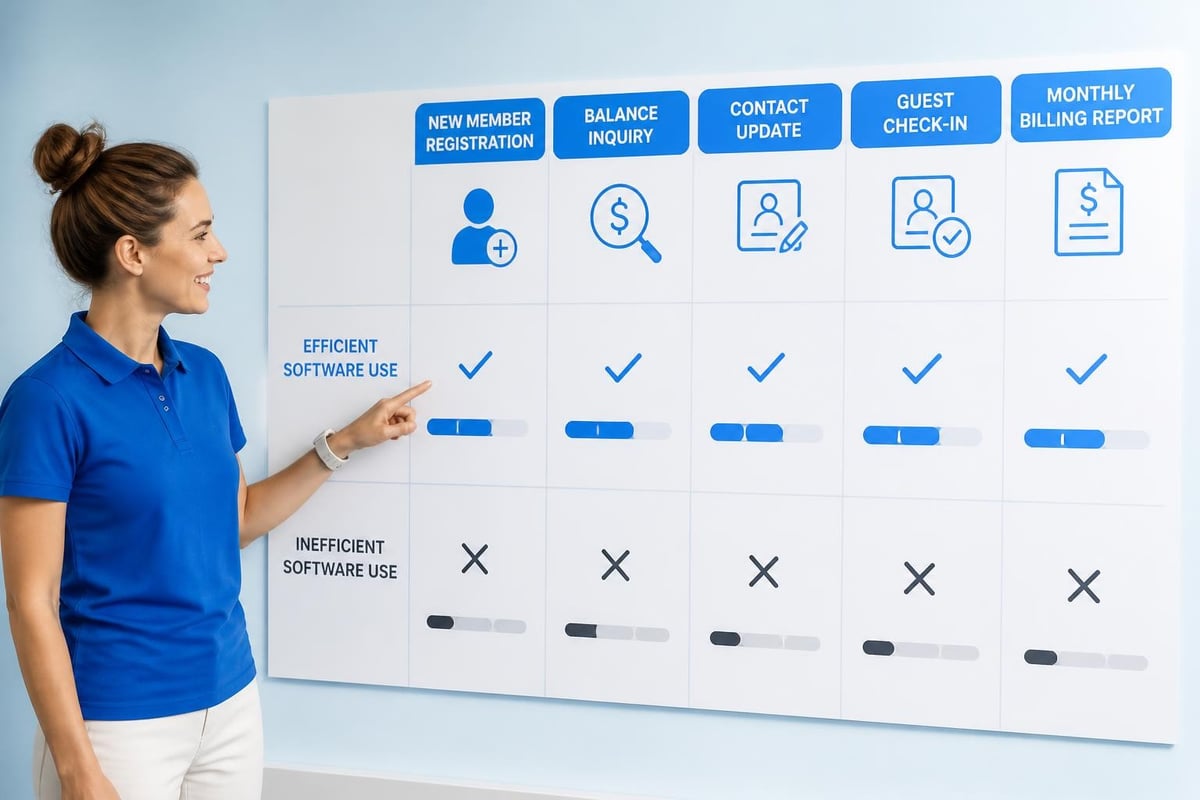
Test One: The New Member Scenario
Ask your front desk person to register a new family while you watch. Time how long it takes from the moment they sit down to the moment you hand them their access cards. Count how many screens they have to click through. Notice how many times they have to ask you a question or look something up.
If this takes more than three minutes, or if they need to ask for help, your software is costing you time every single day. Multiply that extra two or three minutes by every new registration this season. That's hours of wasted effort.
Test Two: The Balance Question
Have someone on your board call you and ask, "What's the Johnson family's current balance?" Time yourself finding the answer. A good system should let you pull this up in under thirty seconds. If you're navigating through multiple menus, running reports, or opening spreadsheets, you have a problem.
Test Three: The Quick Change
Try updating a member's email address and phone number. Then verify the change actually saved and will appear on future communications. If this simple task requires more than two clicks, or if you're not confident the change will stick, your software is fighting you instead of helping you.
What Modern Software Use Should Look Like
You know what good software feels like? It feels invisible. You don't think about the system because it just works. Your seasonal staff figure it out in ten minutes without reading a manual. Your treasurer gets the reports they need without calling you. Your members check in without waiting in line.
Modern swim club software use means:
-
One place for everything. Member profiles, billing, check-ins, communications, and reports all live in the same system. You're not juggling three different platforms or maintaining duplicate spreadsheets.
-
Information that updates automatically. When someone pays their balance, it shows up everywhere immediately. No more manual syncing or wondering which number is correct.
-
Reports that generate themselves. Your monthly board report should take two clicks, not two hours. Revenue tracking, attendance patterns, and membership trends should be available anytime you need them.
-
Smart automation that saves time. Renewal reminders, late fee notices, and seasonal communications should happen automatically based on rules you set once. Understanding how to run a swim club efficiently means letting software handle the repetitive work.
-
Mobile access that actually works. Your board members should be able to check numbers from their phone. Your front desk volunteers should be able to look up members on a tablet. The system should work wherever you are.
The W3C's Web Content Accessibility Guidelines set important standards for making software accessible, but for swim clubs, accessibility also means usability. Can your oldest board member and your youngest seasonal employee both use the system effectively? That's the real test.
The Hidden Patterns in Software Use
After working with dozens of clubs, I've noticed some clear patterns in how good software use differs from problematic software use. These patterns show up regardless of club size or budget.
| Efficient Software Use | Inefficient Software Use |
|---|---|
| Staff answer questions immediately | Staff say "let me check and get back to you" |
| Reports are ready before meetings | Reports are rushed or incomplete |
| Members rarely call about balances | Members frequently dispute charges |
| Renewals happen automatically | Renewals require manual follow-up |
| Check-in takes under 10 seconds | Check-in creates lines and complaints |
The difference isn't about training or effort. It's about whether the software is designed around how swim clubs actually work. Generic membership systems force you to adapt your processes to fit their structure. Purpose-built swim club software adapts to your needs instead.
When Software Use Creates New Problems
Here's a scenario I hear at least once a month: A club switches to a new system because the old one was terrible. Six months later, they're just as frustrated because the "new" system has different problems. They traded one set of headaches for another.
This happens because clubs focus on features instead of workflow. The sales demo looked great, but nobody tested whether the system actually makes daily tasks easier. The vendor promised "comprehensive member management" and "powerful reporting," but those phrases don't mean anything until you try to process twenty renewals on a Tuesday afternoon.
Common Software Use Mistakes
Before you blame your current system entirely, check whether you're making these common mistakes that multiply software problems:
- Using the system as a fancy spreadsheet instead of letting it automate your work
- Maintaining duplicate records in other systems "just in case"
- Ignoring features that could save you time because nobody showed you how to use them
- Accepting workarounds instead of asking whether the software should work differently
- Staying with inadequate software because switching sounds like too much work
Sometimes the problem isn't the software itself but how you're using it. Other times, the software genuinely can't do what you need. The trick is knowing the difference. That's where the swim club software migration checklist becomes valuable, helping you evaluate whether to improve your current setup or move to something better.
The Staff Training Reality
You can have the best software in the world, but if your staff doesn't know how to use it properly, you'll still have problems. This gets complicated for swim clubs because your workforce changes every season. Those college students working your front desk aren't going to spend two weeks learning a complex system. They need to be productive on day one.
Here's what effective software training looks like for swim clubs:
For Seasonal Staff
- Fifteen-minute orientation covering the three things they'll do most: check-ins, guest registration, and answering balance questions
- Cheat sheets posted at the desk with step-by-step instructions for common scenarios
- Confidence to say "let me find out" instead of guessing when something unusual comes up
- Access to help from someone who knows the system well
For Year-Round Staff
- Monthly updates on new features or process changes
- Quarterly review of reports and data to spot trends and problems
- Direct line to support when something doesn't work as expected
- Permission to suggest improvements based on what they're seeing every day
The Nielsen Norman Group's usability heuristics provide excellent guidelines for evaluating software interfaces. But for swim clubs, the real usability test is simpler: Can a new employee start helping members in fifteen minutes or less?
Security and Software Use
Let's talk about something most swim clubs don't think about until it's too late: security. Your software holds sensitive information about your members. Names, addresses, phone numbers, email addresses, payment information, and sometimes even social security numbers for background checks.
When you evaluate software use and effectiveness, security should be part of the conversation. Not in a paranoid way, but in a responsible way. You need to know:
- Where your data lives and who has access to it
- How payments are processed and whether payment information is stored securely
- What happens if the vendor gets hacked or goes out of business
- Who can see member information and whether you can control access levels
- How data is backed up and whether you can recover it if something goes wrong
The OWASP Top 10 project outlines critical application security risks that all software should address. When you're evaluating systems, asking vendors about their security practices isn't being difficult. It's being smart. Your members trust you with their information. Your board trusts you to protect the club. Make sure your software vendor takes that responsibility seriously.
The Documentation Nobody Reads
Every software system comes with documentation. User guides, help centers, video tutorials, knowledge bases. Most of it never gets read. Why? Because people don't want to read documentation. They want to get their work done.
Good software documentation, as outlined in the Write the Docs guide , should be clear, scannable, and task-focused. For swim clubs specifically, you need:
- Search that actually works so you can find answers fast
- Examples from real swim clubs instead of generic business scenarios
- Screenshots that match what you see on your screen right now
- Step-by-step instructions for the tasks you do every week
- Contact information for when documentation isn't enough
But here's the truth: if you're spending significant time in the documentation, the software probably isn't designed well enough. Intuitive systems don't require constant reference to a manual. You should be able to figure out most tasks through clear interface design and logical workflow.
Software Use and Revenue Recovery
One aspect of software use that doesn't get enough attention is how the right system can actually increase your revenue. Not through higher fees, but by capturing money you're already losing to inefficiency and oversight.
Think about these common revenue leaks:
- Members who should have renewed but slipped through the cracks
- Guest fees that weren't collected because check-in was rushed
- Late fees that were never applied consistently
- Facility rental bookings that were forgotten or double-booked
- Program registrations that didn't process because the system dropped them
Effective revenue recovery through better software use means building systems that catch these problems automatically. When a member's renewal is coming up, the system sends reminders. When a guest checks in, the system prompts for payment. When an account is past due, the system applies appropriate fees based on your rules.
This isn't about nickel-and-diming your members. It's about fair, consistent treatment and making sure your club captures the revenue it needs to operate. A good system pays for itself through revenue you would have otherwise lost.
Configurable vs. One-Size-Fits-All
Here's where most swim club software falls short: it assumes every club works the same way. But you and I both know that's not true. Your membership tiers are different. Your billing cycles are different. Your guest policies are different. Your seasonal schedule is different.
Generic software forces you to adapt your processes to fit their rigid structure. Maybe they only support monthly billing, but you bill quarterly. Maybe they can't handle family memberships with different renewal dates for different members. Maybe their guest check-in process doesn't match how your club actually works.
Configurable software adapts to your club instead. You set up membership types that match your tiers. You define billing rules that match your policies. You configure check-in workflows that match your front desk reality. The features that matter most are the ones you can customize to fit how you actually operate.

The Board Meeting Question
Your board asks you, "Is our software working well?" How do you answer that question honestly?
Start by measuring what matters:
| Metric | What Good Looks Like | What Problems Look Like |
|---|---|---|
| Check-in time | Under 10 seconds per member | Lines forming, complaints about waits |
| Registration completion | 95%+ finish without assistance | Frequent abandoned forms, calls for help |
| Billing accuracy | Rare disputes, clean reconciliation | Regular corrections, member confusion |
| Report generation | Minutes, whenever needed | Hours, only when forced |
| Staff questions | "How do I handle this special case?" | "How do I do this basic task?" |
| Member feedback | Rarely mention the system | Complaints about usability, errors |
When boards understand software through operational metrics rather than technical features, the conversation becomes more productive. You're not debating whether to buy "enterprise-grade cloud infrastructure." You're discussing whether members can check in smoothly and whether you have accurate financial data.
Research from the DORA Accelerate State of DevOps report shows that high-performing organizations measure software effectiveness through delivery metrics and user outcomes, not just feature lists. The same principle applies to swim clubs. Your software should make operations measurably better.
The Migration Fear Factor
Let's address the elephant in the room: switching software is scary. You're worried about losing data. You're worried about downtime. You're worried about the learning curve. You're worried about member complaints. These are all legitimate concerns.
But staying with inadequate software has costs too. Every hour you spend fighting your current system is an hour you're not spending on improving your club. Every revenue leak adds up. Every frustrated staff member or board member chips away at your effectiveness.
When you evaluate whether to switch, consider:
-
Data migration support. Can the new vendor import your existing member data, balances, and history? Will they handle the technical work, or are you on your own?
-
Transition timeline. Can you run both systems in parallel during the switch? Can you go live during your slowest season?
-
Training and onboarding. Does the vendor provide live training for your staff? Do they have documentation specific to migrating from your current system?
-
Cost comparison. Factor in both direct costs (subscription fees) and indirect costs (your time, staff frustration, lost revenue). A more expensive system that saves you ten hours a week is actually cheaper than a "cheap" system that wastes your time.
-
Trial period. Can you test the system with real data before fully committing? Can you see exactly how your daily workflows would work?
The migrate to PoolPulse process, for example, is designed around these concerns. Because vendors who understand swim club operations know that migration isn't just a technical challenge-it's a people and process challenge too.
AI and Modern Software Use
You've probably heard a lot about AI in software lately. Some of it's hype, some of it's genuinely useful. For swim clubs specifically, AI can help with:
- Answering routine questions about balances, schedules, and policies
- Identifying patterns in attendance, revenue, and member behavior
- Predicting renewal likelihood so you can reach out to at-risk members
- Automating routine tasks like categorizing transactions or flagging anomalies
- Generating insights from data you're already collecting
The key is understanding what AI should and shouldn't do. AI shouldn't replace human judgment about member relationships or policy exceptions. But AI can save you time on data analysis and help you spot problems before they become serious.
Transparency matters here. When you're using AI-powered features, you should understand how they work and what data they're using. Check whether vendors have clear AI transparency policies and give you control over how AI features are deployed.
Making the Software Use Decision
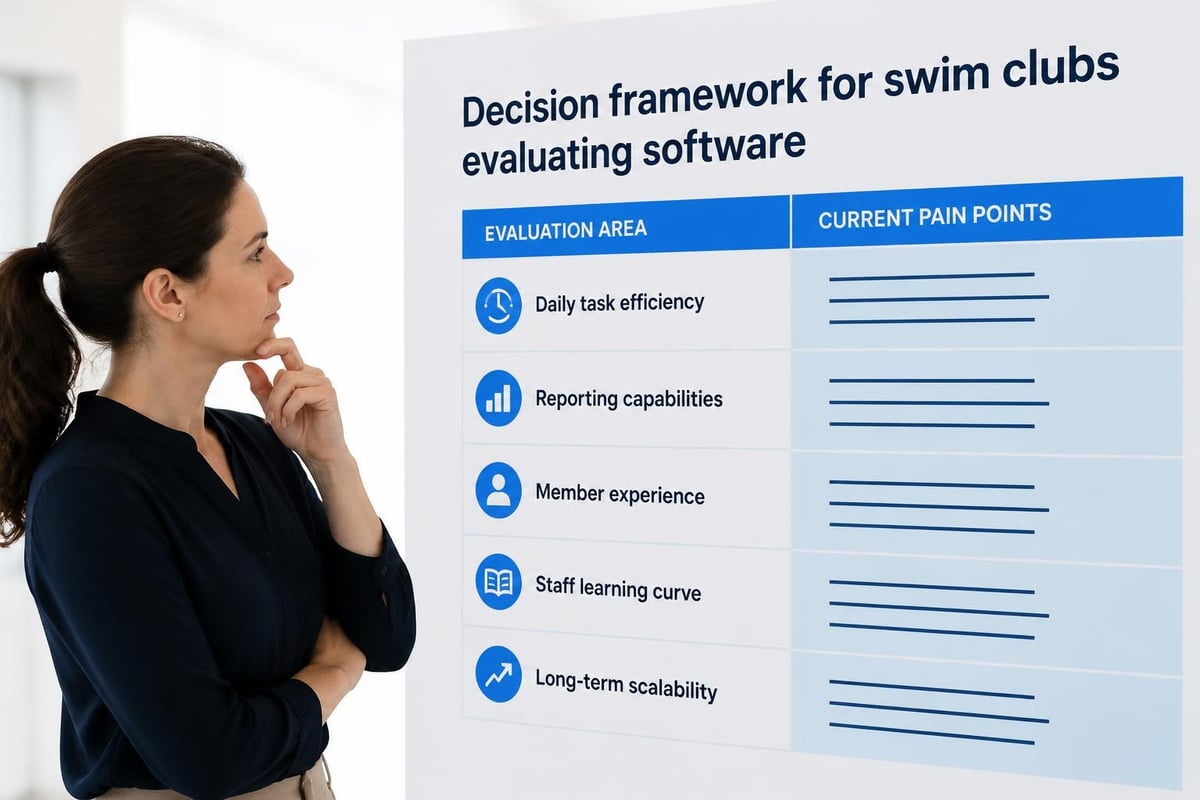
So where does this leave you? You've run the five-minute test. You've identified pain points in your current software use. You've thought about what good software should feel like for your club. Now what?
Start with honest assessment:
Questions to Ask Yourself
- If I could start over, would I choose this software again?
- How many hours per week do I spend working around software problems?
- How often do staff or board members complain about the system?
- What would I gain by switching versus staying?
- What's the actual cost of continuing with the current system?
Questions to Ask Vendors
- How quickly can a new seasonal employee learn to use this system?
- Can you show me how I would handle [specific scenario from your club]?
- What happens to my data if I ever need to leave?
- How do you handle support requests, and what's your typical response time?
- Can I talk to three current customers who run similar clubs?
Don't accept generic answers. Push for specifics. Ask to see the actual interface, not just slides. Request a trial with your real data if possible.
The pricing conversation should come after you understand value, not before. A system that costs twice as much but saves you ten hours a week and captures $5,000 in lost revenue per year is a bargain. A cheap system that frustrates everyone and leaks money is expensive at any price.
The Support System Behind the Software
One last thing that separates good software from great software: what happens when something goes wrong. Because something will eventually go wrong. A payment won't process. A report won't generate. A feature won't work as expected. When that happens, how quickly can you get help?
Evaluate vendor support before you need it:
- Response times: Do they commit to specific response times in a service level agreement ?
- Support channels: Can you call, email, or chat? Is support available when you're actually working?
- Knowledge and expertise: Does the support team understand swim club operations, or are they reading from generic scripts?
- Proactive communication: Does the vendor notify you about issues before you discover them?
- Community: Can you connect with other clubs using the same software to share tips and solutions?
Following Microsoft's technical documentation style guide principles, good software companies write clear, helpful support content. But great software companies go further by providing personalized assistance when you need it.
Long-Term Software Use Strategy
Think beyond next season. Where will your club be in three years? Five years? Will your software grow with you, or will you outgrow it and face another painful transition?
Consider future scenarios:
- What if you add a new facility or amenity?
- What if membership doubles?
- What if you add new program offerings?
- What if board leadership changes and new people need to learn the system?
- What if technology standards change and your software becomes obsolete?
Software vendors should have a clear roadmap for future development. They should release regular updates that improve the system based on customer feedback. Check the releases or update history to see whether the vendor is actively improving the product or just maintaining the status quo.
Systems built on modern, maintainable technology platforms are more likely to evolve with your needs. Systems built on outdated technology will eventually force another migration. Ask vendors about their technical foundation, even if you don't understand all the details. Their willingness to explain and their confidence in their platform tell you a lot.
Measuring Software Success
Six months after you implement new software (or recommit to using your current software better), how will you know if things improved? Set clear metrics before you make changes:
Operational metrics:
- Average check-in time
- Registration completion rate
- Hours per week spent on software tasks
- Number of billing disputes or corrections
- Time to generate monthly reports
Financial metrics:
- Revenue captured vs. revenue lost to oversights
- Cost per transaction
- Total software cost vs. time saved
- Member acquisition cost
- Renewal rate
Satisfaction metrics:
- Staff confidence using the system
- Board satisfaction with reporting
- Member complaints related to system issues
- Volunteer willingness to handle front desk duties
Track these before and after any software changes. Real improvement shows up in measurable results, not just feelings. The Harvard Business Review's research on measuring software value emphasizes connecting software use to business outcomes. For swim clubs, that means operational efficiency, revenue optimization, and member satisfaction.
Better software use starts with honest assessment of what's working and what's not. Run the five-minute test. Ask hard questions about your current system. Consider whether better tools would make your daily work easier and your club more successful. PoolPulse brings modern, AI-powered swim club management to clubs tired of fighting inadequate software, with configurable workflows designed around how you actually operate. If you're ready to stop working around your software and start working with it, take a closer look at what purpose-built club administration can do for your team.

The Seven Signs You've Outgrown Your Club Operations
Your swim club is growing, but your tools aren't keeping up. These seven warning signs reveal when manual processes cost more than solutions.

How to Answer Every Board Question in Under Two Minutes
Your swim club board asks tough questions. Learn how management reporting software helps you pull accurate answers in seconds, not hours.

The Saturday Morning Front Desk Test for Self Check Ins
Self check ins at your swim club save hours every Saturday and reduce errors. Test your setup, avoid common mistakes, and improve member flow.
Want to see if PoolPulse is a good fit for your club?
Book a walkthrough and we'll show you exactly how PoolPulse can help based on your club's needs, goals, and current processes.