

Top Tips for Managing Swim Club Payroll and Staffing
How swim clubs reduce payroll cleanup and scheduling confusion — covering shift coverage, time-sheet accuracy, and smarter staffing workflows.


Swim club payroll problems rarely start in payroll.
They usually start earlier, inside scheduling, shift changes, unclear ownership, and front-line workarounds that feel harmless in the moment.
One guard stays ten minutes late. A snack bar shift gets covered informally. Someone clocks time on paper because the club is busy. By the end of the pay period, the treasurer is trying to turn those small inconsistencies into something accurate enough to pay people confidently.
That is why the best payroll process starts with staffing discipline, not just a better export.
Start with the workflows that create payroll mess
Before you evaluate any tooling or process change, identify where payroll confusion enters the system today.
For many clubs, it shows up in a few predictable places:
- schedule changes shared over text but not updated centrally
- manual time corrections after the fact
- unclear approval for shift swaps
- lifeguard, snack bar, and front-desk roles tracked in different places
- supervisors discovering coverage gaps only after the shift starts
If those issues are still happening, payroll will always feel more manual than it should.
1. Build schedules around actual demand, not habit
Many clubs reuse the same weekly staffing template because it feels safe. But demand changes:
- weather shifts attendance patterns
- lesson blocks create rush windows
- guest traffic changes on event weekends
- snack bar demand does not always match pool traffic evenly
When staffing plans do not adapt, clubs end up paying for quiet windows and scrambling during the busy ones.
The goal is not to optimize every minute. It is to make sure your staffing plan reflects the club you are operating now, not the one you planned for three weeks ago.
2. Keep one source of truth for shifts
This is one of the simplest rules and one of the hardest to enforce.
If schedules live in one place, shift swaps in another, and clocked time somewhere else, no one feels fully responsible for accuracy.
A cleaner system should answer:
- who was scheduled
- who actually worked
- who approved any change
- whether the role or location changed
That matters for payroll, but it also matters for accountability and safety. Clubs should not be reconstructing staffing history from screenshots and memory.
3. Decide how shift changes get approved before they happen
Shift changes are not the problem. Unclear shift changes are the problem.
Set a simple rule for:
- who can offer a shift
- who can accept it
- who must approve it
- where that approval gets recorded
This protects the club in two ways:
- Staff know what counts as a real coverage change.
- Payroll is not forced to guess whether an exception was legitimate.
If the club relies on volunteers or seasonal supervisors, this rule matters even more.
4. Make clock-in expectations obvious
Staff usually do not create timekeeping mess because they are careless. They create it because the rules are fuzzy.
Be explicit about:
- when a shift officially starts
- what happens if someone arrives early
- whether prep time counts
- how breaks should be handled
- who can edit or correct time after the fact
The cleaner these expectations are, the fewer special cases payroll has to untangle later.
5. Separate exceptions from the normal workflow
Every club has edge cases:
- an employee covered two roles in one day
- a manager approved emergency overtime
- weather forced a late close
- the snack bar had an unusual event rush
Those situations are normal. The key is to record them as exceptions, not let them blur into the default staffing process.
When exceptions are visible, they can be reviewed quickly. When they are hidden inside hand-edited time sheets, they create distrust.
6. Review overtime, missed coverage, and edits weekly
Do not wait until payroll closes to see whether staffing drifted.
A short weekly review should highlight:
- open or hard-to-fill shifts
- last-minute coverage patterns
- time edits and why they happened
- overtime or near-overtime trends
- roles that are consistently overstaffed or understaffed
This helps the club solve the root issue instead of treating payroll cleanup as the job.
7. Connect staffing to the rest of the operation
Payroll gets easier when scheduling is not isolated from what the club is actually doing.
For example:
- lesson schedules affect pool deck coverage
- check-in traffic affects front-desk demand
- snack bar rushes affect concession staffing
- underused hours may justify lighter staffing or targeted promotions
When these signals live in separate systems, clubs staff by feel. When they are connected, clubs staff with context.
That context is often what prevents waste without hurting service quality.
8. Give supervisors a lightweight review checklist
Most payroll mistakes can be caught before the pay period closes if supervisors look for the right things.
A simple review checklist can include:
- Are all scheduled shifts accounted for?
- Were any swaps approved and documented?
- Do time edits have a clear reason?
- Did anyone work outside the expected role or location?
- Are overtime hours expected or accidental?
This keeps the review fast and makes it easier for a treasurer or operations lead to trust the final numbers.
9. Use payroll exports as confirmation, not reconstruction
Your payroll export should be the last step, not the first time the club assembles what happened.
By the time you export payroll, the club should already understand:
- which shifts were worked
- which exceptions were approved
- where the costs drifted
- which staffing patterns need adjustment next week
If the export is doing all the detective work, the upstream workflow is still too loose.
10. Measure success in fewer surprises, not just faster processing
The best staffing and payroll system does more than save admin time.
It should create:
- fewer disputes about hours worked
- fewer emergency coverage scrambles
- cleaner supervisor handoff
- better visibility into where staffing is helping or hurting the operation
That is what boards and operators actually feel week to week.
A simple staffing and payroll operating rhythm
If you want the lightweight version, run this every week:
- Publish one shared schedule source of truth.
- Record shift changes in that same workflow.
- Review time edits and exceptions before payroll closes.
- Check overtime, missed coverage, and recurring rush windows.
- Adjust next week's staffing based on real demand, not habit.
This is enough to reduce a surprising amount of cleanup.
Where PoolPulse fits
PoolPulse treats staffing and payroll as part of club operations, not as an isolated back-office task. That matters because schedules become more useful when they are informed by:
- programs and lessons
- check-in traffic
- underused hours
- POS demand
- manager follow-up
If that is the direction your club wants to go, start with Staff Scheduling & Payroll. If you want to see how better staffing discipline fits into the broader economics, use Does It Pay Off? or review Pricing to see where the feature sits in the platform.
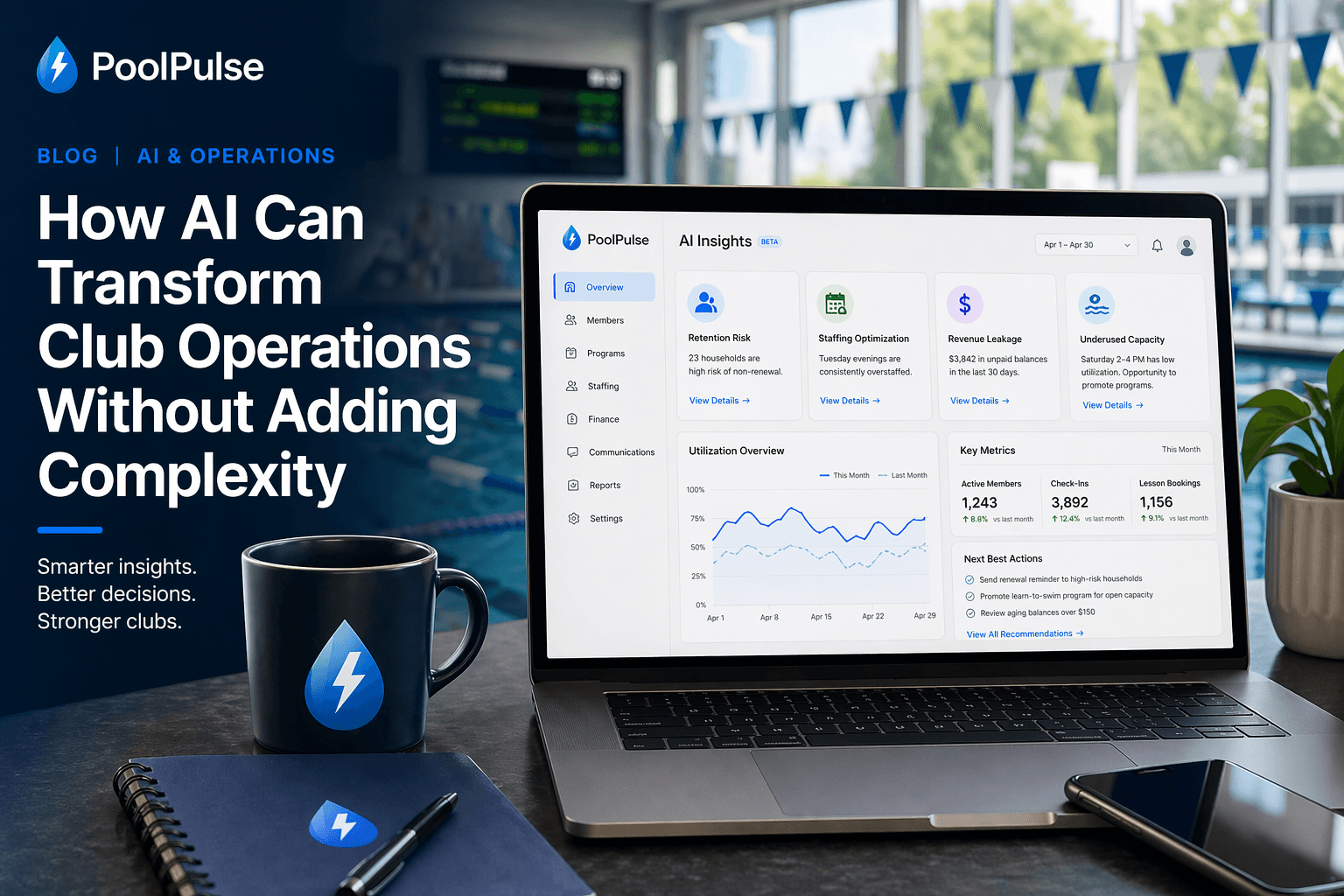
How AI Can Transform Club Operations Without Adding Complexity
How swim clubs use AI signals for staffing gaps, retention risk, and revenue leakage — without creating another dashboard to manage.

Five Front-Desk Tasks Your Swim POS Should Handle
Your front desk shouldn't need three systems to check in a swimmer. Here's how modern swim POS systems save time and reduce errors.

When Your Check-In Line Proves Software Is Too Slow
Discover how software timing affects your swim club's daily operations, from check-ins to billing, and why faster response times mean happier members.
Want to see if PoolPulse is a good fit for your club?
Book a walkthrough and we'll show you exactly how PoolPulse can help based on your club's needs, goals, and current processes.