

Before You Approve Your 2027 Club Budget, Count the Work Between Your Systems
A practical way to expose the software, labor, handoff, and transition costs that ordinary budget lines miss.


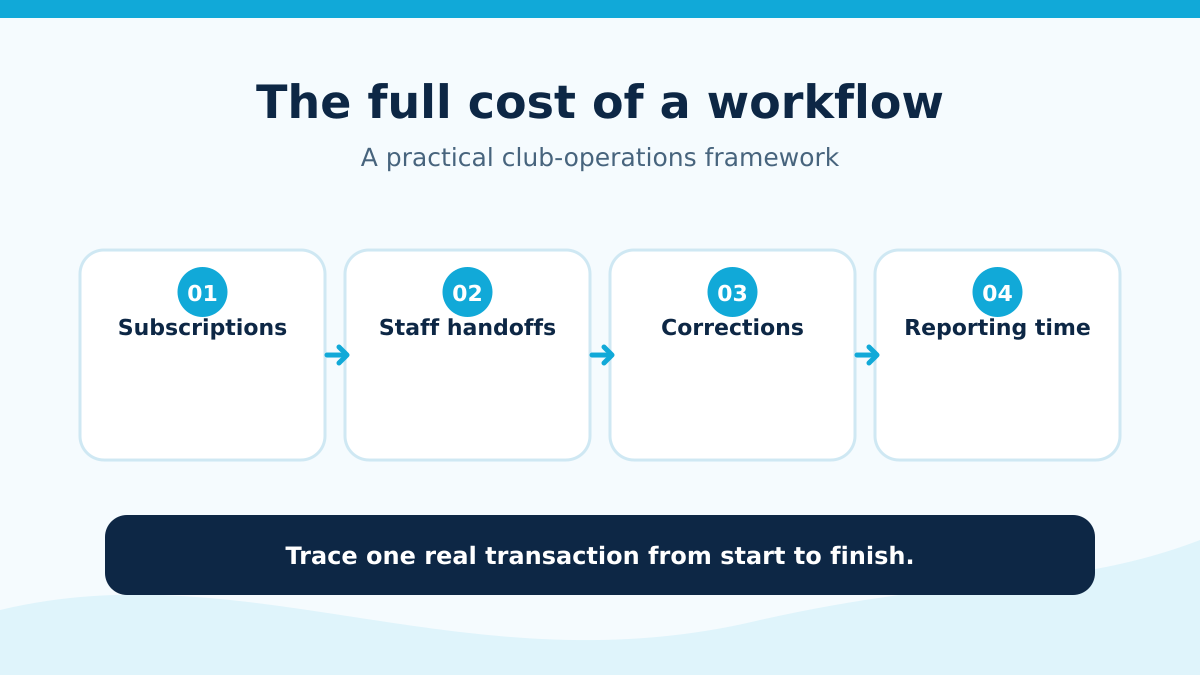
A club budget can list every subscription and still miss the work that holds the operation together. Someone copies a payment into a spreadsheet, confirms membership status before approving a booking, answers a balance question from three sources, or rebuilds a board report after closing. Those minutes rarely appear beside the software line, yet they shape what the system really costs.
The practical answer is to budget the workflow, not just the vendors. Follow a few ordinary jobs from beginning to end, record the systems and people involved, and price the transition period separately from the steady state. That gives the board a comparison grounded in the club’s own volume and calendar instead of a feature list or a hopeful savings claim.
Use this checklist before approving a 2027 technology budget. It will not produce one universal number; every club has different contracts, staffing, payment volume, and volunteer capacity. It will produce something more useful: a visible set of assumptions that the manager, treasurer, and board can challenge together.
Build the decision around the club’s real work
The strongest plan starts with one ordinary transaction, the people who touch it, the rules they apply, and the record that should remain when the work is done. Use the sections below as a working session with the employees and volunteers who run the process. Write down assumptions, unresolved questions, and owners as you go.
1. Start with three ordinary transactions
A broad inventory quickly becomes abstract. Choose three transactions that happen often enough to matter: a household renews, a payment posts, and a member checks in or books a space. The value comes from following actual steps rather than asking staff which software they use.
Write the trigger, every handoff, every place data is re-entered, the final record, and the person who answers when something does not match. Include email and private spreadsheets if they are part of the real process.
Questions to answer:
- What starts the transaction?
- Where is information copied?
- Who resolves an exception?
- Which record is final?
- Who can explain the result?
The map becomes a neutral baseline. It shows where labor sits today and gives every proposed option the same job to demonstrate.
2. Separate cash cost from workload
Subscription prices, processing fees, devices, support, and occasional contractor work belong in the cash-cost column. Staff and volunteer effort belongs in a separate workload column. Combining them too early can turn a planning estimate into a misleading promise of savings.
Measure representative weeks, including one busy period. Record time spent entering, checking, correcting, explaining, and reporting. Apply the club’s own finance method if leadership wants a dollar estimate, while preserving the underlying hours for transparency.
Questions to answer:
- Which costs recur?
- Which costs are seasonal?
- What work is paid labor?
- What work depends on volunteers?
- What estimate needs validation?
The board can see whether a proposed change reduces expense, reduces workload, improves control, or does some combination of the three.
3. Expose the cost of exceptions
Routine work is usually easy to demonstrate. Budgets become more accurate when the club also examines a failed payment, a midseason change, a disputed charge, a duplicate record, and a member whose status is unclear. Those moments create the handoffs that teams remember after launch.
For each exception, record the authorized decision, the correction path, the member communication, and the audit trail. Ask whether the club must rebuild context across systems or whether the relevant history stays with the account.
Questions to answer:
- What commonly goes wrong?
- Who can approve a correction?
- How is the member informed?
- Can the change be traced?
- Does finance see the same outcome?
Exception handling becomes a defined operating requirement instead of an invisible cushion in the staffing plan.
4. Budget the transition as its own phase
The first year may include overlapping contracts, data preparation, training, hardware, configuration, and extra staff time for acceptance checks. Treating all of that as steady-state operating cost distorts the comparison; ignoring it creates an avoidable surprise.
Create a transition row for every option. Show when existing contracts can end, who prepares records, which workflows must be tested, when staff can train, and what support is included. Use the club calendar to protect renewals, registration, and opening day.
Questions to answer:
- When can contracts end?
- Who prepares the data?
- What must be tested?
- When can staff train?
- What overlap is unavoidable?
Leadership sees the temporary investment and can decide whether the timing is realistic before it approves the destination.
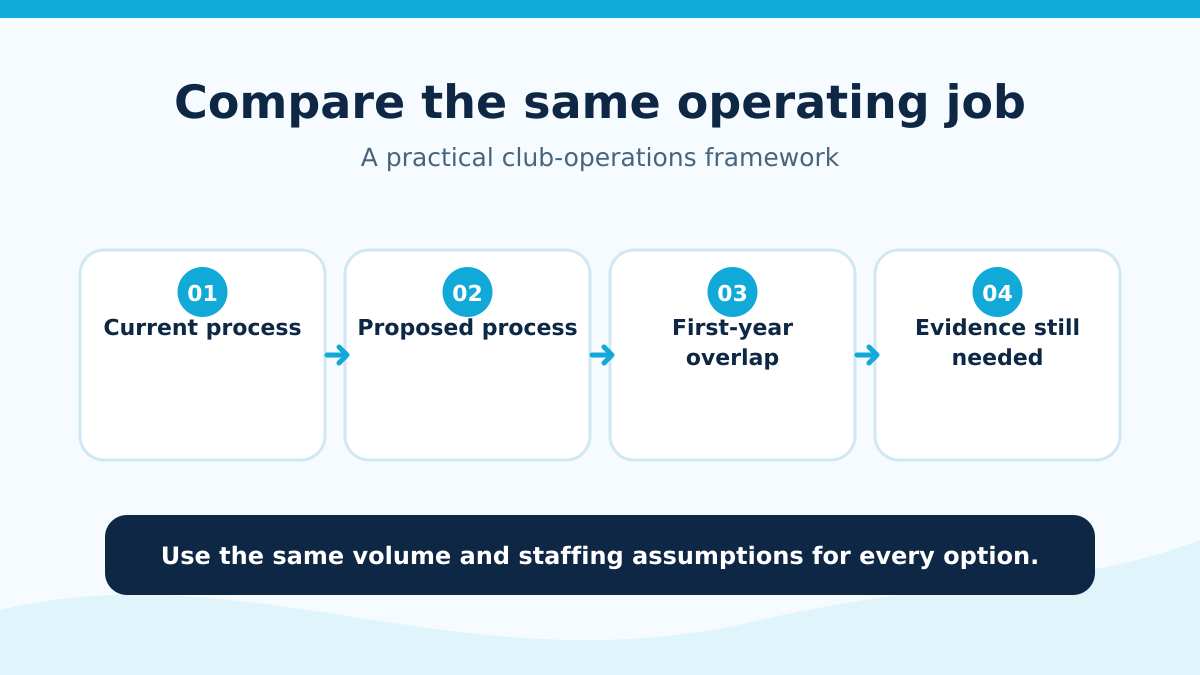
5. Use the same assumptions for every option
A low headline price can look better when important modules, devices, implementation work, or processing assumptions are omitted. An expansive proposal can look better when its benefits are counted but adoption is assumed. A fair comparison holds volume and scope constant.
Build one worksheet with the same household count, transaction mix, locations, staff roles, integrations, and target launch date. Mark every unknown. Do not replace an unknown with zero or with a confident estimate supplied without supporting detail.
Questions to answer:
- What volume is shared?
- Which modules are included?
- What hardware is required?
- Which integrations are confirmed?
- Which number is still unknown?
The comparison becomes explainable. A board member can see why totals differ and which question would materially change the decision.
6. Demand evidence for the workflow change
A proposal should identify the specific steps it changes. “More efficient” is not enough. Ask the vendor to show the renewal, payment, check-in, correction, and report using sample data that reflects the club’s rules.
Record what was demonstrated, what requires configuration, what depends on another service, and what remains unanswered. PoolPulse connects memberships, billing, renewals, check-ins, reservations, POS, staffing, reporting, and member self-service in one operating environment; test the particular workflow your club needs in a tailored walkthrough.
Questions to answer:
- What step disappears?
- What step becomes automatic?
- What still needs a person?
- What was shown live?
- What depends on setup?
The budget ties expected value to observable work rather than to a long list of capabilities.
7. Turn the worksheet into a decision
The board does not need every screenshot and note in the main packet. It needs the problem, current cost and workload, proposed change, first-year impact, steady-state impact, key risks, evidence, and the next decision. Keep the detailed workbook available for review.
State what approval authorizes and what it does not. A budget approval may authorize contracting, or it may only authorize final due diligence. Name the owner and date for the next gate so the project does not drift between meetings.
Questions to answer:
- What is being approved?
- What remains conditional?
- Who owns the next gate?
- When will evidence be reviewed?
- How will success be checked?
The final vote carries a clear scope, a visible basis, and a next step that staff can act on.
Follow one realistic club example
A seasonal club discovers that its membership system, payment service, and gate list each look inexpensive on their own. Mapping a renewal shows four staff handoffs and a weekly reconciliation. The proposed platform costs more than any single current tool, but the board can now compare the combined subscriptions, measured workload, transition overlap, and the exact renewal-to-check-in flow. The decision changes from “Which price is lower?” to “Which complete operating model do we want to fund, and what must be proven before we commit?”
Use the example as a rehearsal, not as a promised result. Replace its assumptions with your club’s approved rules, actual volumes, responsible people, and operating calendar. The goal is to make the next decision observable: another staff member should be able to tell what happened, why it happened, and what must happen next.
A practical readiness checklist
- Name the three workflows being compared.
- Confirm current contract dates and cancellation terms.
- Record transaction volumes and busy periods.
- Measure re-entry, correction, explanation, and reporting time.
- Separate payroll effort from volunteer effort.
- List first-year overlap, training, hardware, and data work.
- Use identical scope assumptions for every option.
- Mark unknowns instead of filling them with zeros.
- Require a demonstrated exception path, not only the happy path.
- Write the approval, owner, date, and success check.
Keep a decision ledger beside the working plan
A checklist shows whether a task is complete; a decision ledger shows why the club chose the rule behind it. For each material choice, record the question, the approved answer, the approving role, the effective date, the source document or meeting, and any condition that would require another review. Keep the language brief enough that the people operating the process can use it.
The ledger is especially useful when reasonable people remember the discussion differently. It prevents a draft suggestion, an old exception, or a vendor demonstration from quietly becoming policy. If no authorized decision exists, mark the item open and name the person responsible for bringing it to the correct group. “Open” is a useful status; it is better than a confident answer nobody actually approved.
Include the decisions that feel obvious today. Staff changes, board turnover, and the pressure of a busy season can make an unwritten assumption expensive to reconstruct. A new employee should be able to see which rule applies, when it began, and where to ask for a change. Archive superseded versions instead of deleting them so the club can explain historical records under the policy that existed at the time.
Review the ledger from the perspective of club managers, treasurers, and board finance committees. The operational owner should confirm that the answer can be carried out. Finance should confirm how money or reporting is affected when relevant. The member-facing owner should confirm that the explanation is understandable. A short cross-role review often exposes a gap that a longer single-department meeting misses.
Rehearse the handoff, not just the happy path
Choose one ordinary case and one difficult case, then let the people who will run the process complete it from beginning to end. Give them the approved rule and sample information, but do not coach every click or conversation. Watch where they pause, switch tools, ask for permission, or create a side note. Those pauses reveal where the operating design still depends on memory.
For the difficult case, change one condition that matters: a deadline has passed, a balance conflicts, an eligible person becomes ineligible, a staff member lacks access, or the expected record cannot be found. The purpose is not to surprise employees. It is to confirm that the process provides a safe next step when the routine path stops. Staff should know what they may decide, what they must escalate, and how to leave a useful record for the next person.
Ask another employee to pick up the saved result without hearing the rehearsal conversation. Can they identify the current state, the last decision, the responsible owner, and the next date? If they must call the original employee to understand the record, improve the labels, notes, ownership, or workflow before launch. A handoff is successful when context survives the shift change.
Repeat the rehearsal after a material correction. Testing the edited version matters because a fix in one place can create inconsistency somewhere else. Re-read the member message, account or work record, report, and staff instruction together. The club is ready when the same approved answer remains visible across the complete journey.
Measure the first cycle without inventing a success story
Decide in advance what the club will observe during the first cycle. Useful measures may include incomplete cases, unresolved exceptions, repeat contacts, manual corrections, processing time, or the number of records waiting for an owner. Choose only measures that the club can define and collect consistently. A small trustworthy set is more useful than a dashboard filled with ambiguous counts.
Pair counts with a review of the underlying cases. A rise in questions may mean the message is unclear, the policy is new, or members are paying closer attention; the number alone does not identify the cause. Read representative records, talk with the employees doing the work, and separate a policy gap from a training need, a data problem, and a product defect before choosing a response.
Set a review date and an owner for each measure. During the review, keep completed changes separate from recommendations. Record what evidence supports the conclusion, what remains uncertain, and whether the next step requires management or board approval. Do not claim saved money, retained members, or better performance unless the club has a sound baseline and a method that supports that conclusion.
The most useful outcome of the first cycle may be a narrower rule, a clearer message, or a better exception route. Treat those corrections as part of operating the process, not as evidence the plan failed. A practical system makes learning visible and controlled while preserving the decisions that still apply.
Connect the decision to one operating record
PoolPulse connects memberships, billing, renewals, check-ins, reservations, POS, staffing, reporting, and member self-service in one operating environment. Explore the relevant PoolPulse workflow .
A connected platform does not remove the need for policy, ownership, or judgment. It should make the approved rule easier to execute, keep the result beside the member or operating record, and give the next authorized person enough context to act. Ask to see the complete journey—including an exception—using sample information that matches the club’s real process.
For a related operating exercise, use the club data export checklist .
Choose the next step
Assign one person to complete the checklist, one person to review it from another role, and one date for the next decision. Keep unknowns visible. If a material question remains unanswered, make resolving it the next gate instead of treating silence as approval.
Bring one mapped workflow and your budget assumptions to a personalized PoolPulse walkthrough. Schedule a personalized PoolPulse walkthrough . You can also review current PoolPulse pricing before the conversation.

Before You Sell Guest Passes for 2027, Decide What They Actually Allow
Build a club guest pass policy staff can apply consistently, covering sponsors, limits, payment, exceptions, records, and opening-day testing.

The Repair Was Reported. Who Checked That It Was Finished?
Make repair handoffs clear with named owners, agreed completion evidence, recorded verification, and useful staff instructions.

Before Renewal Opens, Explain Every Household Credit
Prepare for renewal by tracing household credits to their source, checking remaining value, and recording approved actions.
Want to see if PoolPulse is a good fit for your club?
Book a walkthrough and we'll show you exactly how PoolPulse can help based on your club's needs, goals, and current processes.