

Before Renewal Opens, Explain Every Household Credit
Prepare for renewal by tracing household credits to their source, checking remaining value, and recording approved actions.


Renewal opens next week, and a family asks whether last summer's credit will be used. The balance is visible, but the reason is not. Nobody can tell whether it came from a cancelled lesson, a duplicate payment, or an adjustment that still needs approval.
Do not begin by clearing balances to make a report look tidy. Begin by understanding them. A credit review is a record-and-decision process; any accounting, refund, expiry, or legal treatment belongs with the people responsible for those policies at your club.
Before the review meeting, choose one ordinary household example and write down the questions another reviewer would need answered. Include the original reference, the remaining amount, the permitted next action, and the person who can approve an exception. Ask a colleague who did not create the record to follow it. If they cannot explain the position without extra messages, improve the record before copying that approach across the remaining accounts. This small handoff check keeps the review focused on a usable answer rather than a completed column in a spreadsheet.
Start with a dated review list
Choose a review date and obtain the account information the authorized finance person needs. Record the scope, including whether the list includes inactive households, programme-only accounts, and other groups that may still hold a balance. Keep the original report so later changes can be explained.
Assign one person to coordinate the review. They do not have to decide every case, but they should know which cases are open and who is responsible for each. Give the desk a route for questions rather than asking employees to interpret old account notes themselves.
Keep the working list restricted to the staff who need it. Use household references and links to the authorized account record where possible. A board summary can report counts, amounts, and decisions needed without circulating every family's transaction history.
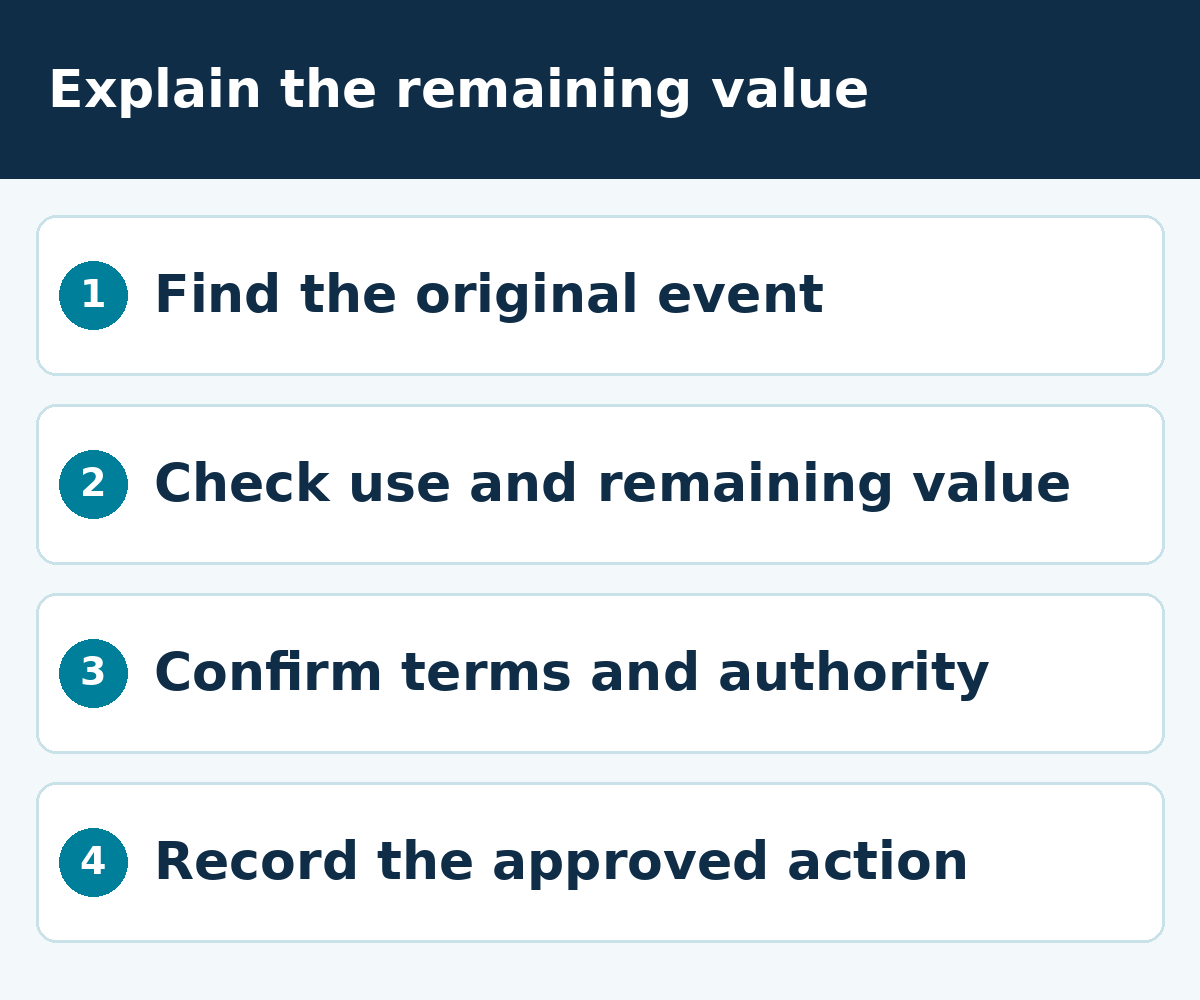
Find the event that created the credit
For each item, locate the original charge, payment, cancellation, or correction. Record a reference that connects the credit to that event. If there is an approval note or relevant membership term, link it too. The next reviewer should be able to retrace the explanation.
Separate the reason from the current amount. A credit may have been partly used after it was created. Check the subsequent activity before telling a family that the original amount remains available. Likewise, a note about a promised adjustment does not establish that the adjustment was actually entered.
If the origin is unclear, mark the case for investigation and name the missing information. Avoid inventing a category because “lesson credit” seems likely. Ask the person who can check the source record, and keep the account question open until the explanation is supported.
Keep unlike balances apart
Use practical review groups that match your club's records. A cancelled-program credit, an overpayment, a promotional adjustment, and prepaid spending value may follow different terms and approval routes. Do not combine them into a single “money owed to members” decision without reviewing what each represents.
Check whether the platform keeps these values in different places. A household ledger credit and a snack-bar prepaid balance should not be assumed to be interchangeable. Ask the administrator to show where each appears and which actions the current configuration permits before preparing renewal instructions.
Review the terms before choosing the action
Find the terms that applied when the credit arose, along with any later authorized agreement. Ask the responsible manager or finance lead to resolve uncertainty. Do not assume every credit expires at season end, automatically carries into dues, or can be transferred to another household.
If the club's records contain conflicting explanations, pause the adjustment and get a decision. Keep the conflict specific: which document says what, which family communication has already been sent, and what action is proposed. That gives the reviewer something concrete to resolve.
Record the approved result in plain language. For example, “Apply the remaining program credit to the next eligible program booking under the recorded terms.” Include the reference and approver where required. A vague “okay to use” note leaves the next employee with the same question in a different form.
Check the household before applying value
Confirm that the credit belongs to the account receiving the adjustment. Similar names, shared contact details, and changed household arrangements deserve a careful review. Use the platform's stable references rather than relying only on the name displayed in an email.
If the family has changed its membership arrangement, follow the club's approved process for any transfer or account change. Keep sensitive personal circumstances out of general notes. Staff need the authorized instruction and enough context to carry it out, not a detailed family history.
Check for pending actions too. Another employee may already be processing a refund, a correction, or a payment dispute. Coordinate those cases through the responsible finance person so two well-intentioned employees do not act on the same value independently.
Work through one account before a batch
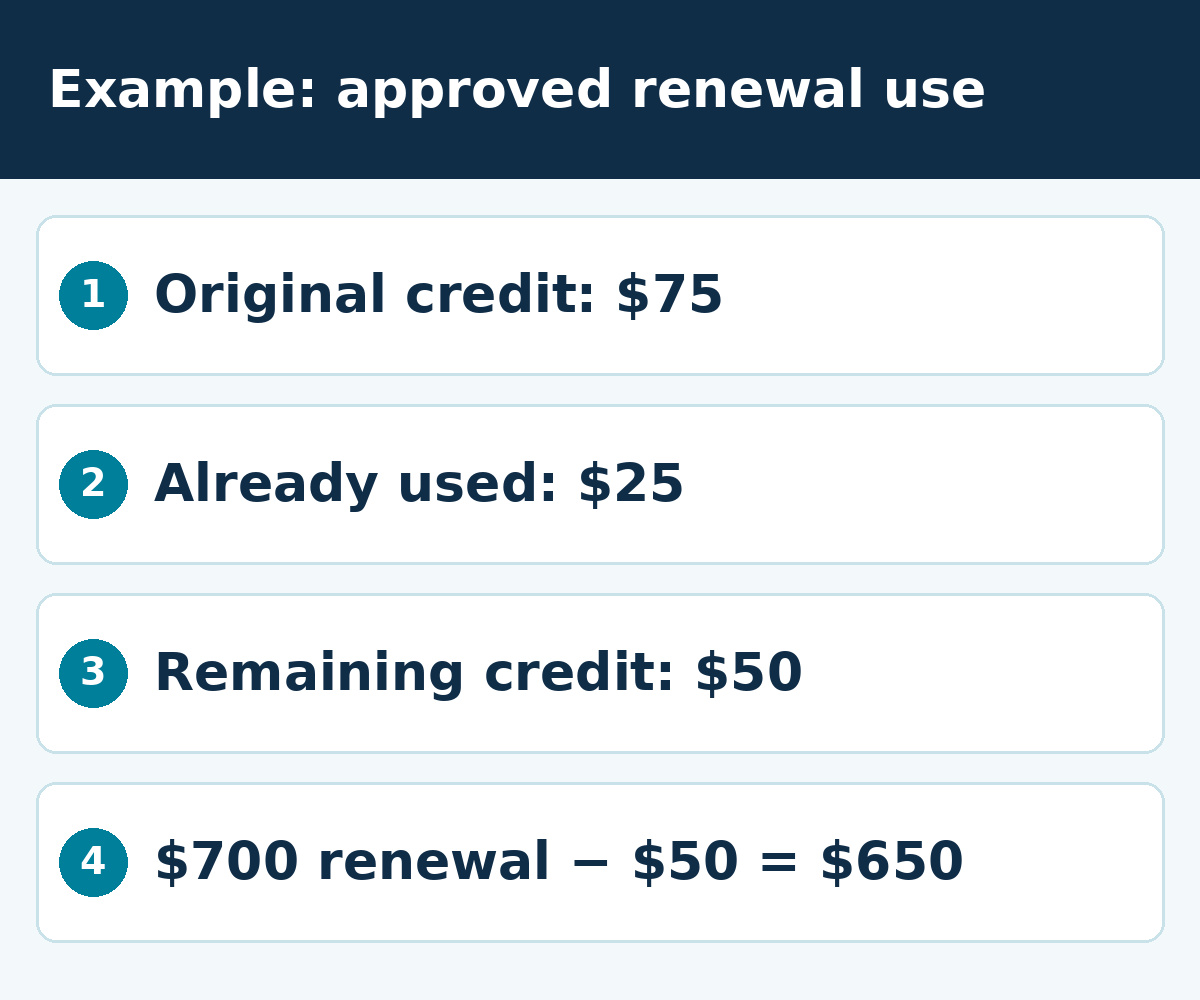
Consider a household with a $75 program credit. It has already used $25 on an eligible booking, leaving $50. The next membership charge is $700. If the club's terms and authorized decision allow the remaining credit to apply to that charge, the resulting amount to collect in this example is $650.
The review must establish each part: the original $75, the $25 already used, the remaining $50, the eligible $700 charge, and the approval to connect them. A correct subtraction does not replace those checks. Keep the supporting references beside the account action.
Now change the terms so the credit can be used only for programs. The arithmetic has not changed, but the approved action has. Staff should not apply it to dues merely because it would produce a plausible total. Route the household's question to the person who can explain the available options.
Use this sample in a staff walkthrough. Ask the reviewer to find the balance and explain why the proposed action is allowed. Then ask the desk employee to describe the result to a family without using internal accounting shorthand. Both parts need to make sense.
Send a statement people can follow
When a credit is used, describe the original reason, the amount applied, the charge it affected, and the remaining position. Use the member-facing record as the basis for the message. Avoid sending a total that differs from the account view the family is about to open.
For example: “Your account had $50 remaining from the approved lesson adjustment. We applied that amount to the eligible charge shown on this statement. The statement now shows $650 to pay.” Use the actual terms and amounts for the household, and provide a contact for questions.
If the case is still under review, say what is pending and who will follow up. Do not promise that a credit will settle a charge until the decision and account action are confirmed. Set a realistic response date and keep it on the review list.
Use a second check where it matters
Agree which cases need another authorized person to review them before processing. Your club may choose to focus on unusual amounts, unclear origin, cross-household transfers, or exceptions to ordinary terms. Set that approach with the responsible finance and governance team rather than inventing a threshold during the review.
Give the second reviewer the original reference, current balance, proposed action, and approval basis. They should be able to check the decision without reconstructing every email. Record the result in the same place the person processing the adjustment will use.
For routine cases, keep the process proportionate. A straightforward, well-documented credit should not require an endless chain of informal approvals. The aim is clear authority and a traceable action, with extra attention directed to the cases that need it.
Reconcile the completed actions
After processing, compare the review list with the saved account records. Confirm the amount used, returned, retained, or still awaiting a decision according to the club's approved process. Check that each original item has one clear outcome and that no action was applied twice.
Keep the amount reviewed separate from the amount adjusted. Some credits may remain unchanged after review. That can be a valid result when the terms and next action are clear. Do not report all reviewed value as recovered revenue or savings; describe what the club actually did.
Ask the finance lead how the operational review should be reflected in the club's accounting records. Provide the transaction references and decision notes they need. The operational team should not improvise financial classification simply to finish the checklist.
Deal with unreachable and inactive households deliberately
An inactive membership does not explain what should happen to a remaining balance. Check the applicable terms and the club's required process. Give unresolved cases a responsible owner rather than deleting them from the list because they are not part of this year's renewal campaign.
Use the approved contact method and keep a record of the attempt. If contact details are out of date, follow the club's process for checking them. Do not expose account details in a broad public message or ask another member to carry a private financial explanation.
If a balance remains unresolved, record why and when it will be reviewed again. Refer questions about required handling, retention, or legal obligations to the appropriate adviser. A clean operational handover means the next person can see the open question and the route to an answer.
Test the account view in PoolPulse
PoolPulse's billing page describes credits and payment collection connected to member records. Use that as a starting point for checking how your household review would work in the current setup. Explore PoolPulse billing and payments .
Bring a partially used credit, a restricted credit, and a case needing approval. Ask where the original adjustment and later activity appear, who can apply value, and what the household sees afterward. Follow a correction too, so staff know how an error is handled without leaving an unexplained trail.
Ask about the reports your finance lead needs to reconcile the review. PoolPulse describes financial and operational reporting on its reports page. Confirm the exact fields, date filters, and current export options for your process rather than assuming that every credit category appears in one ready-made report.
Prevent next season's mystery balances
Use a consistent reason and reference whenever a new credit is created. Record the relevant booking or charge, the applicable approval, and the member explanation at the time of the action. That gives the next reviewer a starting point even if the original employee has left.
Review a small set of recent adjustments during the season. Look for missing origins, unclear member messages, and duplicate pending actions. Improve the specific instruction or field causing the confusion. A targeted check is easier to act on than a broad complaint that the accounts are messy.
Connect the findings to your end-of-season debrief . If cancelled lessons repeatedly produce unexplained credits, give that workflow an owner and a clear closeout step. Fixing the source of the confusion is more useful than repeating the same investigation every renewal season.
Bring these answers into renewal week
- What created each credit, and where is the source reference?
- How much remains after later activity?
- Which terms and approvals govern the next action?
- Does the value belong to the household and charge being considered?
- What will the family see and be told?
- Has the completed action been checked against the review list?
- Who owns the cases that are still unresolved?
The best renewal conversation starts with an account the team can explain. Book a PoolPulse walkthrough and bring one household-credit question, so you can follow the original event, the approved action, and the member's final account view together.

Before You Sell Guest Passes for 2027, Decide What They Actually Allow
Build a club guest pass policy staff can apply consistently, covering sponsors, limits, payment, exceptions, records, and opening-day testing.

Before You Approve Your 2027 Club Budget, Count the Work Between Your Systems
A practical way to expose the software, labor, handoff, and transition costs that ordinary budget lines miss.

The Repair Was Reported. Who Checked That It Was Finished?
Make repair handoffs clear with named owners, agreed completion evidence, recorded verification, and useful staff instructions.
Want to see if PoolPulse is a good fit for your club?
Book a walkthrough and we'll show you exactly how PoolPulse can help based on your club's needs, goals, and current processes.