

What Your Billing and Invoices Are Telling You
Your swim club's billing and invoices reveal hidden patterns about late payments, refund requests, and cash flow. Here's how to read the signals.


You've just opened your accounting system on a Monday morning, and there it is: another batch of unpaid invoices from last month, three families asking about mysterious charges, and a payment dispute that nobody on your team can explain. Sound familiar? If you're running a swim club, tennis facility, or HOA pool, your billing and invoices aren't just paperwork. They're actually telling you a story about what's working and what's breaking down in your operation.
Most club administrators I know treat invoicing as a chore to finish as quickly as possible. Send the bills, collect the money, move on. But when you start paying attention to the patterns in your billing and invoices, you discover early warning signs about member satisfaction, staffing gaps, and even seasonal cash flow problems before they turn into real headaches.
The Three Patterns That Show Up in Every Invoice Batch
Late Payments Aren't Random
When the same families pay late every single month, that's not a coincidence. You're probably looking at one of three things: they don't understand what they're being charged for, your payment options don't fit their schedule, or your invoices are arriving at the wrong time.
I've seen clubs dramatically improve their payment timing just by switching invoice delivery from the 1st of the month to the 15th. Why? Because many families get paid biweekly, and hitting them right after a paycheck makes payment easier. Your billing and invoices should work with your members' lives, not against them.
Here's what to watch for:
- Consistent late payers (same 10-15 families every month)
- Seasonal spikes in late payments (often summer or December)
- First-time member payment delays (usually indicates confusion, not unwillingness)
- Partial payments that suggest families are stretching their budget
Refund Requests Point to Communication Gaps
Every refund request is a signal. When you see patterns in what people are asking to reverse, you've found a spot where your operation isn't clear enough upfront. Maybe your guest fee policy isn't explained during registration. Maybe families don't realize swim lessons have a cancellation deadline. Maybe your renewal process auto-charges people who thought they were opting out.
Track which line items generate the most questions and disputes. That's your priority list for improving member communication and updating your swim club management processes.

Invoice Timing Affects Your Entire Cash Flow
This one catches newer administrators by surprise. When you send invoices matters as much as what you charge. If you bill monthly memberships on the 1st but your biggest expenses (payroll, pool maintenance, insurance) hit on the 20th, you're creating an artificial cash crunch every single month.
Look at a full year of your billing and invoices alongside your expense calendar. You might discover that shifting your billing date by just a week smooths out the roller coaster. Or that splitting annual memberships into quarterly invoices improves your winter cash position when registration is slow.
Reading Your Invoice Report Like a Dashboard
Your invoicing system should give you more than a list of who owes what. It should answer the questions that matter for running your club effectively.
What Questions Your Invoices Should Answer
When I sit down with club administrators who are struggling with their finances, I ask them to run a simple test. Can you answer these five questions in under two minutes using your current billing and invoices system?
- Which membership types bring in the most reliable revenue?
- How many families are consistently 30+ days late on payments?
- What percentage of your invoices include add-on charges (guests, lessons, events)?
- Which months historically have the highest outstanding balances?
- How much revenue are you carrying as accounts receivable right now?
If you can't get fast answers, your invoicing setup is working against you. You're spending time manually hunting through spreadsheets instead of using that information to make better decisions. Many clubs find that switching to a more configurable platform solves this problem by building reporting directly into the billing workflow.
The Monthly Invoice Health Check
| Metric | What to Track | Why It Matters |
|---|---|---|
| Days to Payment | Average time from invoice to payment | Shows if your terms match member habits |
| Dispute Rate | % of invoices that generate questions | Indicates clarity of charges and communication |
| Auto-Pay Adoption | % of members using automatic payment | Predicts future cash flow stability |
| Outstanding AR | Total unpaid past 30 days | Early warning for collection problems |
| Invoice Corrections | How many invoices you void or adjust | Measures billing accuracy and staff training |
Run this check on the first Monday of every month. It takes about 15 minutes once you know what to look for, and it'll save you from nasty surprises later in the quarter.
Five Invoice Mistakes That Cost Clubs Real Money
Vague Line Item Descriptions
"Membership Fee" doesn't tell your members anything useful. When someone looks at their invoice three weeks after registration, they shouldn't have to guess what they're paying for. Better descriptions prevent payment delays and cut down on front desk interruptions.
Instead of "Membership Fee," try "Smith Family - Individual Membership (Jun-Aug 2026)." Instead of "Guest Fee," write "Guest Pass - 2 guests on 7/15/26." The extra detail costs you nothing and saves hours of explanation later.
Sending Everything at Once
If you bill monthly dues, swim lesson fees, guest charges, and facility rental all on the same invoice, you're creating a big number that shocks people. Even when the total is fair, the sticker shock causes payment delays.
Split predictable recurring charges from variable add-ons. Your members process "I knew this was coming" very differently from "What's this extra charge?" Many clubs that struggle with billing and invoices complaints find that breaking invoices into logical pieces solves the problem immediately.
Ignoring Payment Method Preferences
You offer credit card, ACH, and check payments, but 80% of your members use credit cards because that's what you default to during registration. Then you pay 3% processing fees on everything. Meanwhile, the members who would happily use ACH if you asked them are costing you thousands in unnecessary fees every year.
During renewal, actively suggest ACH for members with consistent payment history. The savings add up faster than you'd expect. Just make sure you're following PCI Security Standards when handling any payment data through your invoicing system.
No Clear Past-Due Process
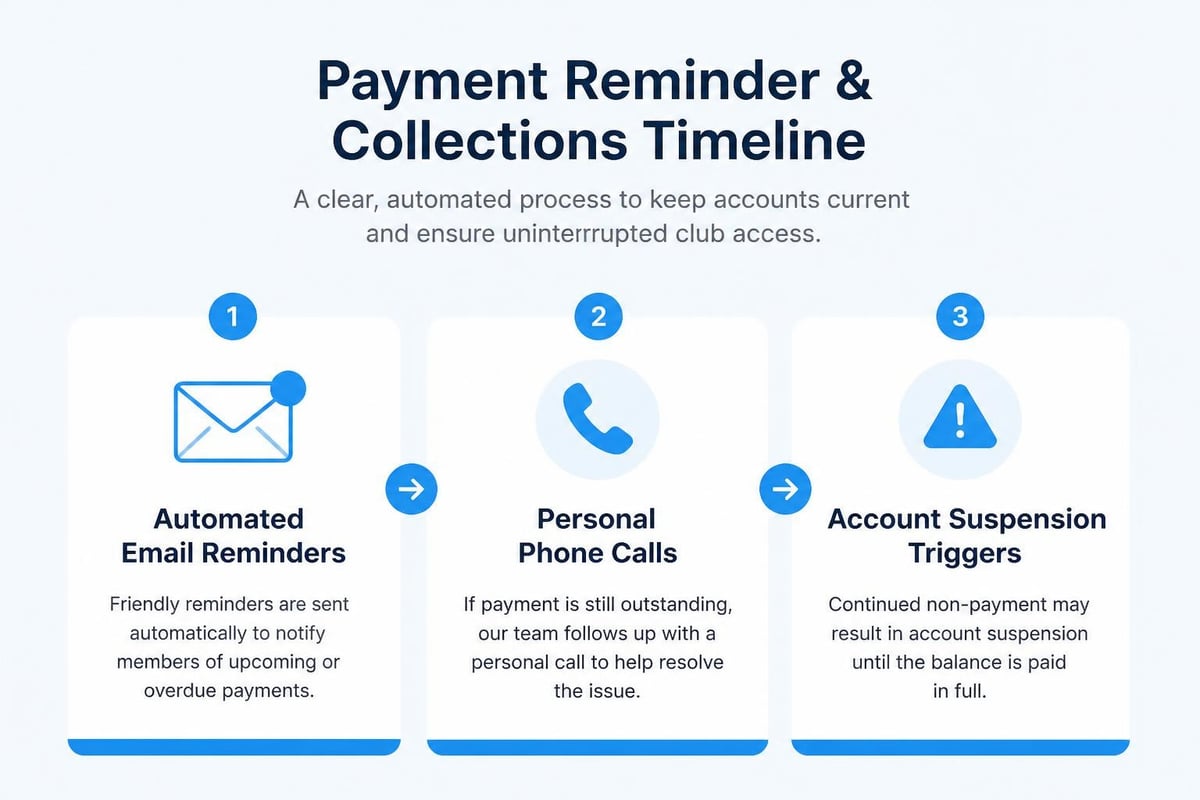
What happens when an invoice goes unpaid for 15 days? 30 days? 60 days? If your staff doesn't know, you don't have a collections process-you have chaos. Some families slip through without follow-up while others get harassed with redundant reminders.
Document your exact follow-up steps and automate them:
- Day 7: Friendly email reminder
- Day 14: Second email with payment link
- Day 21: Phone call from office
- Day 30: Final notice before suspension
- Day 45: Account suspension, board review for collections
Consistency matters more than severity. When members know the pattern, they usually pay before it gets serious.
Forgetting to Reconcile Weekly
Here's a painful truth: if you only reconcile your billing and invoices against your bank deposits once a month, you're going to find errors that are impossible to fix cleanly. Someone will have been charged twice, or not charged at all, or charged for the wrong family member, and by the time you discover it, everyone's confused about what happened.
Reconcile every Friday. Match your invoicing system against your merchant account and bank deposits. Flag discrepancies immediately while people still remember what happened. This 20-minute weekly habit prevents hour-long monthly cleanup sessions.
How Smart Clubs Use Invoice Data to Grow
Spotting Your Most Profitable Programs
Your billing and invoices tell you which programs actually make money versus which ones just feel successful. That Saturday morning swim lesson session that's always packed? Check what you're actually collecting after instructor pay, pool time allocation, and no-shows. Sometimes your busy programs are less profitable than the quiet Tuesday evening adult lap swim that runs itself.
Pull a report of revenue per program hour. Factor in the staff time required to administer it. You might discover that your most profitable offering is something you're barely marketing because it doesn't feel as exciting as your flagship program.
Predicting Seasonal Cashflow Dips
Every swim club has slow months. The question is whether you're prepared for them. Look back at three years of monthly invoice totals and overlay your major expenses. Where are the gaps?
| Month | Avg Monthly Billings | Avg Monthly Expenses | Cash Position |
|---|---|---|---|
| January | $12,000 | $18,000 | -$6,000 |
| February | $11,000 | $17,000 | -$6,000 |
| March | $28,000 | $19,000 | +$9,000 |
| April | $35,000 | $22,000 | +$13,000 |
| May | $42,000 | $24,000 | +$18,000 |
| June | $38,000 | $28,000 | +$10,000 |
Once you know your pattern, you can make smart decisions. Maybe you need a December early-renewal discount to pull spring revenue forward. Maybe you should schedule major repairs in May when cash is strongest, not in January when you're squeezed. Your historical billing and invoices data makes this planning obvious instead of stressful.
Finding Members Who Are Ready for Upgrades
Families who consistently add guest passes are telling you they'd probably benefit from a higher membership tier that includes guest privileges. Members who register for every special event might be interested in an all-access annual pass. Your invoicing history shows buying patterns that reveal upsell opportunities.
Most clubs leave this money on the table because nobody's actually looking at the data. Set up a quarterly review of members with frequent add-on charges and reach out personally with upgrade options. It's not pushy-you're solving a problem they're already showing you they have.
Compliance and Record-Keeping That Actually Matters
What You Legally Need to Keep
The IRS requires detailed recordkeeping for tax and deduction purposes, and your billing and invoices are part of that documentation trail. You need to retain invoices, payment records, and adjustment documentation for at least three years, though seven years is safer for businesses.
This isn't just about avoiding audits. When a former member disputes a charge six months after leaving, or when your board asks about a revenue decision from last summer, or when you're applying for financing and need to prove income history, your invoice records are your evidence.
Store everything digitally with automated backups. Paper files get lost, damaged, or stuffed in boxes that nobody can find during the actual emergency.
International and Electronic Invoice Standards
If you're running a larger facility or working with vendors across state lines, you might encounter questions about electronic invoicing standards. The EU has detailed guidance on e-invoicing that's worth understanding even for U.S. clubs, especially if you're dealing with international members or vendors. The technical standards around invoice validation and interoperability are evolving fast.
For most swim clubs, the practical takeaway is simple: make sure your invoicing system can export clean, structured data that your accountant can actually use. Proprietary formats that lock your data into one system create problems down the road.
Automation That Doesn't Feel Robotic
Where to Automate (and Where Not To)
Automatic recurring billing for standard memberships? Absolutely. That should run itself. Automated late payment reminders? Yes, with clear escalation steps. Automated refund approvals for unhappy members? No. Automated resolution of billing disputes? Definitely not.
The goal isn't to remove humans from billing-it's to remove humans from repetitive tasks so they have time for the situations that actually need judgment and relationship management. When you automate the right parts of your billing and invoices process, your staff spends less time chasing paperwork and more time helping members.
Here's a practical framework:
Automate these:
- Invoice generation on membership renewal dates
- Payment reminder emails on a fixed schedule
- Receipt delivery immediately after payment
- Failed payment retry attempts (for card declines)
- Monthly statements for members with balances
Keep these manual:
- Refund decisions and approvals
- Payment plan negotiations
- Billing dispute resolution
- First collection calls to late accounts
- Invoice adjustments for special circumstances
Making Auto-Pay Work for More Members
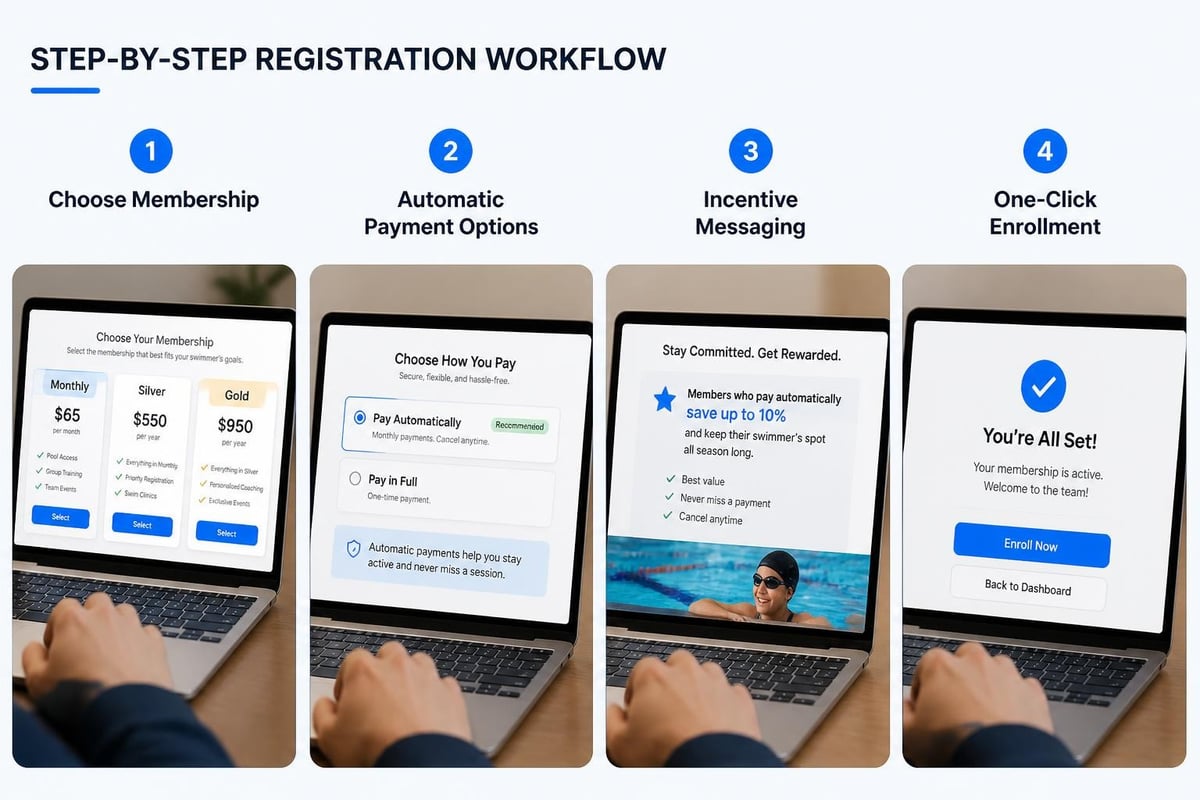
The best way to improve your cash flow is getting more members onto automatic payment. But you can't just tell people "set up auto-pay" and expect it to happen. You need to build it into your registration workflow, explain the benefits clearly, and remove the friction.
Offer a small incentive-even $5 off the first month works. Emphasize that they can cancel anytime and that auto-pay members never worry about late fees. Make the enrollment process two clicks, not ten form fields.
Track your auto-pay adoption rate monthly. If it's below 60%, you're working too hard on collections. If it's above 80%, you've cracked the code and your cash flow is predictable.
When Your Billing System Is the Problem
Signs You've Outgrown Your Current Setup
You know your invoicing system isn't working when you're spending more time fixing it than using it. Here are the red flags I see constantly:
- Staff manually creating individual invoices instead of batch processing
- Frequent errors that require voiding and reissuing invoices
- No way to see total outstanding balance without exporting to Excel
- Members regularly confused about what they're being charged
- Can't easily segment invoices by membership type, program, or date range
If three or more of these describe your situation, you're not dealing with normal administrative friction. Your system is actively costing you time and money. Many clubs stick with outdated tools because switching feels overwhelming, but the migration process is usually simpler than continuing to fight broken workflows.
What Modern Billing Should Look Like
In 2026, your billing and invoices platform should work more like the apps you use every day and less like software from 2010. You should be able to check outstanding balances from your phone while you're at the pool. Members should receive invoices that actually render properly on mobile devices, with one-tap payment links that work.
Your system should suggest which members might have payment issues before they become problems. It should flag unusual patterns automatically-like a long-time member whose payment method suddenly fails, or a spike in refund requests for a specific program. AI-powered insights aren't futuristic anymore; they're practical tools that save you from nasty surprises.
Look for platforms that treat billing as one connected piece of your whole operation, not a separate module you export data to and from. When your membership management, facility reservations, and billing all share the same database, you eliminate the duplicate entry and reconciliation headaches that waste hours every week.
Revenue Recovery Starts with Better Invoices
The Money You're Leaving on the Table
Most clubs focus on late payments and collections, which makes sense-that's the obvious revenue leak. But there's another pile of money hiding in your billing system that nobody talks about: the charges you never invoiced in the first place.
Guest fees that front desk staff forgot to log. Swim lesson makeups that got scheduled but never billed. Facility rentals where someone quoted a price but never followed through with an invoice. Equipment fees for lock replacements, card reprints, or loaner gear that walked out the door.
Do a monthly audit where you cross-reference your activity logs against your invoices. How many guest check-ins happened without corresponding guest fee invoices? How many lesson schedule changes occurred without billing adjustments? The gaps you find represent real revenue you earned but never collected. Tightening up this process with better revenue tracking often recovers thousands of dollars in the first quarter alone.
Building a Culture of Accurate Billing
Your seasonal front desk staff shouldn't be guessing whether something is billable or not. Create a simple one-page reference sheet that answers the common questions:
- Does a member bringing their adult child count as a guest? (Yes, if over 18)
- Do we charge for rescheduled private lessons? (No if 24hr notice, yes if late cancel)
- When does the guest fee kick in for someone's third visit? (Immediately on visit three)
- What's the replacement fee for a lost access card? ($15, added to next invoice)
Post it at every check-in station. Train new staff on it during their first shift. Update it whenever you clarify a policy. This sheet is what prevents the "oh, I didn't know we charged for that" conversation that costs you money.
The Real Cost of Invoice Complexity
Why Simple Invoices Get Paid Faster
There's a reason Amazon's invoices are dead simple: they know complexity creates friction, and friction delays payment. Your swim club invoices don't need to be complicated to be accurate.
One club I worked with had invoices that ran two pages long, with 15+ line items breaking down pool usage by day, facility maintenance fees, insurance allocations, and capital improvement surcharges. Technically accurate. Completely overwhelming. Members constantly called asking for explanations, and payment times averaged 38 days.
They simplified to five standard line items: Membership Fee, Lesson Fee, Guest Pass, Special Events, and Account Adjustments. Same total charges, dramatically clearer presentation. Payment time dropped to 18 days, and billing questions fell by 60%.
Your members don't need to see your internal cost accounting on their invoice. They need to understand what they're paying for and why it's worth it. Save the detailed breakdowns for your board reports.
Creating Invoice Templates That Work
Most clubs use the default invoice template their software provides and never customize it. That's a missed opportunity. Your invoice is a touchpoint with members-make it useful and on-brand.
Include these elements:
- Clear due date at the very top
- Summary box showing previous balance, new charges, payments received, and current balance
- Line items with plain-English descriptions
- Payment methods with direct links (not instructions to log into a separate portal)
- Contact info for billing questions (name and direct number, not just a general office line)
- Upcoming deadlines or program registration reminders
Your invoice shouldn't just ask for money. It should reinforce the value of membership and make paying as frictionless as possible. Think of it as a mini newsletter that happens to include an amount due.
Handling Difficult Billing Conversations
When Members Dispute Charges
Even with perfect processes, you'll face disputes. A member swears they canceled before the auto-renewal date. A parent says their child never attended the lesson you invoiced. Someone claims they never agreed to the guest fee policy.
Your first instinct might be to defend the charge, pull up the documentation, and prove you're right. Resist that instinct. Start by listening and acknowledging the frustration. "I can see this charge caught you by surprise. Let me look into exactly what happened."
Then investigate honestly. Check your records, talk to staff who were working that day, review your communication history. Sometimes you'll find the member is right-your system glitched, a staff member made an error, or your policy wasn't explained clearly during signup. When that happens, reverse the charge immediately and thank them for bringing it to your attention.
When the charge is legitimate, explain it clearly with specific dates, references to signed agreements, and system logs if needed. Offer a one-time courtesy adjustment if it's a long-time member with good payment history. The goal isn't winning the argument-it's keeping the member relationship intact.
Payment Plans and Financial Hardship
Economic conditions change. Families that easily afforded membership last year might be struggling this year. When a good member falls behind on invoices, don't immediately jump to collections. Have a conversation about what they can realistically manage.
A simple payment plan-spreading a $600 balance over three months instead of demanding it all at once-often gets you paid in full while maintaining the relationship. No payment plan should go longer than six months, and they should include automatic suspension if payments stop.
Document everything in writing. Send a confirmation email that lists the agreed-upon payment amounts, dates, and what happens if they miss an installment. This protects both of you from misunderstandings later.
Making Board Reports From Your Billing Data
What Your Board Actually Needs to See
Your board doesn't need to see every invoice. They need to understand the financial health of the club through clear trends and comparisons. Pull this together quarterly using your billing and invoices data:
Revenue Summary:
- Total invoiced vs. same quarter last year
- Breakdown by revenue category (memberships, lessons, events, guests)
- Outstanding accounts receivable by aging bucket
Collections Performance:
- Average days to payment
- Percentage collected within terms
- Write-offs and adjustments as % of total revenue
- Number of accounts in collections
Membership Trends:
- New member invoices vs. renewals
- Upgrade/downgrade activity
- Cancellation rate and reasons (when related to billing)
Present this as a one-page dashboard, not a 20-page packet. Your board members volunteer their time-respect it by making the information scannable and actionable.
Using Data to Support Policy Decisions
When your board debates changing membership fees, adding new policies, or adjusting payment terms, your historical billing and invoices data should drive the conversation. Instead of opinions and gut feelings, show actual numbers.
"If we add a $25 initiation fee, here's how many new members we had last year and what that would have generated." "If we move to quarterly billing instead of monthly, here's how it affects our winter cash position." "If we eliminate the guest fee for premium members, here's how much revenue we're giving up and how many members it would attract to upgrade."
Your invoicing system isn't just administrative-it's your strategic planning tool when you use it right.
Your billing and invoices are telling you everything you need to know about your operation's health-you just need to start listening. From late payment patterns that reveal communication problems to revenue gaps that expose process breakdowns, the data is already there. The clubs that thrive in 2026 treat their billing system as a strategic advantage, not just paperwork. PoolPulse helps swim clubs, tennis facilities, and HOA pools modernize their entire member management platform with AI-powered insights that turn billing data into actionable intelligence, so you spend less time chasing invoices and more time building a better member experience.

The Swim Club Software Test Every Board Should Run
Run this simple test to see if your swim club software actually saves time or creates more work. Real scenarios, honest questions, better tools.

The Seven Signs You've Outgrown Your Club Operations
Your swim club is growing, but your tools aren't keeping up. These seven warning signs reveal when manual processes cost more than solutions.

How to Answer Every Board Question in Under Two Minutes
Your swim club board asks tough questions. Learn how management reporting software helps you pull accurate answers in seconds, not hours.
Want to see if PoolPulse is a good fit for your club?
Book a walkthrough and we'll show you exactly how PoolPulse can help based on your club's needs, goals, and current processes.