

Billing by Time: A Swim Club Guide (2026)
Learn how billing by time works for swim clubs, when to use hourly charges, and better alternatives for member management and revenue tracking.


You've probably wondered whether billing by time makes sense for your swim club. Maybe you're thinking about charging hourly rates for private lessons, renting out lanes by the hour, or tracking coaching time differently. The truth is, billing by time can work well in some situations and create headaches in others. Let me walk you through what I've learned running swim clubs over the years and help you figure out what actually makes sense for your operation.
What Billing by Time Really Means for Swim Clubs
When we talk about billing by time at swim facilities, we're usually looking at a few different scenarios. You might charge families based on how long they use certain services. You could pay coaches based on deck time. Or you might rent your facility to outside groups by the hour.
Here's what billing by time typically covers:
- Private or semi-private lesson fees charged per 30-minute or 60-minute session
- Lane rentals for competitive teams or adult lap swimmers
- Facility rentals for birthday parties, events, or outside organizations
- Coaching compensation based on hours worked
- Additional services like lifeguard staffing for events
The appeal is obvious. You pay for what you use, and you charge for what you provide. It feels fair and transparent.
But the reality gets complicated fast.
The Hidden Complexity of Hourly Tracking
Think about what happens when you start billing by time. Someone needs to track when lessons start and stop. You need to record lane rental periods. Coaches clock in and out. Party rentals run over their scheduled time slots.
Now multiply that by 200 families, a dozen coaches, and multiple activities happening simultaneously.
The administrative work adds up quickly. You're not just running a swim club anymore. You're managing a time tracking operation that happens to involve swimming.
When Billing by Time Actually Makes Sense
Let me be clear: there are situations where billing by time works really well for swim clubs. You just need to know when to use it.

Private Lessons and Specialized Coaching
Private swim lessons are the perfect use case for billing by time. Families understand that a 30-minute session with Coach Sarah costs $45, and a 60-minute session costs $75. It's simple, clear, and matches how most swim instructors structure their work.
Semi-private lessons (two to four kids) follow the same logic. You book the time, show up, get the instruction, and pay for that specific service.
This works because:
- Sessions have clear start and end times
- Parents can see exactly what they're paying for
- Instructors can manage their schedules effectively
- Makeup lessons are easier to handle when you're rebooking specific time slots
Many swim clubs use specialized time tracking software to manage these lesson schedules, though a good club management system should handle this without adding separate tools.
Facility Rentals and Special Events
When another swim team wants to rent your pool for a Saturday morning practice, billing by time is the way to go. They need the facility from 6 AM to 9 AM, you charge for three hours, everyone knows the deal.
Birthday parties work the same way. You offer two-hour party packages. Families book their slot, you staff accordingly, and the billing is straightforward.
| Rental Type | Typical Duration | Billing Structure | Staffing Needs |
|---|---|---|---|
| Team practice | 2-3 hours | Hourly rate | Lifeguard only |
| Birthday party | 2 hours | Package rate (time-based) | Lifeguard + party host |
| Adult lap swim | 1 hour blocks | Punch card or drop-in | Lifeguard only |
| Special event | 3-4 hours | Custom quote (time-based) | Multiple staff |
The key difference here is that these are one-time or occasional bookings. You're not trying to track time for every single member every single day.
Contractor and Part-Time Coach Payments
Paying coaches by the hour makes sense when they're working variable schedules. Your head coach might be salaried, but the assistant coaches who work 10-15 hours per week need accurate time tracking for payroll.
This is where having good systems really matters. Time tracking tools designed for small businesses can help, but honestly, most swim clubs need something simpler that's built into their overall management system.
You want coaches to clock in when they arrive on deck and clock out when they leave. No complicated software, no separate apps, just basic time tracking that feeds directly into payroll.
Why Standard Membership Shouldn't Use Billing by Time
Here's where a lot of swim clubs get themselves into trouble. They think billing by time for regular membership access makes sense. It doesn't, and here's why.
The Administrative Nightmare
Imagine trying to track pool time for every member family. When did the Johnsons arrive? How long did they stay? Did they use the diving board area or just the lap lanes? What about when kids run in and out for snacks?
You'd need staff stationed at entrances logging times. Members would need to check in and out. You'd process hundreds of time-based charges every week.
The staff hours required to manage this system would cost more than any additional revenue you'd generate.
Member Experience Suffers
Think about how your members use your facility. Families want to show up on a hot summer afternoon and stay as long as they want. They don't want to watch the clock or worry about charges adding up by the hour.
Swimming is recreational for most of your members. Adding time pressure changes the whole experience from relaxing to stressful.
Seasonal Access Patterns
Swim clubs see huge variation in usage patterns. Everyone shows up during summer weekends. Fewer people come on weekday mornings. Almost nobody swims in May or September (depending on your climate and whether you're indoor or outdoor).
Billing by time seems fair because heavy users pay more. But in practice, you need the revenue from all members to cover your fixed costs, regardless of how much they swim.
Your pool maintenance costs don't drop just because members swim less in June. Your insurance doesn't get cheaper when attendance is light. You're paying coaches and lifeguards whether the deck is packed or empty.
Better Billing Approaches for Regular Membership
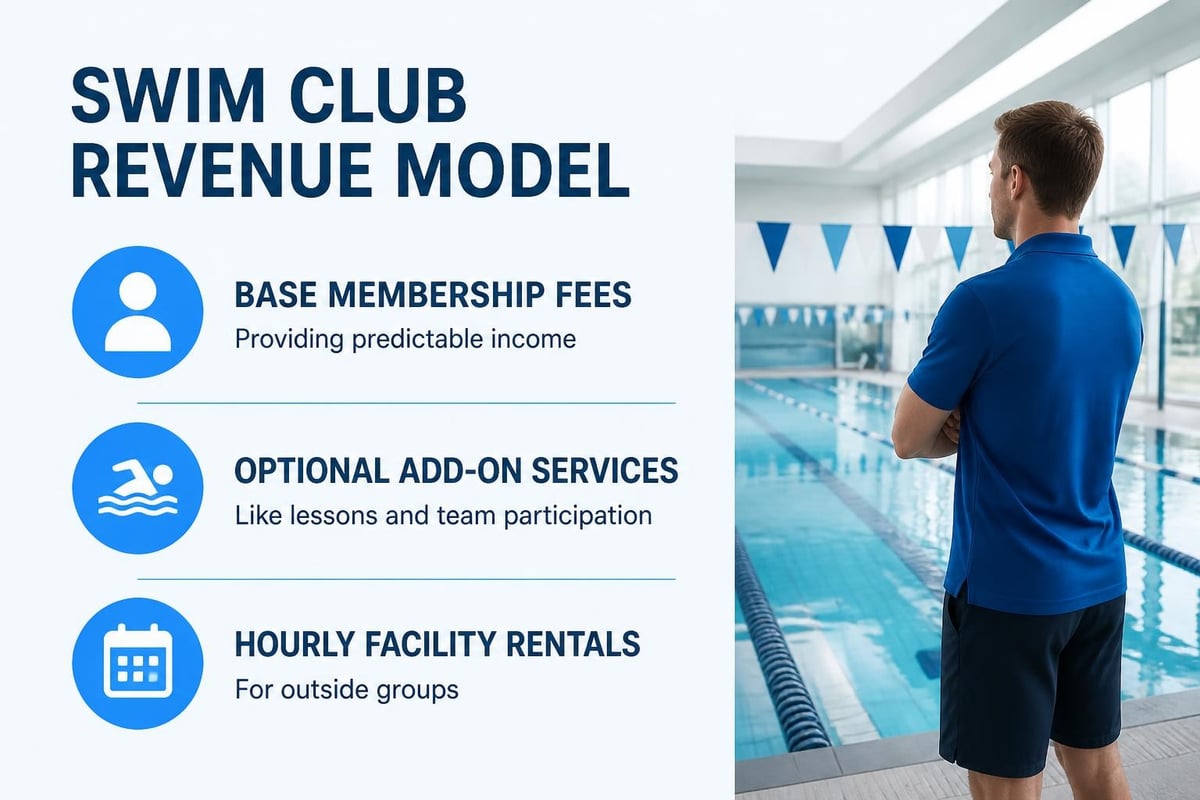
Most successful swim clubs have moved away from billing by time for standard membership. Instead, they use structures that provide predictable revenue while keeping administration simple.
Tiered Membership Levels
You create different membership categories based on family size, access level, or season length:
- Single member: $500/season
- Couple: $750/season
- Family (up to 4): $1,200/season
- Family (5+): $1,400/season
Each tier gets the same access. The pricing reflects household size, not time spent at the pool. Members pay once (or in installments) and swim as much as they want during the season.
This approach gives you predictable revenue that you can count on before the season even starts.
Add-On Services for Extra Value
Instead of billing by time for basic access, you use time-based billing only for premium services:
- Regular membership: flat fee
- Private lessons: billed by session
- Swim team participation: separate flat fee
- Guest passes: per visit or day rate
- Special programs: class-based pricing
This hybrid approach keeps your base membership simple while still using billing by time where it makes sense.
The Cash Flow Advantage
Here's something that doesn't get talked about enough: when you bill membership as a flat rate (especially if you collect in advance or offer payment plans), your cash flow becomes predictable.
You know in March how much revenue to expect for the summer season. You can plan hiring, maintenance projects, and facility improvements with confidence.
Billing by time for membership means your revenue fluctuates based on weather, local events, and other factors you can't control. That makes planning really difficult.
Tracking Time Without the Headaches
Even when you're not billing by time, you might want to track facility usage. Understanding peak hours, popular amenities, and attendance patterns helps you make better decisions.
Usage Analytics vs. Billing
There's a difference between tracking time for insights and tracking time for billing. You can monitor when members check in without charging them by the hour.
Good swim club management software lets you see patterns like:
- Busiest hours and days
- Average length of visits
- Most popular amenities
- Seasonal attendance trends
You get the benefits of time data without the complexity of time-based billing. This information helps you schedule lifeguards appropriately, plan maintenance during slow periods, and understand what members value most.
Check-In Systems That Work
Modern check-in systems make tracking arrivals easy without creating billing complications. Members scan a card, tap their phone, or check in at a tablet. You get a timestamp and headcount without manual logs or complicated processes.
The key is choosing systems that give you the data you need without adding steps that slow down member access. Nobody wants to wait in line on a busy Saturday just so you can track their arrival time.
If you're considering different platforms, exploring detailed reviews of swim club software can help you understand which systems balance functionality with ease of use.
Technology That Simplifies Time-Based Services
When you do need billing by time for lessons, coaching, or rentals, the right technology makes all the difference. But you don't need a dozen different tools.
The Problem with Multiple Systems
I've seen swim clubs trying to juggle:
- One system for membership management
- A separate app for lesson scheduling
- Spreadsheets for coaching hours
- Another tool for facility rentals
- Manual processes for billing coordination
Each system requires training. Data doesn't sync. Staff wastes time entering information multiple times. Billing errors happen because someone forgot to update the spreadsheet.
This is where looking at comprehensive time tracking reviews might seem helpful, but honestly, most swim clubs don't need enterprise time tracking software. They need club management software that handles time-based services as one feature among many.
What Actually Works for Swim Clubs
The best approach is finding a platform that handles all your needs in one place:
- Member management and billing
- Lesson scheduling and registration
- Coach time tracking for payroll
- Facility rental bookings
- Automated invoicing and payment processing
When everything lives in one system, you eliminate the coordination headaches. A parent books a lesson, the coach sees it on their schedule, the billing happens automatically, and you get clean reports for payroll.
Your staff doesn't need to learn multiple platforms or reconcile data across systems. Everything just works together.
Features That Save You Time
Look for specific capabilities that reduce your administrative workload:
- Automatic session tracking: Lessons and rentals create billing entries without manual input
- Coach schedule integration: Time tracking connects directly to what's on the calendar
- Flexible rate structures: Different prices for different services, coaches, or time slots
- Payment automation: Charges process based on completed sessions
- Clear reporting: See exactly what time-based revenue you're generating
The right platform should make time-based billing so simple that you barely think about it. If you're constantly tweaking settings or fixing billing errors, something's wrong.
Common Mistakes with Time-Based Billing
Let me share some things I've seen swim clubs get wrong so you can avoid the same problems.
Overcomplicating Rate Structures
Some clubs create incredibly complex pricing: different rates for different times of day, seasonal adjustments, member vs. non-member pricing, early bird discounts, and promotional rates.
The problem? Your staff can't explain it, members get confused, and billing errors happen constantly.
Keep it simple:
- One rate for 30-minute private lessons
- One rate for 60-minute private lessons
- One rate for facility rentals (maybe two: member and non-member)
That's it. You can always adjust rates once per year, but constant changes create chaos.
Inadequate Time Tracking Policies
If you're paying coaches by the hour, you need clear policies about:
- When they should clock in (arriving on deck vs. arriving at the facility)
- Break periods and whether they're paid
- Prep time before lessons and cleanup time after
- Administrative work like responding to parent emails
- Make-up lessons and how they're scheduled
Without clear policies, you'll have inconsistent practices and payroll disputes. Write it down, train everyone, and enforce it consistently.
Ignoring the Hidden Costs
Billing by time carries costs that aren't obvious at first:
- Staff time spent tracking, verifying, and processing time-based charges
- Software fees for time tracking and billing systems
- Error correction when times are logged incorrectly
- Customer service handling billing questions
- Payment processing fees (these add up with lots of small transactions)
Before you implement billing by time for a new service, calculate whether the administrative costs eat up your profit margin.
Making Time-Based Billing Work for Your Club
If you've decided that billing by time makes sense for certain services at your club, here's how to implement it effectively.
Start Small and Test
Don't overhaul your entire billing system at once. Pick one service where billing by time clearly makes sense (like private lessons) and start there.
Run it for a full season. Track the administrative time required. Monitor billing accuracy. Ask staff and members for feedback.
If it works well and doesn't create too many headaches, you can consider expanding to other services.
Set Clear Policies and Communicate Them
Your members need to understand:
- What services are billed by time
- How rates are calculated
- When charges will appear on their account
- Cancellation policies and how they affect billing
- How to dispute charges if something looks wrong
Put this information on your website, in your member handbook, and in confirmation emails when people book time-based services. The more clearly you communicate upfront, the fewer billing questions you'll handle later.
Train Your Staff Thoroughly
Everyone who interacts with time-based billing needs training:
- Front desk staff who schedule sessions and handle questions
- Coaches who need to track their time accurately
- Administrative staff who process billing and handle disputes
- Managers who oversee the whole system
Create simple checklists and procedures they can reference. Make sure they know who to ask when unusual situations come up.
Monitor and Adjust Regularly
Set up a monthly review process:
- Check for billing errors or discrepancies
- Review time tracking accuracy
- Look at administrative time spent on time-based billing
- Gather feedback from staff and members
- Adjust policies or rates as needed
Don't just set up a system and forget about it. Regular monitoring helps you catch problems before they become major issues.

Real-World Examples from Swim Clubs
Let me share a few scenarios I've seen play out at different clubs.
The Club That Tried Hourly Membership
A mid-sized community pool decided to switch from seasonal memberships to hourly access. They installed turnstiles and tracking systems. Members got charged $5 per hour for facility access.
The first weekend was a disaster. Lines backed up at entry points. Families were frustrated trying to figure out their costs. Staff spent hours answering questions instead of managing the facility.
By mid-season, they calculated that administrative costs exceeded any additional revenue. They switched back to seasonal memberships the next year.
The lesson? Some ideas sound good in theory but fall apart in practice.
The Club That Nailed Private Lessons
Another club created a simple private lesson program. Three instructors, two session lengths (30 and 60 minutes), clear pricing. Parents booked online through the club's management system.
Instructors got automated schedules on their phones. Billing happened automatically. Parents loved the flexibility of booking exactly what they needed.
The club generated an extra $25,000 in lesson revenue the first summer with minimal additional administrative work.
The lesson? Billing by time works great when the service naturally fits that model.
The Facility Rental Success Story
A swim club started renting their pool to a local triathlon team for early morning workouts. Two-hour blocks, three mornings per week, consistent schedule.
They charged a flat hourly rate that covered lifeguard staffing plus a margin for facility use. The billing was simple and predictable for both parties.
Over time, they added other rental opportunities: a water aerobics instructor, a master's swim group, and occasional private events.
These rental relationships became a steady secondary revenue stream that helped offset operating costs.
The lesson? Billing by time for facility rentals can create win-win situations when you're dealing with organized groups that need consistent access.
The Technology Decision
When you're ready to implement or improve time-based billing, choosing the right technology matters more than you might think.
What to Look For
You want a platform that:
- Handles both time-based and flat-rate billing seamlessly
- Integrates scheduling with automatic billing
- Provides clear reporting on all revenue streams
- Offers member-facing tools for booking and payment
- Includes mobile access for staff and members
- Supports your specific needs without unnecessary complexity
Swim clubs have unique requirements that general-purpose tools don't always address. You need something built for membership organizations, not just time tracking or general billing.
Integration Matters More Than Features
The most feature-rich platform means nothing if it doesn't work with your other systems. Think about:
- Payment processing integration
- Accounting software connections
- Member communication tools
- Website integration for online booking
- Mobile app access
A simpler platform that connects everything smoothly beats a complex platform that creates data silos.
If you're evaluating different options, understanding how modern club management platforms work helps you ask the right questions during demos.
Don't Overlook Support and Training
The best software in the world doesn't help if your team can't use it effectively. Look for:
- Responsive customer support when issues arise
- Clear documentation and training resources
- Onboarding assistance for initial setup
- Regular updates and improvements
- A vendor that understands swim club operations
You're not just buying software. You're choosing a partner who'll help you run your club more effectively. That relationship matters as much as the features.
Balancing Member Value and Club Revenue
At the end of the day, billing decisions come down to a balance between serving your members well and generating the revenue you need to operate.
Billing by time can absolutely be part of that equation. But it shouldn't be your only approach or even your primary one for most services.
Think About Member Perception
How do your members view different billing approaches? For many families, flat-rate seasonal memberships feel fair and simple. They pay once and don't think about it again.
Time-based billing for basic access can create anxiety. Parents worry about costs adding up. Kids feel rushed. The relaxed, fun atmosphere you want at your pool gets replaced with clock-watching.
But when parents choose to add private lessons, they understand and accept time-based pricing. It's an optional service with clear value.
Consider Your Administrative Capacity
Be honest about your staff's ability to manage different billing approaches. If you're running a small club with limited administrative support, complex time-based billing for multiple services might overwhelm your team.
Start with simple, flat-rate membership. Add time-based services only where they clearly make sense and you have the capacity to manage them well.
As you grow and potentially invest in better technology (like exploring what modern club management software offers), you can handle more sophisticated billing approaches without drowning in administrative work.
Revenue Predictability Vs. Usage Fairness
This is the fundamental tension in billing decisions. Time-based billing feels fair because people pay for what they use. But it creates unpredictable revenue that makes planning difficult.
Flat-rate membership provides predictable revenue but seems unfair to families who barely use the pool.
Most successful clubs address this by:
- Keeping base membership simple and flat-rate
- Offering different tiers based on family size, not usage
- Using time-based billing only for clearly optional services
- Creating value through amenities, programs, and community (not just pool access)
When members feel they're getting good value, they care less about exact usage calculations.
Planning for 2026 and Beyond
As we move through 2026, swim club billing continues to evolve with better technology and changing member expectations.
What's Changing
Members increasingly expect:
- Online booking for all services
- Transparent, upfront pricing
- Flexible payment options
- Mobile access to their accounts
- Clear communication about charges
These expectations work well with modern billing approaches, whether time-based or not. The key is having systems that support member self-service while reducing your administrative burden.
What's Not Changing
Despite technology improvements, some fundamentals remain constant:
- Families want predictable costs for regular access
- Members value simplicity over perfectly precise billing
- Administrative efficiency matters for your bottom line
- Personal service and community still drive member satisfaction
Don't let technology trends push you toward billing approaches that don't serve your members or your operational reality.
Future-Proofing Your Approach
As you think about billing decisions for the coming years:
- Choose flexible platforms that can adapt as your needs change
- Keep member experience central to every decision
- Build systems that scale as your club grows
- Maintain financial health through diverse revenue streams
- Stay focused on what actually works, not what sounds innovative
The clubs that thrive aren't necessarily the ones with the most sophisticated billing systems. They're the ones that serve their members well while maintaining financial stability through smart, sustainable practices.
Billing by time works well for specific swim club services like private lessons, coaching compensation, and facility rentals, but it creates unnecessary complexity for regular membership access. The key is using time-based billing strategically where it adds value while keeping your core membership structure simple and predictable. PoolPulse helps swim clubs manage both flat-rate memberships and time-based services in one integrated platform, giving you the flexibility to bill appropriately for different services without the administrative headaches of juggling multiple systems. Whether you're running a small community pool or a large swim club, having the right tools makes it easier to focus on serving your members rather than wrestling with billing complications.

What Your Billing and Invoices Are Telling You
Your swim club's billing and invoices reveal hidden patterns about late payments, refund requests, and cash flow. Here's how to read the signals.
The Swim Club Software Test Every Board Should Run
Run this simple test to see if your swim club software actually saves time or creates more work. Real scenarios, honest questions, better tools.

The Seven Signs You've Outgrown Your Club Operations
Your swim club is growing, but your tools aren't keeping up. These seven warning signs reveal when manual processes cost more than solutions.
Want to see if PoolPulse is a good fit for your club?
Book a walkthrough and we'll show you exactly how PoolPulse can help based on your club's needs, goals, and current processes.