

Why Your Billing Platform Decides Who Stays or Quits
Your billing platform shapes member experience more than you think. Learn what swim clubs need to avoid late fees, confusion, and churn.


You probably don't think about your billing platform when a family quits your swim club. You might assume they moved away or found a cheaper option. But here's what actually happens: someone gets a surprise late fee, can't figure out why their card declined, or spends fifteen minutes on hold trying to update their payment method. Then they decide it's not worth the hassle. Your billing system just cost you a member, and you didn't even know it was broken.
This isn't dramatic. It happens every season at clubs across the country. The way you bill members, process payments, and communicate about money shapes their entire experience with your facility. A good billing platform runs quietly in the background. A bad one creates friction at every renewal, generates complaints during your busiest hours, and slowly drains your membership numbers.
The Saturday Morning Billing Crisis
Picture this: It's the first Saturday in June, and your front desk is slammed. Three families are trying to check in for swim team practice. Two of them have declined cards from last month. One parent is arguing about a late fee they didn't know existed. Your seasonal staff member is frantically searching through spreadsheets while a line forms behind the desk.
This scenario plays out because most swim clubs patch together billing from tools that weren't designed for membership operations. You might use QuickBooks for invoicing, a separate payment processor for cards, spreadsheets to track who paid, and manual emails to chase late payments. Each piece works fine alone, but together they create gaps where members fall through.
What Actually Breaks Down
The problems start small. Someone updates their credit card with their bank but forgets to tell you. Your system tries to charge the old card, fails, and now you're chasing them down. Multiply that by fifty members and you've got a part-time job just managing payment failures.
Then there's the communication gap. Your billing platform sends an invoice. Your email system sends a reminder. Your front desk staff mentions it during check-in. But these messages don't connect, so members hear conflicting information about what they owe and when it's due.
Late fees are another flashpoint. You need them to encourage on-time payment, but if members don't understand when they'll be charged or how much, every late fee becomes a potential argument. Some clubs avoid this by not charging late fees at all, which creates its own problems with cash flow.
The Five Things Your Billing Platform Must Handle
Let's get practical. Forget the feature lists and marketing promises. Here's what actually matters when you're running a swim club, tennis facility, or HOA pool.
Automatic Payment Retries
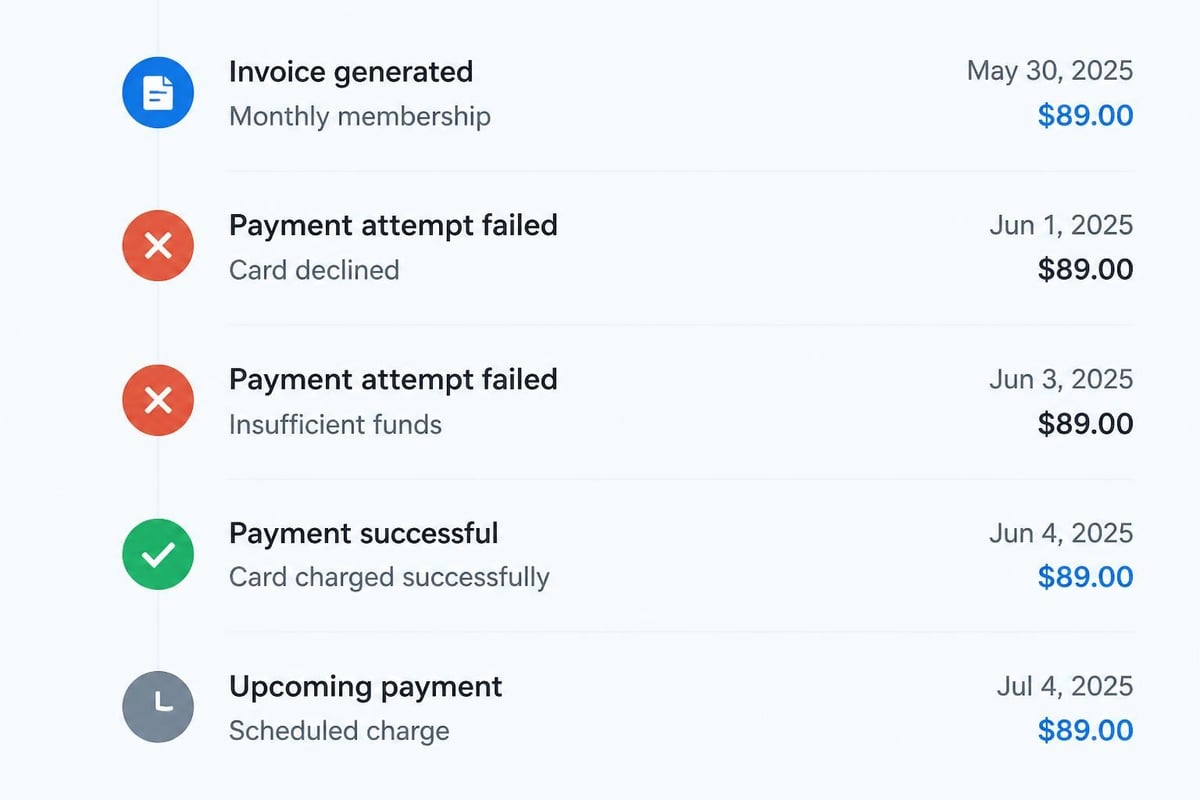
When a card declines, your billing platform should automatically retry it a few days later. Credit card companies have processing windows, and timing matters. A charge that fails on Tuesday might go through on Thursday when the member's paycheck clears.
Why this matters for swim clubs:
- Seasonal income patterns mean families have different cash flow throughout the year
- Multi-family memberships often split payments across different cards
- Corporate cards used by some members have monthly limits that reset
- Failed payments during peak season create administrative bottlenecks
The best systems retry intelligently based on the failure reason. A lost card won't magically work three days later, but insufficient funds might. Modern billing and invoicing software uses logic to determine which failures are worth retrying and which need member intervention.
Clear Payment History
Every member should be able to log in and see exactly what they've paid, what they owe, and when the next charge hits their card. This simple feature prevents ninety percent of billing questions.
When someone calls asking "why was I charged $87.50 last week," you need to pull up their account and know immediately. No digging through email threads or bank statements. The transaction should show the invoice, the items charged, any credits applied, and the payment method used.
Flexible Billing Schedules
Not every family wants to pay the same way. Some prefer annual payments to get it done. Others need monthly installments. Your billing platform should handle both without creating extra work for your office.
Here's where it gets tricky: You also need to handle mid-season joins, family discounts, sibling rates, early-bird specials, and board member exemptions. If your system can't accommodate these variations, you end up processing exceptions manually, which defeats the entire purpose of automation.
| Payment Schedule | Best For | Common Issues |
|---|---|---|
| Annual upfront | Established families, discount seekers | Large charges can bounce, hard to reverse mid-season |
| Monthly installments | Budget-conscious members, new joiners | More transaction fees, higher decline rates |
| Quarterly payments | Seasonal users, snowbirds | Timing mismatches with actual usage |
| Custom schedules | Corporate members, special arrangements | Difficult to track, requires manual oversight |
The swim club management software you choose should make these options easy to set up and modify when circumstances change.
Automated Renewals
Manual renewal processes kill you during peak season. You send reminders, wait for responses, follow up with non-responders, process payments individually, and somehow do all this while running daily operations.
Automatic renewal changes everything. Members opt in once, and their membership continues each year until they actively cancel. Their card gets charged on the renewal date, they receive a receipt, and you never touch it.
The psychology matters here. When renewal is automatic, the default is staying. When it's manual, the default is dropping out. That shift in friction dramatically improves retention, especially for families who love your club but forget to renew during busy spring months.
Requirements for successful auto-renewal:
- Clear opt-in during initial signup
- Reminder emails 30 and 7 days before the charge
- Easy opt-out process (don't make people call)
- Updated card request if the one on file is expiring
- Instant confirmation once renewal processes
Transparent Fee Structure
Hidden fees destroy trust. If your billing platform adds processing fees, administrative charges, or late penalties that members don't expect, you'll spend more time explaining charges than collecting them.
Show all fees upfront during registration. Build them into your pricing if possible, or display them clearly before someone commits. The extra two percent processing fee shouldn't be a surprise when they get their first invoice.
This extends to how you communicate rate changes. If membership dues increase next season, members should know months in advance, not when they see a higher charge on their card statement.
How Poor Billing Compounds Other Problems
Your billing platform doesn't exist in isolation. It touches nearly every other system you use to run your facility, and when it breaks down, the damage spreads.
Front Desk Chaos
When billing isn't automated and reliable, your front desk becomes a collections agency. Staff spend check-in time asking about overdue balances instead of welcoming members. Families feel embarrassed in front of other members. Kids hear their parents arguing about money instead of enjoying swim practice.
This creates a negative association with your facility. Even if you resolve the billing issue, that family remembers feeling awkward and stressed at your front desk.
Board Member Stress
Nothing consumes board meetings faster than financial confusion. When your billing data doesn't match your bank deposits, when you can't quickly report on outstanding receivables, or when you're not sure which members are current, board members lose confidence in operations.
They start asking for detailed reports, requesting audits, and questioning management decisions. All because your billing platform can't provide clean, accurate data.
Revenue Recovery Issues
Failed payments represent immediate revenue loss. If your billing platform doesn't have systematic ways to recover unpaid balances , you either write them off or spend administrator time chasing them down manually.
The longer a balance goes unpaid, the less likely you'll collect it. Automated follow-up within days of a failed payment recovers significantly more than manual efforts weeks later.
Member Communication Breakdown
When your billing platform is separate from your member management system, you create duplicate communication streams. Members get billing emails from one address and operational updates from another. They can't tell which messages are urgent and which are routine.
Integrated systems solve this by centralizing all member communication. Billing updates, schedule changes, weather alerts, and facility announcements all come from the same platform, creating a consistent member experience.
The Hidden Costs of Cheap Billing Solutions
Free or cheap billing tools are tempting, especially for smaller clubs watching every dollar. But the actual cost goes far beyond the monthly subscription fee.
Administrator Time Tax
Processing payments manually takes time. Reconciling transactions across multiple systems takes more time. Investigating discrepancies, handling member questions, and generating financial reports all consume hours that could go toward improving your facility or growing membership.
Calculate what you're actually spending. If your administrator dedicates ten hours per month to billing tasks at twenty-five dollars per hour, that's three thousand dollars annually. A proper billing platform that automates those tasks pays for itself even if it costs a hundred dollars monthly.
Transaction Fee Creep
Many basic payment processors charge higher per-transaction fees than integrated platforms. The difference between 2.9% and 2.5% seems trivial until you multiply it across thousands of dollars in monthly payments.
On $50,000 in monthly membership charges, that 0.4% difference costs you $200. Over a year, you've paid an extra $2,400 just in transaction fees. Some billing platforms designed for membership organizations negotiate better rates because they process higher volumes.
Compliance and Security Risks
Payment card industry standards require specific security measures for storing and processing credit card data. If your billing platform isn't compliant, you're exposing your club to liability and potential fines.
Many swim clubs don't realize they're non-compliant until after a security incident. The damage goes beyond financial penalties. Member trust evaporates when you announce that payment information may have been compromised.

What AI-Powered Billing Actually Means
You've probably seen "AI-powered" slapped on every software product lately. Most of it is marketing noise. But artificial intelligence does have legitimate applications in billing that save clubs real time and money.
Predicting Payment Failures
Machine learning can identify patterns that predict which payments are likely to fail before you attempt to charge them. This might be based on historical decline patterns, card expiration dates, or member payment history.
When the system flags a high-risk payment, it can automatically send a card update request before attempting the charge, preventing the failure entirely. Recent research on AI in billing processes shows how machine learning can improve accuracy in payment assessments.
Intelligent Retry Timing
Not all payment retries should happen on the same schedule. AI can determine the optimal retry time based on why the charge failed, the member's payment history, and statistical likelihood of success.
A charge that fails for insufficient funds might retry successfully in three days when paychecks typically clear. A charge that fails because the card is reported lost shouldn't retry at all, instead triggering an immediate card update request.
Automated Anomaly Detection
AI can spot unusual patterns that indicate problems. Maybe a member who always pays on time suddenly has three failed payments. Maybe your total collected revenue is ten percent lower than expected for June. Maybe a specific card type is declining at twice the normal rate.
These anomalies might indicate member financial hardship, technical issues with your payment processor, or fraud. Either way, catching them early prevents bigger problems.
Natural Language Processing for Support
When members contact you about billing questions, AI can parse their inquiry, pull relevant account information, and either answer directly or route them to the right person with context already prepared.
"Why was I charged twice in May?" becomes a searchable question that instantly pulls up both transactions, shows they were for different invoices (May dues and swim team fees), and provides an explanation without staff intervention.
Building Member Trust Through Transparent Billing
The best billing platform becomes invisible to satisfied members. They know when charges will hit their card, they understand what they're paying for, and everything works without requiring their attention.
Clear Invoice Design
Your invoices should be readable by someone who isn't a financial expert. Use plain language to describe charges. Break down totals into meaningful categories. Show payment due dates prominently.
Essential invoice elements:
- Member name and account number
- Invoice date and due date
- Itemized charges with clear descriptions
- Any credits or adjustments applied
- Previous balance carried forward
- Total amount due
- Payment method on file
- How to update payment information
- Who to contact with questions
Compare that to invoices that just show "May Charges: $127.45" with no breakdown. Members can't verify accuracy, can't understand what they're paying for, and have no confidence in your billing system.
Proactive Communication
Don't wait for members to discover problems. If their card is expiring next month, ask them to update it now. If their payment failed, notify them immediately with clear steps to resolve it. If you're changing your billing schedule, explain why and when it takes effect.
Communication timing matters too. Sending a reminder email about an upcoming charge the day before it processes gives members no time to react if they need to update information. Send it a week in advance.
Self-Service Portal
Members should be able to manage their own billing without contacting your office. Update payment methods, view transaction history, download receipts, set up payment plans, and modify billing preferences all through a simple portal.
This doesn't just reduce your workload. It gives members control, which builds confidence. They can check their account at eleven PM on Sunday when they remember they need to update their card, not wait until office hours to call.
Many swim club registration software platforms now include member portals as standard features, recognizing that self-service capabilities are expected, not optional.
Integration With Operations
Your billing platform needs to connect with how you actually run your facility. Payment status should automatically affect access permissions. Outstanding balances should flag during check-in. Renewal payments should trigger welcome-back emails and restore member privileges.
Real-Time Access Control
When someone's payment fails and goes thirty days overdue, should they still be able to check in? Most clubs say no, but enforcing this manually is impossible.
Automated systems link payment status to access. When an account goes to suspended status due to non-payment, their access card or app check-in stops working. They get a notification explaining why and how to resolve it. Once payment clears, access restores automatically.
This sounds harsh, but it's actually fairer than selective enforcement. Staff aren't put in the position of deciding who to allow in despite overdue balances, and members can't claim they didn't know they were behind.
Financial Reporting
Your billing platform should generate the reports your board needs without manual data compilation. Monthly revenue by category, year-over-year comparisons, outstanding receivables aging, payment method distribution, and membership retention metrics all need to be available on demand.
The platform should also export data cleanly for your accountant at tax time or for annual audits. Financial data should flow directly to QuickBooks or whatever accounting system you use, eliminating double entry.
Seasonal Adjustments
Swim clubs have unique seasonal patterns. Summer memberships, winter training programs, spring registration rushes, and fall renewals all create billing complexity that generic platforms don't handle well.
You need a billing platform that understands seasonal operations. It should handle different membership types with different billing calendars, manage waitlists and conversion to active membership, process pro-rated charges for mid-season joins, and adjust for facility closures or extended weather issues.

Migration Without Disaster
Switching billing platforms feels risky. You're moving member payment information, historical transaction data, and active billing schedules from one system to another while trying not to disrupt service or double-charge anyone.
Pre-Migration Cleanup
Before you migrate, clean up your current data. Reconcile outstanding balances, resolve disputed charges, update expiring cards, and archive inactive members. Moving messy data to a new system just gives you messy data in a nicer interface.
This is also when you standardize billing schedules. If you have fifteen different payment arrangements because you've made exceptions over the years, migration is the time to simplify to three or four standard options.
Parallel Processing Period
Run both systems simultaneously for at least one billing cycle. Process new charges in the new platform but keep the old one accessible for reference. This gives you time to verify accuracy before fully committing.
During parallel processing, don't migrate automatic payments yet. Keep those running in the old system until you've confirmed the new platform handles everything correctly.
Member Communication Strategy
Tell members what's changing and why. Emphasize improvements they'll notice: easier payment updates, better payment history access, clearer invoices, or new payment options.
Give them specific action items if needed. "You'll need to log in and confirm your payment method by June 15th" is actionable. "We're switching billing platforms" leaves them uncertain about what they need to do.
The migration process should include multiple touchpoints: initial announcement, reminder emails, FAQ document, support contact for questions, and confirmation once their account is successfully migrated.
Testing Everything
Before going live, test every scenario:
- New member registration and first payment
- Existing member monthly charge
- Failed payment and retry sequence
- Member updates their own payment method
- Manual adjustment or credit application
- Renewal processing for annual members
- Mid-season cancellation and refund
- Payment plan setup for families who need it
Each test should involve actual small transactions, not just demo mode. Process a one-dollar charge and refund it. The cost is negligible compared to discovering problems after you've processed thousands of dollars in member payments.
When Your Current Platform Is Holding You Back
You might not realize your billing platform is the problem. You've gotten used to workarounds and manual processes. But there are clear signs it's time to upgrade.
Your administrator spends more than five hours weekly on billing tasks. You're constantly explaining charges to confused members. Failed payments take more than two days to detect and address. You can't generate accurate financial reports without exporting data to spreadsheets. Members complain about difficulty updating payment methods.
Any of these symptoms indicate your billing platform has become a bottleneck. The longer you wait to address it, the more it costs you in lost revenue, administrative time, and member frustration.
Calculate Your True Costs
Most clubs underestimate what they're currently spending on billing when they factor in only the software subscription or transaction fees.
Hidden billing costs:
- Administrator salary hours spent on billing tasks
- Uncollected revenue from failed payments you don't chase
- Member churn from billing friction
- Board member time discussing financial confusion
- Opportunity cost of not focusing on growth initiatives
- Transaction fees from inefficient payment processing
- Compliance consulting to ensure you're meeting standards
Add these up honestly, and you'll probably find you're spending several thousand dollars annually more than you thought. That context makes investing in a proper billing platform look very different.
Comparison Shopping
When evaluating billing platforms, look beyond feature lists. Ask about real-world swim club usage. Request references from similar facilities. Try the demo with your actual data and scenarios, not their sanitized examples.
Key questions for vendors:
- How do you handle seasonal membership patterns?
- What happens when a payment fails at 2 AM on Sunday?
- Can members manage their own payment information?
- How does billing status integrate with facility access?
- What reports do you generate for board meetings?
- How do you ensure PCI compliance?
- What does migration from our current system involve?
- What ongoing support is included versus additional charges?
The answers reveal whether they understand membership operations or just process generic recurring payments. Understanding serverless billing models can also help you evaluate how different platforms structure their costs.
Small Clubs Have Different Needs
If you're running a small swim club with under two hundred families, you don't need enterprise billing features. But you also can't afford to waste time on manual processes.
Right-Sized Automation
Small clubs benefit most from automating the repetitive tasks that consume disproportionate time. Automatic payment retries, renewal reminders, and failed payment notifications deliver immediate value without complexity.
You probably don't need advanced analytics, multi-entity management, or custom API integrations. You do need simple setup, reliable processing, and support that actually answers questions.
Growth Flexibility
Even if you're small now, your billing platform shouldn't prevent growth. If you add fifty families next season, the system should handle it without requiring an upgrade or architecture change.
Scalability isn't just about volume. It's about adding new programs, creating membership tiers, offering different billing schedules, or expanding to multiple locations without switching platforms again.
Pricing That Makes Sense
Percentage-based pricing often favors smaller clubs because you pay less when you're processing less. Fixed monthly fees can be cheaper once you reach certain volumes but expensive when you're starting out.
Watch for setup fees, migration charges, training costs, and support tiers. Some platforms advertise low monthly rates but add hundreds in one-time charges. Others include everything in a simple per-member or per-transaction price.
Check out transparent pricing structures that show you exactly what you'll pay based on your club size and needs.
The Board Wants Numbers
Your board wants to know if your billing platform is working. They want metrics that prove you're collecting what you're owed, retaining members, and operating efficiently.
Key Performance Indicators
Collection rate: Percentage of billed revenue actually collected within 30 days. Healthy clubs collect 95% or higher. If you're below 90%, your billing platform isn't doing its job.
Payment failure rate: Percentage of attempted charges that decline. The industry average is around 15%, but good platforms with retry logic and proactive card updates keep this below 10%.
Days to collect after invoice: How long between when you bill someone and when payment clears. Shorter is better. Anything over 20 days indicates problems with your payment terms, member communication, or platform reliability.
Member support tickets related to billing: If more than 5% of members contact you monthly with billing questions, your invoices aren't clear enough or your platform isn't user-friendly.
Administrative hours per billing cycle: Track how much staff time goes to processing payments, answering billing questions, and resolving issues. This should decrease dramatically with proper automation.
| Metric | Poor Performance | Acceptable | Excellent |
|---|---|---|---|
| Collection Rate | < 85% | 90-94% | > 95% |
| Payment Failure Rate | > 20% | 12-18% | < 10% |
| Days to Collect | > 30 days | 15-25 days | < 12 days |
| Billing Support Tickets | > 10% members | 5-8% members | < 3% members |
| Admin Hours Monthly | > 20 hours | 10-15 hours | < 5 hours |
Presenting to the Board
Don't just dump numbers in a spreadsheet. Show trends over time, explain what they mean operationally, and connect metrics to member experience.
"Our payment failure rate dropped from 18% to 9% after implementing automated retries. That's an extra $3,200 collected monthly that we previously wrote off or spent administrator time chasing." This tells a story the board can understand and value.
Frame billing platform investments in terms of outcomes, not features. "This upgrade will reduce billing-related member complaints by an estimated 60% and free up twelve administrator hours monthly for member engagement" works better than "it has automated dunning and smart retry logic."
Real-World Implementation Timeline
Switching billing platforms isn't instant, but it shouldn't drag on forever either. Here's a realistic timeline for a typical swim club:
Week 1-2: Selection and Contract
- Finalize platform selection
- Review contract terms
- Set up accounts and credentials
- Schedule kickoff call with implementation team
Week 3-4: Data Preparation
- Export member data from current system
- Clean up discrepancies and outdated information
- Map data fields to new platform structure
- Set up billing schedules and pricing tiers
Week 5-6: Configuration
- Configure platform settings and preferences
- Set up automated workflows
- Design invoice templates
- Create member communication templates
- Integrate with existing systems
Week 7-8: Testing
- Process test transactions
- Verify reporting accuracy
- Test member portal functionality
- Train staff on new system
Week 9-10: Soft Launch
- Migrate subset of members
- Monitor closely for issues
- Collect feedback from early users
- Refine based on real usage
Week 11-12: Full Migration
- Migrate remaining members
- Send member communications
- Provide support during transition
- Monitor metrics closely
This timeline assumes active participation from your team and reasonable complexity. Very small clubs might compress this to six weeks. Large facilities with custom requirements might extend to sixteen weeks.
Questions to Ask Your Current Platform
Before you assume you need a new billing platform, evaluate whether your current one is configured optimally. Many clubs use only a fraction of available features because they didn't complete setup properly.
Schedule a call with your current vendor's support team. Ask them:
- Are we using automatic payment retries?
- Can we enable member self-service for payment updates?
- What reporting capabilities exist that we're not using?
- How can we automate our renewal process?
- Are there integration options we haven't explored?
- What's included in our current plan that we're not leveraging?
Sometimes you don't need a new platform. You need better implementation of what you already have. But if their answers reveal limitations that prevent you from operating efficiently, then yes, it's time to switch.
Managing club billing doesn't have to feel like wrestling with outdated systems and chasing failed payments every month. The right billing platform handles the tedious work automatically, gives members control over their accounts, and provides the financial clarity your board needs. PoolPulse brings together modern billing automation, member management, and AI-powered insights in a platform built specifically for swim clubs, tennis facilities, and HOA pools, helping you spend less time on administrative hassles and more time creating exceptional member experiences.

Five Front-Desk Tasks Your Swim POS Should Handle
Your front desk shouldn't need three systems to check in a swimmer. Here's how modern swim POS systems save time and reduce errors.

When Your Check-In Line Proves Software Is Too Slow
Discover how software timing affects your swim club's daily operations, from check-ins to billing, and why faster response times mean happier members.

The Swim Club Software Test Every Board Should Run
Run this simple test to see if your swim club software actually saves time or creates more work. Real scenarios, honest questions, better tools.
Want to see if PoolPulse is a good fit for your club?
Book a walkthrough and we'll show you exactly how PoolPulse can help based on your club's needs, goals, and current processes.