

Your 2027 Club Calendar Needs Decisions, Not Just Dates
Work backward from member-facing dates to the policy, pricing, staffing, system, and communication decisions that make them possible.


Opening day can be on the calendar while the decisions behind it are still scattered across board minutes, a supplier's email and the manager's notebook. That becomes visible when registration opens with an unfinished fee, staff publish conflicting hours or a maintenance visit displaces a program that members have already purchased.
A useful 2027 operating calendar connects each public promise to the work that makes it deliverable. Start with the date members will see. Work backward through approval, preparation, testing and communication, assigning an owner to each step. Keep proposed dates separate from confirmed commitments so a planning conversation cannot quietly become a public promise.
Start with the dates you cannot move casually
Collect the club's existing commitments before adding next year's ambitions. Include signed bookings, approved meeting dates, contract renewals, known maintenance shutdowns and dates already announced to members. Record where each date came from. A vendor confirmation and last year's spreadsheet have different levels of certainty, even when both contain a precise day and time.
Then add dates that depend on decisions still to be made: renewal opening, registration windows, seasonal hours, hiring and major events. Label these proposed. Give each a decision deadline and an approver. This makes an unfinished plan visible without misleading the team about what it may publish or sell.
Use a separate external-calendar check for school breaks, local events and holidays that affect attendance or staffing. The U.S. Office of Personnel Management's holiday calendar is a primary reference for federal holidays, not a rule requiring a private club to close. Confirm your own opening hours, employment arrangements and supplier availability rather than copying federal observance into an operating policy.
Give every milestone a clear finish line
“Prepare renewals” is too broad to tell the front desk what will be ready. “Members can review an approved offer and submit their renewal from February 1” describes an observable outcome. It also reveals several dependencies: the offer must exist, the eligible audience must be identified, the payment path must work and someone must be available to answer questions.
Write one finish line per milestone. For a lesson program, it might be an approved timetable, confirmed instructors and registration available for the correct age groups. For opening day, distinguish facility readiness from membership access. A completed membership list cannot substitute for required operating approvals or a safe, staffed facility.
Keep the public milestone and its internal checkpoints linked, but do not give them the same deadline. If every task is due on opening morning, the calendar has recorded a wish rather than a workable sequence. The person preparing a member announcement needs a confirmed decision before the announcement's review and delivery dates.
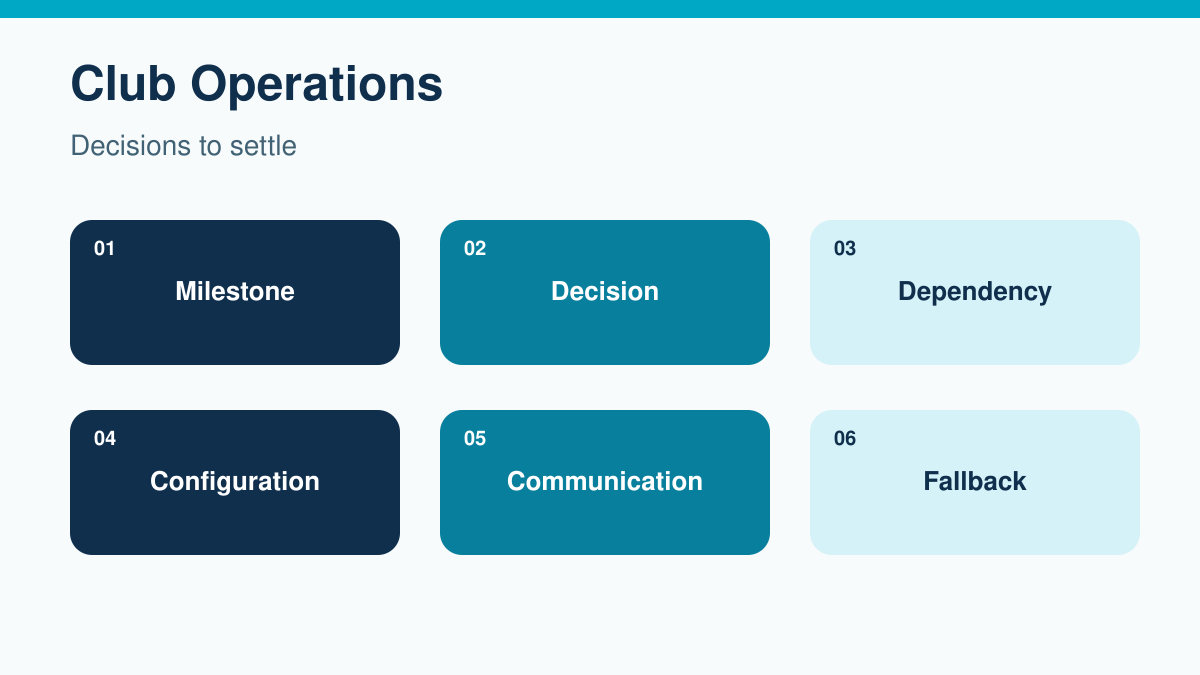
Work backward through one real example
Suppose a club proposes opening membership renewals on February 1, 2027. The following sequence is an illustration, not a universal lead time. The manager first asks when the board can approve the offer. That approval needs a finance recommendation, and the recommendation needs current membership counts, expected costs and a clear statement of which benefits or access rules may change.
Once the offer is approved, an administrator configures the packages, dates and forms. A second person checks a sample of household types before the invitation is released. The communication owner prepares the message using the approved amounts and term dates. The front desk receives the same explanation, including the route for exceptions it cannot resolve.
The calendar should expose the dependency chain. If finance cannot supply its recommendation until after the board meeting, changing the configuration deadline will not solve the problem. The approver must choose a different decision route or revise the proposed opening date. Staff should not fill the gap by guessing what the board will approve.
Use relative lead times while the sequence is being designed, then assign actual dates when owners confirm capacity. Ask each owner what input they need, how long their work takes and who verifies the result. Include review time and a reasonable correction window. Do not treat the fastest result from last year as the normal time required this year.
Keep decisions and tasks distinguishable
A decision approves an answer: the renewal price, guest allowance, booking window or seasonal operating hours. A task puts that answer into effect: configuring a package, updating a form, training staff or publishing a notice. A task can be complete while its underlying decision is still provisional, which is why the distinction matters.
For each decision, record the question, options that genuinely need approval, decision owner and latest useful decision date. Link the approval record when the decision is made. A meeting invitation is evidence that a discussion is planned, not that the answer has been agreed.
For each task, record the expected output and reviewer. “Update registration” becomes more useful when it identifies the specific program, approved capacity and evidence that registration was tested. Keep the record short enough to maintain. Detailed instructions can live in the relevant procedure rather than turning the calendar into a second operations manual.
Build six connected planning lanes
Membership and finance: Include renewal decisions, offer setup, payment-plan reviews, reconciliation checkpoints and the handoff to whoever prepares financial reports. Make clear which dates are internal planning targets and which arise from a contract or an applicable filing requirement.
Facilities: Put maintenance, inspections, contractor access and reopening checks beside the activities that use the space. A maintenance appointment alone does not establish when a court, pool or room is available again. Name who confirms the space can return to use and who updates affected bookings.
Programs: Connect instructor confirmation, capacity decisions, registration opening, equipment needs and the final participant communication. Leave room to review low enrollment before committing additional expenditure. Record who may cancel, combine or move a session and which member communication follows that decision.
People: Add recruiting, availability collection, required training, supervised practice and schedule publication. Check whether the same manager is expected to interview staff, approve renewals and run a major event in the same week. A realistic calendar accounts for the people doing the work, not just the number of tasks.
Member communication: Plan announcements, reminders and change notices as separate deliverables. Record the intended audience and the approval they depend on. A message to current members may need different content from a public announcement, especially when an offer or registration period has eligibility restrictions.
Governance and continuity: Include board decisions, annual reviews, access handovers and exercises for important disruptions. Keep confidential personnel or financial details out of broadly shared calendar entries. A descriptive milestone can link to a restricted record without exposing its contents to every staff member.
Make external deadlines traceable
Do not rebuild tax, licensing or insurance requirements from memory. Ask the responsible adviser or authority to confirm the applicable obligation, due date and preparation lead time. Save the source and its review date. Different legal structures, fiscal years and jurisdictions can produce different calendars for otherwise similar clubs.
For example, the IRS explains the due-date rule for Forms 990, 990-EZ and 990-PF by reference to the organization's accounting period. That is a useful reason to verify the club's actual filing requirement with its preparer, not to put the same filing date on every club calendar. Keep the preparation and review milestones earlier than the confirmed submission deadline.
Apply the same discipline to contracts. Record the notice window as well as the renewal date, then assign a review before the notice window closes. A reminder on the renewal day may arrive too late for a useful decision. Check the actual contract rather than assuming every supplier accepts cancellation or changes on the same terms.
Check collisions before publishing the member calendar
Review the plan by resource as well as by month. A clubhouse may appear available in an events list while a maintenance contractor has reserved it in another schedule. An instructor may be assigned to two programs whose times only partly overlap. A registration launch may coincide with the only administrator's leave.
Bring the relevant owners together for a short conflict review. Start with shared spaces, key staff, payment and communication deadlines, then consider setup and cleanup time. Ask whether the calendar includes the full period a resource is unavailable, rather than only the member-facing event hours.
Resolve the collision in the source record and update the affected views. Sending a corrective email without changing the booking or operating schedule leaves the next employee with the old answer. If a public commitment changes, retain the earlier date and record what was communicated so staff can explain the difference.
Test the plan with a disruption
Choose one realistic interruption for a short tabletop discussion: a contractor postpones essential work, a key staff member becomes unavailable or registration cannot open at the announced time. Ask who identifies the problem, who may change the plan and when members need an update. The exercise should reveal missing handoffs, not predict every possible incident.
The Ready Business resources provide a starting point for broader business preparedness planning. Use the club's own emergency procedures, qualified advice and local requirements for safety decisions. A calendar exercise helps test communication and continuity; it does not replace a safety plan or required training.
Record a practical fallback for the chosen milestone. That might be a revised registration announcement, an alternative approved space or a temporary way to answer member questions. Identify the point at which the fallback is selected. “We will decide if needed” is not enough if nobody knows who may decide or how late the decision can wait.
Use a rolling review without rewriting the year
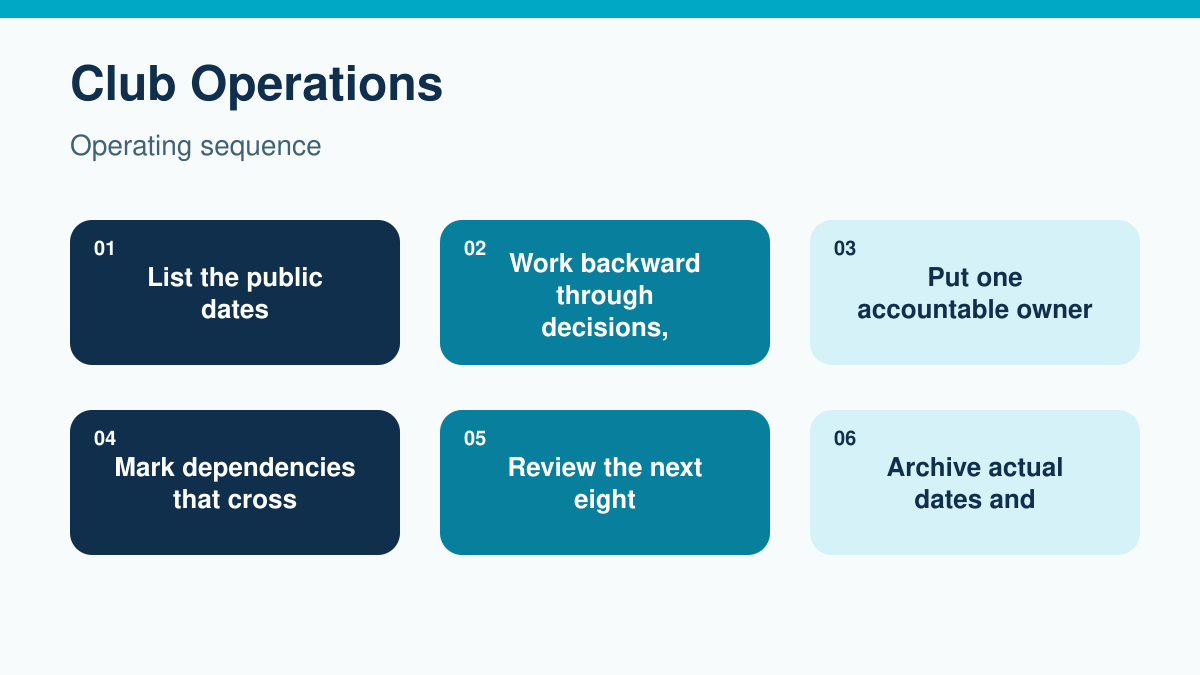
At each operating meeting, review the next eight weeks in enough detail to find decisions that are approaching their latest useful date. Look for missing inputs, unavailable owners and unconfirmed external commitments. Keep the remainder of the year visible at a higher level so long-lead work does not disappear.
Use status labels that describe the evidence: proposed, approved, in preparation, ready for release and completed. A completed status should refer to the milestone's finish line. For an announcement, that includes delivery evidence; for a facility reopening, it includes the appropriate readiness confirmation. A draft or a scheduled message is not an actual delivery.
When a date moves, identify the downstream work before editing it. A delayed renewal opening may affect reminder dates, reporting expectations and staffing. Record the reason, approving person and changed member communication. Keep the previous commitment in the history rather than silently replacing it and making the plan appear to have been on time all along.
Keep a short decision list at the top of the meeting agenda. For each blocked milestone, show the answer needed, who can provide it and what happens if it is late. Close the discussion with an assigned next step rather than a general request to follow up. At the following meeting, review that specific answer before adding another reminder to the same unresolved task.
Carry useful evidence into 2028
After each major milestone, save the planned date, actual date and the cause of any significant difference. Record which lead times were realistic and which dependencies arrived late. A short note such as “package review needed two additional days because household eligibility was unresolved” is more useful next year than a broad comment that renewals were difficult.
Retain the approved policy and working procedure separately from the annual date list. The next planning cycle can then reuse sound decisions while checking whether the people, costs and operating conditions have changed. Remove obsolete reminders deliberately; do not leave last year's deadlines active beside the new ones.
Bring one milestone to a Clubward walkthrough
Clubward brings membership, payment, program, space and staff work into a connected platform . Your annual calendar still needs approved decisions and accountable owners. The useful product discussion is how the related records and workflows support a specific milestone, with capabilities confirmed for the selected plan and modules.
Book a Clubward walkthrough around one 2027 event, renewal opening or program launch. Bring the public date, its dependencies and one likely exception. That gives the conversation a concrete purpose: finding where your team needs a clearer handoff before it makes the next promise to members.

Before the Pool Closes: The 60-Minute Season Debrief Every Swim Club Should Run
Before the details of the season fade, use this focused 60-minute swim club debrief to capture operational problems, protect what worked and turn real evidence into priorities for next year.

Your Vendor Contracts Have Deadlines. Build the Calendar Before They Choose for You.
Software, insurance, maintenance, communications and payment vendors often renew on different terms, and the club notices the deadline only when an invoice or automatic renewal arrives. Learn the practical decisions, owners and checks that turn the issue into a controlled club workflow.

Before You Sell Guest Passes for 2027, Decide What They Actually Allow
Build a club guest pass policy staff can apply consistently, covering sponsors, limits, payment, exceptions, records, and opening-day testing.
Want to see if PoolPulse is a good fit for your club?
Book a walkthrough and we'll show you exactly how PoolPulse can help based on your club's needs, goals, and current processes.