

Before the Pool Closes: The 60-Minute Season Debrief Every Swim Club Should Run
Before the details of the season fade, use this focused 60-minute swim club debrief to capture operational problems, protect what worked and turn real evidence into priorities for next year.


By January, most clubs remember that the summer was difficult. They no longer remember exactly why.
The duplicate household that blocked a check-in. The balance nobody noticed until a member reached the gate. The waiver staff could not find. The guest rule that required three people and a spreadsheet to interpret. The report the board requested but nobody could confidently produce.
Those moments are more than seasonal frustrations. They are evidence.
Your club's best requirements document for next season is the work that broke down this season.
The problem is that operational memory fades quickly. Seasonal employees leave. Volunteers rotate. Workarounds that felt unacceptable in July begin to sound manageable by December. Decisions for the next season are then made from impressions instead of facts.
A focused, 60 minute season debrief prevents that. It gives the people closest to the work a structured way to identify what held up, what created friction and what must change before the next opening day.
Your Season Is Operational Evidence
Swim clubs do not need another meeting where everyone agrees that the season was "busy." They need a review that turns lived experience into specific decisions.
USA Swimming includes club assessment, program evaluation and an annual review of important club functions in its governance resources. Its suggested annual calendar places evaluation of programs and services in September, followed by strategic planning in October. Its club assessment checklist asks a particularly useful question: If we were starting today, would we do it this way?
That question belongs at the center of the debrief.
The objective is not to produce a long complaint list. It is to preserve operational evidence while the people, examples and consequences are still available. A good review should identify:
- What worked well and should be protected
- What repeatedly required a workaround
- Where members or staff experienced avoidable friction
- Which problems affected revenue, access, safety or trust
- What action the club will take and who owns it
This is similar to the basic logic of an after-action review. FEMA's continuous-improvement guidance describes a process of collecting observations, validating what happened, identifying recommended actions and tracking whether those actions worked. A swim club does not need a formal incident report to use the same sound principle: examine the evidence, agree on the problem and assign the next action.
Who Should Be in the Room?
Keep the group small enough to work, but broad enough to represent the full operation. Include the club manager or board lead, someone responsible for membership and billing, a front-desk representative and a person involved in programs, staffing or member communication.
If seasonal staff have already left, ask for their input before the meeting. A short form with three questions is enough:
- What task created the most repeated frustration?
- What information was hardest to find when you needed it?
- What should work differently next season?
Member complaints, support emails and survey responses should also be represented. The National Council of Nonprofits recommends using organizational self-assessment to collect data, evaluate progress and identify where effectiveness can improve. That means the loudest person in the room should not become the only source of truth.
What to Bring
Do not spend two weeks preparing a perfect data package. Bring enough evidence to distinguish a pattern from a memorable bad day.
- Membership totals, incomplete registrations and duplicate-account examples
- Outstanding balances, failed payments, refunds, credits and reconciliation notes
- Check-in overrides, denied entries and common front-desk questions
- Guest-pass exceptions, missing waivers and policy disputes
- Reservation waitlists, cancellations, no-shows and capacity problems
- Support requests, member complaints and frequently repeated explanations
- Staffing gaps, schedule changes and tasks that depended on one person
- Reports the board requested, including anything that required manual assembly
Aquatic health and safety records belong in the broader annual operational review as well. The CDC's Model Aquatic Health Code resources include forms, protocols and inspection tools that aquatic operators can adapt to their needs. This 60 minute session focuses on administrative and member-facing workflows, but it should connect to the club's separate safety, maintenance and compliance reviews rather than replace them.
The 60 minute Season Debrief
| Time | Focus | Output |
|---|---|---|
| 0 to 10 minutes | Establish what happened | Shared facts, recurring examples and confirmed strengths |
| 10 to 45 minutes | Review seven operational handoffs | Specific breakdowns, workarounds and consequences |
| 45 to 55 minutes | Rank the findings | Top priorities for the next season |
| 55 to 60 minutes | Assign the next actions | Owners, decision dates and definitions of done |
Minutes 0 to 10: Establish What Actually Happened
Begin with facts, not solutions.
Ask each participant to name one thing that worked reliably and one recurring point of friction. Capture the example, who was affected and how often it occurred. If the group cannot agree on the frequency, mark it for validation rather than debating from memory.
Useful observations sound like this:
- Front-desk staff regularly opened the billing system to determine whether a household should be admitted.
- Guest waivers were completed, but staff could not consistently see their status during check-in.
- The treasurer spent several hours each month matching payment exports to household balances.
- Reservation cancellations were communicated by email, but the released capacity was not always offered to the waitlist.
- The opening team trusted the morning readiness report and rarely needed to verify it elsewhere.
The last example matters. Preserve what worked. Improvement is not only about fixing weaknesses. It is also about protecting the practices and systems that carried the season successfully.
Minutes 10 to 45: Review the Seven Operational Handoffs
Most club problems do not live entirely inside one department. They appear where one action is supposed to update another person, process or system. Review these seven handoffs for five minutes each.
1. Registration and Renewals
Could families complete registration without staff intervention? Did household relationships, membership types, eligibility rules and required documents remain accurate? Which registrations stalled, and why?
Look for manual approvals, duplicate records, unclear membership status and rules that existed in policy but were not consistently enforced in the workflow.
2. Billing and Financial Follow-Through
Could the club explain every open balance, credit, refund and failed payment? Did a payment automatically affect the member's standing, or did someone have to update another system?
Review where money and membership status separated. If staff chased balances manually, repaired billing records after the fact or built reports from several exports, document the full chain of work. Our article on the Saturday morning billing crisis provides a deeper review of those warning signs.
3. Member Check-In and Access
What did staff need to see before admitting a member? Was that information available in one place? Count how often staff overrode a result, consulted another person or left the check-in screen to answer a routine question.
The goal is not simply fast scanning. It is a confident access decision. Use the five-minute front-desk test if the team needs a practical way to examine the current experience.
4. Guests, Waivers and Exceptions
Could staff tell who the guest was, who invited them, whether the correct waiver was complete and whether the visit complied with club policy? Which exceptions required a manager?
Pay attention to policies that are simple on paper but difficult to enforce at the gate. If the system cannot carry the rule to the decision point, the front desk becomes responsible for interpreting policy under pressure.
5. Reservations and Programs
Did availability match actual capacity? Were cancellations, waitlists, eligibility and payments connected? Could the club see which programs were full, underused or producing repeated support questions?
Document where staff moved information between forms, calendars, payment records and rosters. Those manual handoffs are easy to forget once the program ends.
6. Staffing and Communication
Did schedule changes reach the right people? Could supervisors identify coverage gaps early? Were certifications, responsibilities and contact information current?
Then review member communication. When a closure, rule change or program update occurred, could the club identify the affected audience quickly? Note messages that had to be assembled manually or sent from personal accounts.
7. Reporting, Data and Board Continuity
Could leadership answer basic questions about membership, revenue, attendance and program performance without commissioning a spreadsheet project? Were reports reproducible, or did the result depend on who prepared them?
Also ask what happens when a board member, manager or volunteer leaves. The club should retain the records, definitions and process knowledge needed to continue operating. If a platform change is being considered, validate that the data is not merely transferable but operationally usable. Our five-part migration readiness test explains the difference.
Minutes 45 to 55: Rank What Matters
A debrief can produce more findings than a club can address at once. Rank each issue from one to three in three areas:
- Frequency: Was this isolated, recurring or constant?
- Impact: Did it create inconvenience, material rework or meaningful risk?
- Reach: Did it affect one person, one team or the wider membership?
Add the three numbers:
- 7 to 9: Resolve or materially reduce before the next season
- 5 to 6: Scope the improvement, assign an owner and set a decision date
- 3 to 4: Document and monitor unless the issue carries unusual safety, legal or financial consequences
This score is a prioritization aid, not a substitute for judgment. A rare problem involving safety, privacy or substantial financial exposure may require immediate action regardless of frequency.
Minutes 55 to 60: Give Every Priority an Owner
Do not end the meeting with a list titled "Things to Improve." Every selected priority should leave the room with:
- A named owner
- The next piece of evidence or information needed
- A decision date
- A clear definition of done
For example:
Problem: Front-desk staff cannot verify balances, waivers and access status without checking multiple systems.
Owner: Operations chair.
Next action: Document the current check-in path and collect five representative exception cases.
Decision date: September board meeting.
Done means: Staff can make the full access decision from one trusted view and exceptions follow a documented escalation path.
Is It a Process, Training or Platform Problem?
Not every frustration requires new technology. Classify the cause before selecting the solution.
- Process problem: The club has not defined the rule, sequence or owner clearly.
- Training problem: The process and tools are capable, but knowledge is inconsistent.
- Platform problem: The work requires duplicate entry, disconnected data, manual reconciliation or information that is unavailable where the decision occurs.
- Ownership problem: The task repeatedly fails because responsibility is shared vaguely or belongs to no one.
Some findings will involve more than one category. A confusing process may have been built around a platform limitation. Weak training may be the predictable result of a workflow that is difficult to explain. The point is to diagnose the whole system without defaulting to blame.
Turn the Debrief Into Requirements for Next Season
Feature lists encourage clubs to compare products in the abstract. Operational requirements describe what the club must be able to accomplish.
Write each requirement in this form:
We need to make a decision or complete an action when a real situation occurs, using a trusted source of information, without the current workaround. We will know it works when the result can be verified.
Examples:
- Front-desk staff need to verify membership, balance, waiver and access status from one view before admitting a household, without opening separate systems. We will verify this with real exception cases before launch.
- The treasurer needs payments, credits and open balances to reconcile to household records without rebuilding the month from exports. We will verify this by reproducing the month-end close from a test data set.
- Program managers need a cancellation to release capacity to the correct waitlist without sending individual follow-up emails. We will verify this through an end-to-end registration test.
If the debrief points toward a platform change, use those requirements during every demonstration. Ask vendors to show the real workflow, including the exception path, rather than confirming that a feature exists. These nine vendor questions can help the board test the launch plan as carefully as the product.
The Board Should Receive a Decision Packet, Not a Transcript
The final board packet can be one page. Include:
- The five highest-priority findings
- The evidence behind each finding
- The proposed improvement and accountable owner
- The expected operational outcome
- The decision or funding required from the board
Attach detailed notes only when they support a decision. The purpose of the debrief is not to preserve every sentence from the meeting. It is to create organizational memory that survives board turnover and leads to action.
Do It While the Details Are Still Fresh
The best time to learn from a season is before its frustrations become vague stories.
Run the debrief while seasonal staff can still contribute and while reports, support requests and exception cases are easy to retrieve. Use September to validate the highest-priority findings. Use the fall to make process, training and platform decisions with enough time to prepare properly for the next registration cycle.
If a migration becomes part of that plan, begin with the records, relationships and workflows the club must protect. The PoolPulse migration checklist provides a practical starting point.
PoolPulse is built around the connections between membership, billing, waivers, access, reservations, staffing and reporting. If your debrief reveals that staff are serving as the human bridge between disconnected systems, bring those workflows to a personalized PoolPulse walkthrough . We will show you how they can operate as one connected process.
Do not begin next season with a longer feature list. Begin it with a clearer understanding of the work.
Sources

Your Club Survey Says ‘Communicate Better.’ What Should You Change?
When members ask for better communication, find out what they mean. Ask clearer questions, read the comments, and turn the answers into changes your club can finish.
The Board Approved the Rule. Why Does the Front Desk Give Three Answers?
A board decision needs to make sense at the front desk. Get the rule, start date, staff instructions, and member messages ready so every shift has the same answer.
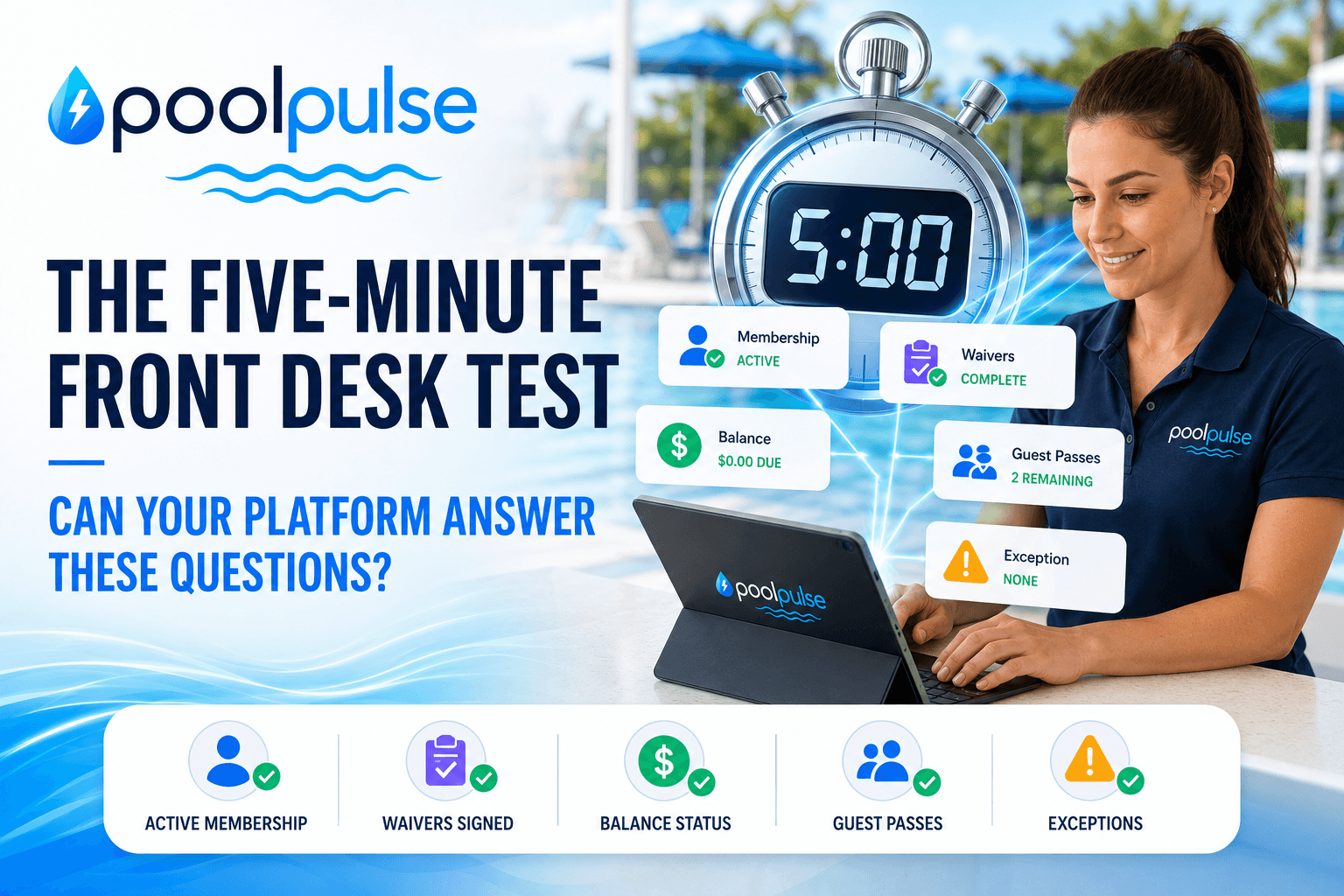
The Five-Minute Front Desk Test: Can Your Platform Answer These Questions?
Use this five-minute front desk checklist to test whether a club platform can surface membership status, waivers, balances, guest rules and exceptions when staff need them.
Want to see if PoolPulse is a good fit for your club?
Book a walkthrough and we'll show you exactly how PoolPulse can help based on your club's needs, goals, and current processes.