

Your Vendor Contracts Have Deadlines. Build the Calendar Before They Choose for You.
Software, insurance, maintenance, communications and payment vendors often renew on different terms, and the club notices the deadline only when an invoice or automatic renewal arrives. Learn the practical decisions, owners and checks that turn the issue into a controlled club workflow.


The pool is closed, the last guard has turned in a key, and the treasurer is finally working through next season’s budget. Then a vendor invoice arrives for another year. The board had meant to compare options, but the agreement’s notice deadline passed while everyone was busy closing the club.
A vendor renewal calendar gives those decisions a place before they become urgent. It connects the signed contract, the last date to act, the person reviewing the service and the meeting where spending can be approved. For a seasonal club, that calendar needs to follow both the contract and the swimming season. A replacement that looks affordable in November can still be a poor choice if installation will interrupt spring registration.
Start with the vendors whose interruption would stop the club from operating, collecting money or serving members. Then bring the smaller subscriptions and service agreements into the same record. The goal is a calendar the next treasurer or manager can pick up without having to reconstruct last year’s decisions from an inbox.
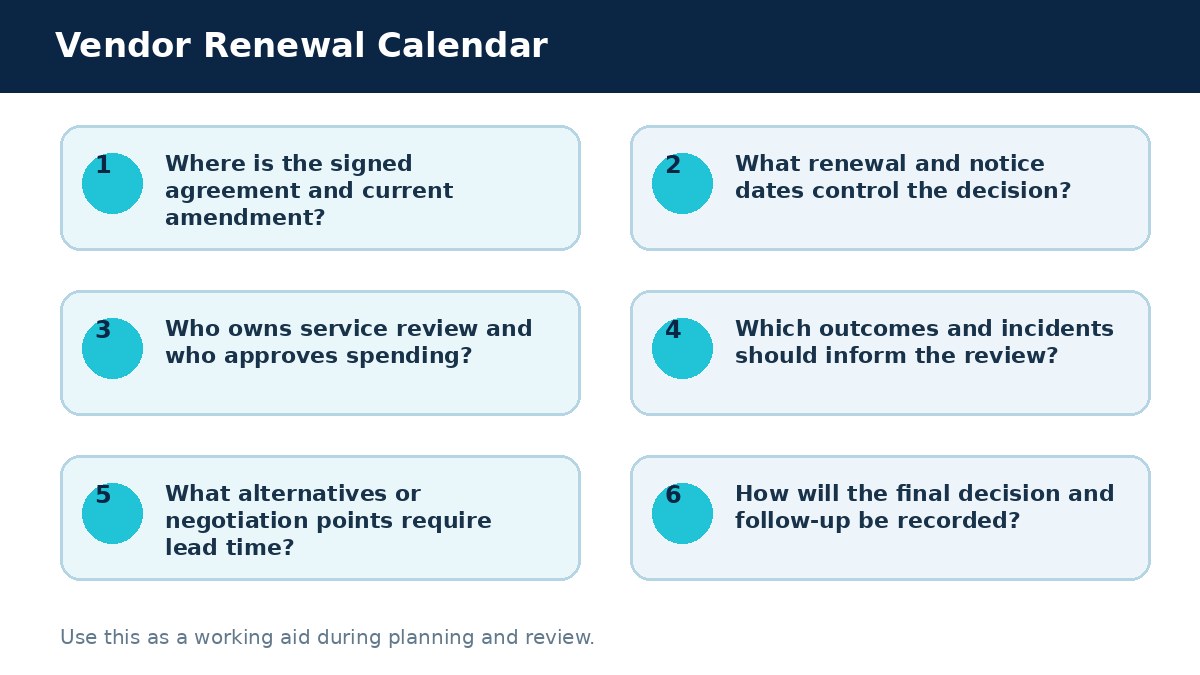
Answer these six control questions first
- Where is the signed agreement and current amendment? Link the executed agreement, accepted order form, schedules and later amendments. Keep the version that governs this term, not just the sales proposal. Flag missing pages or conflicting terms for the person qualified to resolve them.
- What renewal and notice dates control the decision? Record the current term, renewal date, notice deadline, service dates and payment dates separately. Include how notice must be delivered and whether the agreement measures sending, receipt or another event.
- Who owns service review and who approves spending? Name an operational owner who knows the service and a financial owner who checks costs. Identify the person or board authorized to approve the commitment and the person authorized to communicate it.
- Which outcomes and incidents should inform the review? Gather the season’s actual service record: missed visits, support cases, outages, disputed charges, staff workarounds and successful deliveries. Include what the vendor did well so one difficult week does not stand in for the entire season.
- What alternatives or negotiation points require lead time? Check quote availability, equipment compatibility, setup, training, data movement and any overlap between suppliers. Decide how early the club needs an answer to keep opening preparations on schedule.
- How will the final decision and follow-up be recorded? Save the approval, signed terms, required notices and evidence of delivery together. Give the next action an owner and date, including the first invoice check and the following renewal review.
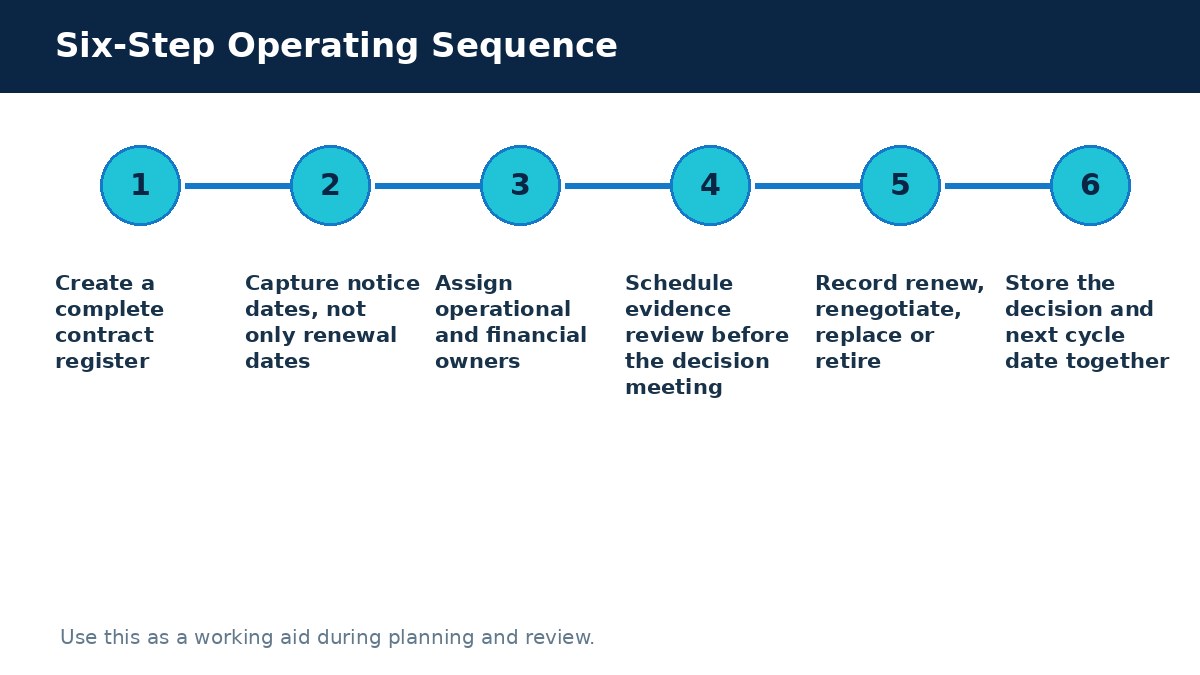
Build the plan in six deliberate steps
1. Create a complete contract register
Use a shared spreadsheet or other record the club already maintains reliably. Give each vendor relationship one entry, with separate rows when one supplier has agreements with different terms. Start with software, insurance, pool maintenance, chemical supply, waste collection, internet, communications, payment processing and leased equipment. Add inspection, landscaping and security services where applicable.
Reconcile the list against the general ledger, bank and card payments, accounts payable, and the previous season’s purchase records. A subscription paid on a former volunteer’s card is easy to miss. Ask department leads which vendors they contact directly and whether any supplier owns equipment on site. An invoice proves a charge occurred; it may not contain the agreement controlling renewal.
For each entry, record the club’s contracting name, vendor’s legal name, service, account reference, current term, costs, contact details and document links. Store the source agreements in a club-controlled location with appropriate access. Where an amendment changes pricing or notice terms, link it beside the original and identify the affected provision. Leave an unresolved field visibly open rather than filling it from memory.
2. Capture notice dates, not only renewal dates
The calendar needs distinct dates because each answers a different question. The renewal date begins the next contractual term. The notice deadline may determine when the club must act to prevent or change that renewal. Service dates describe when the work or access is provided. Invoice and payment dates describe when money is billed and due. These dates can be months apart.
Read the actual provision before calculating a deadline. Note whether it uses calendar days, business days, a named date or a window; which date starts the calculation; and any stated time zone, cutoff time or receipt requirement. A cancellation right, a non-renewal right and a price-change objection may have different conditions. Route unclear language to the club’s appropriate adviser rather than guessing at a universal rule.
Save the calculation beside the source provision and have a second person check it. Then add earlier working dates for evidence, quotes, approval and notice preparation. Those internal targets provide room to act; they do not change the contractual deadline. If the club discovers that a deadline may have passed, escalate promptly and establish the current position before promising the board that a change remains available.
3. Assign operational and financial owners
The operational owner should be close enough to the service to describe what happened. The pool manager may review maintenance and chemical delivery; the membership lead may review registration software; the treasurer may review payment processing. Give each role a current name and a backup. “The board” is too broad to own the task of finding an agreement or collecting three months of invoices.
The financial owner checks the proposed commitment against the budget, payment history and approval limits. That person should know who can sign, whether the board must vote and when meeting papers are due. Staff can gather quotes without assuming they have authority to accept them. Record approval and signing responsibilities separately when the club’s rules separate them.
Keep the calendar available through leadership changes. Club-controlled email and storage help prevent a renewal reminder from disappearing with a departing volunteer. Limit access to contract and financial details to the people who need them, while making assigned actions visible to their owners.
4. Schedule evidence review before the decision meeting
Work backward from the notice deadline and the board’s actual calendar. Allow time after approval to prepare, authorize and deliver any notice. Before approval, leave enough time for negotiation or replacement quotes. Before that, schedule the service review. If the only board meeting falls after the deadline, raise the scheduling problem early and use the club’s approved decision process.
Collect evidence that suits the vendor. For pool maintenance, compare promised and completed visits, response to breakdowns, repeated faults and work left outstanding. For chemical supply, review delivery reliability, emergency orders, price changes, minimum quantities and any equipment tied to the agreement. Separate a supplier problem from a stock-ordering problem inside the club.
For software, review busy-day availability, support cases, registration or check-in problems and time spent correcting records. For payment processing, compare statements, transaction mix, refunds, disputes, settlement timing and equipment charges. For communications services, check whether messages reached members and whether staff could manage bounced addresses or urgent announcements. Insurance reviews need the appropriate broker or adviser to examine the proposed coverage, exclusions and changing club activities, as well as the premium.
Ask staff for concrete examples while the season is still fresh. A short log with the date, impact, vendor response and resolution is more useful than “support was slow.” Give the vendor an opportunity to clarify disputed service facts before presenting them as settled findings.
5. Record renew, renegotiate, replace or retire
Bring a recommendation to the decision meeting. Renew when the service still fits and the proposed terms are acceptable. Renegotiate when the relationship is useful but price, scope or service commitments need attention. Replace when another provider offers a workable improvement. Retire when the club no longer needs the service and has checked what depends on it.
Compare the full cost over the same period. Include recurring charges, usage fees, minimums, applicable taxes, equipment, setup, training, migration, termination charges and any necessary overlap. Show assumptions, especially transaction volumes or chemical quantities. A lower headline rate can cost more once staff time and replacement hardware are included. Keep one-time transition costs separate from ongoing savings so the board can see both.
Test whether the alternative can actually be ready. A new maintenance contractor may need a site inspection and equipment history. A payment change may involve terminals, settlement accounts and refund handling. A software move may depend on usable exports, import testing, permissions and staff practice. Get those dependencies into the proposal before choosing a date. For critical services, establish a workable continuity plan before ending the current arrangement.
Record the approved option, scope, spending authority, conditions and next owner. If negotiations continue, keep the notice deadline active. A helpful conversation with an account manager should not be treated as changing the signed terms unless the club has the required documented agreement.
6. Store the decision and next cycle date together
Put the decision, approval record and resulting agreement in the vendor entry. If notice is required, verify its destination, permitted method, authorized sender, required content and timing against the governing document. A message to a familiar salesperson may not satisfy a provision naming a different recipient. Preserve the exact notice and the applicable evidence of sending and receipt, and follow up on missing acknowledgments while time remains.
For a replacement or retirement, keep a closeout list: open invoices, credits, deposits, disputed amounts, equipment returns, access removal and any continuing obligations. For systems containing club records, arrange exports and verify that the club can open and use them before access ends. Confirm how historical transactions, future refunds and unresolved disputes will be handled. Check applicable retention requirements and agreed deletion arrangements with the responsible owner.
Keep the entry open until the transition has been checked and the first new invoice matches the approved terms. Then enter the next review and notice dates immediately. Link supporting documents from the calendar event so a reminder leads to the work, rather than another search through email.
A worked club scenario: a December notice deadline
Consider a hypothetical 420-household club reviewing its pool maintenance agreement for 2027. In this example only, the agreement starts its next annual term on March 1, 2027. It expressly requires non-renewal notice to be received at a specified renewals email address by 5 p.m. Eastern Time on the date 60 calendar days before that renewal date. The stated method gives December 31, 2026: counting back 28 days reaches February 1, another 31 reaches January 1, and one more reaches December 31.
That calculation belongs to this invented agreement. Another contract could use a different counting method, notice window or delivery requirement. The manager records the source language and calculation, and the treasurer checks both. Neither person assumes that holiday staffing changes the deadline.
The board meets on December 10 and needs its papers by December 3. The manager schedules the service review for November 17, replacement proposals and site checks for November 24, and a recommendation for the packet deadline. The club’s internal target for completing any notice is December 17, leaving time to investigate a delivery problem before December 31.
The evidence shows that routine visits were completed, but two breakdowns took longer to address than the club could comfortably manage. The current vendor proposes a revised response arrangement. A competing quote is cheaper, but excludes spring startup and requires a separate equipment assessment. The treasurer adds those costs and the manager checks availability before the board compares the proposals.
Suppose the board authorizes replacement, subject to confirming the new provider’s service start. The authorized signer completes that agreement, and the designated sender submits non-renewal notice by the existing contract’s required method. The club saves the notice and receipt evidence, confirms the final service date, and assigns outstanding repairs and any equipment handover. January follow-up checks that both suppliers understand their responsibilities. The decision is finished when the handover is workable, not when the board vote is entered in the minutes.
Fit the calendar around the club’s year
Use the seasonal rhythm to make reviews easier, without letting it override individual contract dates. In late summer, collect service evidence while managers and seasonal staff are available. At closing, record outstanding repairs, equipment condition and services that must continue through winter. During fall budgeting, review the commitments that affect next season’s dues and operating plan.
In winter, check long-lead replacements, installation dates and training. Before registration opens, verify that membership, communications and payment arrangements will support that cycle. Before pool opening, confirm critical service coverage, supplier contacts and equipment readiness. During the season, keep a brief incident log and check approaching notice deadlines rather than postponing every review until closing.
Set calendar alerts for the work stages, not just the final deadline. A useful sequence might include review kickoff, quote deadline, board packet, approval, notice target and receipt check. Choose intervals that fit the agreement and replacement lead time. Give each event a named owner, backup and link to the vendor record. Have someone check the coming quarter regularly so an unaccepted calendar invitation or absent volunteer does not become the only warning.
At a volunteer handoff, review the next six months together. Open the document links, confirm access, identify unresolved negotiations and transfer outstanding actions. Explain why the club chose its current vendor and what would trigger a fresh review. That small handoff protects more continuity than a folder full of unsigned proposals.
Make the next renewal easier
Keep the current view simple: vendor, owner, next deadline, decision status and next action. Preserve the supporting history behind it. The club should be able to see what needs attention this month without reading every contract again.
For a club software review, use the PoolPulse features overview to prepare questions about the work your team needs to do. Bring the actual registration, billing or check-in problems from the season, and ask to see the relevant workflows rather than relying on a general feature comparison.
If you are considering PoolPulse, See how connected club records support better operational reviews . Bring one recurring staff problem and the records needed to explain it. Keep your contract calendar close: a useful demonstration, a realistic transition plan and an authorized decision all need time before the notice deadline arrives.

Your 2027 Club Calendar Needs Decisions, Not Just Dates
Work backward from member-facing dates to the policy, pricing, staffing, system, and communication decisions that make them possible.

Before You Sell Guest Passes for 2027, Decide What They Actually Allow
Build a club guest pass policy staff can apply consistently, covering sponsors, limits, payment, exceptions, records, and opening-day testing.

Before You Approve Your 2027 Club Budget, Count the Work Between Your Systems
A practical way to expose the software, labor, handoff, and transition costs that ordinary budget lines miss.
Want to see if PoolPulse is a good fit for your club?
Book a walkthrough and we'll show you exactly how PoolPulse can help based on your club's needs, goals, and current processes.