

Changing Payment Methods? Plan the Member Transition Before the Invoice
A payment change looks technical until the first invoice fails, a member cannot find a receipt or staff cannot explain whether an old authorization still applies. Learn the practical decisions, owners and checks that turn the issue into a controlled club workflow.


The first member to call about a payment change may not be asking about the new processor. They may want to know whether the club still has their card, whether their installment will come out twice or where last season’s credit went. Those are reasonable questions, and the office needs clear answers before the renewal invoice arrives.
A useful transition plan follows the household’s money as carefully as its contact details. It covers what members owe, what they have already paid, what they have authorized and which system is allowed to collect the next payment. A successful import is only one part of that work.
Put the treasurer or finance lead in charge of financial approval, with a membership administrator coordinating member action and support. Give both people enough time to investigate exceptions. A processor change squeezed between a renewal email and its due date leaves very little room for a member who needs help.
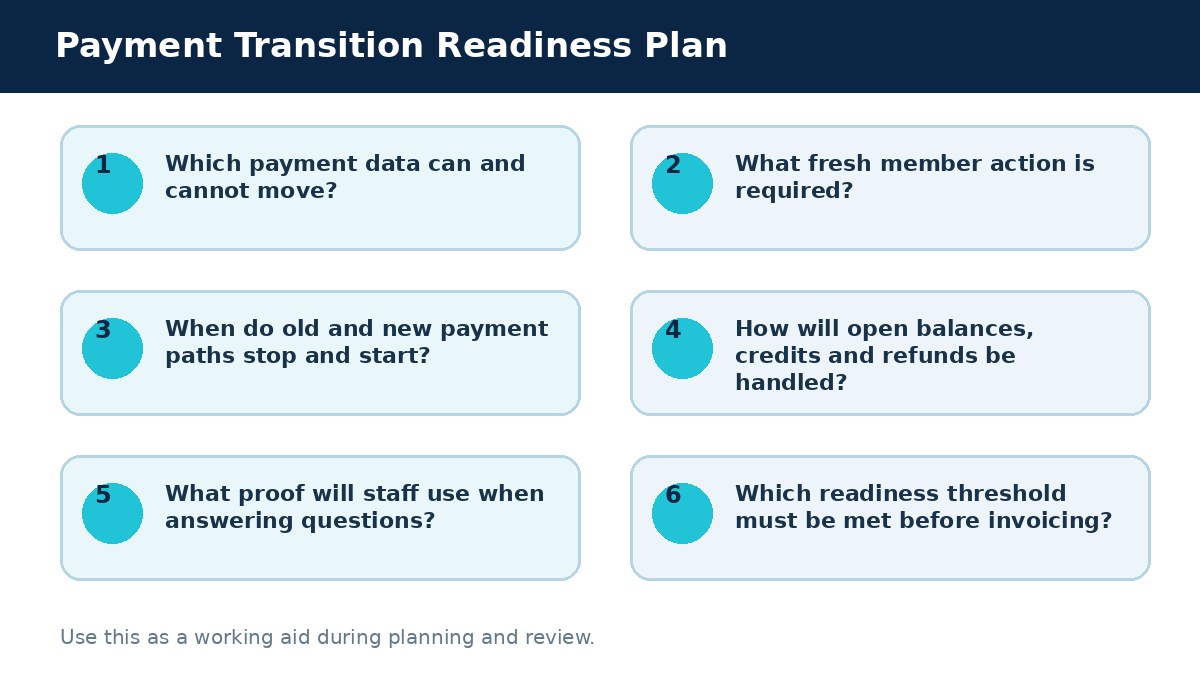
Answer these six control questions first
- Which payment data can and cannot move? Confirm separately what happens to customer records, saved methods, authorizations, invoices and transaction history. Record the answer from both providers, including anything the club must rebuild.
- What fresh member action is required? Identify who must enter a method, complete verification, provide a new authorization or choose an alternative. Do not ask everyone to repeat a step only some households need.
- When do old and new payment paths stop and start? Specify the cutoff date, time and time zone, the final old-system collection and the first new-system collection. Include automated retries.
- How will open balances, credits and refunds be handled? Decide where each item belongs, how it will be matched to its source and who checks that it appears exactly once.
- What proof will staff use when answering questions? Keep invoice references, transaction status, authorization records and approved schedules accessible to the appropriate staff, without exposing payment credentials.
- Which readiness threshold must be met before invoicing? Require reconciled balances and tested invoice delivery before release. For automatic collection, also require the necessary authorization and a single active collection path for each included account.
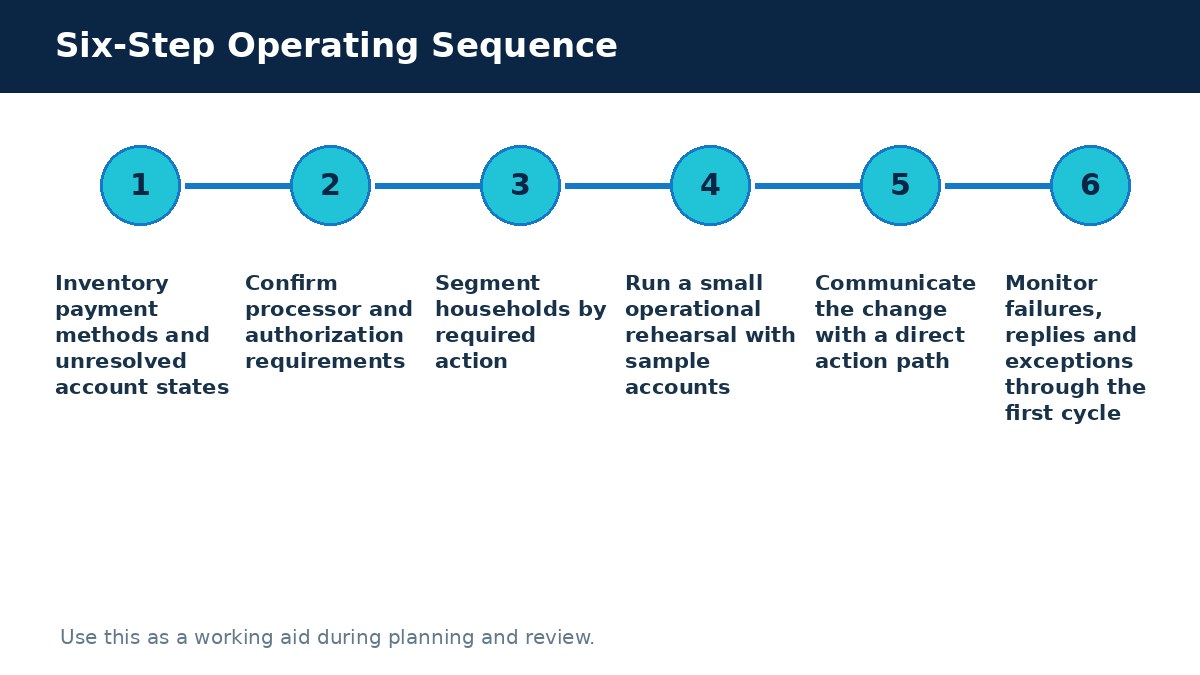
Build the plan in six deliberate steps
1. Inventory payment methods and unresolved account states
Start with the accounts that will be affected, rather than a total membership count. Separate saved cards, bank debits, member-initiated online payments, checks and any other accepted method. Identify the responsible payer for each household; the person receiving club newsletters may not be the person authorized to manage its payments.
Build a restricted working list using household IDs and provider references. Include the current method, next due date, payment schedule, outstanding amount, available credit and any action needed. Keep full card numbers, bank details and security codes out of this list. Staff need to know what is missing, not possess the credentials themselves.
Pull a separate exception list for pending payments, failed attempts awaiting retry, unapplied checks, partial refunds and open disputes. A refund approved by the manager but not yet processed needs different treatment from a credit available against next season’s dues. Ask finance to confirm the difference on each affected account.
Reconcile both individual households and totals. Two misplaced balances can cancel each other out in a grand total while leaving both families with incorrect bills. Save a dated opening-balance report and a mapping between old and new household references. Preserve original invoice dates and identifiers where possible so staff can explain an old charge without guessing.
2. Confirm processor and authorization requirements
Ask the outgoing and incoming providers to confirm the supported migration route for the club’s actual setup. A saved payment reference in one system is not evidence that the next system can use it. Do not assume card tokens, bank mandates or recurring-payment permissions transfer with the membership file.
Get answers about supported methods, who performs any secure transfer, expected lead time, customer matching and the evidence supplied when migration is complete. Stripe’s payment-data migration guidance , for example, treats payment-data transfer and subscription migration as separate work and warns about duplicate billing when old subscriptions remain active. Follow the process confirmed by your own providers.
Have the provider confirm which existing authorizations remain usable, which notices or fresh consents are required and what records must be retained. Where the answer depends on the club’s terms or local requirements, involve its appropriate adviser. A staff member’s assumption that “the member already agreed last year” should never be the basis for a new collection.
Also confirm settlement timing, refunds against old transactions, dispute access and reporting after the change. Ask what access, funding or account arrangements must remain in place to handle outstanding activity before closing the old account.
Review installment schedules separately. Record the original total, installments already paid, credits applied, remaining amount and future dates. Check whether importing a schedule creates an invoice or payment immediately. The member’s next installment should follow the approved arrangement, rather than restart the whole season’s bill.
3. Segment households by required action
Give each household one clear next step. Useful groups include members whose supported transfer needs no action, members who must add a card, members who must complete bank verification or authorization, manual-payment households and accounts held for finance review. Add a separate contact flag for bounced emails or an unconfirmed payer.
Within those groups, prioritize by the next payment date. Someone with an installment due next week needs help before a household whose annual bill is months away. Avoid treating every incomplete account as reluctant or overdue; a member may be waiting for bank verification or trying to recover portal access.
Use specific statuses such as “invitation sent,” “member action complete,” “verification pending” and “ready for scheduled collection.” Sending an invitation does not establish payment readiness. Record the owner and next follow-up date for anything unfinished.
Decide in advance how the club will handle members who cannot use the new route. Confirm any permitted alternative, extension or account hold with the person authorized to approve it. Front-desk staff should be able to explain the option without negotiating a new policy while other families wait.
4. Run a small operational rehearsal with sample accounts
Use the provider’s sandbox or test environment and test payment details for the initial rehearsal. Include a straightforward annual bill, an installment account, an account with a credit, a declined payment, a pending payment and a partial-refund case. Keep test records and messages away from live members.
Walk each case from the member’s action through the staff record and financial report. Does the right payer receive the notice? Does the remaining amount match? Is the receipt understandable? Can support distinguish a failed attempt from a payment still processing? Test on a phone as well as a staff computer.
Rehearse the transition cutoff too. Agree on a short freeze for changes to balances, schedules and payment settings while the final reconciliation happens. Keep a log of necessary changes during that window, such as a check received at the office, and apply each once after the snapshot. Tell staff where to record it.
Before enabling new collections, check old scheduled charges, retry queues, reminder links and staff permissions. Disable or redirect the routes that should stop, following provider instructions. Retain the access needed for permitted historical work. Two systems may remain available, but they should not both be trying to collect the same installment.
A sandbox rehearsal cannot establish that a live bank settlement has occurred. If a live pilot is needed, agree on the participants, genuine charges and member communication first. Do not run surprise “test” charges against member accounts.
5. Communicate the change with a direct action path
Send the first notice with enough time for members to act and staff to help, based on provider lead times and the renewal calendar. Explain what is changing, when it affects their household, the exact action needed and how to recognize completion. State any confirmed change to payment dates or fees plainly.
Use the club’s familiar sender and a verified secure portal or provider-hosted action link. Give members a way to reach the same destination from the club’s known website if they prefer not to follow an email link. Check the message and destination on a phone before sending.
Never ask members to email card numbers, bank details, passwords or security codes. The PCI Security Standards Council’s guidance on messaging prohibits sending unprotected card account numbers through email and similar channels. Keep the club’s practical instruction simple: enter payment information only through the approved secure route.
Offer help with finding the page, signing in and understanding the next step. Let the member enter their own payment details privately. Staff should not copy them into notes, photograph a card or collect passwords to finish later. If information arrives through an unintended channel, follow the club’s incident procedure rather than forwarding it around.
Send reminders only to households still needing action, after checking current status. Include actual office hours and a monitored contact. Avoid promising uninterrupted autopay or immediate refunds unless the team has verified those outcomes.
6. Monitor failures, replies and exceptions through the first cycle
Have finance review the first invoice batch before release: household count, amounts, credits, due dates, installment dates and collection settings. Separate sending an invoice from attempting automatic payment. An account awaiting authorization may need an invoice and assistance without being included in an automatic collection batch.
During the first cycle, compare invoices, payment attempts and member replies daily while activity is high. Before retrying an apparent failure, check its current provider status and whether another attempt is already scheduled. A member’s second click or a staff member’s manual retry can complicate an account that is still processing.
Continue through settlement reconciliation. Match household payments to provider transactions, then reconcile payouts and remaining provider balances to the club’s bank and accounting records. Identify fees, refunds, disputes and timing differences separately. Stripe’s payout reconciliation documentation illustrates why the report must fit the payout arrangement: its automatic-payout report differs from the approach needed for manual payouts.
Give each exception a named owner. Membership staff can handle missing action and delivery problems; finance should resolve unexplained balances, duplicate collections, refunds and settlement differences. Assign provider questions to one staff contact so contradictory support threads do not develop.
Record the affected household, invoice and transaction references, current status, last check, next action and member update. Close the first-cycle review when the released batch is reconciled and remaining items have explicit owners and follow-up dates. Keep older refunds and disputes under review for as long as they remain open.
A worked club scenario
Consider a hypothetical 420-household club changing processors before its March renewal cycle. Its provider-confirmed plan requires 250 card-paying households to enter a method again and 90 bank-paying households to complete a new authorization. Another 60 households pay by check. Twenty accounts need finance review before collection because of unresolved balances or account changes.
The administrator sends different instructions to each group. Check-paying members receive the confirmed payee, delivery instructions and reference to include, rather than an irrelevant demand to add a card. The 20 review accounts receive individual follow-up without an automatic collection attempt.
One installment account shows $1,200 in dues, $300 already paid and a $100 approved credit. Finance verifies an $800 remaining balance, scheduled as four future $200 payments. The rehearsal catches a proposed import that would have recreated the full $1,200 obligation. Staff correct the opening balance and schedule before releasing an invoice.
By the club’s action deadline, 238 card households and 81 bank households have completed the required steps. That leaves 319 ready for the planned automatic-payment route, subject to final checks. The 60 check households retain their separate route. The remaining 41 households, including the original 20 review accounts, stay outside automatic collection until their individual issues are resolved.
During the final freeze, the office receives a check against an old balance. Staff log it against the household and original invoice, and finance applies it once before approving the new opening balance. After launch, finance matches the first collected payments to provider reports and bank deposits. The administrator contacts members with missing actions while finance handles payment discrepancies. Each person knows which list belongs to them.
Know what a pause can and cannot reverse
Write down who can stop an invoice release or collection batch and how to reach them. Set clear reasons to pause, such as unexplained opening-balance differences, incorrect household matching, missing authorization evidence or an old retry process that remains active.
Before payment submission, a pause may allow the team to correct records and reschedule work. After submission, do not assume restoring an earlier file will reverse the payment. Check the actual transaction status with the provider and use its supported correction or refund process when appropriate. Keep members informed about confirmed actions and expected next updates.
Returning to the old system also needs a controlled decision. Check which new transactions have occurred, which schedules were stopped and whether the old payment route remains authorized and available. Never reactivate all old collections simply because the new batch has a problem. Reconcile first, then decide account by account.
Make the first invoice easy to explain
Before approval, ask a staff member to explain one ordinary account and one exception using the records they will actually have. They should be able to show what is owed, what has already happened, what happens next and whom to contact if it differs from the member’s expectation.
Use the PoolPulse features overview to prepare questions about your club’s billing and member workflows, then verify the specific payment and migration arrangements for your setup. To discuss the practical handoffs, Review PoolPulse billing and payment workflows . Bring a sample installment schedule, an account with a credit and the member-support questions your office expects to receive.

Renewal Emails Need an Owner, a Trigger and an Exit Rule
The club has a renewal calendar, but reminders are still assembled from different lists and different interpretations of who needs what. Learn the practical decisions, owners and checks that turn the issue into a controlled club workflow.

Freeze, Cancel, or Defer? Give Staff One Membership Answer
Separate membership freezes, cancellations, and deferrals with clear dates, financial treatment, access rules, approvals, and member communication.

One Household, Three Adults, One Bill: Decide Who Owns What
A household record can contain several adults, dependents and payment relationships, yet the club still needs one clear answer when a charge, refund or renewal question arrives. Learn the practical decisions, owners and checks that turn the issue into a controlled club workflow.
Want to see if PoolPulse is a good fit for your club?
Book a walkthrough and we'll show you exactly how PoolPulse can help based on your club's needs, goals, and current processes.