

Renewal Emails Need an Owner, a Trigger and an Exit Rule
The club has a renewal calendar, but reminders are still assembled from different lists and different interpretations of who needs what. Learn the practical decisions, owners and checks that turn the issue into a controlled club workflow.


You know the reply: “I paid yesterday. Why am I getting another reminder?” You open the account, find the payment, and spend the next few minutes reassuring someone who has already done what you asked. Meanwhile, the next reminder is waiting in a different queue.
Renewal season can feel like that even when everyone is working hard. The treasurer has the payment records, the membership volunteer has the email list, and the front desk knows about a conversation neither of them has seen yet. Each person has part of the answer. The member only sees the message that arrived.
A useful renewal communication plan brings those pieces together. Each email has someone looking after it, a clear reason for sending, and a clear reason to stop. That gives you a much better answer than “Sorry, it was automated,” and makes the next busy renewal week easier for whoever is covering the inbox.
Why renewal messages get harder as the deadline approaches
At the beginning of the season, “send everyone a reminder next Friday” sounds reasonable. By Thursday, some households have renewed, some have declined, a few are waiting on an account correction, and someone has mailed a check. Your audience has changed while the email was sitting there ready to go.
There is usually a practical explanation. Perhaps the mailing list was exported before the treasurer finished posting payments. Perhaps “renewed” means the form is complete to one person and the money has arrived to another. Those differences matter when the subject line says a member still owes something.
It helps to talk through those everyday situations before writing another reminder. You do not need a complicated system of meetings. You need the people handling renewals to agree on what the account statuses mean, which record they will trust, and who checks the audience before a message leaves.
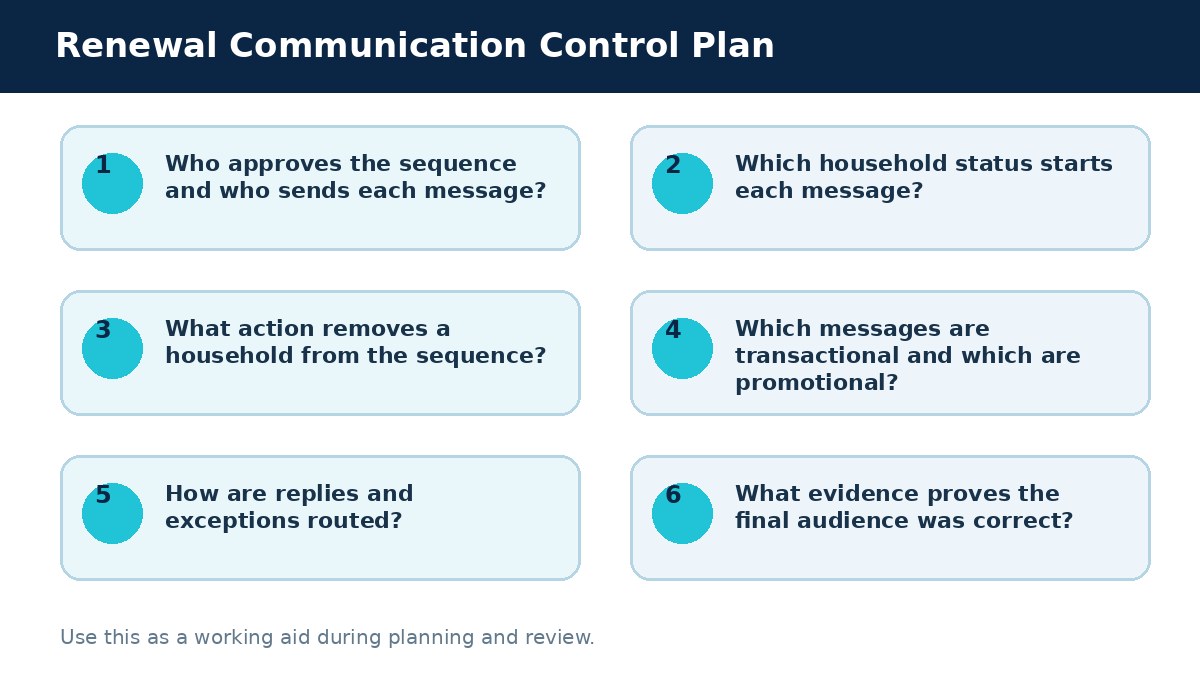
Six questions worth talking through together
- Who approves the sequence and who sends each message? Your board might approve the offer while the membership coordinator handles delivery. Naming both avoids an email being treated as approved simply because somebody finished writing it.
- Which household status starts each message? A household eligible to renew needs an invitation. Someone who started but did not finish may need help. Those are different conversations, even if both accounts appear on an unfinished-renewals list.
- What action removes a household from the sequence? A completed payment, a declined renewal, or a manual hold may change what comes next. Your agreed rule should explain each case so a member does not keep receiving the same request.
- Which messages are transactional and which are promotional? A receipt and an invitation to buy an extra program serve different purposes. Keeping that distinction visible helps you review the wording and the appropriate audience.
- How are replies and exceptions routed? When someone asks about a credit, the reply needs to reach a person who can check it. A named backup matters just as much when the usual coordinator is away.
- What evidence proves the final audience was correct? Keep the audience rule and the time it was checked with the send record. If a member calls later, you can follow what happened without asking three volunteers to search their laptops.
If two colleagues answer one of these questions differently, you have found something useful. It is far easier to sort out the meaning of “complete” over coffee than after a paid member has received a final warning.
Keep the explanation close to the account
When a member asks why they received an email, the useful starting point is their renewal record. Was the form unfinished? Was a payment still pending? Was an approved adjustment waiting to be entered? A note that answers the actual question is more helpful than a general explanation of how your mailing software works.
PoolPulse connects memberships, billing, check-ins, reservations, programs, POS, staffing, reports and member self-service in one operating record, as described in the PoolPulse features overview. That connection matters here because a decision rarely stays inside one screen. A membership rule can affect billing, access and communications; a program rule can affect capacity, staffing and household balances. Evaluate the complete handoff, not only the first action.
When a message is primarily commercial, the club also needs to follow the Federal Trade Commission’s CAN-SPAM compliance guidance , including accurate headers and subject lines, a valid address, a clear opt-out path and prompt handling of opt-out requests. The FTC explains that membership does not eliminate a recipient’s right to opt out of marketing email. Keep legal review separate from the operating checklist when the line between account notice and promotion is unclear.
Putting the renewal sequence together
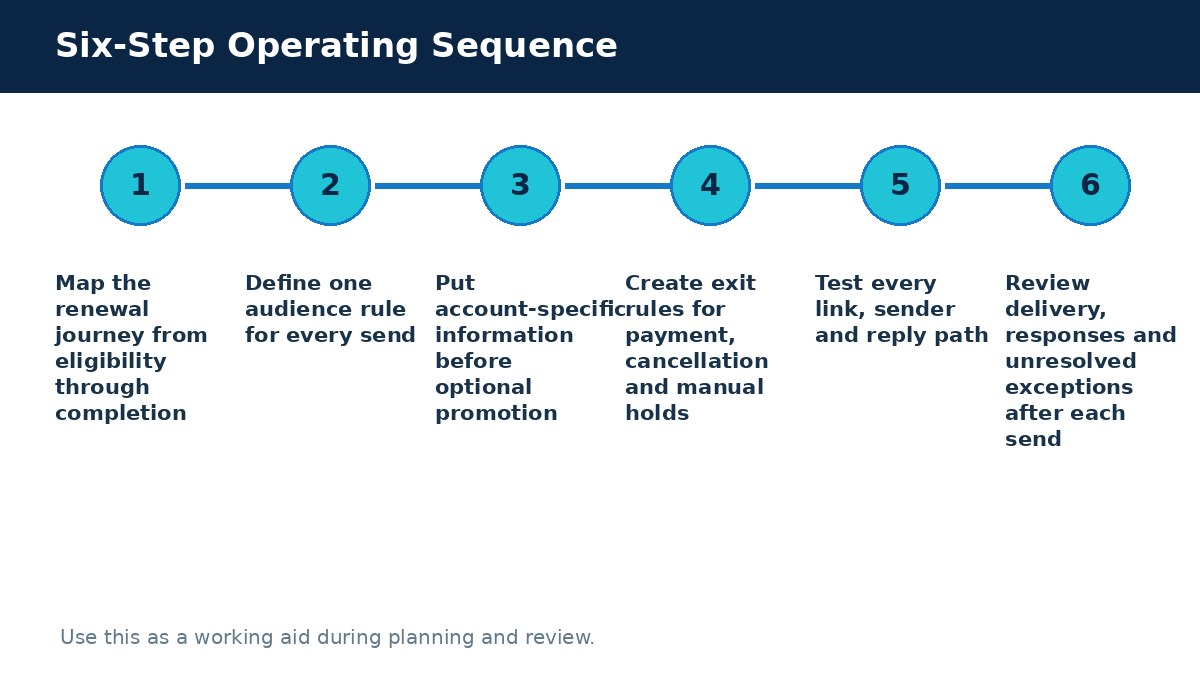
1. Follow a household from invitation to finished renewal
Picture a member opening the first invitation on their phone. They should be able to recognize the club, understand the offer, and find the right place to renew. After they act, the next message should make sense for what they actually did.
Walking through one household makes gaps easier to spot. Perhaps the payment succeeds but a required form is still missing. That family needs a clear explanation of the remaining form, rather than another request to pay. Include an awkward case too, such as an approved credit that changes the balance.
2. Give every email a specific audience
“Members who have not renewed” leaves plenty of room for interpretation. A more useful description might be eligible households that have not started, excluding those that declined or are on a staff review hold. Your club's actual categories may differ, but a colleague should be able to understand the selection.
Before the send, try a few accounts you already know: one completed renewal, one incomplete renewal, and one held account. Seeing the right people included and excluded gives you more confidence than checking the total alone. If the count looks surprising, there is still time to investigate.
3. Lead with what this member needs to know
A renewal email has a fairly simple job. It tells the member what is available, what applies to their account, when they need to act, and where to get help. That is plenty to work through on a small phone screen.
Optional news can wait if it distracts from the account question. Imagine opening a balance reminder and having to scroll past a program promotion to find the amount or payment link. A friendly greeting and a clear next step often feel more welcoming than adding another paragraph about everything happening at the club.
4. Make sure the reminders know when to stop
This is the part worth testing carefully. Once the agreed completion condition is met, the household should leave the unfinished-renewal sequence. A cancellation or declined invitation needs its own treatment, and a staff hold should have a reason and someone responsible for reviewing it.
Pending payments deserve particular care. Your team's rule should explain what the member sees while the outcome is being checked. You want to avoid prompting a second payment simply because the first has not reached its final state. The finance owner can help define that point using your actual payment process.
5. Try the links, sender name and reply route yourself
A quick test message can catch surprisingly practical problems: an old sender name, a link that lands on the wrong page, or replies going to an inbox nobody checks. Open it on your phone as well as your usual computer.
Then reply as though you were a member with a question. Who receives it? Can they find the household? What happens if the question needs the treasurer? The person covering Saturday morning should have a usable answer without tracking down the colleague who built the campaign.
6. Leave a little room to check what happened
The send button is the beginning of the next part of the work. Failed deliveries, member replies and account corrections can all change who belongs in the following reminder. A short review after each send keeps those changes from piling up.
A question that remains open needs a person and a next step. “Treasurer checking the credit; membership coordinator replying after review” gives the next shift something to work with. It also makes it easier to spot the accounts that should stay out of another automated message for now.
What this might look like at your club
Imagine a 420-household club preparing its 2027 renewals. The membership coordinator has a reminder planned for Friday. On Thursday afternoon, the treasurer posts a batch of payments, a family declines its invitation, and another household asks about a credit that was promised last season.
With a saved list from Monday, all three could still receive the same reminder. With a current audience check, their paths separate. The paid household leaves the payment-reminder group. The declined household follows the club's agreed process. The credit question goes on a temporary review hold while the treasurer checks the record.
The coordinator can now explain Friday's audience to the volunteer covering the inbox. If the held member calls, that volunteer sees who is checking the credit and what response is expected. Nobody has to invent an answer or tell the family to start again.
That small example also exposes a useful test: what happens when the hold is resolved? If the credit is approved and entered, the next communication needs to reflect the resulting balance. Releasing the hold should include checking the next message, rather than quietly putting the household back into an old mailing list.
A short record your colleague can actually use
You can keep the plan in whatever shared place your team already checks. For each message, the useful details are the purpose, audience, exclusions, approved wording, send time, sender, reply owner and stopping rule. Link the relevant policy or decision instead of copying a long board discussion into the email notes.
After a send, add its actual outcome and the audience check that went with it. If someone changes the selection, keep a brief reason. “Excluded households with unresolved credits” tells the next coordinator much more than “list updated.”
The record should make absence manageable. A colleague stepping in needs to find what is due next and which accounts need care. They should not need access to a former volunteer's personal spreadsheet to understand the renewal sequence.
The awkward cases are worth rehearsing
Think about the questions that tend to arrive at the front desk. One adult paid while another received the reminder. A member mailed a check. Someone says they opted out and wants to know why this email arrived. These situations need different checks, even though they may all begin with an unhappy reply.
For each case, agree on where staff look and who can make the relevant decision. A volunteer can acknowledge the concern without promising a credit or changing a payment record. They can also explain when the member should expect a response, using a timeframe the responsible person has actually agreed to.
A repeated exception is worth discussing after the rush. If several members ask the same question, the wording or account status may be unclear. That is a chance to improve the next email rather than prepare the team to answer the same confusion indefinitely.
Look at the member experience after the send
A delivery report answers one useful question, but it does not tell you whether the message made sense. Member replies, unfinished renewals and manual corrections help explain the rest. A busy inbox may reveal an unclear instruction rather than a need for more reminders.
Keep the review small enough to happen. Which question came up repeatedly? Did completed households receive another request? Were any replies left without an owner? One specific improvement, checked before the next send, is more useful than a long list nobody has time to tackle.
Let the wording change as the household moves forward
The first invitation can be welcoming and straightforward: your renewal is available, here is what it covers, and here is where to review it. A later reminder has a different job. It should help someone finish the remaining step, without making them read the entire invitation again.
Suppose a member has completed the form but still has a balance. A useful message might explain that the form has arrived and identify the payment step still outstanding. If the account instead shows a pending payment, the appropriate wording may explain that the result is being checked. Your finance team's agreed status definitions determine which version is right.
Someone who has not started may simply need the original link and deadline again. Someone who has already asked for help needs an answer to their question. Treating those households differently makes the communication feel attentive without requiring you to write every message from scratch.
Keep the member's likely question in mind as you read the draft aloud. “Is this asking me to do something? Have you received what I already sent? Who can help me?” If the email answers those questions clearly, it is doing useful work. A friendly opening helps, but the reassurance comes from information that fits their situation.
There is room for warmth in a practical message. “Thanks for taking care of your renewal” sounds human when the account really is complete. A short acknowledgment of a question can help someone feel heard while a colleague investigates. The important part is that the words match what you know, rather than promising an outcome you have not checked.
Give the inbox a handover of its own
The day after a large send is a good time to make coverage visible. If the coordinator is away, the backup needs access through the club's approved arrangements, an understanding of the common questions, and a way to reach the people who can resolve account issues. A name on the calendar is only useful if that person can actually do the work.
A short handover can say which message went out, which households were included, and what unusual cases are already under review. It can also identify any wording that may need clarification. That gives the person opening the inbox context before they begin replying.
Failed deliveries need a little attention too. A household that never received its invitation may look inactive in the renewal list. Before assuming the member has decided not to return, check the delivery record and follow your club's approved contact process. Any corrected address should reach the account record, so the next email does not repeat the same problem.
Duplicate replies can be confusing for members and waste time for staff. If the treasurer is handling a balance question, the membership volunteer should be able to see that the conversation has an owner. A brief note about who will respond and what they are checking can prevent two well-meant but conflicting answers.
At the end of the shift, the useful handover is the unfinished work. Which member is waiting? What information is missing? Who has agreed to check it? A colleague coming in tomorrow should be able to continue the conversation without asking the member to explain the whole history again.
It is worth trying this once before the busiest renewal week. Send a test question, have the backup find the sample account, and follow the question through to a response. You may discover a missing permission, an outdated contact name or an unclear responsibility while there is still time to put it right.
One final detail can save a surprising amount of searching: keep the actual sent version beside the record. If somebody adjusts a deadline or corrects a link after the first email, your colleague needs to know which wording that member received. The current template may no longer answer that question. Keeping the earlier message, its audience and its send time together makes it easier to explain a correction clearly and avoid sending another message based on an outdated account assumption.
A last conversation before the sequence goes out
Before approving the sequence, ask the colleague who will answer replies to read it. Can they explain why a household receives each message and what stops it? Can they find the help route and understand the payment language? Their practical questions can reveal something the person writing the emails has stopped noticing.
It is also worth agreeing who can pause a send if the audience looks wrong. A late payment import or unresolved account problem may need a quick decision. Knowing who can make that call keeps a routine correction from becoming a scramble.
Keeping it useful through the season
During setup, the plan may need frequent attention. Once renewals are moving, focus your check-ins on open questions, changed accounts and the next scheduled message. Completed work can stay in the history without crowding the everyday view.
Attach responsibilities to roles as well as names. “Membership coordinator” still means something when a volunteer changes, while the current person's name tells everyone where to take a question today. A simple handover includes the next send, outstanding holds and the location of the approved copy.
The communication plan should continue to reflect the club's decisions. It cannot settle a disputed fee, change payment authorization or rewrite policy on its own. When one of those questions comes up, the right owner resolves it and the messages follow the approved answer.
One helpful check is to read the sequence as a household rather than as its author. Put the invitation, reminder and confirmation together in order. Does each message recognize what came before it? Are the deadline, contact details and description of the renewal consistent? A small wording change between templates can leave someone wondering whether they are looking at a different offer.
You can ask a colleague who didn't write the messages to try this with a sample account. Give them the same information a member would see, then ask what they think happens next. Their answer may reveal that an instruction makes sense only because you already know the process. Fixing that sentence is usually easier than explaining it repeatedly during renewal week. Keep the test account fictional, and check any account-specific details before sending the real version to members. That rehearsal gives the team something concrete to discuss.
Give the next renewal week a better starting point
You do not have to anticipate every conversation a member might start. A dependable sequence gives you enough context to respond thoughtfully: who received the message, why they received it, and what needs to happen next. That leaves more time for helping people and less time apologizing for a reminder they never needed.
If you would like to walk through that experience with your own club in mind, See PoolPulse communications and renewal workflows . Bring a typical renewal and one of the account questions that slows your team down. Following both through together gives the conversation a useful place to start.

Changing Payment Methods? Plan the Member Transition Before the Invoice
A payment change looks technical until the first invoice fails, a member cannot find a receipt or staff cannot explain whether an old authorization still applies. Learn the practical decisions, owners and checks that turn the issue into a controlled club workflow.

Before Renewals Open, Decide What “Active Member” Actually Means
Build one membership-status rule that billing, check-in, renewals, and staff can apply without guessing.

Freeze, Cancel, or Defer? Give Staff One Membership Answer
Separate membership freezes, cancellations, and deferrals with clear dates, financial treatment, access rules, approvals, and member communication.
Want to see if PoolPulse is a good fit for your club?
Book a walkthrough and we'll show you exactly how PoolPulse can help based on your club's needs, goals, and current processes.