

One Household, Three Adults, One Bill: Decide Who Owns What
A household record can contain several adults, dependents and payment relationships, yet the club still needs one clear answer when a charge, refund or renewal question arrives. Learn the practical decisions, owners and checks that turn the issue into a controlled club workflow.


Picture a familiar front-desk conversation. One adult asks why the renewal notice went to their partner. Another says they paid the bill last year. A third is listed on the household and wants to change the card on file. Everyone is talking about the same membership, but they may be asking for very different kinds of access.
If you've ever had to untangle that conversation while other members are waiting, you know how quickly a simple billing question can become uncomfortable. You want to help. You also don't want to share a balance with the wrong person, change an arrangement without permission or send the family another round of conflicting messages.
A household billing responsibility map gives your team somewhere sensible to start. It brings together who is responsible for the dues, who receives billing messages and who may request particular changes. Those answers can live in your existing account records. The useful part is making them clear enough that the next administrator can pick up the conversation without guessing.
Why this gets harder when renewals are close
Households change between seasons. An adult moves out, a grandparent helps with the membership fee, or the person who always handled renewals asks someone else to take over. Meanwhile, last year's email address is still sitting in the billing contact field. Nothing looks obviously wrong until an invoice arrives somewhere unexpected.
The word “primary” can cause its own confusion. Your membership coordinator may use it for the person who answers messages fastest. Finance may read it as the person responsible for payment. A volunteer may assume it means anyone allowed to make changes. All three are trying to do their jobs, but they're working from different definitions.
It's easier to settle those meanings before the renewal batch goes out. A short conversation between membership, finance and the person responsible for account permissions can save staff from having to improvise in front of a member. Start with the questions your team actually receives, including the awkward ones.
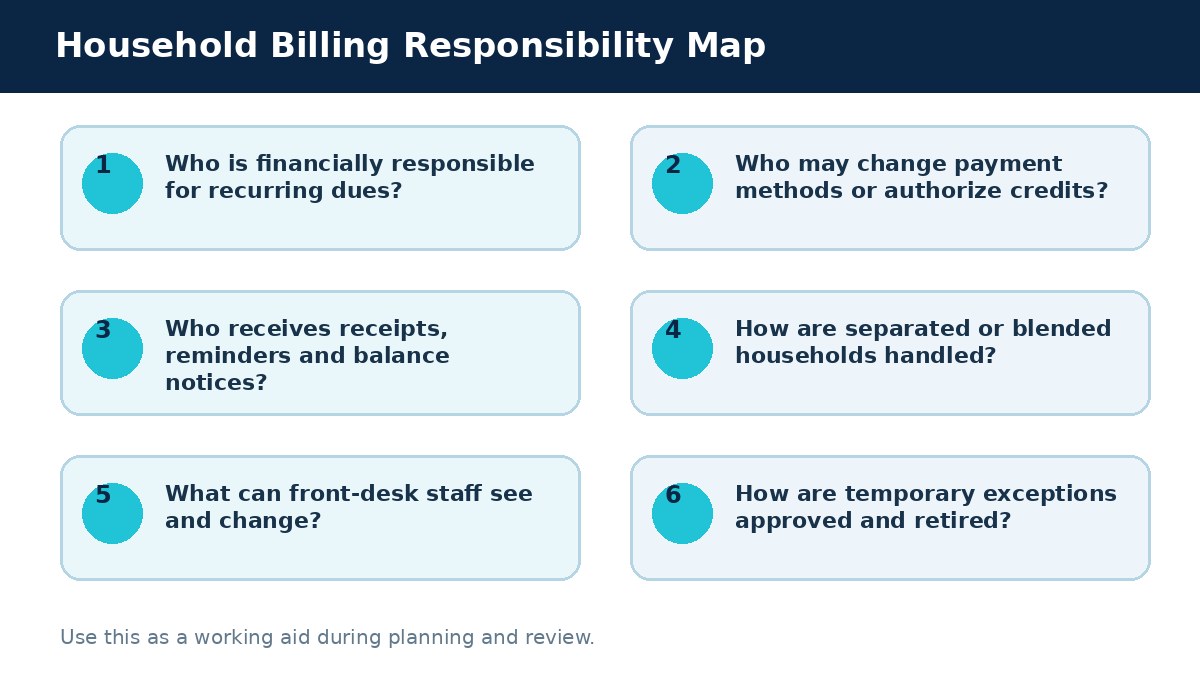
Six questions worth talking through together
- Who is financially responsible for recurring dues? The person who paid once may simply have been helping. Your answer should come from the membership agreement and the club's approved arrangement, rather than whichever name appears on the latest receipt.
- Who may change payment methods or authorize credits? A member's permission to request a change and an employee's authority to approve it are separate questions. Knowing both helps staff explain why a request sometimes needs another person's review.
- Who receives receipts, reminders and balance notices? A household may want ordinary club news sent to several adults while billing goes to one contact. Keeping those preferences distinct makes the messages easier to understand.
- How are separated or blended households handled? A shared membership doesn't settle every question about access to information. A private review with the appropriate administrator is kinder and safer than asking a family to explain sensitive details at the counter.
- What can front-desk staff see and change? They need enough information to help with the visit and direct a billing question. They don't necessarily need the account history or permission to alter the financial arrangement.
- How are temporary exceptions approved and retired? Someone might handle billing while another adult is away. A recorded end date and an approving person help that temporary arrangement end without another round of confusion.
You don't need perfect answers to every possible family situation before getting started. You do need an agreed route for questions that don't fit the usual arrangement. Staff should know who can help, and members should know when they can expect an answer.
The account record should explain the answer
When someone asks why they received a reminder, “that's how the system is set up” isn't a very satisfying answer. It's much more helpful to see the approved billing contact, when the choice was confirmed and whether a later request is still being reviewed. The record lets you explain what happened without blaming the member or another colleague.
The same principle applies when evaluating software. Try a sample household with different billing and general communication contacts. Follow an invoice, a receipt and a request to change the contact. A screenshot of a settings page won't tell you where those messages actually end up.
PoolPulse connects memberships, billing, check-ins, reservations, programs, POS, staffing, reports and member self-service in one operating record, as described in the PoolPulse features overview. That connection matters here because a decision rarely stays inside one screen. A membership rule can affect billing, access and communications; a program rule can affect capacity, staffing and household balances. Evaluate the complete handoff, not only the first action.
Putting the household arrangement into everyday practice
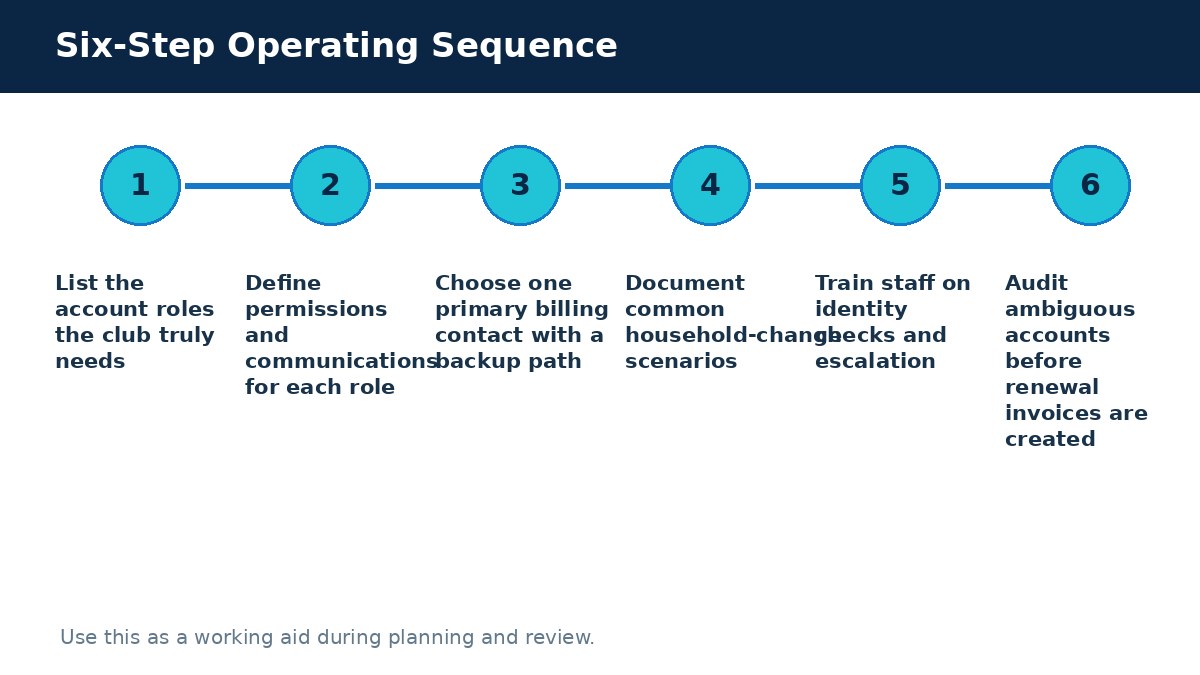
1. Start with the account roles your club actually needs
Think about a household you could comfortably use as a training example. Who signed the membership agreement? Who normally pays? Who answers questions about the children’s activities? Who needs ordinary access to the club? One person may fill several roles, but that doesn't make the roles interchangeable.
A short list is usually easier to maintain than a collection of labels nobody can explain. If “billing contact” and “responsible member” mean different things at your club, a sentence beside each definition helps. The board or treasurer should settle any policy question before staff start applying the new labels.
2. Pair each role with the messages and changes it allows
Now imagine that adult signing in or calling the office. Which messages should they receive? Could they update their own contact details? Would a request to change the household's billing arrangement need approval? Talking through those ordinary moments makes a permission discussion much less abstract.
A simple test is to ask a colleague to use the sample account without coaching. If they cannot tell whether a balance notice will go to one adult or everyone, there's still something to clarify. Keep a note of what actually happened so the next check starts from the same information.
3. Give billing a clear contact and a sensible backup
One agreed billing contact gives the team a starting point when an invoice needs attention. That choice should be confirmed through your approved process, with a clear explanation of what the contact will receive. It shouldn't quietly change who is financially responsible under the membership arrangement.
A backup route matters when that person is unavailable or their email stops working. That might mean contacting them through another approved channel or referring the account to membership staff. Adding another adult to financial messages just because they're easy to reach can create a different problem.
4. Make room for the changes families actually bring you
Useful examples include a new billing contact, an adult leaving a household, a grandparent paying for a season and a temporary arrangement during travel. Each brings a slightly different question. A payment from someone else, for instance, doesn't by itself tell you that future reminders should go to them.
For each example, your team needs to know which information to confirm and who can approve the change. Sensitive circumstances belong in the appropriate restricted record. The everyday staff note can simply explain the permitted action and where further questions should go.
5. Give staff a comfortable way to pause and ask
A volunteer shouldn't have to choose between sounding unhelpful and making a change they aren't authorized to make. A natural response might be, “I can help get that reviewed. Our membership administrator handles billing-contact changes, so I'll make sure the request reaches them.”
Practice the club's identity checks along with that response. Include a caller who knows the household names but isn't listed for billing access. The exercise helps staff recognize when to continue, when to pause and how to avoid sharing information while they find the right colleague.
6. Review the unclear accounts before creating invoices
The accounts worth attention are often recognizable: two adults both marked primary, a bounced billing address, an old temporary note or a contact-change request without a recorded outcome. Reviewing those cases before invoice creation gives members time to confirm arrangements without the pressure of a payment reminder.
Where an answer is still pending, give the account a named reviewer and a follow-up date. Your club's policy should explain how invoicing and reminders are handled during that review. A blank field should never leave the next shift wondering whether anyone is working on it.
How this might look at a 420-household club
Imagine a club preparing its 2027 renewals. On one sample account, Morgan handles membership questions, Alex is the confirmed billing contact and another adult is included in the membership. Last season, Morgan helped make a payment while Alex was away. The receipt is still there, but the temporary arrangement was never clearly closed.
Before the next invoice goes out, the coordinator checks the approved record and asks for confirmation through the club's usual process. The question is small and specific: does the existing billing-contact arrangement still apply? There's no need to ask the family to retell unrelated personal details.
The team notices that “updated” has been used for two different stages. One colleague means the family has requested a change; another means the change has been approved and applied. They agree to distinguish proposed, approved, configured and released changes, with a date and responsible person for each. Now the front desk can see that the request is being reviewed without assuming the account is already different.
After approval, someone checks the next invoice recipient and the member-facing account view. The coordinator confirms the completed arrangement with the appropriate contact. A colleague covering the following shift can then answer a question from the record, rather than searching an email thread or relying on whoever remembers the conversation.
A note the next administrator can use
A useful account note is brief, factual and specific to the request. “Billing sorted” leaves too much to interpretation. “Billing contact confirmed through the approved process; next invoice recipient checked; temporary arrangement ended” tells the next person what was completed, with references to the supporting records where appropriate.
For an open request, the useful details are different: what is being reviewed, who is handling it, what information is outstanding and the promised follow-up date. Keep unnecessary family details out of general notes. You want colleagues to understand the work they need to do without exposing information they don't need.
Older decisions still have value. Keeping the previous arrangement and the effective date of the new one helps explain why last month's receipt went somewhere different. That history is especially useful when a new administrator takes over halfway through the season.
Try the awkward questions before the busy weekend
It's worth asking, “What would we do if two adults gave us conflicting instructions?” Another useful case is a person requesting a refund when someone else made the payment. Your staff shouldn't settle either situation by choosing the most confident caller. They need the club's approved review route and a way to record the question.
Some situations will still require judgment. The aim is to make it easy to reach the person authorized to exercise it. If the same exception keeps coming back, it may be worth revisiting the policy or the way the account labels are explained. More reminders won't repair a definition everyone understands differently.
Check how the first renewal cycle feels for members
Once the new arrangements are in use, the replies are useful feedback. Are people asking why they received a balance notice? Are staff forwarding the same question repeatedly? Is a household waiting because its request moved between membership and finance without a clear handoff?
A short review with the colleagues answering those messages can reveal where the process needs a small adjustment. Keep the original decision, explain the change and check it on a sample account before applying it more widely. That gives future staff a reason they can understand, rather than another unexplained setting.
A payment from another adult deserves its own explanation
Suppose a grandparent offers to pay a family's annual dues. It's a generous gesture, and nobody wants the paperwork to make it difficult. The account still needs to show which charge the payment covers and how the club confirmed it. The person paying may need a receipt without becoming the household's ongoing billing contact.
Before changing anything, the administrator checks the existing arrangement and the club's process for payments made by someone else. If there is a question about a refund later, finance can follow the original transaction and its approved handling. Staff won't need to reconstruct the relationship from a surname or assume the cardholder should receive every future balance notice.
When a message goes to the wrong place
An incorrect reminder can be embarrassing for the club and frustrating for the recipient. The immediate job is to understand what happened and prevent another incorrect message while the account is reviewed. A considerate reply acknowledges the question and explains who is checking it, without discussing anyone else's private details.
The underlying cause matters. Perhaps the contact was corrected on the household screen but an older mailing list was still being used. Perhaps the request was recorded but never approved. Checking the actual recipient list, account history and message record helps your team correct the right part. The follow-up should say what was resolved and what, if anything, the member still needs to confirm.
A backup contact without an accidental permission change
Imagine the usual billing contact is away during renewal week. Another adult calls because the household wants to renew before the deadline. It's tempting to change the contact immediately and get the question out of the queue. A little care here can save a much more awkward conversation when the usual contact returns.
Your approved process might allow a temporary communication arrangement after the required checks. If so, the record can explain its purpose, the information that may be shared, who approved it and when it ends. Staff can then help within those boundaries. The temporary note doesn't have to grant broader account access or silently replace the family's established billing arrangement.
A small rehearsal for the colleague covering your desk
Before handing the process to a weekend volunteer, try a short practice conversation. One person plays a member asking to update the billing email. The other uses only the information and permissions they will actually have on shift. No hints from the person who built the setup.
You'll quickly hear where the language needs work. “I can't do that” can become a helpful explanation of who handles the request and how it will reach them. An unclear account note can become a simple next step. The rehearsal also shows whether the volunteer can find the right contact without searching several systems while the member waits.
What the treasurer needs at the handover
The treasurer may receive a billing question after the membership office has already spoken with the family. A useful handover connects the account reference, the specific charge or payment, the request and the checks already completed. It should be clear whether the member is asking a question, requesting a change or disputing an amount.
That distinction helps the treasurer respond without repeating the entire interview. It also keeps an administrator's helpful note from sounding like an approval they weren't authorized to give. Once finance reaches a decision, the outcome belongs back with the request so the next person sees a complete conversation.
A follow-up date is helpful even when the answer isn't ready. If the treasurer is waiting for an approval record, the membership administrator can tell the appropriate contact that the review is still open and give the agreed update time. That keeps silence from looking like a forgotten request. When the answer arrives, somebody should check both the account and any pending message, so the member receives the same explanation whichever colleague they speak with next.
A final conversation before the team uses it
Ask a colleague to talk you through one ordinary household and one unresolved request. Can they identify the billing contact, find the approved arrangement and explain what happens next? Can a front-desk volunteer direct the question without opening private board notes? Can someone stop an incorrect message or send a disputed change for review?
If those answers are comfortable, you're much closer to an arrangement the team can use. If someone hesitates, that's helpful too. It's better to find the unclear part together now than have a member discover it while standing at reception.
Keeping the record useful after opening day
Household administration keeps moving after renewals. A regular review of open changes and temporary arrangements helps prevent them from becoming permanent by accident. Completed requests can move out of the working list while their approval history stays available to authorized staff.
Role names make a handover easier, but somebody still needs to be responsible today. “Membership administrator” should lead to a current person and a backup. When a volunteer finishes their term, outstanding requests need a deliberate handover rather than another season in an unattended inbox.
The map also has limits. It should reflect approved club policy, payment authorization and applicable legal obligations. It shouldn't quietly rewrite them. When a question reaches beyond routine administration, the appropriate owner needs to resolve it before the account is changed.
It also helps to distinguish a corrected address from a different billing contact. They can look similar in an inbox: “Please send the next invoice here.” One request may fix a typo for the same authorized person. Another may change who receives private account information. Your colleague needs enough context to tell which request they are handling before making the update.
A clarification can keep the conversation friendly. “Are you updating your own email address, or asking us to change the household's billing contact?” From there, staff can follow the relevant approved process rather than treating every new address as a routine correction. If the answer is unclear, the request can wait for the membership administrator without leaving the member wondering why.
After a permitted correction, check where the next message will actually go. An address stored correctly on the account is only part of the answer if a prepared invoice or reminder still carries the old details. A quick check of that pending communication can prevent the family from having to raise the same issue again during another visit.
Making the next conversation easier
The real benefit is a more comfortable conversation with the member. Your colleague can explain the arrangement, recognize a request that needs review and give a useful next step. The family doesn't have to repeat the same story to three people, and your team doesn't have to guess who may do what.
If this is a familiar challenge at your club, Explore PoolPulse household and billing workflows . Bring one everyday household arrangement and one question that tends to send staff searching through old messages. Following those examples together is a useful way to see where clearer records could make your team's day easier.

Changing Payment Methods? Plan the Member Transition Before the Invoice
A payment change looks technical until the first invoice fails, a member cannot find a receipt or staff cannot explain whether an old authorization still applies. Learn the practical decisions, owners and checks that turn the issue into a controlled club workflow.

Renewal Emails Need an Owner, a Trigger and an Exit Rule
The club has a renewal calendar, but reminders are still assembled from different lists and different interpretations of who needs what. Learn the practical decisions, owners and checks that turn the issue into a controlled club workflow.

A Payment Dispute Is Won or Lost Before the Bank Email Arrives
Build a chronological payment record that connects the charge, policy, service, communication, and refund history.
Want to see if PoolPulse is a good fit for your club?
Book a walkthrough and we'll show you exactly how PoolPulse can help based on your club's needs, goals, and current processes.