

Do Not Ask Your Board to Approve Software From a Demo Deck
A board-ready framework that converts demos and proposals into an operational, financial, and implementation decision.


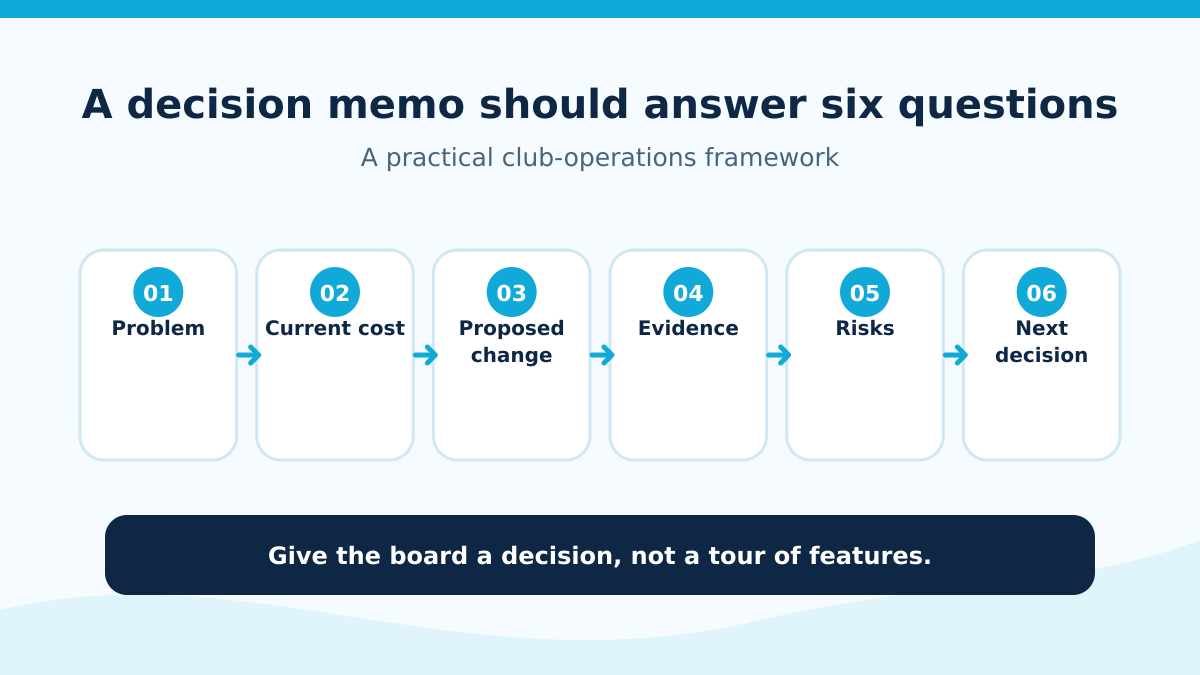
A polished demo can show dozens of capabilities and still leave a board unable to make a responsible decision. The unanswered questions usually sit outside the slides: Which current problem are we solving? What work changes? What does the first year cost? What was actually demonstrated? Who owns implementation? What happens if the calendar slips?
Give the board a short decision memo, not a transcript of the sales process. The memo should translate product information into the club’s operating model, preserve unknowns, and state exactly what approval is requested. Supporting proposals, notes, and test results can remain in an appendix.
This structure is useful whether the recommendation is to buy, continue due diligence, run a limited test, or stop. A good memo makes “not yet” as actionable as “yes.”
Build the decision around the club’s real work
The strongest plan starts with one ordinary transaction, the people who touch it, the rules they apply, and the record that should remain when the work is done. Use the sections below as a working session with the employees and volunteers who run the process. Write down assumptions, unresolved questions, and owners as you go.
1. State the operating problem in one paragraph
Name the recurring club moment that creates the decision: staff cannot see a household’s current standing, billing and POS require reconciliation, reservations live in a side calendar, or board reporting depends on manual assembly.
Describe frequency, affected roles, and the current workaround using the club’s own evidence. Avoid universal claims about what every club experiences.
Questions to answer:
- What happens today?
- Who is affected?
- How often does it occur?
- What workaround exists?
- What evidence is ours?
The board understands why the item is on the agenda before it sees any product detail.
2. Describe the proposed change as a workflow
Do not lead with modules. Explain how a household, payment, booking, check-in, schedule, or report would move differently. Identify what becomes connected, what remains manual, and which role makes each decision.
Link every expected benefit to a step that was demonstrated or otherwise verified. Keep planned, configurable, and available capabilities distinct.
Questions to answer:
- What step changes?
- What remains manual?
- Who uses it?
- What was verified?
- What depends on configuration?
The recommendation is tied to observable work rather than to persuasive labels.
3. Show current, first-year, and steady-state cost
Present existing subscriptions and measured workload, the proposed commercial terms, implementation and overlap, and the expected steady state. Use the same transaction and staffing assumptions for each option.
PoolPulse plans start at $349 per month , with selected capabilities, no setup fee, no contracts, and free migration. Confirm the club’s actual configuration and commercial terms in writing before approval.
Questions to answer:
- What do we pay now?
- What overlaps in year one?
- What is the quoted configuration?
- What remains variable?
- What is the steady state?
The financial view separates published starting information from the specific proposal the board is being asked to fund.
4. Summarize evidence and unanswered questions
List the workflows tested, people who participated, sample data used, links or documents reviewed, and outcomes. Put unanswered questions beside their owner and due date.
Use a simple confidence label such as verified, partially verified, or open, with a plain explanation. Do not turn an attractive screenshot into proof that the complete workflow fits.
Questions to answer:
- What was shown live?
- Who tested it?
- Which source is current?
- What remains open?
- When will it be answered?
The board can see both the strength and boundary of the evaluation.
5. Make implementation concrete
Name the data owner, configuration owner, training owner, acceptance reviewer, executive sponsor, and vendor counterpart. Show milestones around renewal, registration, staffing, and opening dates.
Define acceptance checks for member records, balances, permissions, daily workflows, reports, and support. Include a decision point if a gate does not pass.
Questions to answer:
- Who owns data?
- Who owns configuration?
- Who trains staff?
- What must pass?
- What happens after a miss?
Approval funds a manageable project rather than an undefined handoff to staff.
6. Present risks with responses
Use club-specific risks: contract overlap, incomplete data, unavailable staff, unclear policy, unverified integration, compressed training, or a peak-season conflict. Pair each with an owner and response.
Avoid theatrical probability scores when the club lacks evidence. A clear description, trigger, mitigation, and decision point is more useful.
Questions to answer:
- What could block launch?
- What would reveal it?
- Who responds?
- What is the fallback?
- When is the decision revisited?
The board can judge whether remaining uncertainty is acceptable and controlled.
7. Ask for one exact decision
End with the motion or next gate: authorize final contract review up to a stated amount, approve a defined test, approve implementation subject to named conditions, or decline and document why.
State the owner, deadline, and reporting expectation. Separate approval to continue due diligence from approval to publish, migrate, or launch.
Questions to answer:
- What is approved?
- What is not approved?
- What conditions apply?
- Who acts next?
- When does the board hear back?
The meeting ends with an action the team can execute and a record future board members can understand.
Follow one realistic club example
A manager has seen a platform demo and likes the connected household view. Instead of asking the board to approve “new software,” the memo states the current renewal-to-check-in problem, measured reconciliation work, proposed workflow, verified demo cases, first-year overlap, implementation owners, and two unanswered integration questions. The board authorizes final due diligence with a spending ceiling and requires the questions resolved before contract signature. Staff leave with a next step, not a vague endorsement.
Use the example as a rehearsal, not as a promised result. Replace its assumptions with your club’s approved rules, actual volumes, responsible people, and operating calendar. The goal is to make the next decision observable: another staff member should be able to tell what happened, why it happened, and what must happen next.
A practical readiness checklist
- State the operating problem using club evidence.
- Describe the proposed workflow, not only features.
- Show current, first-year, and steady-state cost.
- Separate published pricing from the club’s quote.
- List verified, partial, and open evidence.
- Name data, setup, training, and acceptance owners.
- Place milestones around the real operating calendar.
- Pair each material risk with an owner and response.
- Write the exact approval requested.
- Record conditions, next date, and reporting responsibility.
Keep a decision ledger beside the working plan
A checklist shows whether a task is complete; a decision ledger shows why the club chose the rule behind it. For each material choice, record the question, the approved answer, the approving role, the effective date, the source document or meeting, and any condition that would require another review. Keep the language brief enough that the people operating the process can use it.
The ledger is especially useful when reasonable people remember the discussion differently. It prevents a draft suggestion, an old exception, or a vendor demonstration from quietly becoming policy. If no authorized decision exists, mark the item open and name the person responsible for bringing it to the correct group. “Open” is a useful status; it is better than a confident answer nobody actually approved.
Include the decisions that feel obvious today. Staff changes, board turnover, and the pressure of a busy season can make an unwritten assumption expensive to reconstruct. A new employee should be able to see which rule applies, when it began, and where to ask for a change. Archive superseded versions instead of deleting them so the club can explain historical records under the policy that existed at the time.
Review the ledger from the perspective of club managers, board members, and treasurers. The operational owner should confirm that the answer can be carried out. Finance should confirm how money or reporting is affected when relevant. The member-facing owner should confirm that the explanation is understandable. A short cross-role review often exposes a gap that a longer single-department meeting misses.
Rehearse the handoff, not just the happy path
Choose one ordinary case and one difficult case, then let the people who will run the process complete it from beginning to end. Give them the approved rule and sample information, but do not coach every click or conversation. Watch where they pause, switch tools, ask for permission, or create a side note. Those pauses reveal where the operating design still depends on memory.
For the difficult case, change one condition that matters: a deadline has passed, a balance conflicts, an eligible person becomes ineligible, a staff member lacks access, or the expected record cannot be found. The purpose is not to surprise employees. It is to confirm that the process provides a safe next step when the routine path stops. Staff should know what they may decide, what they must escalate, and how to leave a useful record for the next person.
Ask another employee to pick up the saved result without hearing the rehearsal conversation. Can they identify the current state, the last decision, the responsible owner, and the next date? If they must call the original employee to understand the record, improve the labels, notes, ownership, or workflow before launch. A handoff is successful when context survives the shift change.
Repeat the rehearsal after a material correction. Testing the edited version matters because a fix in one place can create inconsistency somewhere else. Re-read the member message, account or work record, report, and staff instruction together. The club is ready when the same approved answer remains visible across the complete journey.
Measure the first cycle without inventing a success story
Decide in advance what the club will observe during the first cycle. Useful measures may include incomplete cases, unresolved exceptions, repeat contacts, manual corrections, processing time, or the number of records waiting for an owner. Choose only measures that the club can define and collect consistently. A small trustworthy set is more useful than a dashboard filled with ambiguous counts.
Pair counts with a review of the underlying cases. A rise in questions may mean the message is unclear, the policy is new, or members are paying closer attention; the number alone does not identify the cause. Read representative records, talk with the employees doing the work, and separate a policy gap from a training need, a data problem, and a product defect before choosing a response.
Set a review date and an owner for each measure. During the review, keep completed changes separate from recommendations. Record what evidence supports the conclusion, what remains uncertain, and whether the next step requires management or board approval. Do not claim saved money, retained members, or better performance unless the club has a sound baseline and a method that supports that conclusion.
The most useful outcome of the first cycle may be a narrower rule, a clearer message, or a better exception route. Treat those corrections as part of operating the process, not as evidence the plan failed. A practical system makes learning visible and controlled while preserving the decisions that still apply.
Connect the decision to one operating record
PoolPulse offers personalized demonstrations built around a club’s workflows, covering pricing, migration timing, onboarding, and next steps. Explore the relevant PoolPulse workflow .
A connected platform does not remove the need for policy, ownership, or judgment. It should make the approved rule easier to execute, keep the result beside the member or operating record, and give the next authorized person enough context to act. Ask to see the complete journey—including an exception—using sample information that matches the club’s real process.
For a related operating exercise, run a complete workflow evaluation before the vote .
Choose the next step
Assign one person to complete the checklist, one person to review it from another role, and one date for the next decision. Keep unknowns visible. If a material question remains unanswered, make resolving it the next gate instead of treating silence as approval.
Build a personalized PoolPulse demo around the operating question your board needs answered, then use the result in the decision memo. Schedule a personalized PoolPulse walkthrough . You can also review current PoolPulse pricing before the conversation.

Before You Switch Club Platforms, Name Who Owns Every Handoff
Build a club software transition plan that assigns data, validation, configuration, training, cutover, and post-launch ownership.

A Club Dashboard Is Not a Report Dump. It Should Answer These Seven Questions.
Design a club board dashboard around decisions, definitions, ownership, and follow-up instead of filling meetings with disconnected exports.

Before You Approve Your 2027 Club Budget, Count the Work Between Your Systems
A practical way to expose the software, labor, handoff, and transition costs that ordinary budget lines miss.
Want to see if PoolPulse is a good fit for your club?
Book a walkthrough and we'll show you exactly how PoolPulse can help based on your club's needs, goals, and current processes.