

Before Renewals Open, Fix the Household Records That Make Staff Guess
A household-record cleanup process that protects history, clarifies responsibility, and gives staff one reliable member view.


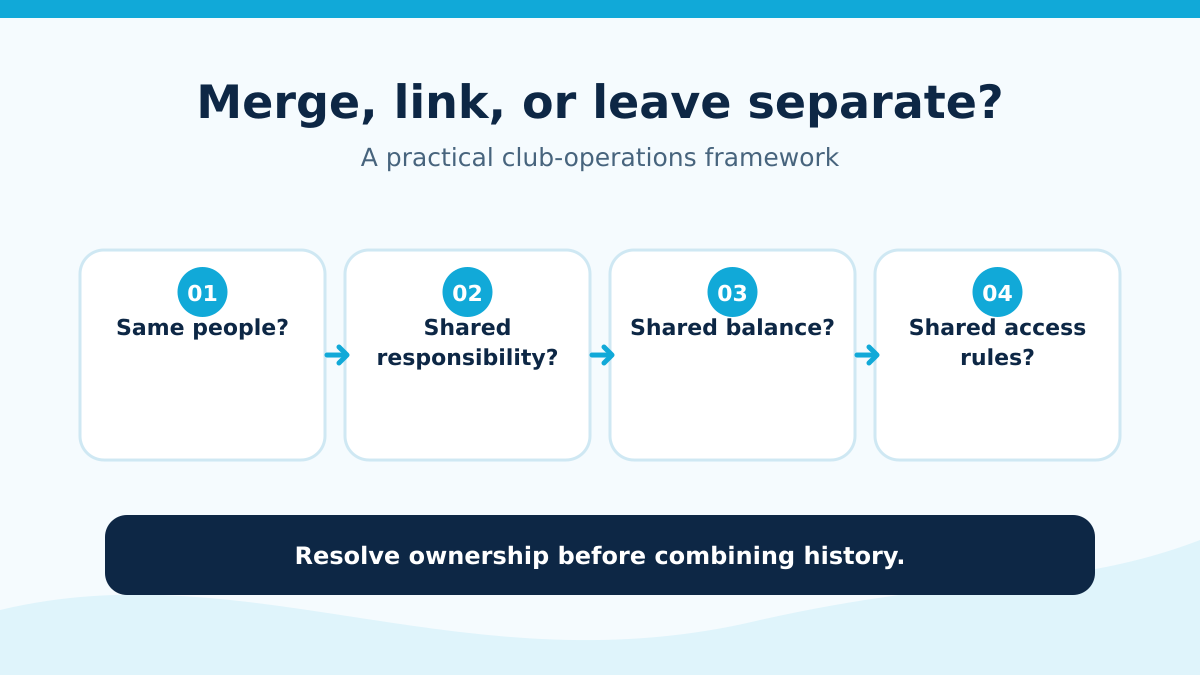
Duplicate household records are rarely just duplicate names. One may hold the current email, another the payment history, and a third the waiver signed last season. A quick merge can hide an obligation or attach one person’s history to another. Leaving everything separate makes staff guess each time the family calls.
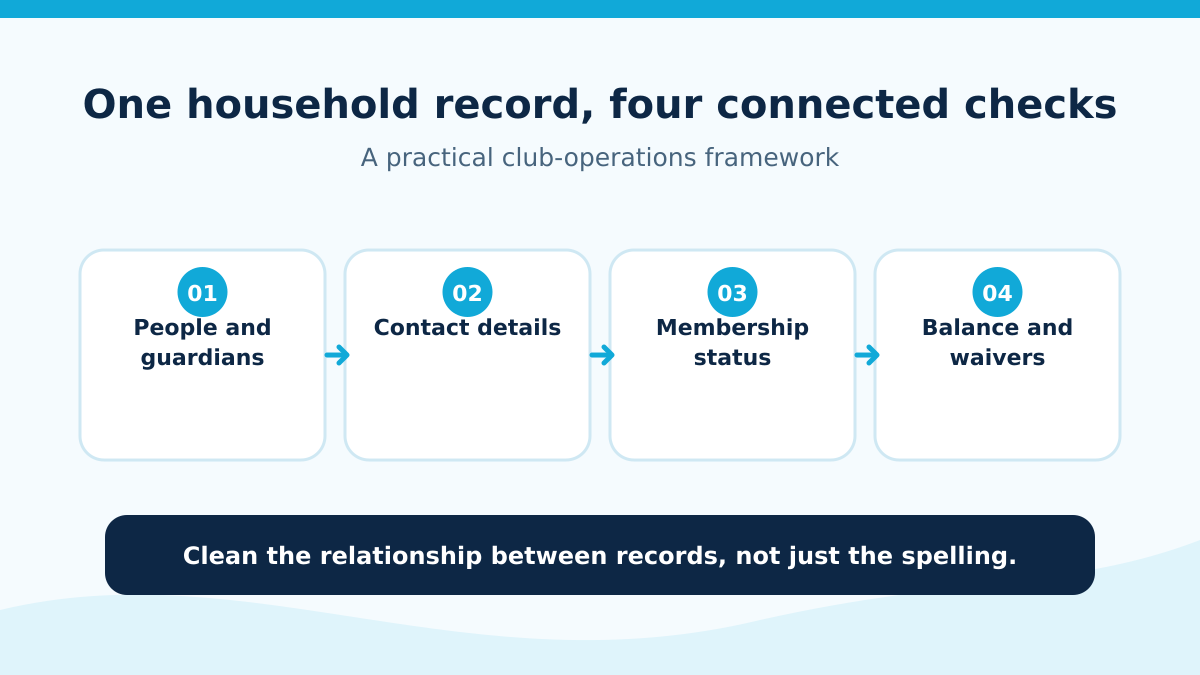
Clean the relationship between records, not just the spelling. Confirm the people involved, responsibility, membership status, balance, waivers, and history before deciding whether records should merge, link, or remain separate. Preserve an audit trail for every consequential change.
Do this work before renewal audiences, invoices, and reminder campaigns are built. Once those processes start, a small record error becomes a member-facing problem.
Build the decision around the club’s real work
The strongest plan starts with one ordinary transaction, the people who touch it, the rules they apply, and the record that should remain when the work is done. Use the sections below as a working session with the employees and volunteers who run the process. Write down assumptions, unresolved questions, and owners as you go.
1. Find suspicious records without assuming they are duplicates
Matching surnames, addresses, phone numbers, or emails can surface candidates, but none proves two records should become one. Families may share contact details, people may change households, and guardians may manage more than one account.
Create a review queue with the reason each pair was flagged. Keep the original records unchanged until an authorized person has enough context to decide.
Questions to answer:
- Why were records flagged?
- Which fields match?
- Which fields conflict?
- Is the relationship known?
- Who may decide?
The team investigates likely problems without turning a search result into an irreversible merge.
2. Confirm people and responsibility
List the adults, children, guardians, sponsors, and other roles represented by each record. Determine who may receive communications, manage the account, approve purchases, sign forms, or make membership decisions under club policy.
Use the club’s established verification process for material changes. Do not rely on a note from an unrelated transaction when responsibility or access is disputed.
Questions to answer:
- Who belongs to each record?
- Who manages the account?
- Who receives notices?
- Who can authorize changes?
- What requires verification?
The future household structure reflects approved relationships instead of convenience for the data cleaner.
3. Choose a primary contact deliberately
The newest email is not automatically the right primary contact. Ask whether the club needs one operational contact, separate billing and emergency contacts, or both. Record consent and preferences through the club’s normal process.
Remove clearly obsolete details only when the club’s retention and verification rules allow it. Otherwise, mark their status so staff do not accidentally select an old address.
Questions to answer:
- Who receives renewal notices?
- Who receives billing messages?
- Who is the emergency contact?
- Which detail is obsolete?
- How was the change confirmed?
Renewal and operational messages reach the intended person without erasing useful history.
4. Reconcile membership status and eligibility
Two records may show different membership states because one represents the prior season, a pending application, or a program enrollment rather than the household membership. Identify the meaning and effective dates before choosing a current state.
Preserve historical memberships and connect them to the correct people. If eligibility depends on board approval, residency, age, or another rule, route the decision instead of inferring it from a payment.
Questions to answer:
- What status is current?
- What period does each record cover?
- Is approval pending?
- Which people are included?
- What history must remain visible?
Staff can explain the household’s current standing and how it reached that state.
5. Resolve balances, credits, and payment instruments
Never add balances together merely because two household names look similar. Trace each charge, payment, credit, refund, and prepaid balance to its source and responsible account. Involve finance when ownership is unclear.
Decide which open items move, which remain with a historical account, and how the member will see the result. Avoid exposing saved payment details or changing authorization as part of an administrative cleanup unless the approved process supports it.
Questions to answer:
- What created each balance?
- Who owns each credit?
- Is a refund pending?
- What may be transferred?
- Who approves the result?
The combined view remains financially explainable and does not turn cleanup into an unsupported transfer.
6. Review waivers and documents by signer and scope
A signed form belongs to the signer, covered people, text, date, and period defined by the club. It should not become current for a newly linked person merely because the file now appears under the same household.
Map each document to the people and season it covers. Mark what must be renewed and what remains historical. Keep access limited to the roles that need the information.
Questions to answer:
- Who signed?
- Who is covered?
- Which season applies?
- Has the text changed?
- Who may view it?
The front desk sees a meaningful waiver status instead of a misleading household-level checkmark.
7. Merge only after a preview and recovery plan
Create a before-and-after summary: surviving household, linked people, primary contacts, current membership, open balance, credits, waivers, notes, and retained history. Have another authorized person review consequential merges.
PoolPulse keeps household profiles, membership history, waivers, emergency contacts, and account context together. Test your merge, audit, and access needs with sample records before changing live data.
Questions to answer:
- What record survives?
- What fields win?
- What history stays?
- Who reviews the preview?
- How can the change be corrected?
The team can predict the result, detect a bad assumption, and understand how to correct it if the outcome is wrong.
Follow one realistic club example
A family appears twice because one parent registered for lessons with a personal email while another renewed the household through a work address. The first record holds program attendance; the second holds dues and a credit. Staff confirm the people and responsibilities, preserve both histories, move only the approved contact and account relationships, and verify waiver coverage separately. The result is one usable household view without pretending every old field was identical.
Use the example as a rehearsal, not as a promised result. Replace its assumptions with your club’s approved rules, actual volumes, responsible people, and operating calendar. The goal is to make the next decision observable: another staff member should be able to tell what happened, why it happened, and what must happen next.
A practical readiness checklist
- Flag candidates and record why they matched.
- Keep source records unchanged during review.
- Confirm people, guardians, and account responsibility.
- Choose operational, billing, and emergency contacts.
- Resolve current membership and preserve historical periods.
- Trace every balance and credit to its source.
- Map waivers to signer, covered people, and season.
- Preview the surviving record.
- Use a second review for consequential merges.
- Re-read the saved household from a front-desk perspective.
Keep a decision ledger beside the working plan
A checklist shows whether a task is complete; a decision ledger shows why the club chose the rule behind it. For each material choice, record the question, the approved answer, the approving role, the effective date, the source document or meeting, and any condition that would require another review. Keep the language brief enough that the people operating the process can use it.
The ledger is especially useful when reasonable people remember the discussion differently. It prevents a draft suggestion, an old exception, or a vendor demonstration from quietly becoming policy. If no authorized decision exists, mark the item open and name the person responsible for bringing it to the correct group. “Open” is a useful status; it is better than a confident answer nobody actually approved.
Include the decisions that feel obvious today. Staff changes, board turnover, and the pressure of a busy season can make an unwritten assumption expensive to reconstruct. A new employee should be able to see which rule applies, when it began, and where to ask for a change. Archive superseded versions instead of deleting them so the club can explain historical records under the policy that existed at the time.
Review the ledger from the perspective of membership administrators and front-desk leads. The operational owner should confirm that the answer can be carried out. Finance should confirm how money or reporting is affected when relevant. The member-facing owner should confirm that the explanation is understandable. A short cross-role review often exposes a gap that a longer single-department meeting misses.
Rehearse the handoff, not just the happy path
Choose one ordinary case and one difficult case, then let the people who will run the process complete it from beginning to end. Give them the approved rule and sample information, but do not coach every click or conversation. Watch where they pause, switch tools, ask for permission, or create a side note. Those pauses reveal where the operating design still depends on memory.
For the difficult case, change one condition that matters: a deadline has passed, a balance conflicts, an eligible person becomes ineligible, a staff member lacks access, or the expected record cannot be found. The purpose is not to surprise employees. It is to confirm that the process provides a safe next step when the routine path stops. Staff should know what they may decide, what they must escalate, and how to leave a useful record for the next person.
Ask another employee to pick up the saved result without hearing the rehearsal conversation. Can they identify the current state, the last decision, the responsible owner, and the next date? If they must call the original employee to understand the record, improve the labels, notes, ownership, or workflow before launch. A handoff is successful when context survives the shift change.
Repeat the rehearsal after a material correction. Testing the edited version matters because a fix in one place can create inconsistency somewhere else. Re-read the member message, account or work record, report, and staff instruction together. The club is ready when the same approved answer remains visible across the complete journey.
Measure the first cycle without inventing a success story
Decide in advance what the club will observe during the first cycle. Useful measures may include incomplete cases, unresolved exceptions, repeat contacts, manual corrections, processing time, or the number of records waiting for an owner. Choose only measures that the club can define and collect consistently. A small trustworthy set is more useful than a dashboard filled with ambiguous counts.
Pair counts with a review of the underlying cases. A rise in questions may mean the message is unclear, the policy is new, or members are paying closer attention; the number alone does not identify the cause. Read representative records, talk with the employees doing the work, and separate a policy gap from a training need, a data problem, and a product defect before choosing a response.
Set a review date and an owner for each measure. During the review, keep completed changes separate from recommendations. Record what evidence supports the conclusion, what remains uncertain, and whether the next step requires management or board approval. Do not claim saved money, retained members, or better performance unless the club has a sound baseline and a method that supports that conclusion.
The most useful outcome of the first cycle may be a narrower rule, a clearer message, or a better exception route. Treat those corrections as part of operating the process, not as evidence the plan failed. A practical system makes learning visible and controlled while preserving the decisions that still apply.
Connect the decision to one operating record
PoolPulse’s member-management workflow connects household profiles, membership history, waivers, emergency contacts, balances, and account context. Explore the relevant PoolPulse workflow .
A connected platform does not remove the need for policy, ownership, or judgment. It should make the approved rule easier to execute, keep the result beside the member or operating record, and give the next authorized person enough context to act. Ask to see the complete journey—including an exception—using sample information that matches the club’s real process.
For a related operating exercise, follow the household credit review before renewal .
Choose the next step
Assign one person to complete the checklist, one person to review it from another role, and one date for the next decision. Keep unknowns visible. If a material question remains unanswered, make resolving it the next gate instead of treating silence as approval.
Use a personalized PoolPulse walkthrough to test how one complicated household would appear to membership, finance, and front-desk staff. Schedule a personalized PoolPulse walkthrough . You can also review current PoolPulse pricing before the conversation.

Your Registration Form Is Asking for More Data Than Staff Can Maintain
Use a practical data-minimization checklist to decide what a club should collect at registration, verify annually, archive, or stop asking for.

Swim Club Waiver Management: What Good Software Should Make Easier
How swim clubs handle digital waiver collection, front-desk verification, and connected member records without the manual overhead.

Swim Club Member Management Software: What Clubs Actually Need
What clubs actually need from member management software: billing, renewals, check-ins, waivers, and growth without second-system sprawl.
Want to see if PoolPulse is a good fit for your club?
Book a walkthrough and we'll show you exactly how PoolPulse can help based on your club's needs, goals, and current processes.