

Swim Club Member Management Software: What Clubs Actually Need
What clubs actually need from member management software: billing, renewals, check-ins, waivers, and growth without second-system sprawl.

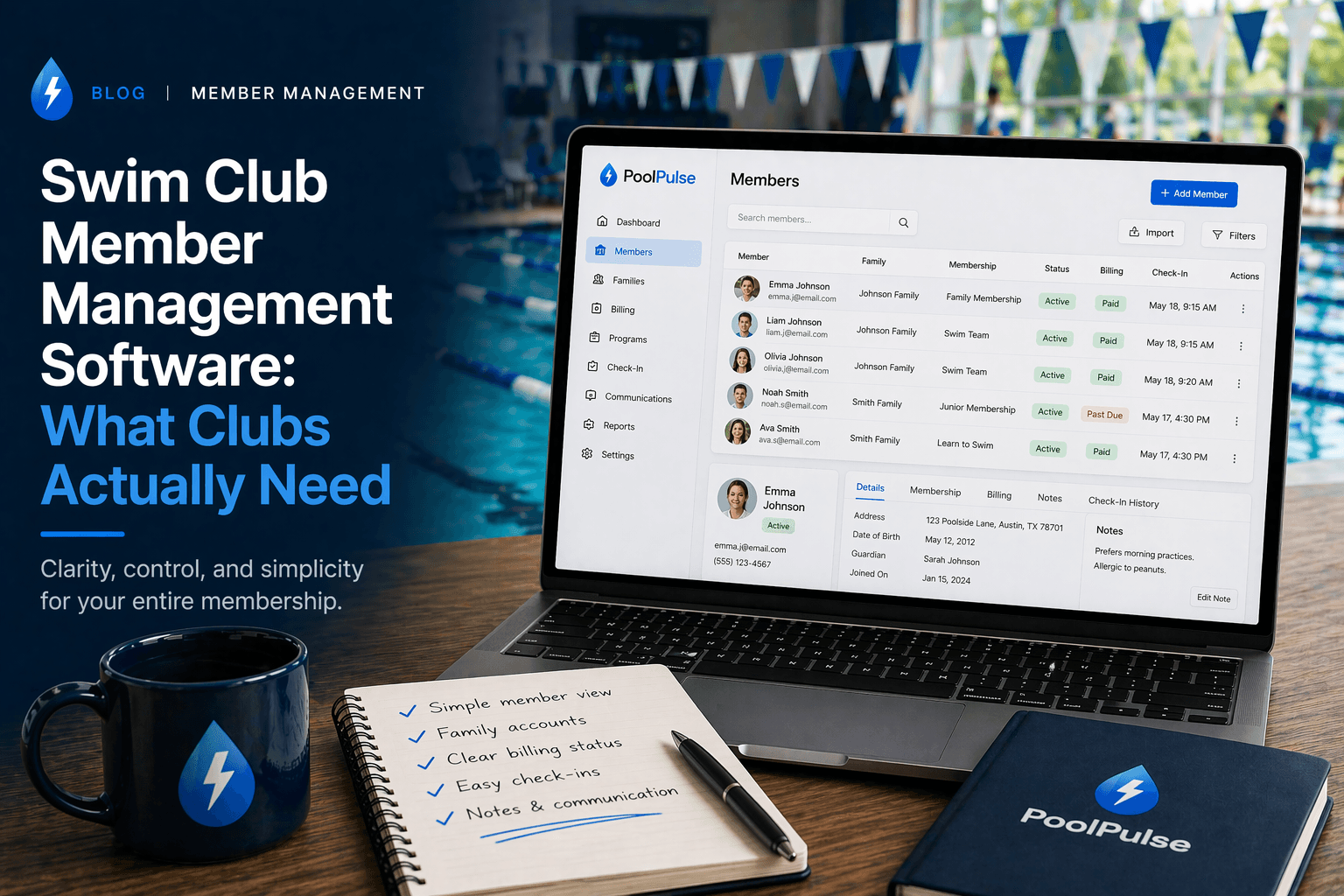
If you are searching for swim club member management software, you are probably not just shopping for a cleaner database.
You are trying to run a club without billing confusion, missing waivers, front-desk bottlenecks, scattered member notes, and a growing pile of second systems that never quite agree with each other.
That is why the best swim club member management software does more than store names and payment methods. It should help the club operate faster, safer, and with fewer handoffs between board members, staff, and families.
Quick answer: what should swim club member management software do?
At a minimum, strong swim club member management software should help your team:
- manage households, members, emergency contacts, and historical notes in one place
- handle billing, renewals, credits, and open balances without spreadsheet cleanup
- confirm check-in eligibility quickly at the front desk or on a kiosk
- track waivers and policy acknowledgements without hunting through PDFs
- keep role-based visibility clean for treasurers, guards, snack bar staff, and board members
- support club growth with communication, retention, and operational insight
If the system only solves registration but leaves billing, waivers, check-ins, or staff context scattered elsewhere, it is not really solving member management. It is just moving the mess around.
Why this category matters more than clubs expect
Many clubs underestimate how much of their operation depends on good member records.
Member management is not only about onboarding. It affects:
- who can check in right now
- whether a family is current on billing
- whether required waivers are on file
- whether guest passes or prepaid balances are still valid
- which communications should go to which families
- what the board can trust when reviewing renewals, revenue, and staffing decisions
When those answers live in multiple tools, clubs lose time in small ways all season long. Staff pause the line to verify eligibility. Treasurers reconcile balances manually. Board members make decisions from partial information. Families experience the result as friction.
Good swim club member management software reduces that friction everywhere, not just on registration day.
The 7 workflows you should test before buying anything
Most buyer guides stay too abstract. If you want to choose the right system, test the workflows your team actually depends on.
1. Household and member record quality
Start with the basics.
Can the platform keep household relationships, member status, emergency contacts, notes, and history together in one place? Can your team see enough context to help a family without opening three different tabs?
Look for:
- household-level and member-level records
- searchable notes and account history
- emergency contacts that are easy to retrieve
- clear status visibility for active, inactive, suspended, or expired members
This is where a lot of clubs realize their current setup is not true member management. It is just a registration archive.
2. Billing and renewal visibility
Member management software should not force your treasurer to maintain a second truth for financial status.
Test whether the system can show:
- current balances
- past billing history
- payment failures or expired cards
- renewal timing
- credits, adjustments, and late-fee context
If billing lives outside the member record, staff end up answering family questions with incomplete information. That creates support churn and board frustration fast.
For clubs that want a deeper look at renewal workflow, see Swim Club Renewal Playbook: 7 Automated Messages That Save More Families.
3. Check-in and access control
This is one of the easiest places to separate real operational software from a glorified membership directory.
When a family arrives, your staff should be able to answer one question immediately: can this person get in right now?
That means the system should account for:
- membership status
- guest rules
- waiver completion
- account holds or billing issues
- barcode, phone, or kiosk-based access flows
If the answer still depends on a binder, a printed list, or a staff member's memory, the club is carrying unnecessary risk and unnecessary line friction.
4. Waivers and document acknowledgements
Clubs often discover their waiver problem only when they need the answer urgently.
Strong swim club member management software should make waiver status visible inside the member workflow, not in a disconnected file folder. Your staff should be able to confirm whether a required document is complete, current, and attached to the right person or household.
Look for:
- digital waiver completion
- stored acknowledgements
- document retrieval without manual searching
- easy visibility during check-in or support conversations
If waiver tracking is still a side process, member management is incomplete.
5. Role-based staff visibility
Not everyone at the club should see the same level of information.
Lifeguards, snack bar staff, front-desk teams, treasurers, and board members all need different context. Good software should make that easy without turning permissions into a maintenance project.
Test whether you can:
- limit access by role
- give staff the context they need without exposing everything
- keep operational notes visible to the right team
- reduce ad hoc data sharing over text or email
This matters for security, but it also matters for speed. Staff work better when the system shows what they need and hides what they do not.
6. The second-system problem
This is where many swim club software platforms start to feel thinner than they looked in the demo.
Ask what happens when the club needs more than member records:
- guest passes or prepaid balances
- snack bar tabs or charge-to-account checkout
- programs, clinics, or lesson workflows
- marketing automation for renewals and promotions
- staffing and payroll visibility
If each of those needs requires another vendor, your team is not buying simplicity. It is buying future integration debt.
PoolPulse is opinionated here. The platform keeps core Member Management, Billing & Payments, Check-Ins & Access Control, and Memberships & Packages together first, then extends into Waivers & Document Sharing, POS & Snack Bar, Marketing Automation, Staff Scheduling & Payroll, and Pulse Signal.
That matters because clubs rarely stay within the clean boundaries of a single module.
7. Board-ready reporting and operational signals
The best swim club member management software should help you answer board questions with more confidence, not more manual prep.
At some point, leadership wants to know:
- which families are at risk of not renewing
- where billing follow-up is accumulating
- which hours are underused
- where front-desk friction is highest
- whether staffing and demand still line up
If your software can only export a member list, it is not helping the club operate strategically.
This is where analytics and AI become useful when they are tied to real club workflows. The point is not novelty. The point is faster visibility into the next action.
Red flags in swim club member management software
If you are comparing vendors, watch for these warning signs:
- the platform handles registration well but billing still lives somewhere else
- waiver tracking depends on manual uploads and separate lookup steps
- check-in staff cannot see enough account context to act quickly
- family communication is broad and generic rather than behavior-based
- the product solves member records but not the operational workflows around them
- implementation and migration answers stay vague
That last point matters more than it seems. Many clubs do not switch because they fear disruption, not because they love their current tool.
If your team is actively evaluating options, review How to Switch Swim Club Software Mid-Season Without Losing Billing History, Waivers, or Check-In Data alongside the feature comparison.
Questions to ask every vendor
Before you commit, ask these questions directly:
- Can we see a household record, a balance issue, a waiver issue, and a check-in decision in one workflow?
- How does the platform handle renewal timing, billing history, and open balances?
- What happens if a family arrives with an incomplete waiver or invalid guest status?
- Which staff roles can see what?
- What second systems will we still need after implementation?
- How do you handle migration of member records, balances, waivers, and front-desk context?
- If our club has a workflow gap, how flexible is the system?
Those questions usually reveal the difference between a true operations platform and a narrower membership tool.
What better software feels like in day-to-day club life
The best systems do not just make demos look organized. They reduce weekly friction:
- front-desk teams stop guessing
- treasurers stop reconciling mystery balances
- boards stop asking for manual one-off reports
- families stop getting mixed messages
- staff can move from issue to answer without switching systems
That is the real outcome most clubs want when they search for swim club member management software.
They want a club that runs cleaner.
Frequently asked questions
What is swim club member management software?
Swim club member management software is the system a club uses to track households, memberships, billing status, waivers, communication, and front-desk eligibility. Strong platforms do more than hold records. They support the workflows that depend on those records every day.
What features matter most for swim club member management?
The most important features are member and household records, billing visibility, renewal workflows, check-ins, waiver tracking, role-based access, and clear operational reporting. For many clubs, the next question is whether those records also connect to guest passes, POS, staffing, and marketing automation.
Can one system handle member management, billing, and check-ins together?
Yes, but not every platform does it well. That is exactly what you should test before buying. If the member record does not connect cleanly to billing and access decisions, staff still end up working around the platform.
Is it realistic to switch swim club member management software mid-season?
Yes, if the migration scope is defined clearly and the club validates billing, waivers, and check-in workflows before go-live. It does require planning. If you are evaluating a move, start with Switch & Save and then review Switch from PoolDues or your migration checklist depending on your current setup.
The bottom line
If your club is shopping for swim club member management software, look past the surface-level checklist.
The real question is whether the system helps your club answer operational questions quickly and confidently:
- who is this member?
- what is their current status?
- can they check in?
- is anything missing?
- what should staff do next?
When a platform answers those questions cleanly, member management becomes more than an admin function. It becomes the operating layer the rest of the club can trust.
If you want to see how PoolPulse approaches that stack, start with Member Management, review Switch from PoolDues, or go straight to Pricing.

Swim Club Waiver Management: What Good Software Should Make Easier
How swim clubs handle digital waiver collection, front-desk verification, and connected member records without the manual overhead.

Five Front-Desk Tasks Your Swim POS Should Handle
Your front desk shouldn't need three systems to check in a swimmer. Here's how modern swim POS systems save time and reduce errors.

When Your Check-In Line Proves Software Is Too Slow
Discover how software timing affects your swim club's daily operations, from check-ins to billing, and why faster response times mean happier members.
Want to see if PoolPulse is a good fit for your club?
Book a walkthrough and we'll show you exactly how PoolPulse can help based on your club's needs, goals, and current processes.