

When to Add a Renewals Manager to Your Swim Club
Learn when your swim club needs a renewals manager, what the role involves, and how to manage renewals effectively during your growth.


It's mid-January, and you're staring at a spreadsheet with 340 families who need to renew by March. Last year, 47 members slipped through the cracks because someone forgot to follow up, payment cards expired, or families just didn't respond to your emails. Your board is asking why revenue is down 8% from projections, and you're spending 15 hours a week chasing renewals instead of planning your summer season. Sound familiar? This is the moment many clubs realize they need someone focused specifically on keeping members coming back.
Whether you call it a renewals manager role or simply "the person who makes sure we don't lose members," this function becomes critical as your club grows. Let's walk through when you need it, what it actually involves, and how to handle renewals effectively no matter your club's size.
What Does a Renewals Manager Actually Do?
The core job is simple: make sure members renew their memberships on time, with minimal friction, and stay happy enough to come back year after year. But the day-to-day work involves a lot more than sending reminder emails.
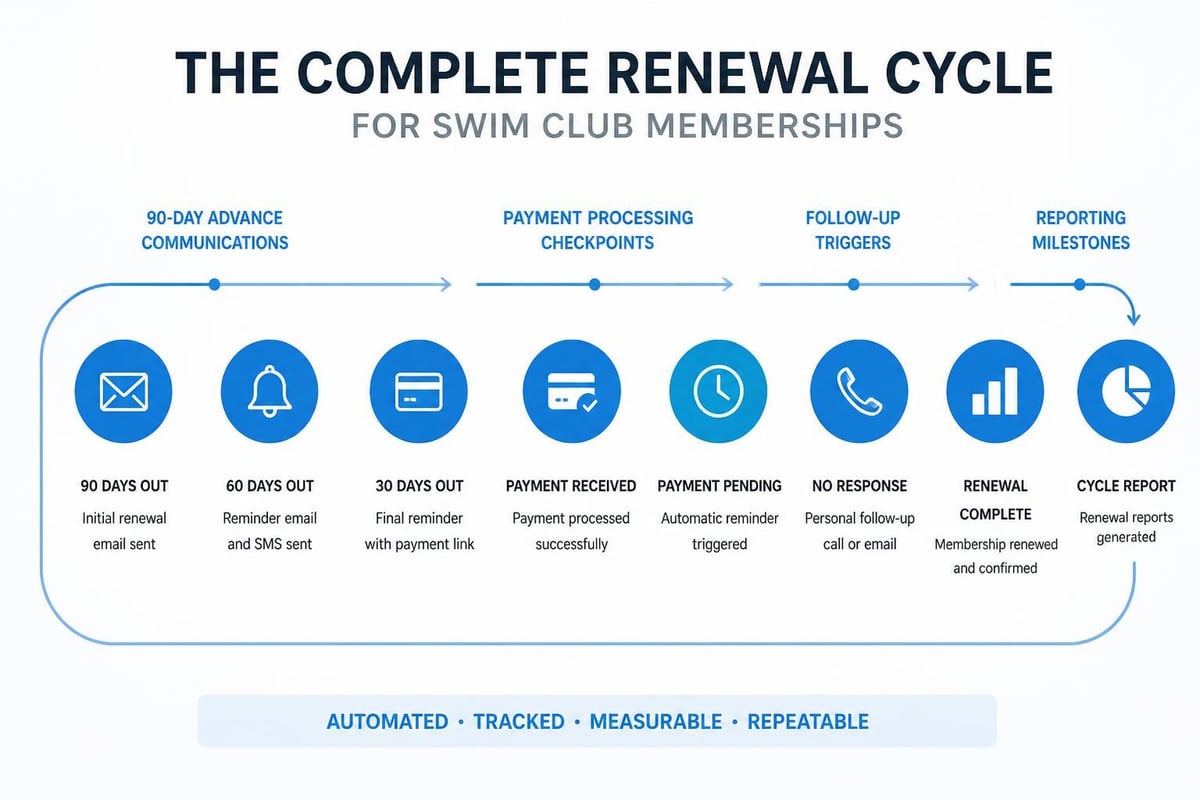
A renewals manager owns the entire renewal cycle from start to finish. That means:
- Tracking renewal dates for every membership tier (family, individual, senior, student)
- Sending timely reminders at 90, 60, 30, and 7 days before expiration
- Handling payment failures when credit cards decline or checks bounce
- Managing early-bird discounts and renewal pricing incentives
- Answering member questions about benefits, pricing changes, or account status
- Coordinating with front desk to catch members who show up with expired memberships
- Running reports on renewal rates, revenue forecasts, and at-risk members
- Following up personally with high-value members or long-term families
According to GitLab's renewals manager job description , this role typically sits at the intersection of sales, customer success, and operations. For swim clubs, that translates to someone who understands both the business side (we need X% renewal rate to hit budget) and the member experience (why families stay or leave).
When Manual Renewal Tracking Stops Working
You don't need a dedicated renewals manager on day one. Most clubs start with the administrator or office manager handling renewals alongside everything else.
But there's a breaking point. Here's when clubs typically realize they need help:
Member count crosses 200-250 families. Below that, you can track renewals in a spreadsheet or basic system. Above that, the volume of follow-ups, payment issues, and questions becomes a part-time job by itself.
Seasonal staffing creates gaps. If your team shrinks after summer and you're relying on seasonal workers, renewal tasks fall through the cracks during your critical enrollment windows.
Revenue leakage exceeds 10%. When more than one in ten members don't renew who should have (not counting intentional departures), you're leaving serious money on the table.
You're spending 10+ hours weekly on renewal tasks during peak periods. That time could go toward member experience improvements, facility upgrades, or program development.
Board pressure increases. As your club becomes more financially sophisticated, your board will want predictable renewal rates and revenue forecasting. That requires someone tracking the numbers closely.
The ChurnZero Customer Success Leadership Study found that 62% of organizations now have a dedicated renewals function, up from 41% just three years ago. Even smaller membership organizations are recognizing this need.
The Two Types of Renewal Problems You're Solving
When you add a renewals manager (or formalize the renewal process), you're really addressing two completely different problems that get lumped together.
Involuntary Churn: Members Who Want to Stay But Don't
This is the low-hanging fruit. These are families who fully intend to renew but something goes wrong:
- Credit card expires or gets replaced by their bank
- Payment method on file has insufficient funds
- Email reminders go to spam or an old address
- Family forgets the deadline during a busy month
- Auto-renewal isn't set up or fails silently
Stripe's research on combating churn shows that involuntary churn (payment failures) accounts for 20-40% of total customer loss in subscription businesses. For swim clubs, that percentage runs even higher because many members pay annually and don't update payment information regularly.
A renewals manager can recover most of this revenue through:
| Recovery Tactic | Success Rate | Effort Level |
|---|---|---|
| Automated email retry with card update link | 30-40% | Low |
| Personal phone call within 48 hours | 60-75% | High |
| Text message with payment portal | 45-55% | Medium |
| In-person conversation at check-in | 80-90% | Medium |
The key is catching these failures quickly. Every day that passes after a failed payment reduces your recovery rate by roughly 5%.
Voluntary Churn: Members Who Choose to Leave
This is harder and takes more time. These families are actively deciding not to renew because:
- They're unhappy with pool conditions, crowding, or amenities
- Pricing increased beyond their budget
- Their kids aged out or interests changed
- They had a negative interaction with staff or other members
- Competing facilities offer better value
- Life circumstances changed (moved, financial hardship)
Your renewals manager can't solve all of these, but they can identify patterns and give you early warning. When five families in one month cite "too crowded on weekends," that's actionable feedback for your board.
The relationship-building work matters here. Harvard Business Review's research on B2B relationships emphasizes that retention depends heavily on trust, responsiveness, and perceived value. Those same principles apply to member-driven facilities.
Building Your Renewal Process (Before You Hire)
Here's the truth: you might not need to hire a renewals manager right away. But you absolutely need a renewal process, and it needs to work whether one person handles it or three.
Let's build this step by step.
Step 1: Map Your Renewal Calendar
Start by documenting when renewals happen:
- Mark your renewal periods. Annual? Seasonal? Rolling throughout the year?
- Set communication milestones. When should first notice go out? Final reminder?
- Identify busy periods. Don't schedule major renewal pushes during your peak operational season.
- Plan for board reporting. When do you need renewal data for budget meetings?
Most swim clubs renew annually in late winter or early spring (January-March) for the upcoming summer season. That means renewal communications should start in October or November.
Step 2: Standardize Your Communications
Create templates for every renewal touchpoint:
- 90-day early bird notice (benefits of renewing early, discount details)
- 60-day standard reminder (membership benefits, pricing, how to renew)
- 30-day urgent reminder (last chance for early pricing, deadline approaching)
- 7-day final notice (specific expiration date, consequences of lapsing)
- Post-expiration (we miss you, how to rejoin, any reinstatement process)
Each template should include:
- Clear subject line with the member's name
- Exact renewal deadline
- Current membership type and pricing
- Simple renewal link or instructions
- FAQ or contact information
- Personal sign-off from a real person
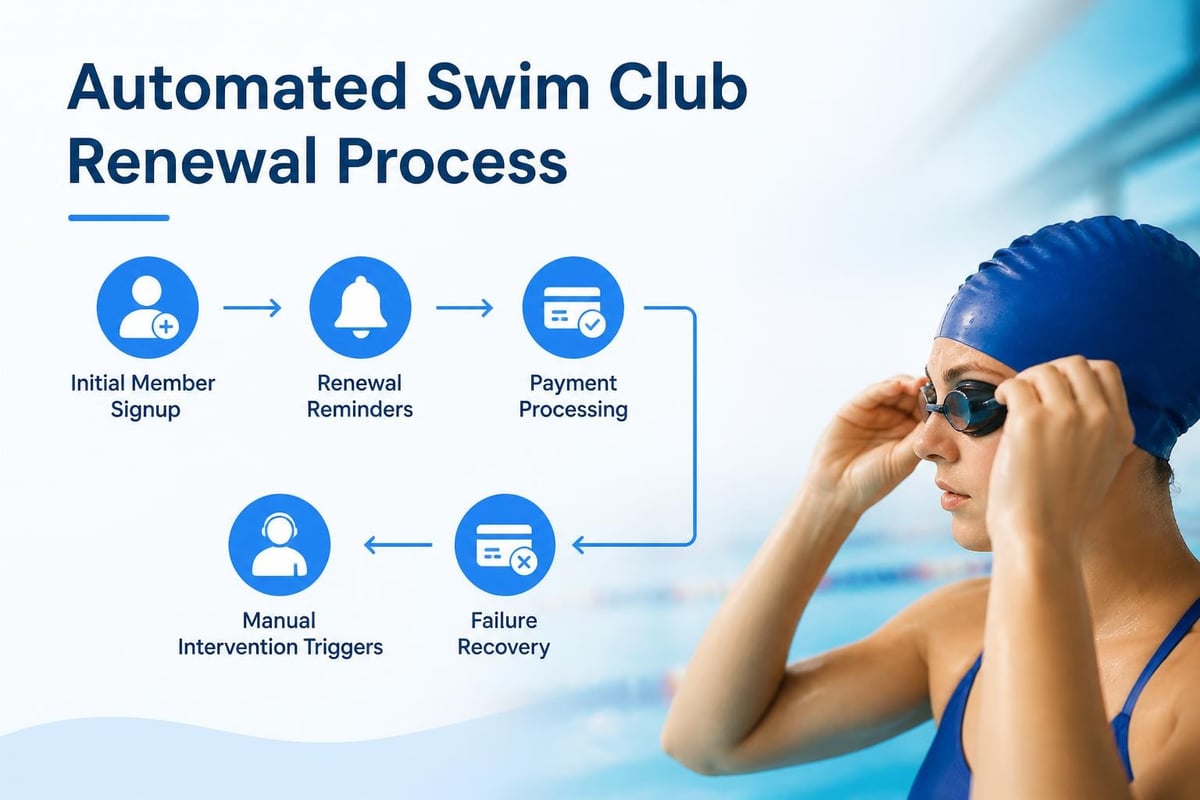
Step 3: Automate What You Can
Modern swim club management software should handle most renewal automation. Look for systems that:
- Trigger emails based on membership end dates
- Update payment methods automatically (card account updater)
- Flag failed payments immediately
- Generate renewal reports on demand
- Track which members opened emails or clicked renewal links
Zuora's subscription management documentation provides excellent technical guidance on designing renewal logic. While your swim club software likely won't match enterprise subscription platforms, the principles around auto-renewal settings, grace periods, and renewal pricing rules still apply.
Step 4: Define Success Metrics
You can't manage what you don't measure. Track these key numbers:
| Metric | Formula | Target Range |
|---|---|---|
| Renewal Rate | (Renewed Members / Total Eligible) × 100 | 75-90% |
| Early Renewal % | (Early Renewals / Total Renewals) × 100 | 30-50% |
| Payment Failure Rate | (Failed Payments / Total Attempts) × 100 | 5-15% |
| Recovery Rate | (Recovered Failures / Total Failures) × 100 | 40-70% |
| Average Days to Renew | Sum of days before/after deadline / Renewals | -30 to -10 |
MetricHQ's renewal rate benchmarks show that top-performing subscription businesses maintain renewal rates above 85%. For swim clubs with strong community ties, hitting 90%+ renewal rates is realistic once you have good processes in place.
The Hidden Skills a Renewals Manager Needs
If you do decide to hire or assign someone to this role, the job description goes beyond "send emails and process payments." The best renewals managers combine several skillsets that don't always appear together.
Systematic follow-up without being annoying. This is harder than it sounds. You need someone who can persistently track down 40 families with expired memberships without making people feel harassed. It requires judgment about when to call, when to email, and when to let it go.
Empathy for money conversations. When a family says they can't afford to renew, your renewals manager becomes the face of your club's flexibility (or rigidity). They need to listen well, understand your pricing policies, and know when to offer payment plans or hardship accommodations.
Data analysis basics. Running weekly renewal reports, spotting trends, and translating numbers into action items. If renewal rates for families with kids under 8 are dropping, that's a programming question, not just a renewals issue.
Cross-functional coordination. This person will interact with everyone: front desk staff who see expired members showing up, coaches who hear complaints, board members who want forecasts, and your accounting team who needs revenue timing information.
Technology comfort. Whether you're using PoolPulse's configurable platform or another system, your renewals manager needs to navigate the software confidently, troubleshoot member login issues, and adapt as systems update.
One swim club director told me: "I hired someone with customer service experience from a hotel. She had no swim club background, but she was amazing at difficult conversations and keeping track of 50 moving parts. That mattered way more than knowing competitive swimming."
Should This Be a Full-Time Role?
For most clubs under 500 families, no. Renewals management works best as part of a broader member services or operations role.
Here's how clubs typically staff this function:
Under 200 families: Club administrator handles renewals as 10-15% of their job, heavily supported by automation.
200-400 families: Member services coordinator owns renewals (30-40% of role) along with new member onboarding and general member questions.
400-700 families: Dedicated renewals manager, full-time during peak renewal season (Jan-Apr), part-time the rest of year. Often combined with event coordination or facilities management in off-season.
700+ families: Full-time renewals manager year-round, possibly with seasonal support during peak periods.
The State of Subscription Apps 2025 report notes that renewal workload doesn't scale linearly with member count. Clubs that implement strong automation and self-service renewal options can handle 50-75% more members with the same staffing level.
Technology That Actually Helps
Let's be practical about software. You need tools that reduce manual work, not create more of it.
Essential renewal features in club management software:
- Automated renewal notices sent via email and SMS
- Member self-service portal where families can renew without staff involvement
- Payment retry logic that attempts failed cards 2-3 times before flagging for manual follow-up
- Saved payment methods with tokenization (not storing raw card numbers)
- Renewal dashboard showing who renewed, who's pending, who needs follow-up
- Customizable renewal windows for different membership types
- Early-bird discount automation that expires on schedule
- Integration with accounting so renewed revenue posts correctly
Many clubs still use basic tools that create extra work. If your renewals manager is manually entering credit card numbers over the phone, updating spreadsheets with renewal status, or copying information between systems, you're wasting their time on tasks software should handle.
The Ventana Research buyers guide on subscription management evaluates platforms based on renewal capabilities, automation maturity, and operational efficiency. While this report focuses on enterprise SaaS, the evaluation criteria translate well to membership organizations.
Consider how PoolPulse approaches this differently. Rather than forcing clubs into rigid renewal workflows, the platform's configurability lets you design renewal processes that match your club's actual policies. Want to offer quarterly payment options? Three-tier early-bird discounts? Family referral bonuses? Grace periods for long-term members? You can configure those rules once and let automation handle the execution.
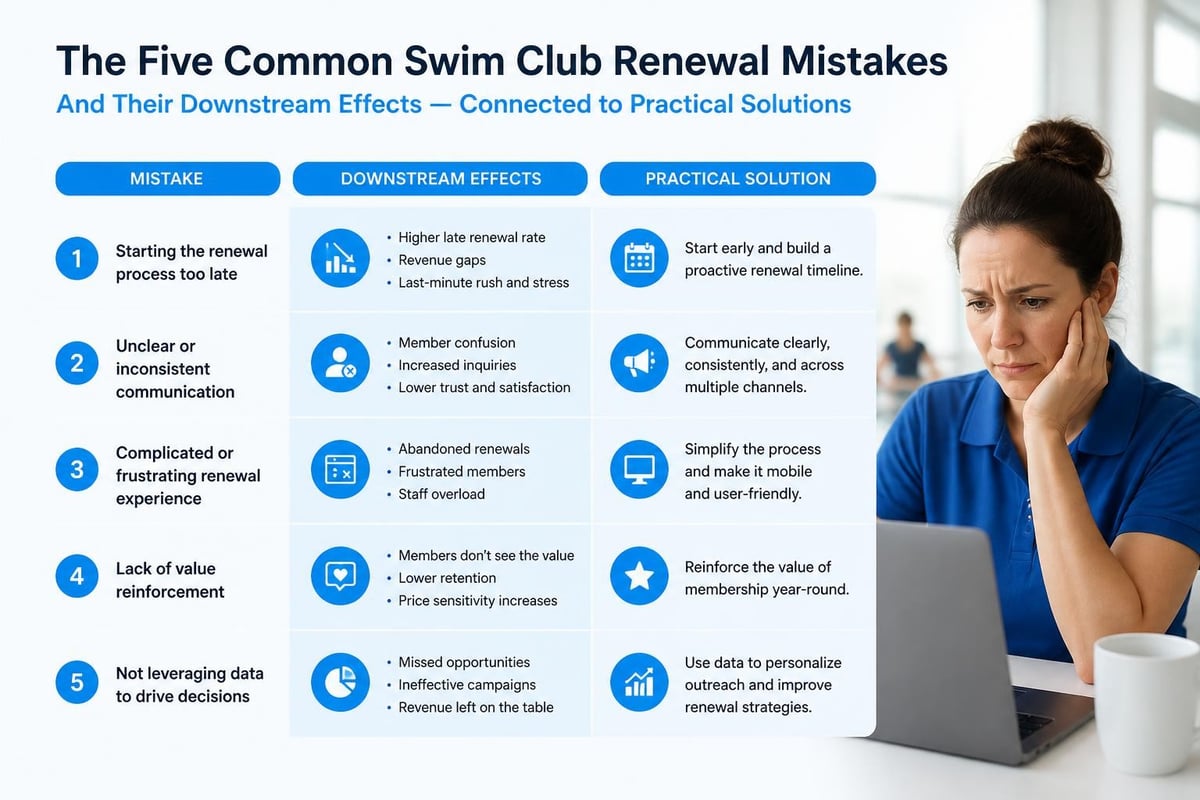
Common Renewal Mistakes and How to Fix Them
After talking with dozens of club administrators, here are the renewal pitfalls that come up repeatedly:
Mistake 1: Starting Too Late
Sending your first renewal notice 30 days before expiration doesn't give families time to budget or make decisions. Start at 90 days minimum. Your early-bird period should run 60-90 days before renewal deadline.
Fix: Build your communication calendar backward from your deadline. If memberships expire March 31, start early-bird communications January 1.
Mistake 2: Making Renewal Harder Than Joining
New members get a beautiful welcome email with a big "Complete Your Registration" button. Renewals get a text-heavy email with confusing instructions. This is backward.
Fix: Renewal should be one click to a prefilled form. Payment method already on file? Just click "Confirm Renewal." Done.
Mistake 3: No Follow-Up on Payment Failures
Cards fail. It happens. But if you're not following up within 24-48 hours, you're losing members who wanted to stay.
Fix: Daily reports of payment failures. Personal outreach within two business days. Phone call or text, not just email.
Mistake 4: Treating All Members the Same
A family that's been a member for 15 years deserves different handling than someone who joined last summer. Senior citizens, scholarship recipients, board members, and donor families all need slightly different approaches.
Fix: Segment your renewal communications. Add personal notes to long-term members. Acknowledge board service. Mention the specific program their kids participate in.
Mistake 5: No Visibility Into Why People Leave
When members don't renew, do you know why? Or do they just disappear?
Fix: Simple exit survey. Two questions: "What's the main reason you're not renewing?" and "What could we do to earn your membership back?" Even a 30% response rate gives you actionable data.
How AI Is Changing Renewals (For Real)
Let's cut through the AI hype and talk about what's actually useful right now for renewal management.
Predictive renewal scoring. Modern systems can analyze which members are likely to renew based on facility usage, payment history, complaint tickets, and engagement patterns. Your renewals manager can prioritize outreach to at-risk members before they decide to leave.
Smart follow-up timing. Instead of fixed 90-60-30-7 day reminders, AI can optimize send times based on when each family typically opens emails and takes action. One family might respond best to Saturday morning emails; another prefers Tuesday evening.
Automated response drafting. When members email with renewal questions, AI can draft response templates that your team reviews and personalizes. This cuts response time from hours to minutes.
Revenue forecasting. By analyzing historical renewal patterns, seasonal trends, and current pipeline, AI can predict final renewal rates with surprising accuracy. This helps with budget planning and identifying when you're falling behind pace.
PoolPulse's AI-powered insights apply these capabilities specifically to swim club operations. The system learns your club's unique patterns and surfaces actionable recommendations your renewals manager can act on immediately.
Building the Business Case for Better Renewal Management
When you go to your board asking for budget to improve renewals (whether that's hiring help, better software, or both), here's how to frame it:
Calculate your current renewal leakage. If you have 400 member families, an average membership fee of $1,200, and an 80% renewal rate, you're losing $96,000 annually in revenue that should be recurring.
Now model improvement. What if better renewal management brought you from 80% to 88%? That's 32 additional families renewing. At $1,200 each, that's $38,400 in recovered annual revenue.
If investing $15,000 in software upgrades and $20,000 in part-time renewals help generates $38,400 in recovered revenue, your payback period is one year. Every year after that is pure margin improvement.
Most clubs also see secondary benefits:
- Less time chasing payments means more time improving programs
- Fewer expired members showing up creates better front desk experiences
- Predictable revenue helps with facility planning and capital projects
- Higher retention rates improve community culture and member satisfaction
Present this as a growth investment, not an expense. You're not spending money on renewals; you're recovering revenue that's already being earned and lost.
What Gets Measured Gets Managed
Your renewals manager (or whoever owns this function) needs a dashboard they check weekly during peak season, monthly the rest of the year.
Essential metrics to track:
- Renewal rate by segment (family vs. individual, long-term vs. recent members)
- Revenue at risk (dollar value of members who haven't renewed yet)
- Days until deadline for current renewal period
- Payment failure rate and recovery rate
- Response rate to renewal communications
- Average renewal processing time from reminder to completed payment
- Support ticket volume related to renewals
Set targets for each metric based on your club's history. If you renewed 82% of members last year, aim for 85% this year. If payment failures ran at 12%, target 9%. Incremental improvement compounds quickly.
Share these numbers with your board monthly during renewal season. They should see: total renewals to date, revenue collected, projected final renewal rate, and any concerns that might impact forecast.
This transparency builds confidence that renewals are being actively managed, not just hoped for.
The Member Experience Side of Renewals
Everything we've discussed so far treats renewals as an operational challenge. But from your members' perspective, renewal is an experience touchpoint. How you handle it shapes their perception of your club.
Think about what renewal feels like for a busy parent:
They get an email in January. Do they read it now or save it for later? (Later usually means never.) The email says renewal is due March 1. Okay, they'll deal with it in February. February arrives and gets busy. Suddenly it's March 3 and they get a "Your membership has expired" notice. Now they're stressed.
Compare that to:
Email in January with a clear deadline and an "early bird saves $100" incentive. They click through and renew in two minutes while thinking about it. Confirmation email arrives immediately. They're done, and they saved money.
Which experience makes them feel good about being a member?
Your renewals manager should be optimizing for ease and clarity:
- One-click renewal from email
- Clear savings for renewing early
- Simple payment plan options if annual payment is difficult
- Immediate confirmation and receipt
- Human response if they have questions
- Grace period if they accidentally miss deadline by a few days
These small friction points add up. Make renewal easy and most members will do it. Make it complicated and they'll procrastinate, forget, or consider whether membership is worth the hassle.
When NOT to Focus on Renewals
Here's an unpopular opinion: some clubs spend too much energy on renewals while ignoring the real problem.
If your renewal rate is below 70%, renewals management isn't your issue. Member satisfaction is.
No amount of reminder emails, personal phone calls, or early-bird discounts will fix a club where:
- Facilities are deteriorating
- Staff are rude or unhelpful
- Pool is overcrowded every weekend
- Programs don't match member needs
- Pricing is out of line with value delivered
In these situations, a renewals manager becomes someone who professionally manages decline. They'll work hard and hit incremental improvements, but they can't overcome fundamental value or experience problems.
Fix the underlying member experience first. Then optimize renewals.
How do you know which situation you're in? Ask members who didn't renew. If the feedback is consistently "too expensive," "never used it," "kids lost interest," or "not worth it anymore," you have experience and value issues. If feedback is "forgot," "card expired," "meant to but didn't get around to it," you have a renewals process problem.
Renewals as Part of the Bigger Picture
Ultimately, renewals sit at the intersection of several club functions:
- Finance: Revenue recognition, cash flow, budget forecasting
- Operations: Access control, facility capacity planning, staffing
- Member services: Communication, problem resolution, experience quality
- Marketing: Retention messaging, value demonstration, referrals
- Technology: System automation, data integrity, reporting
Your renewals manager doesn't own all of these, but they touch all of them. That's why the role requires someone who can see the big picture while handling tactical details.
The best renewals managers become internal advocates for members. When they notice that 15 families cited "weekend crowding" as their reason for not renewing, they bring that to leadership as a facility issue. When payment failures spike after a pricing change, they flag it as a communications problem. When renewal rates drop among families with teenagers, they identify it as a programming gap.
This feedback loop makes your club stronger over time. Renewals become not just a revenue function but an organizational learning system.
Managing renewals effectively directly impacts your club's financial health and member experience. Whether you formalize this as a dedicated renewals manager role or build better processes into existing positions, the goal is the same: keep good members coming back year after year with minimal friction. PoolPulse's swim club management platform handles the automation, reminders, payment processing, and reporting that make renewal management efficient, so your team can focus on the personal touches that keep families engaged. Book a demo to see how the right tools can help you improve renewal rates while spending less time on administrative follow-up.

Five Front-Desk Tasks Your Swim POS Should Handle
Your front desk shouldn't need three systems to check in a swimmer. Here's how modern swim POS systems save time and reduce errors.

When Your Check-In Line Proves Software Is Too Slow
Discover how software timing affects your swim club's daily operations, from check-ins to billing, and why faster response times mean happier members.

What Your Billing and Invoices Are Telling You
Your swim club's billing and invoices reveal hidden patterns about late payments, refund requests, and cash flow. Here's how to read the signals.
Want to see if PoolPulse is a good fit for your club?
Book a walkthrough and we'll show you exactly how PoolPulse can help based on your club's needs, goals, and current processes.