

Your Seasonal Staff Onboarding Is Not Finished Until the Live Shift Test
Turn onboarding from a document checklist into a role-based rehearsal that proves staff can handle normal and exception cases.


A completed handbook acknowledgment does not prove that a new employee can admit a guest, explain a balance or escalate an incident. Those tasks require the employee to recognize a situation, find the current rule and act within their authority while other people are waiting.
Finish seasonal staff onboarding with a role-based live shift test. Cover normal work, a boundary case, an emergency action, an escalation and the record that completes the handoff. Here, “live” means using the actual workspace and realistic task order under supervision. It does not mean inventing emergencies around unsuspecting members or letting an unready employee handle a safety-critical assignment alone.
For operations managers and front-desk leads, the useful result is a specific readiness decision: which tasks the employee can perform independently, which still need supervision and what must be practiced again. Attendance at orientation is one input. Observed performance is another.
Define what readiness means for this role
Start with the tasks that fill an ordinary shift. A front-desk employee may check membership status, record a guest and route a billing question. A snack bar employee may enter an order, confirm its account and close a drawer. A supervisor may approve an exception or take over a difficult conversation. Avoid testing everyone against the same list simply because they attended orientation together.
Choose tasks that have meaningful consequences when done incorrectly. Admitting someone without the required approval, posting a charge to the wrong household or failing to reach the emergency lead deserves more attention than remembering where spare stationery is stored. Also include frequent low-risk tasks: a trainee who needs help with every routine check-in will struggle when the line grows.
Write the expected action before you run the test. “Understands guest policy” is too vague to score. “Checks the approved guest allowance, explains the result and requests supervisor approval when required” gives both the trainer and employee something observable. Let employees use the same approved reference materials they will have during work. Finding the correct answer is often more useful than reciting it.
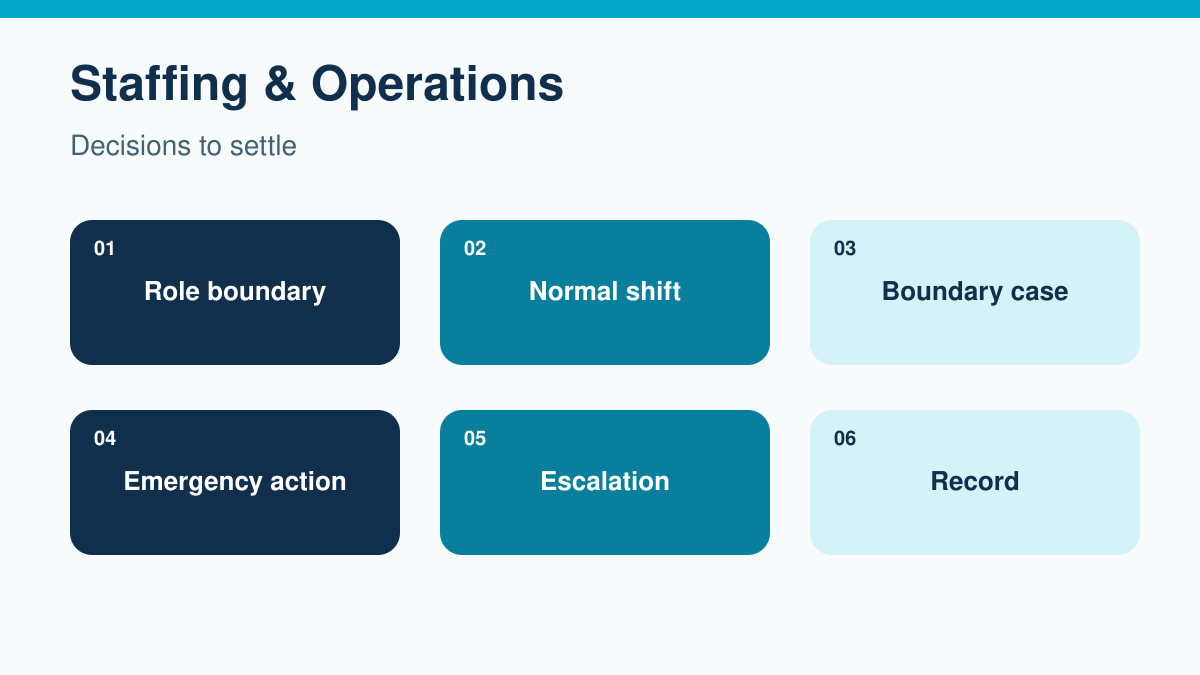
1. Role boundary: make authority visible
Give the trainee a short list of actions they may complete, actions requiring approval and actions reserved for another role. Use examples from the club’s actual policy. A desk employee might be able to correct a misspelled phone number but need a supervisor for a disputed fee. A new hire should not have to infer that distinction from which buttons happen to be available.
During the rehearsal, ask who can approve a guest exception, who can change an account balance and who can authorize reopening after a closure. The correct response can be a handoff. Do not reward confident improvisation when the employee lacks authority. If two trainers disagree about the answer, resolve the policy question before treating it as a trainee failure.
Check access at the same time. The employee should use their own approved login and see only what their role needs. A test performed through a manager’s account can conceal missing permissions or expose tools the employee should not use. Record access problems as setup work for the responsible administrator, then rerun the affected task after the correction.
2. Normal shift: rehearse the whole sequence
Begin where the shift begins. Have the trainee find the handoff notes, identify the supervisor on duty and check the equipment needed at their station. Then move through several ordinary transactions in their usual order. Watch whether the employee finishes one record before starting another and whether they can recover after a brief interruption without mixing up households.
Use sample accounts wherever possible. Include similar surnames, a family with several authorized purchasers and a routine guest visit. The trainer should know the expected account and outcome in advance. Avoid entering fictional purchases or changing real memberships just to make the exercise realistic. If a production system must be used, agree on a controlled method with the system owner first.
Let the trainee speak to the trainer as though speaking to a member. An accurate screen action can still produce a confusing explanation. Listen for clear language about what has happened and what comes next. “I have sent this to the billing lead” is different from “Your balance is fixed.” The employee should not promise an outcome that the next role has not approved.
3. Boundary case: test conflicting information
One useful front-desk scenario is a member who says a guest pass was approved yesterday while the account shows no approval. Provide the trainee with a sample account, the current policy and a reachable supervisor. The test is whether they can acknowledge the request, check the relevant record and explain the approval path without accusing the member or silently bypassing the rule.
Add a realistic time pressure, such as another member waiting, but do not turn the exercise into a humiliation test. Ask the trainee to protect the conversation from unnecessary disclosure. A disputed balance should not be read aloud to everyone in the entrance line. They can ask the supervisor to continue the discussion away from the queue while another employee keeps routine service moving.
Afterward, ask what fact would change the decision. Perhaps a valid approval exists in a different record or the request falls under a published exception. This reveals whether the employee understands the rule or merely memorized the scenario. Repeat with different names and a slightly different situation so the retest measures judgment rather than recall of the trainer’s script.
4. Emergency action: practice the first safe steps
Use the club’s approved emergency procedures and the employee’s assigned role. A desk employee might need to alert the designated lead, direct people to the approved location and keep an access route clear. They should not be expected to perform rescue work or make safety decisions outside their training. The rehearsal supplements required training and credentials; it does not replace them.
Keep emergency exercises clearly identified as drills and coordinated with the people responsible for safety. Test a radio message through an approved training channel or role-play the call rather than contacting emergency services unnecessarily. Walk the actual route so the employee can find it from their station. Ask what happens if the primary route is unavailable, using the alternatives in the site plan.
OSHA’s education and training guidance recognizes worksite demonstrations and on-the-job training as useful ways to teach safety practices. It also emphasizes knowing whom to contact with questions. That supports practical rehearsal, but it does not establish a universal club onboarding test. The club still needs to determine which legal requirements and role-specific qualifications apply to its location and work.
5. Escalation: verify the person behind the contact
Give every trainee a primary contact and a backup for the shift they will actually work. A weekday office number is not a complete escalation path for a Sunday closing employee. During an agreed rehearsal, verify that the intended channel reaches the right person. Test what the employee should do when there is no response rather than assuming a second call will solve the problem.
Have the employee deliver a concise handoff: the location, the immediate issue, what they have checked and what decision they need. They should distinguish urgent safety concerns from routine account questions according to the club’s procedures. Do not make collecting a complete history a prerequisite to urgent action. The necessary first message may be brief, with details supplied once the immediate response is underway.
Close the loop in the exercise. The supervisor should acknowledge the handoff and state who now owns the next step. Ask the trainee what they will tell the member while waiting. This catches a common failure: staff correctly send a message but leave the person at the desk believing someone has already resolved the issue.
6. Record: leave the next employee a usable account
Ask the trainee to write the note that belongs to the scenario. A useful service note identifies the relevant account, the request, the action taken and the person handling the follow-up. Use factual language rather than judgments about the member. “Member requested review of guest charge; sent receipt reference to duty manager” is more useful than “Member difficult again.”
Review the note from the next shift’s perspective. Could another employee tell whether a request is pending or completed? Can they find the original transaction without searching unrelated accounts? Include only information appropriate for that record and the people allowed to see it. Sensitive incident details may belong in a restricted process rather than a general member-service comment.
Run the test in six practical steps
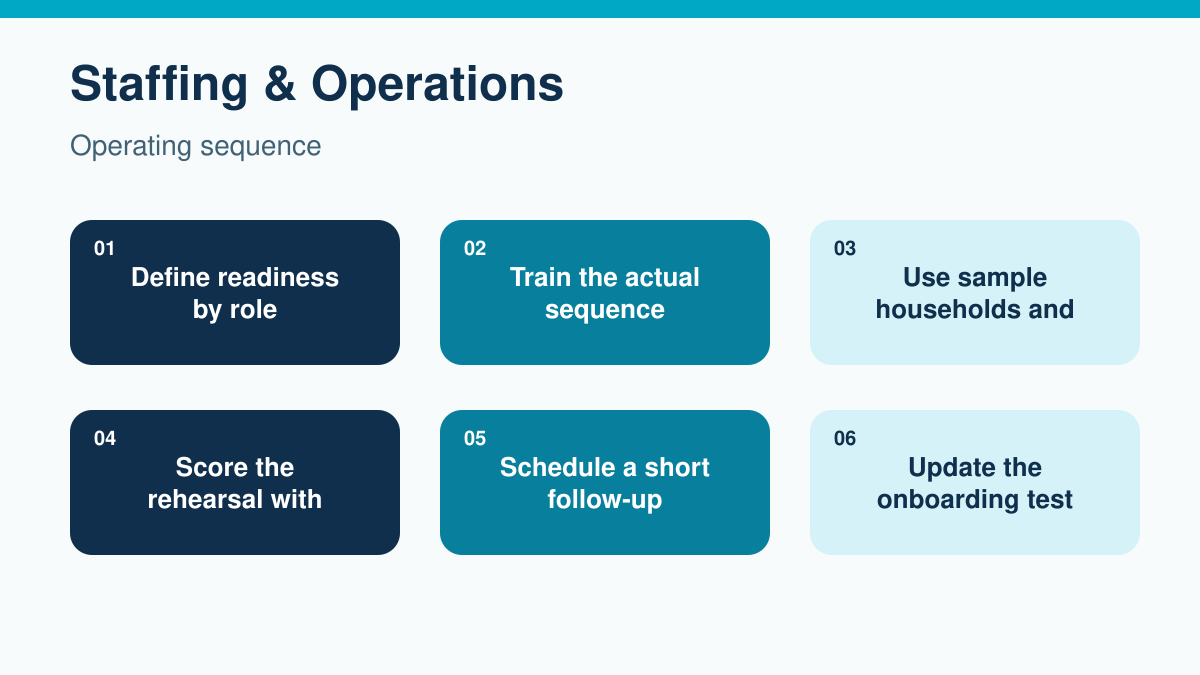
First, define readiness by role and select a manageable set of tasks. Second, teach the sequence in the actual workspace before assessing it. Third, prepare sample households and ordinary operational data with known expected outcomes. This preparation prevents the trainer from changing the rules halfway through a test or confusing a broken setup with an employee’s mistake.
Fourth, score observable actions. A simple local rubric can use “independent,” “needs prompting” and “not yet demonstrated.” Define which errors require immediate intervention, particularly unsafe action or an unauthorized account change. A trainee who needs a hint has given you useful information. Record the hint rather than marking the task independent because the final screen looked correct.
Fifth, schedule a short review after the employee’s first independent shifts. Sixth, update the test when the club changes its policies or workflows. Name the trainer responsible for each employee’s follow-up so it does not disappear into a shared calendar. These steps give the original training sequence a practical finish: observed work, a bounded assignment and a date to revisit unresolved skills.
Separate coaching from the readiness decision
Tell the employee when you are teaching and when you are observing an attempt without prompts. During teaching, demonstrate the task and explain why each step matters. During assessment, give the agreed scenario and watch. Intervene immediately if safety or a real account is at risk. Otherwise, let the employee complete the sequence before discussing where the attempt went wrong.
For each gap, prescribe a small next action. A trainee who selected the wrong household might practice identity checks on three sample families. Someone who cannot find the closure contact needs a corrected reference and a repeated handoff. “Needs more confidence” is not a training plan. State the behavior to practice and what successful performance will look like on the next attempt.
A partial pass can support a limited assignment when the supervisor considers it appropriate. The employee might handle routine check-ins with a lead nearby while withholding responsibility for closing or account adjustments. Make those limits visible to the shift supervisor. A note in an onboarding folder is insufficient if the schedule later places that employee alone in a role they have not demonstrated.
Check the first shifts without rebuilding orientation
Ask the employee which situations differed from the rehearsal. Compare those answers with handoff notes and supervisor observations. Look for repeated searches, uncertain approvals or corrections that required another employee to reconstruct the transaction. A short discussion tied to real work gives more useful information than asking whether onboarding was helpful in general.
Review patterns across trainees before blaming individuals. If several new hires choose the wrong guest category, the labels or instructions may be unclear. If everyone struggles to find the backup contact, repair the contact sheet. Keep a dated version of the test so returning seasonal staff can review what changed rather than sitting through unchanged material while missing the one new procedure that matters.
Bring one realistic case to a software walkthrough
The strongest onboarding test works with the club’s actual policies regardless of the software used. If you are considering Clubward, request a demo and bring one routine task plus the boundary case that causes the most staff confusion. Ask the team to demonstrate the relevant permissions, handoff and resulting record, then confirm whether the available workflow fits your requirements.
Do not treat a successful sales demonstration as staff readiness. Employees still need supervised practice in the configured environment and a clear approval boundary. Finish with a record of what each person can do independently, who will coach remaining gaps and when the next observation will occur. That is a more useful end to onboarding than one final signature.

Build Next Season’s Staff Schedule Around Coverage, Not Names
A list of returning employees is not a staffing plan. Define the coverage the operation needs before assigning names to shifts.

Switching Club Platforms Shouldn't Become a Second Job
The fear of migration keeps many clubs stuck on platforms they have already outgrown. A modern, well-supported transition should remove work from your team, not create more of it.

Staff Scheduling Shouldn't Feel Like Crisis Management
From schedules and timesheets to volunteers and training records, learn how clubs can simplify staff management and spend less time coordinating coverage.
Want to see if PoolPulse is a good fit for your club?
Book a walkthrough and we'll show you exactly how PoolPulse can help based on your club's needs, goals, and current processes.