

Build Next Season’s Staff Schedule Around Coverage, Not Names
A list of returning employees is not a staffing plan. Define the coverage the operation needs before assigning names to shifts.


A spreadsheet can have a name in every shift and still leave the club uncovered when lessons begin, the front-desk line grows, and a manager has to handle an incident. Build the plan around responsibilities and the conditions under which they must be performed before assigning employees.
Map the operating day, define the qualified roles required in each period, add breaks and handoffs, and test what happens when someone is absent. Then assign people whose qualifications and availability match those responsibilities. This guide is an operating-planning framework; the club must use its applicable staffing and safety requirements when setting minimums.
PoolPulse supports staff identities, roles, permissions, and operational coordination through Staff & Users. Staffing requirements, qualifications, labor rules, and safety coverage remain organization-specific and should be approved by the appropriate leaders.
Start with the operating day
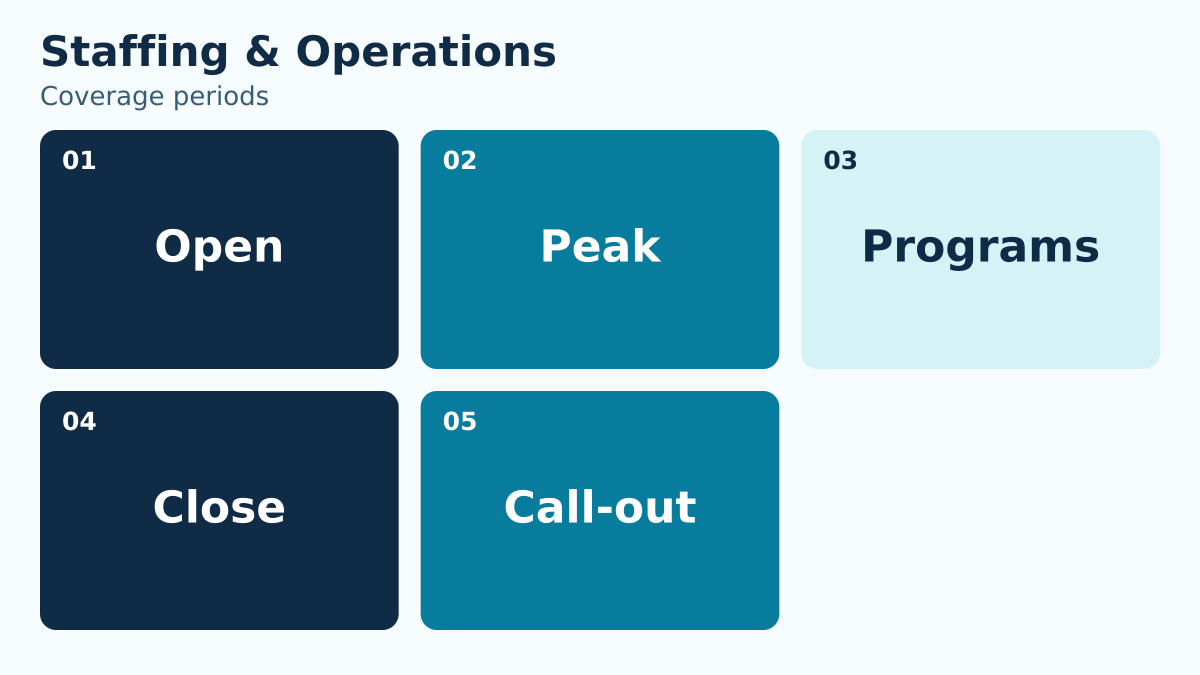
Break the day into meaningful periods: opening, lessons, peak arrival, program blocks, meal periods, events, closing, and after-hours work.
Demand changes during the day. A flat headcount target hides the moments when several responsibilities collide.
Draw a timeline from the first opening task to the final lockup. Add the activities that create simultaneous work: preparing the facility, receiving deliveries, opening admissions, starting lessons, serving concessions, hosting an event, and balancing the desk at close. For each period, ask what must already be finished before the next activity begins. A person scheduled from opening time may arrive too late for preparation that must happen beforehand. Record the task duration as a planning assumption and check it with the person who actually performs the work. Do the same at the end of the day: a facility closing time is not automatically the employee’s departure time. Build a complete operating window before calculating hours so the plan does not hide necessary work outside the visible shifts.
Define coverage by responsibility
List the responsibilities that must be covered in each period: supervision, entry, member questions, concessions, programs, maintenance coordination, cash handling, and manager escalation.
Some responsibilities can be combined during quiet periods; others require dedicated attention. Document the conditions for combining them.
Use a responsibility matrix with periods across the top and roles down the side. Mark each cell as dedicated, shareable under stated conditions, or not required during that period. For example, a club may decide that routine desk administration can pause when arrivals are heavy, while another responsibility needs continuous qualified coverage. The club’s safety requirements determine which combinations are permitted; do not assume spare time makes a combination acceptable. Name the condition that ends a shared arrangement. If a queue reaches an agreed trigger, an event starts, or a supervisor leaves the area, who moves to which responsibility? Test whether that move leaves another role uncovered. The matrix should reveal these dependencies before people are assigned, rather than relying on an experienced employee to notice the conflict during the shift.
Attach qualifications to roles
Record the training, certification, experience, or approval required for each responsibility. Do not schedule a person merely because they are available.
Track qualification status and expiration separately from availability so an open shift does not appear covered by someone who cannot legally or operationally perform it.
Keep a qualification register separate from the availability sheet. Include the responsibility, required evidence, verification owner, expiration or review date, and any restriction that affects assignments. A person may be available for a shift but not yet approved to perform every task within it. Mark training in progress visibly instead of treating an anticipated completion as completed. Before assigning a name, check the qualification against the date of the actual shift. If a certificate or approval expires during the season, place the renewal action before that date and identify the coverage consequence if it is delayed. Ask the responsible safety or operations lead to approve the role requirements. Avoid copying a generic staffing ratio into the plan without checking its applicability to the club’s facility, activity, and governing requirements.
Plan breaks and handoffs
A schedule is not fully covered if the plan collapses during breaks, shift changes, or a manager meeting.
Name the handoff for keys, cash, incidents, member issues, reservations, and open tasks. Give overlap where the risk justifies it.
Write the handoff as a task with an owner and enough scheduled time. The outgoing desk lead should be able to identify unresolved member questions, pending approvals, cash responsibilities, equipment issues, and any change affecting the next period. The incoming lead should acknowledge the items they now own. Decide what information belongs in a shared shift record and what requires a private conversation or restricted record. For breaks, identify the qualified replacement and the task they leave behind while providing relief. A break plan that merely says “cover each other” conceals whether the replacement is available at the required time. Test the busiest overlap, not only a quiet weekday. Where a handoff repeatedly takes longer than planned, adjust the schedule or simplify the work instead of asking employees to absorb the gap informally.
Model predictable peaks
Use last season’s check-ins, program rosters, reservation patterns, events, and concession demand to identify recurring pressure. Treat the pattern as a planning input, not a guarantee.
Add a short explanation for each peak assumption and define what signal would trigger extra coverage.
Use last season’s evidence to describe a pattern with limits. A Saturday event may have produced an arrival surge unlike ordinary Saturdays; rain may have shifted demand into a different period. Separate recurring conditions from unusual events before building the baseline. Combine arrival timing with program and reservation information so the team can see when demand overlaps. Set a review point for the opening weeks and compare the planned pattern with what actually happens. Write an escalation trigger in operational terms, such as a sustained queue or a scheduled program requiring an additional approved role, rather than a vague instruction to “add help if busy.” Name who may call in extra coverage and which qualified person is realistically available. A forecast becomes useful when it leads to an authorized staffing response.
Create an absence response
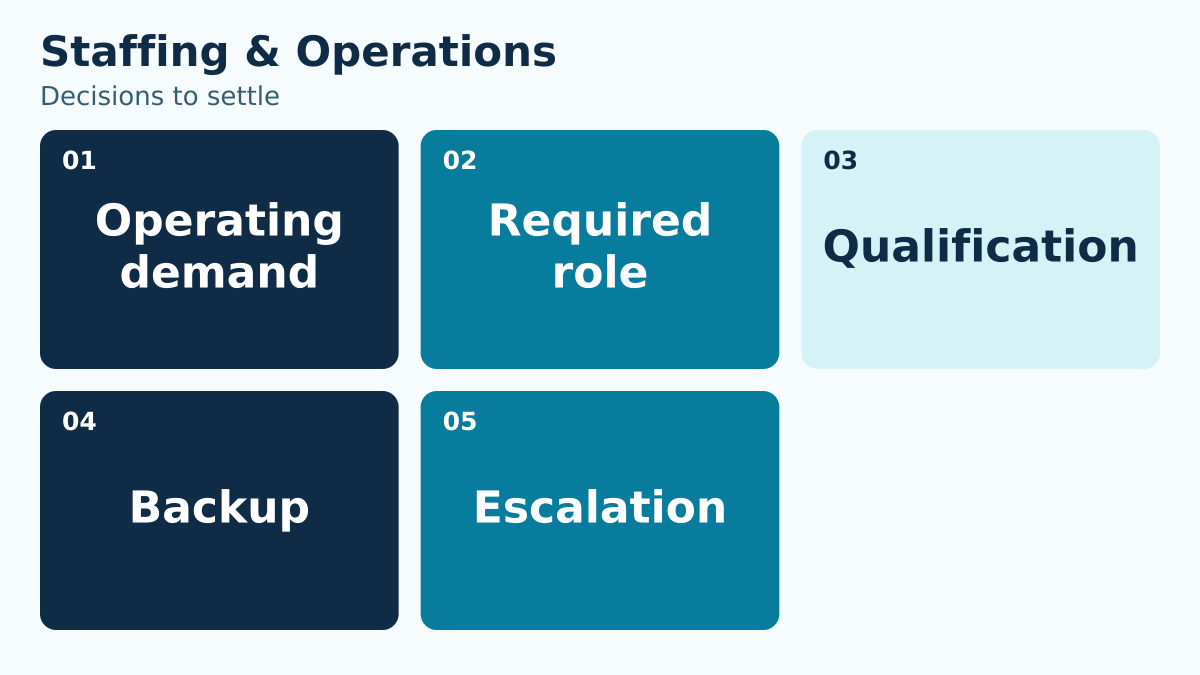
Define who receives a call-out, who may approve overtime or a substitute, what minimum coverage cannot be reduced, and which activities may be delayed or closed.
Keep a current backup pool with qualifications and realistic availability. A long contact list is not useful if no one can perform the open responsibility.
Design the call-out process before asking employees to find their own replacements. Identify the contact method, the receiving role, the information needed, and the point at which management takes over. The substitute must meet the responsibility’s requirements, not simply accept the hours. Maintain a small backup list showing actual availability and qualification, with a clear process for keeping it current. Define the approved operating response when no qualified replacement is available. That may involve delaying or reducing a service according to the club’s rules, rather than stretching an existing employee across incompatible duties. Prepare the member communication at the same time as the staffing response. A manager should not have to invent an announcement while also trying to repair the schedule. After the event, record which assumption failed and update the backup plan.
Test the schedule against scenarios
Walk through rain delays, an early event, a staff absence, a member incident, a payment issue, and a late close.
The goal is not to predict everything. It is to expose single points of failure while there is still time to recruit, train, or redesign the workflow.
Choose three tests with different failure patterns. First, remove one employee during the busiest arrival period and trace the consequences across the responsibility matrix. Second, extend a program or event into the next shift and check breaks, handoffs, and closing tasks. Third, make the manager temporarily unavailable while an approval is needed. Ask each department lead to name the person or role that takes over and the evidence that the assignment is permitted. Mark any answer that depends on someone being “probably around” as unresolved. For each gap, choose recruitment, cross-training, a schedule change, or an approved service adjustment. Record the decision and repeat that scenario. The purpose is to expose a specific dependency and close it, not to collect a long list of hypothetical problems the team cannot act on.
Publish one accountable version
Set a release date, owner, change process, and notification method. Staff should know where the current schedule lives and how changes become official.
Track uncovered responsibilities separately from unpublished drafts. Leadership needs to see risk, not assume a name in a cell means the operation is ready.
Choose one authoritative schedule and state when a proposed change becomes official. A private text asking a colleague to swap should not be mistaken for approval if the club requires a supervisor to check coverage. Record the requesting employee, proposed replacement, qualification check, affected responsibilities, and approving role. Confirm both employees receive the final result. Keep an open-coverage list alongside the schedule so leadership can distinguish an unassigned shift from a fully covered one awaiting publication. Use the seasonal staff availability guide when collecting commitments from returning employees. At the first operating review, compare the plan with actual handoffs, call-outs, and service pressure. Change the coverage model when needed rather than repeatedly moving names around a structure that does not match the work.
Check one busy Saturday before releasing the season
Take a sample Saturday with a morning program, a midday arrival peak, an afternoon event, and a closing shift. Place the required responsibilities on the timeline before placing employee names. Mark which roles need dedicated qualified coverage and which tasks may wait. Then add breaks and the handoff needed between the program and regular operations.
Now remove one available employee from the busiest period. Which approved backup can perform the uncovered responsibility? What work must that backup stop doing? Does the replacement create another gap at concessions, the desk, or closing? Follow the consequences until every responsibility has an answer. A replacement name solves the problem only if the whole operating plan still works.
Use the result to decide what to recruit or cross-train before the season. If the gap cannot be closed, obtain approval for the corresponding service adjustment and prepare the member message. Keep this tested day with the planning assumptions and repeat it when hours or programs change. It gives leaders a concrete basis for discussing staffing cost: the conversation becomes which responsibilities the proposed coverage can reliably support, rather than whether the spreadsheet appears full.
Use this working-session checklist
- Name the reader or staff role who must make the decision.
- Write the operational question in one sentence.
- Identify the source record and the person responsible for it.
- Define the normal path and the most common exception.
- State which role can approve an override or correction.
- Choose the evidence that proves the outcome was completed.
- Set a review date and a trigger for revisiting the rule.
- Test the process with a realistic household, staff account, or operating day.
Do not mark the work complete because a document exists. Ask someone who did not write it to use it. If that person cannot reach the correct outcome without private coaching, the process still depends on memory.
How to make the decision durable
Write the final rule in language a seasonal employee can understand. Put technical configuration details in the implementation record, not in the staff instruction. Connect the policy to the screen, report, or record staff actually use, and give exceptions a visible route instead of an informal favor.
Then review the first few real cases. Compare the expected result with what staff and members experienced. Correct wording, permissions, fields, or training while the evidence is fresh. A small early review is more useful than a large annual cleanup because it catches interpretation gaps before they become habits.
Finally, keep ownership visible. Every open item needs a person and a date. “The board,” “the office,” or “the vendor” is not an owner. A role or named person who can act is.
Turn the framework into an operating advantage
The purpose of this work is not a perfect document. It is a club that can answer a member, complete a shift, prepare a report, and hand responsibility to the next person without losing context. Clear records reduce the number of situations that require heroic memory.
PoolPulse staff and user workflows can help keep the relevant account and operational context connected. The club still owns its policies, approvals, and judgment; the platform should make those decisions easier to apply and review.
See how PoolPulse connects staff roles with club operations.

Seasonal Staff Should Not Inherit Last Year’s Access
Returning staff do not automatically need last year’s permissions. Review roles, devices, exports, and approvals before next season’s accounts go live.

Opening Day Is the Wrong Place to Start Your Renewal Calendar
A practical renewal calendar that works backward from opening day and gives every milestone an owner and release gate.

The Demo Looked Great. What Would Prove This Platform Works for Your Club?
Go beyond a polished software demo. Bring one everyday club task, let staff try it, and check what happens from the member's request to the final follow-up.
Want to see if PoolPulse is a good fit for your club?
Book a walkthrough and we'll show you exactly how PoolPulse can help based on your club's needs, goals, and current processes.