

Your Snack Bar Closeout Needs Three Numbers, Not One Cash Total
Reconcile tender totals, item movement, and household activity before small differences become season-long uncertainty.


A cash drawer can balance while a member tab is wrong, product movement is unexplained or a card payout belongs to a different reporting period. Counting the till answers a useful question, but it cannot explain every transaction at a club snack bar.
A stronger closeout compares three views: payment and tender activity, the items or credits delivered and the household or transaction records connecting them. These are three checks rather than three interchangeable totals. Cash is counted in dollars, stock in units and household activity by account. The job is to explain how those views relate without forcing unlike figures to match.
For snack bar managers and club treasurers, a practical closeout should produce a clear status: reconciled, reconciled with documented timing differences or unresolved with an owner. A tidy total without supporting records is less useful than a small difference that has been identified and assigned for review.
Set the reporting boundary before counting
Define the business date, location and registers included in the closeout. Note the time zone and cutoff used by each report. A late sale can appear on one day in the point-of-sale report and another in the processor record. If the snack bar has a second terminal used only during swim meets, include it deliberately rather than assuming the main register report covers both.
Decide how late corrections will be handled. If a refund is entered after the daily report is saved, preserve the original closeout and identify the later transaction instead of quietly replacing the evidence. Name the report version or export time so the next reviewer can reproduce the comparison. Different filters can produce different totals even when the underlying transactions are accurate.
The six operational decisions below organize the three-way check: tender and sales establish the transaction totals, household and inventory checks test what those transactions represent, then deposit custody and exception handling complete the closeout.
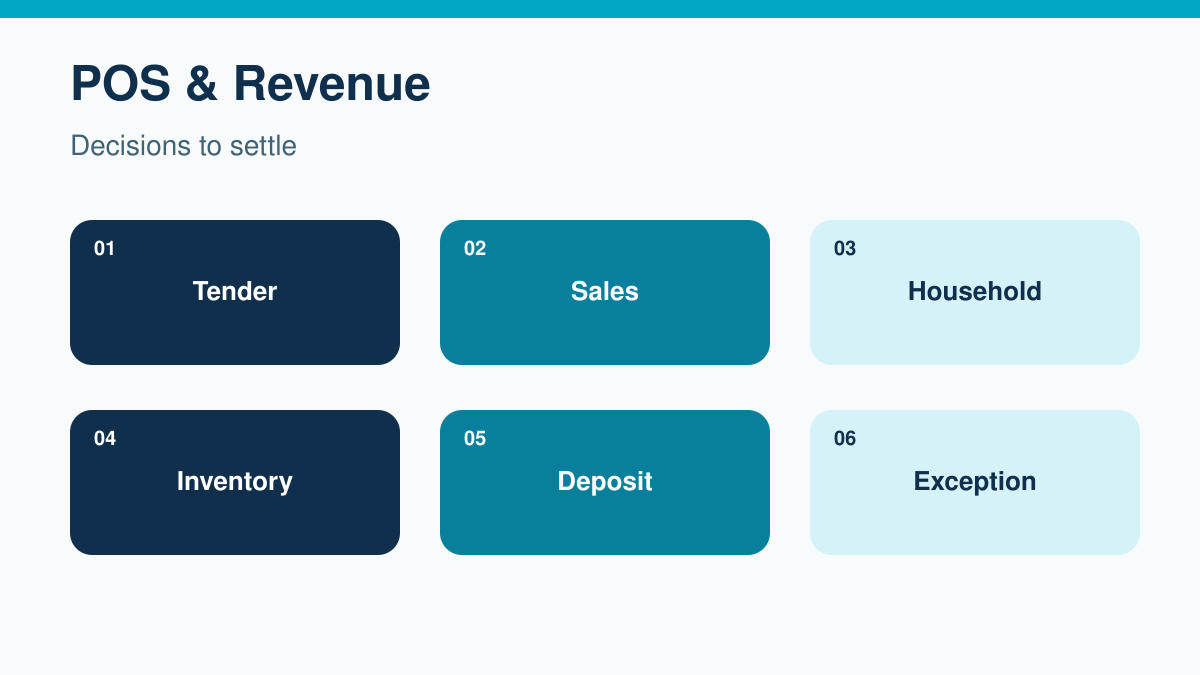
1. Tender: separate money from account activity
List every payment path the snack bar accepts. Cash and card payments are different from a charge added to a household account or a deduction from a previously funded balance. A prepaid top-up brings in funds, while a later purchase consumes that balance. Adding both to the same sales measure can count the same value twice. Ask the finance owner how these categories should appear in the club’s records.
For cash, start with the opening float and add cash receipts. Subtract cash refunds, authorized paid-outs and documented cash drops already removed from the drawer. The result is expected cash remaining. Count the drawer independently of that calculation when staffing permits, then compare. Record denominations so a second person can repeat the count without relying on the first person’s mental arithmetic.
For example, a $100 opening float plus $280 in cash sales less $20 in cash refunds and a $200 documented cash drop leaves $160 expected in the drawer. If the physical count is $157, the drawer is $3 short. The earlier $200 drop remains part of the custody record. It should not disappear simply because it is no longer in the till.
This example assumes there are no tips, paid-outs or other cash movements. Add separate lines if those apply rather than hiding them in sales. Keep the opening float distinct from the amount designated for deposit. A cash movement worksheet explains physical custody; it does not by itself determine revenue or the accounting treatment of every receipt.
2. Sales: explain what happened to each order
Use an item or transaction report to review quantities, discounts, voids and refunds. Confirm whether the report displays gross amounts or net amounts and whether tax is included. Comparing a tax-inclusive tender total with tax-exclusive sales creates an apparent difference that is only a definition mismatch. Keep tips or service charges separate where relevant to the club’s setup.
Check the distinction between a void before completion and a refund after payment. The reports may treat them differently. A voided order can still represent food prepared and discarded, while a refunded unopened product might return to stock. Financial reversal and physical product movement are separate events. Both need a record when they affect the closeout.
Look at unusual quantities as well as unusual dollars. Twenty zero-priced waters may reflect an approved team arrangement, a price setup error or an employee choosing the wrong button. A high discount total may come from one event rather than widespread mistakes. Find the transactions behind the pattern before deciding what changed or asking staff to explain it from memory.
3. Household: reconcile the right account, not just the total
A household charge can balance perfectly in the register while landing on the wrong family. Review transactions where staff selected an account manually, changed the selected household or corrected a purchase after checkout. Similar surnames and children purchasing independently make these useful test cases. Confirm identity using the club’s approved method rather than assuming the first search result is correct.
Consider a simplified shift with $900 in completed purchases after discounts and with tax included. The payment allocation is $300 cash, $350 card, $150 charged to household accounts and $100 deducted from prepaid balances. Those allocations total $900. Only $650 represents new cash and card receipts from these purchases. The other $250 follows account paths that need their own supporting records.
Suppose another member adds $50 to a prepaid balance by card during the shift. The processor activity can now include $400 in card receipts even though card-funded purchases total $350. That extra $50 needs a matching balance increase, not another food sale. This operational example leaves out refunds and fees. The club’s accountant should determine how the categories map into its books.
For household corrections, preserve the original reference and the approved correction. If a $12 purchase belongs to a different family, verify both the reversal on the first account and the charge on the intended account. Moving only one side can leave the club with either a duplicate charge or a missing receivable. Confirm what the affected member will see before calling the issue resolved.
4. Inventory: count the products that reveal problems
Choose a focused set of items for daily checking, based on value, sales volume or recurring differences. Keep a separate schedule for broader counts. Cans, bottled drinks and packaged snacks are often easier to reconcile than ingredients used across several recipes. For prepared food, define the portion or recipe assumption before interpreting consumption as missing stock.
For a packaged item, expected closing stock equals opening units plus receipts and transfers in, less units sold, documented waste and transfers out. Add returns to stock only when the product actually returns in a condition that permits resale under the club’s food-handling procedures. Do not assume every refund restores inventory.
For example, start with 80 drinks, receive 24 more and sell 63. Record three damaged units and transfer six to another service point. Expected closing stock is 32. A physical count of 30 leaves a two-unit difference to investigate. Recount the shelf and cooler, check the transfer record and confirm that the sales report uses individual drinks rather than cases.
Do not convert every unexplained unit into an accusation. A delivery entered twice, an unrecorded event transfer or a wrong package size can create a variance. Keep food-safety decisions separate from reconciliation: unsafe stock should not remain available merely to avoid recording waste. The purpose of the stock check is to explain movement and improve the process, not to make the numbers look cleaner.
5. Deposit: document the custody handoff
Record who counted the cash, who checked it and where it went next. Include the amount, business date and deposit or sealed-bag identifier used by the club. Note any retained float separately. Where staffing permits, have a second authorized person verify the count or review the evidence. For a small operation, the manager can design a later independent review instead of pretending two-person coverage always exists.
Distinguish a prepared deposit from a confirmed bank deposit. A bag in a safe has completed one handoff, not every handoff. The finance reviewer should be able to connect the register cash activity, counted funds and eventual bank record. If deposits combine several days, preserve the breakdown so a later mismatch can be traced to the relevant closeout.
Card receipts need a different bridge. Stripe’s payout reconciliation documentation , for example, explains that automatic payouts can include multiple transactions and provides ways to review them. Use the equivalent detail for the club’s processor. Match the payout to its underlying activity and documented adjustments rather than expecting each bank credit to equal one day’s card sales.
6. Exceptions: keep a difference visible until resolved
Give closers a short sequence for differences: recount, confirm report filters, check refunds and cash movements, then send the remaining issue to the named reviewer. Establish local thresholds for escalation, but do not let a dollar threshold hide a wrong-household charge or a repeated control failure. A small account error may deserve prompt correction even when the drawer itself balances.
The exception record should include expected and actual amounts, the transaction references checked and the next action. Write “$3 shortage remains after recount; no matching paid-out found; finance lead to review tomorrow” rather than “probably change error.” A hypothesis can guide investigation, but it should not be recorded as a confirmed cause without evidence.
Never add a fictional sale, erase a transaction or alter a count merely to force agreement. Corrections should follow the club’s approval process and preserve the reason. Keep an unresolved item open through the next review. If the difference remains unexplained, record the authorized disposition without claiming the cause was established.
Put the closeout into a repeatable sequence
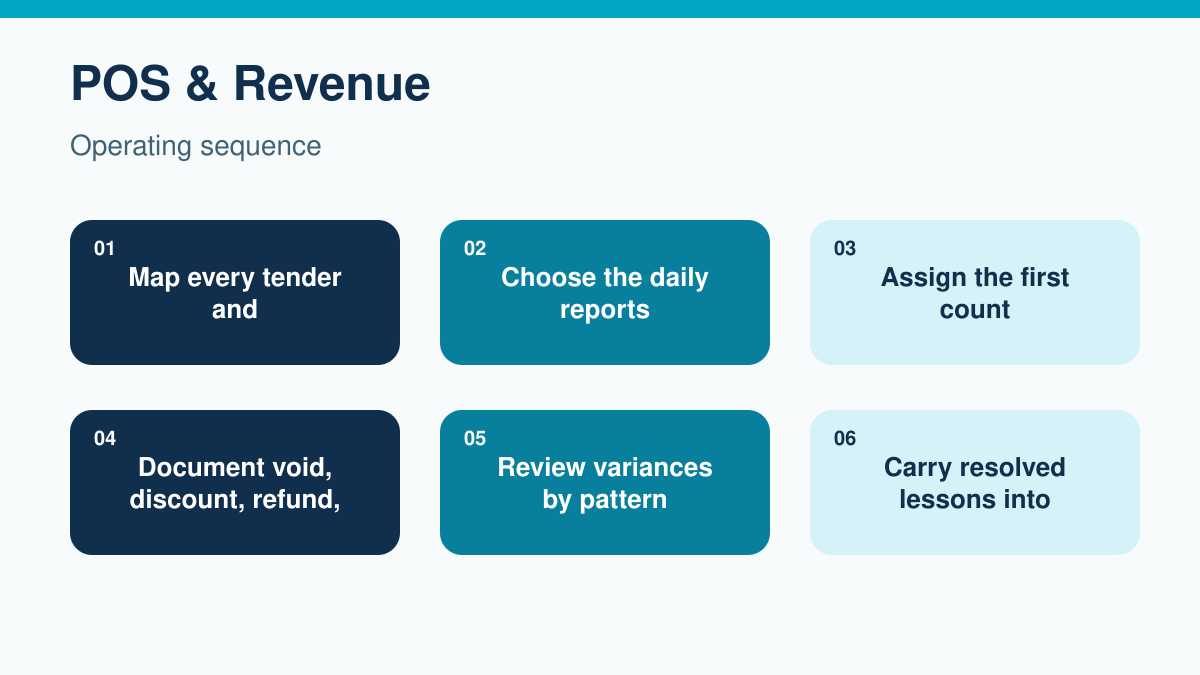
First, map every tender and account path. Second, choose the reports and physical counts that explain each path. Third, assign the initial count and verification. These choices should happen before the busiest evening, when the person closing has little time to discover that a report is inaccessible or an account category has no matching worksheet.
Fourth, make reason records practical for voids, discounts and refunds. Use categories that fit real snack bar work, with room for a short explanation when needed. Fifth, review recurring variances across shifts. Sixth, use resolved findings to improve price setup, training or stock handling. A correction is more valuable when it prevents the same confusion on the next weekend.
Save a compact closeout packet
Keep the saved reports, count sheet and exception references together under the same business date and location. Include the opening float, expected cash, counted cash and custody handoff. Add the household charge and prepaid activity reports needed to support those totals. Store only the transaction and account information needed for review, with access appropriate to the people doing that work.
The IRS recordkeeping guidance lists cash register tapes, deposit information, receipt books and invoices among supporting documents for gross receipts. That is useful support for keeping transaction evidence, not a requirement to use this particular closeout design. Ask the club’s accountant about applicable retention, tax treatment and reporting obligations rather than adopting a generic rule from an operational checklist.
A reviewer should be able to start from a reported total and reach the supporting transactions without asking the closer to reconstruct the evening. Check that exports can be opened and that report filters are recorded. A screenshot of one number may be useful as a quick reference, but it is a weak substitute for transaction detail when a member questions a charge weeks later.
Test the process before the busiest weekend
Run a rehearsal with a small cash shortage, a prepaid top-up and a purchase posted to the wrong household. Ask the closer to identify which check detects each issue. Then have the reviewer follow the saved references. If every scenario is handled as a cash variance, the process is not yet distinguishing physical money from account activity.
At the weekly review, group issues by cause rather than by employee name alone. Repeated wrong-account selections may call for a better identity check. Frequent drink variances may point to transfers that are never logged. A recurring card difference may be a cutoff mismatch. Assign one corrective action and check the next relevant closeouts to see whether the pattern changes.
Use a demonstration to test the handoffs
If the club is considering new software, bring the worked examples to a Clubward demo. Ask how the proposed setup would represent household charges, prepaid activity and corrections, then request the reports needed to trace each example. Confirm available functionality and configuration before relying on it; a product demonstration should answer your operational questions rather than replace them.
A good closeout does not promise that every number will agree immediately. It makes the difference understandable, preserves the evidence and gives unresolved work an owner. That allows the next shift to open without inheriting a mystery and gives finance a dependable starting point for its own reconciliation.

One Family Balance or One per Child? The Snack Bar Decision to Make Before Next Season
A shared family balance and separate member balances solve different problems. Work through the spending rules, visibility, and checkout questions before choosing your club’s setup.
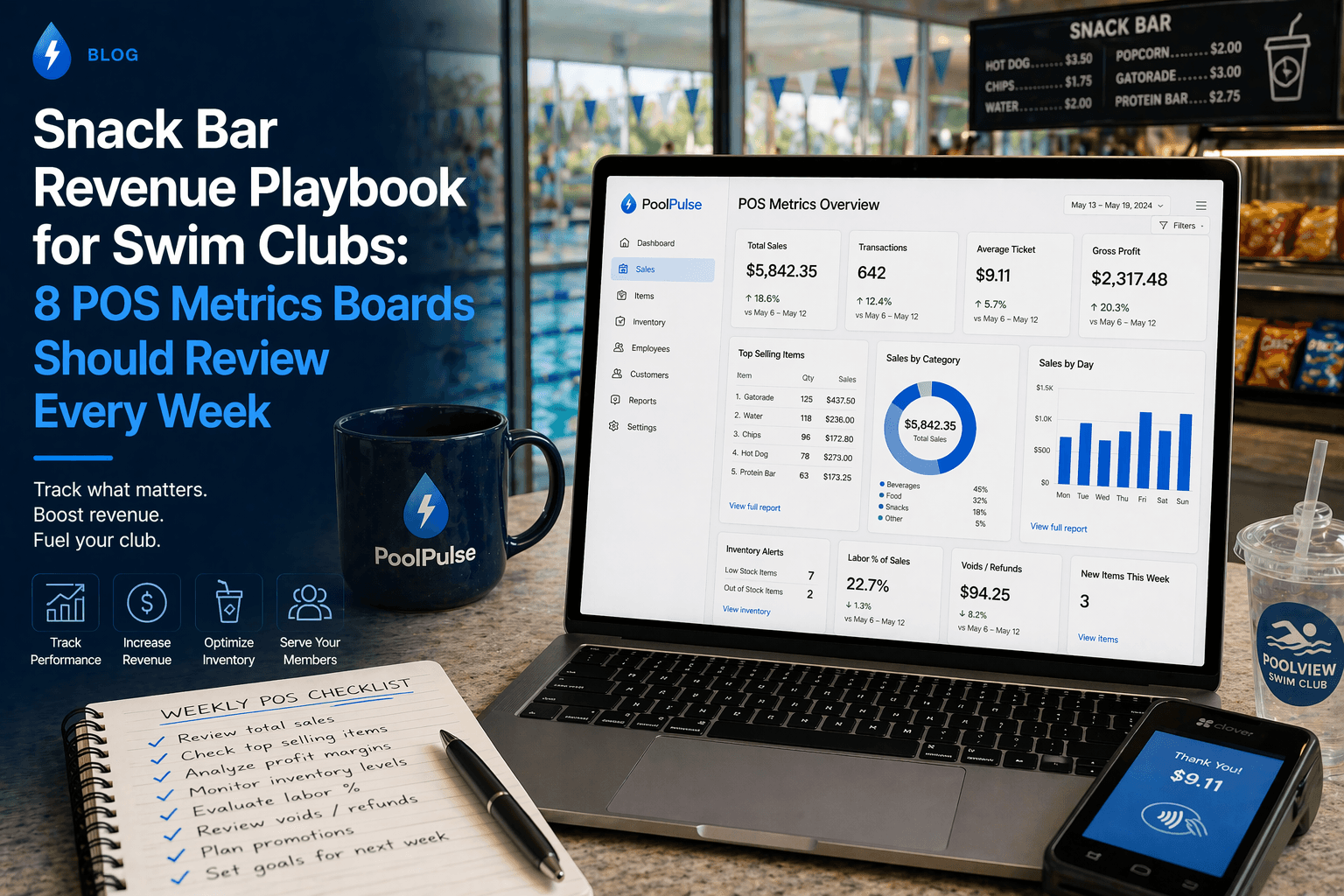
Snack Bar Revenue Playbook for Swim Clubs: 8 POS Metrics Boards Should Review Every Week
The POS metrics swim club boards should review weekly: snack bar revenue, inventory signals, and account risk in one clear view.

Five Front-Desk Tasks Your Swim POS Should Handle
Your front desk shouldn't need three systems to check in a swimmer. Here's how modern swim POS systems save time and reduce errors.
Want to see if PoolPulse is a good fit for your club?
Book a walkthrough and we'll show you exactly how PoolPulse can help based on your club's needs, goals, and current processes.