

How to Know If Your Swim Club Software Works
Most swim clubs don't know if their software actually works until something breaks. Here's how to test yours before the season starts.

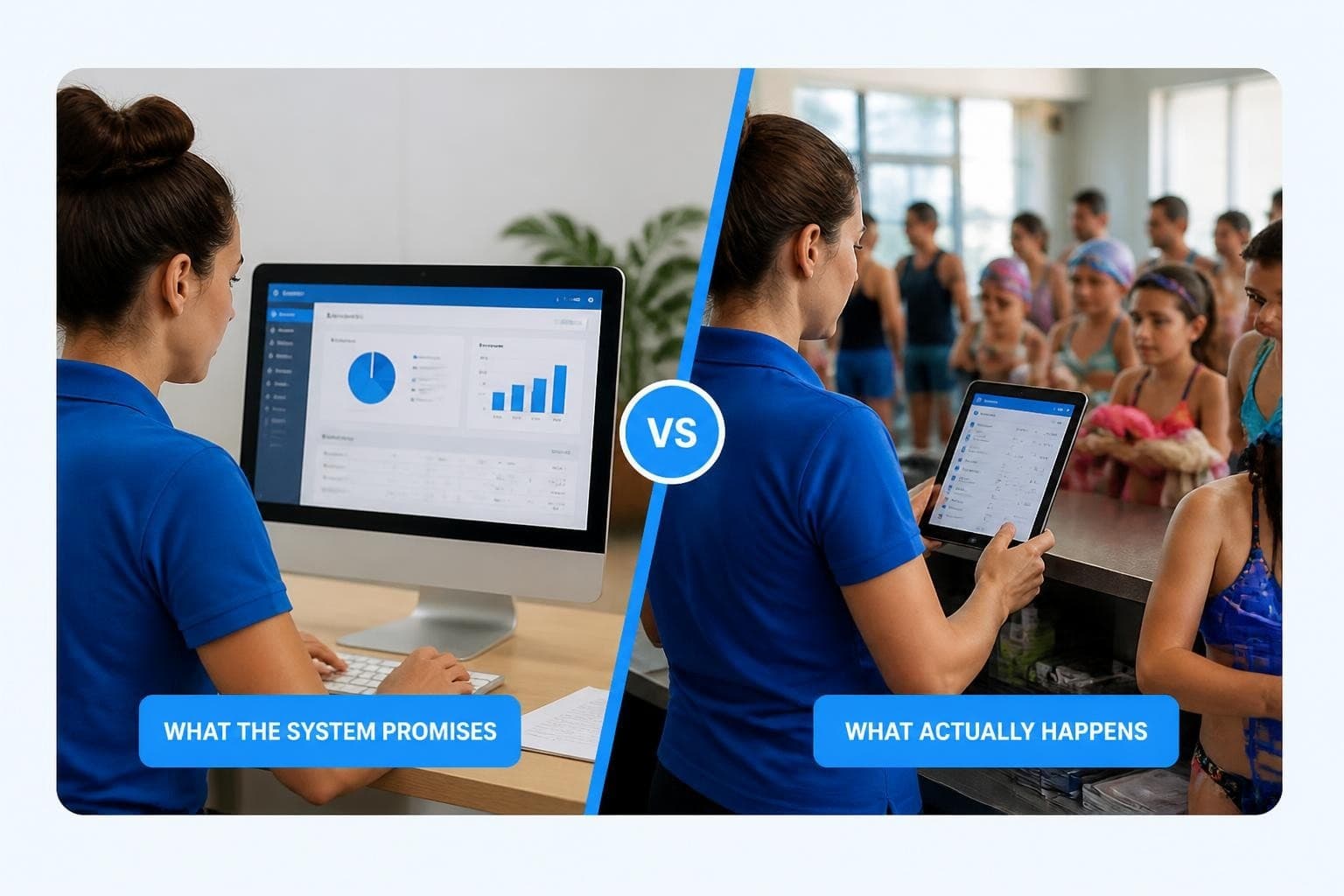
You're two weeks into summer season and your front desk staff is manually checking in every member because the software works too slowly. Your treasurer just spent three hours reconciling payments that should have been automatic. And your board president is asking why the renewal emails went to members who already paid. Sound familiar? Most swim clubs don't realize their software isn't working until they're already in the middle of the chaos.
The Saturday Morning Reality Check
Let's talk about what actually happens when your software works the way it should. It's Saturday at 11 AM. Your pool is packed. Three families are checking in at once, two want to add guests, and someone's asking about their balance from last month. Your front desk volunteer should be able to handle all of this without calling you.
That's the test. Can your newest volunteer handle a busy Saturday morning without texting you for help?
If the answer is no, your software works against you instead of for you. And here's the thing: most swim clubs accept this as normal. They think club management software is supposed to be complicated. They budget extra hours for "administrative work" that shouldn't exist.
What Working Software Actually Looks Like
When software works properly, it disappears into the background. Your staff doesn't think about it. They just do their jobs.
Here's what that means in practice:
- Check-ins take seconds, not minutes. Members walk up, staff confirms them, they're in.
- Guest additions happen at the desk. No forms to file later or balances to calculate manually.
- Payment questions get answered immediately. Staff can see the history right there.
- Membership status is always clear. Active, suspended, expired - it's obvious at a glance.
Compare that to what most clubs deal with. Multiple screens to check one member. Calculations done by hand. Sticky notes with guest counts. Email threads trying to figure out who paid what.

The Five Functions That Reveal Everything
You don't need to test every feature. Just watch these five things. If your software works well here, it probably works everywhere. If it struggles, you've got problems.
Member Check-In During Rush Hours
Time yourself on a Saturday morning between 10 AM and noon. Pick five random member check-ins. How many clicks does each one take? How long until the screen refreshes?
Good software works in two clicks or less. Great software works in one. If you're waiting for pages to load or hunting through menus, that's a problem multiplied by every visit all season long.
Now add a complication. Member brings two guests. Their cousin wants to sign up as a new member. They're asking about swim team registration. Can your staff handle all of that in one interaction? Or do they need to "circle back" after checking three different places?
Billing and Payment Tracking
Pull up three member accounts at random. Can you see their complete payment history in one view? Does it show pending charges, completed payments, and outstanding balances together?
Try to answer these questions without opening multiple screens:
- Which members have balances over $100?
- Who paid in the last 24 hours?
- Which families are on payment plans?
- What's your total outstanding receivables?
If you can't answer these in under two minutes, your software works against your financial health. According to IBM's comprehensive overview of software development , well-designed systems should provide immediate access to critical operational data.
| Task | Good Software | Problem Software |
|---|---|---|
| Find member balance | One screen, 5 seconds | Multiple screens, 30+ seconds |
| Process guest payment | Add guest, collect payment, done | Manual calculation, separate payment entry |
| Generate financial report | Click, export, done | Pull multiple reports, combine in Excel |
| Identify delinquent accounts | Automatic list with filters | Manual review of all accounts |
Renewal Season Management
This is where most swim club software fails spectacularly. Renewals should be automatic. Members get notified. They pay. They're renewed. Done.
Instead, most clubs experience renewal chaos. Emails go to the wrong people. Payment links break. Some members get charged twice. Others fall through the cracks. You spend April and May doing detective work instead of preparing for summer.
Test your renewal process in the off-season. Set up a test batch of 10 fictional members with different scenarios:
- Family that renewed early
- Member who needs to update payment method
- Account with outstanding balance
- New membership tier request
- Seasonal membership conversion
Can your system handle all of these cleanly? Or does each one require manual intervention?
Why Most Club Software Fails the Real-World Test
Here's what nobody tells you when you're shopping for swim club management software. Most platforms were built by people who've never run a pool. They designed what they thought clubs needed, not what actually happens on a busy Saturday.
The Dashboard Problem
You log in and see charts. Graphs. Colorful widgets showing member growth and revenue trends. Looks impressive in a demo. Completely useless when you're trying to figure out why the Johnson family got charged twice.
Software works when it shows you what you need, when you need it. During operating hours, you need member info, check-in tools, and quick payment processing. The pretty analytics can wait until Monday morning.
The Training Trap
"Just watch these tutorial videos." That's the response when your seasonal staff can't figure out how to add a guest. If your software needs extensive training for basic tasks, it doesn't work. Period.
Think about it. You're hiring college students for three months. Parent volunteers working one shift per week. They need to learn your system in one afternoon. Complicated software creates constant problems because you're always training someone new.

The Customization Nightmare
"You can customize everything!" sounds great until you realize you need a developer to change your guest fee from $10 to $12. Or you want to add a new membership category. Or adjust your seasonal hours.
When software works properly, you can make normal operational changes yourself. No support tickets. No waiting for updates. No workarounds.
Many clubs using traditional systems discover this too late. They're locked into configurations that made sense three years ago but don't match how they operate now. The software development process should include flexibility for changing business needs, especially in seasonal operations.
The Hidden Costs of Software That Barely Works
Let's talk money. Not what you pay for the software, but what it costs when the software works poorly.
Time Multiplied by People
Your treasurer spends five extra hours per month reconciling payments manually. Your front desk lead stays late twice a week closing out the register. You personally spend Sunday afternoons fixing membership issues that shouldn't exist.
Five hours at $25 per hour, times 12 months. That's $1,500 per year, per person. Multiply by everyone touching the system. Now you're looking at real money.
And that's just direct time. What about the membership renewals you lose because the process is too complicated? The guests who don't come back because check-in was slow? The board members who quit because financial reporting is a mess?
The Mistake Tax
Wrong charges. Duplicate accounts. Lost guest payments. Members who slip through renewal without paying. Every software limitation creates opportunities for expensive mistakes.
A single missed renewal is $500 to $1,500 in lost revenue. One family gets frustrated and quits because of billing errors. That's $2,000 gone. These add up faster than your monthly software fee.
The Opportunity Cost
Here's the one most clubs never calculate. What could you accomplish if your software actually worked?
Instead of spending 10 hours per week on administrative cleanup, you could:
- Plan better member events
- Improve your facilities
- Actually enjoy running your club
- Focus on member experience instead of data entry
Time is the only resource you can't get back. Software that barely works steals it from you every single day.
What Modern Club Software Should Do
You deserve software that works without constant attention. Here's what that looks like in 2026.
AI-Powered Insights That Actually Help
Not talking about buzzwords here. Real AI that notices patterns and tells you about them. "Hey, 15 members haven't checked in yet this season. Want to send them a reminder?" or "Guest revenue is down 20% from last year on Saturdays."
The integration of AI in software development has advanced significantly, making it possible for systems to actively support decision-making rather than just store data. This technology should work for your club, not add complexity.
Smart software notices when something's unusual. Member always checks in on Tuesdays but hasn't been in three weeks? Family typically brings guests but hasn't this month? These are opportunities to reconnect, but only if your system surfaces them.
Automatic Revenue Recovery
Expired credit cards. Failed payment retries. Members who forget to renew. Every club has revenue that should be automatic but gets lost.
Software works when it handles this for you. Automatically retries failed payments. Sends payment method update reminders. Follows up on expired memberships without you lifting a finger.
The difference between basic club management software and modern platforms often comes down to these automatic processes. One requires constant manual intervention. The other works while you sleep.
Configuration Without Coding
Your club is unique. Your membership tiers, pricing, policies, and seasons don't match anyone else exactly. Software should adapt to you, not force you into someone else's model.
Modern platforms let you adjust settings yourself. Change guest fees. Add membership categories. Modify check-in rules. Update billing cycles. All without contacting support or waiting for the next software update.
The Real-World Configurability Test
Here's a practical way to test if your current software works for your actual needs. Try to make these five common changes:
- Add a new membership tier for pool-only members (no swim team)
- Adjust your guest policy to allow three free guests per month instead of two
- Create a mid-season joining option with prorated fees
- Set up automatic late fee assessment after 30 days
- Modify check-in rules for special events versus regular swim hours
How many of these can you do yourself in under 10 minutes? If the answer is less than four, your software works against your operational flexibility. You're stuck with someone else's assumptions about how clubs should operate.
| Change Type | Time Required (Good Software) | Time Required (Typical Software) |
|---|---|---|
| Pricing adjustment | 2 minutes | Support ticket, 2-3 days |
| New membership category | 5 minutes | Configuration fee, 1 week |
| Guest policy update | 1 minute | May not be possible |
| Automated fee rules | 3 minutes | Custom development required |
| Event-specific check-in | 2 minutes | Workaround with manual tracking |

When to Know It's Time to Switch
You've been making it work. You've developed workarounds. Your team knows the quirks. But there's a point where working around bad software costs more than switching to something better.
The Warning Signs
Watch for these patterns. They indicate your software works against you more than for you:
You're maintaining shadow systems. Excel spreadsheets tracking what the software should track. Email threads serving as your real record of member communications. Separate payment logs because you don't trust the software's numbers.
New staff can't learn it. Every new volunteer or seasonal employee needs extensive handholding. You've created detailed instruction documents. You field the same questions every week because the software isn't intuitive.
You're paying for features you can't use. The software promises automation, reporting, and integrations. But you can't figure out how to set them up, or they don't work with your actual operations.
Member complaints are increasing. Families frustrated by the check-in process. Billing questions that shouldn't exist. Renewal confusion every year. When members start commenting on your software, that's a problem.
The Migration Fear
"We can't switch. We have years of data in this system." That's what every club says. And it's a legitimate concern. But here's what you need to know about modern migration.
Good platforms, like PoolPulse's swim club management software , handle data migration as part of onboarding. Your member records, payment history, and account details transfer cleanly. You don't lose anything.
The complete migration checklist actually shows you it's less complicated than running another season with broken software. Most clubs complete the transition in 2-3 weeks during their off-season.
Calculating the True Cost
Before you decide to stick with struggling software, run the real numbers:
- Staff time spent on workarounds (hours per week × hourly cost)
- Lost revenue from missed renewals or billing errors
- Member frustration leading to cancellations
- Your personal time dealing with software issues
- Opportunities missed because you're buried in administrative work
Now compare that annual cost to switching to software that actually works. Most clubs discover they're spending far more money and time keeping bad software running than they would investing in a modern platform.
What Working With Modern Software Feels Like
Let's paint a different picture. It's the same busy Saturday morning. Same three families checking in. Same guest additions and balance questions.
But now your volunteer handles it all in under three minutes. No calls to you. No confusion. No sticky notes for follow-up. The system just works.
The Daily Difference
Members check in smoothly. Guests get added with two clicks. Payments process instantly. Reports generate automatically. Renewals happen without drama.
Your staff actually enjoys working the desk because they're not fighting the software. Your treasurer doesn't dread month-end closing. Your board gets clear financial updates without asking.
This isn't fantasy. This is how software should work. And in 2026, there's no excuse for settling for less.
The Seasonal Transition
Remember how renewal season used to consume April and May? Now it's automated. Emails go out on schedule. Payment reminders trigger automatically. Members renew themselves. You monitor progress instead of manually processing everything.
Opening day used to mean panic. Making sure everyone's status updated correctly. Fixing accounts that got messed up. Training staff on workarounds. Now? You focus on welcoming members back and making sure operations run smoothly.
The Board Meeting Upgrade
No more showing up with hastily assembled reports. No explaining why the numbers don't quite match. No defensive responses about administrative efficiency.
Instead, you pull up real-time dashboards. Show membership trends. Demonstrate revenue tracking. Present insights about peak usage times and member engagement. The conversation shifts from "what's happening?" to "what should we do about it?"
When software works properly, it makes you look good. It makes your whole operation look professional and organized. Because it actually is.
The Questions You Should Ask
Before you commit to any swim club management platform, test these specific scenarios. Don't just watch a demo. Make them show you how the software works in your actual situations.
The Real-World Scenario Test
Bring these situations to any demo or trial:
-
Rush hour check-in: Five members arrive simultaneously, including one with a guest, one asking about their balance, and one whose kid wants to sign up for swim team.
-
Billing complexity: A family wants to switch from seasonal to annual membership mid-season, add their cousin to their account, and set up a payment plan.
-
Reporting emergency: Your treasurer needs complete revenue reports for the last fiscal year by tomorrow morning for your accountant.
-
Policy change: You need to update guest fees effective next week and notify all affected members.
-
Integration requirement: Connect your website so members can check their balance and update payment methods without calling you.
Watch how the software handles these. More importantly, watch whether the demo person understands these are normal operations, not edge cases.
The Support Reality Check
Ask about support during the scenarios above. What happens when your Saturday front desk volunteer can't figure something out at 11 AM? Is there real-time help? Or does "support" mean submitting a ticket and waiting until Monday?
Understanding how the software development process includes ongoing support and updates tells you whether the company views the software as a product they sold you or a partnership that continues after purchase.
Making Software Work for Your Club's Future
Here's what most clubs miss when evaluating software. They're solving for today's problems. But your club changes. Your board changes. Your membership grows (hopefully). Your policies evolve.
Software that works isn't just good enough for right now. It grows with you. It adapts when you need new capabilities. It doesn't lock you into decisions from three years ago that no longer make sense.
The Five-Year Test
Ask yourself: Can this software handle our club in five years? When you've grown by 30%? When you've added new amenities? When you've changed board members twice and have completely different volunteers?
Systems designed for flexibility survive long-term. Rigid platforms force you into another painful migration down the road.
The Staff Turnover Reality
Your front desk lead is graduating college. Your treasurer is moving across the country. Your webmaster got a new job. This happens every year at swim clubs.
Software works when institutional knowledge isn't required. New people can learn it quickly. Processes continue smoothly. You're not trapped because only one person knows how everything works.
This is why intuitive club management features matter more than feature lists. A system with 100 features that requires extensive training is worse than a platform with 50 features that anyone can use.
Understanding whether your swim club software actually works comes down to honest assessment of daily operations and real costs. If you're spending more time fighting your system than running your club, that's not normal and you don't have to accept it. PoolPulse offers modern, AI-powered management software designed specifically for how swim clubs actually operate, with the configurability to match your unique needs and the simplicity that lets seasonal staff start helping members immediately. Schedule a demo to see how software should work when it's built for your world, not adapted from someone else's.

Five Front-Desk Tasks Your Swim POS Should Handle
Your front desk shouldn't need three systems to check in a swimmer. Here's how modern swim POS systems save time and reduce errors.

The Swim Club Software Test Every Board Should Run
Run this simple test to see if your swim club software actually saves time or creates more work. Real scenarios, honest questions, better tools.

The Seven Signs You've Outgrown Your Club Operations
Your swim club is growing, but your tools aren't keeping up. These seven warning signs reveal when manual processes cost more than solutions.
Want to see if PoolPulse is a good fit for your club?
Book a walkthrough and we'll show you exactly how PoolPulse can help based on your club's needs, goals, and current processes.