

System and Management for Swim Clubs in 2026
Learn how effective system and management practices help swim clubs save time, reduce errors, and improve member experience. Real advice for club admins.


Running a swim club means juggling dozens of tasks every day. You're managing member registrations, processing payments, tracking who's current on their dues, coordinating facility access, and fielding questions from families. When your system and management approach doesn't work smoothly, everything becomes harder than it needs to be. You spend hours fixing problems that shouldn't exist, chasing down information that should be at your fingertips, and wondering why something that should be simple feels so complicated.
The truth is, most swim clubs still rely on outdated ways of organizing information. Maybe you're using spreadsheets for member lists, a separate tool for billing, email folders for communications, and paper sign-in sheets at the gate. Each piece lives in its own world, and you're the one constantly translating between them. That's not a system. That's a collection of workarounds held together by your personal knowledge and effort.
What System and Management Actually Means for Swim Clubs
Let me be clear about what we're talking about here. System and management isn't about buying expensive software or hiring consultants to draw flowcharts. It's about how your club organizes information, handles recurring tasks, and makes decisions based on accurate data.
Think about your member database. In a good system, you can see at a glance who's paid, who needs to renew, who's on a waitlist, and who has special access arrangements. You can pull that information in seconds, not hours. You can send targeted messages to specific groups without manually sorting through records.
The Real Cost of Disorganized Systems
When your system and management structure breaks down, you pay for it in ways that don't show up on your balance sheet.
You spend time doing work twice. Someone updates the membership list, but the billing system doesn't know about it. A family pays their dues, but the gate attendant doesn't have them on the approved list. A renewal deadline passes, and you don't know who to follow up with because that information lives in someone's email inbox.
Here's what poor system and management creates:
- Staff spending hours each week on tasks that should take minutes
- Members getting frustrated because they can't find basic information
- Revenue leaking out because you don't catch lapsed memberships quickly
- Board meetings where you can't answer simple questions about your club's operations
- Turnover in volunteer positions because the job is harder than it should be
The principles of system management have evolved over decades, but the core idea remains simple: organize your work so information flows naturally and people can focus on what matters.
Building Blocks of Effective System and Management
You don't need to rebuild everything at once. Start by understanding what makes a system work in the first place.
Single Source of Truth
Every piece of information should live in one place. When someone asks "Is the Johnson family current on their dues?" you should be able to answer immediately without checking three different places.
This is harder than it sounds when you're using multiple tools that don't talk to each other. But it's the foundation of everything else. If your member data lives in a spreadsheet, your billing information lives in QuickBooks, and your access records live on paper, you don't have a system. You have chaos with filing cabinets.

Automatic Updates Across Functions
When something changes, that change should ripple through your entire operation without manual work. A family renews their membership? Their access should update automatically. Their billing cycle should adjust. The attendance tracking should reflect their active status.
| Manual System | Connected System and Management |
|---|---|
| Update spreadsheet, then email gate staff | Update member record once |
| Export list, import to billing tool | Billing sees live data automatically |
| Print new access list each week | Access control updates in real-time |
| Track changes in multiple places | One change updates everything |
The difference isn't just convenience. It's accuracy. Every manual step is a chance for error. Every time you copy information from one place to another, something can go wrong.
Clear Process Workflows
Your system and management approach should make it obvious what happens next. A family submits a membership application. What's the next step? Who handles it? When do they get access? How do they know what to do?
A clear workflow might look like:
- Family completes online registration form
- System sends confirmation email with next steps
- Payment processor charges membership fee
- System activates access permissions
- Family receives welcome packet and gate codes
- Board member reviews new member list weekly
Notice there's no step that says "someone remembers to do something." The system knows what comes next.
Common System and Management Mistakes Swim Clubs Make
I've seen clubs struggle with the same issues year after year. These aren't unique problems. They're predictable results of specific system failures.
Relying on Institutional Knowledge
You know the scenario. Janet has run membership for twelve years. She knows exactly how everything works, where every exception lives, which families have special arrangements. Then Janet moves to Florida, and suddenly nobody can find anything.
That's not a system. That's a Janet-dependent operation. Your club management approach should work even when key people leave.
Using Tools That Don't Connect
Maybe you found a great billing tool. And a great communication platform. And a great scheduling system. But they don't talk to each other, so you're constantly moving information between them.
This creates what I call "update debt." Every change requires multiple updates. Skip one, and your systems fall out of sync. Now you're not sure which version is correct.
Treating Technology as the Solution
Here's a hard truth: buying software doesn't fix broken processes. If your current system is disorganized, moving that mess into new software just gives you digital chaos instead of paper chaos.
The software should support your processes, not replace thinking about them. Before you look at any swim club management software , map out how things should work. Then find tools that make that easier.

Designing System and Management for Different Club Functions
Let's walk through how good system design applies to specific areas you deal with every day.
Member Registration and Onboarding
Your registration process is the first impression families get of your club. A smooth system and management approach here sets the tone for everything else.
Think about what information you actually need upfront versus what you can collect later. Too many clubs ask for everything in one massive form, then wonder why families abandon the process halfway through.
Break registration into logical steps:
- Basic contact and family information
- Membership type selection and payment
- Emergency contacts and medical information
- Photo upload and access card setup
- Orientation scheduling and welcome materials
Each step should save automatically. If someone starts registration on Monday and finishes on Wednesday, they shouldn't have to re-enter everything.
Billing and Revenue Tracking
This is where system and management failures cost you real money. Late renewals you don't catch. Families who fall through the cracks. Payment processing issues that take weeks to resolve.
A good billing system doesn't just collect payments. It tells you what's coming. Who renews next month? Who's on a payment plan? Who's failed a payment and needs follow-up?
Your system should also connect billing to access. If someone's payment fails, their gate access should pause automatically until it's resolved. Not because you're being harsh, but because automation prevents the awkward situation where someone uses the pool for months without paying.
The integration of digital practices into system management has made this much easier than it used to be, but many clubs haven't updated their approach in years.
Facility Access and Security
Managing who gets into your facility sounds simple until you're doing it for 300 families with different membership types, guest policies, and seasonal variations.
Your system and management structure needs to handle:
- Active members with full access
- Members with restricted hours or amenity access
- Guest check-ins and tracking
- Temporary access for events or lessons
- Suspended access for non-payment or violations
All of this should connect back to your member database. When you update someone's membership status, their access permissions should change automatically. When you run a report on facility usage, it should pull from actual check-in data, not someone's best guess.
Communication and Member Engagement
How do you tell members about schedule changes, maintenance closures, or upcoming events? Email to everyone? Hope they check your website? Post signs at the gate?
Effective system and management here means knowing who needs what information. Families with young kids might care about lap swim hours. Your competitive swimmers need practice schedule updates. Board members need different information than general members.
Your communication system should let you:
- Send targeted messages to specific groups
- Track who opened what messages
- Schedule announcements in advance
- Store templates for recurring communications
- Link messages to member records for reference
When someone calls asking about something you announced, you should be able to see whether they received and opened that message. Not to prove them wrong, but to understand where communication is breaking down.
Measuring System and Management Effectiveness
How do you know if your system is actually working? Here are the questions I ask clubs:
Can you answer these questions in under 60 seconds?
- How many memberships renew next month?
- What's your current renewal rate compared to last year?
- Which families haven't checked in during the past two weeks?
- How much revenue are you tracking for Q2?
- Who submitted a maintenance request this week?
If any of these takes longer than a minute, your system and management structure needs work. This isn't about having impressive dashboards. It's about having organized information that answers real questions.
Signs Your System is Working
You'll know you've got it right when certain things start happening naturally. Staff stops asking where to find information because it's always in the expected place. Volunteers can step into roles without weeks of training. Questions get answered quickly instead of requiring research.
Members notice too. They can update their own information. They get confirmations automatically. Renewals happen smoothly without reminders and follow-ups.
Your board meetings change. Instead of spending 45 minutes trying to figure out basic facts about your operations, you're actually discussing strategy and making decisions.
Implementing Better System and Management Practices
So how do you actually improve your system? Start small and build on what works.
Audit Your Current State
Map out how information flows right now. Where does member data live? How does billing happen? Who has access to what? Where are the manual handoffs?
Don't judge it yet. Just document reality. You'll probably discover processes you didn't know existed and workarounds people created because the official system doesn't work.
Identify Your Biggest Pain Points
Which processes cause the most frustration? Where do errors happen most often? What takes way more time than it should?
Maybe it's chasing down lapsed memberships. Maybe it's coordinating guest access. Maybe it's pulling together numbers for board reports. Pick one area to improve first.
Design the Ideal Process
Before you touch any software, describe how this process should work in a perfect world. What information do you need? Who does what? What happens automatically versus what requires human judgment?
Write it out step by step. Show it to the people who actually do the work. They'll catch issues you missed and suggest improvements you wouldn't think of.
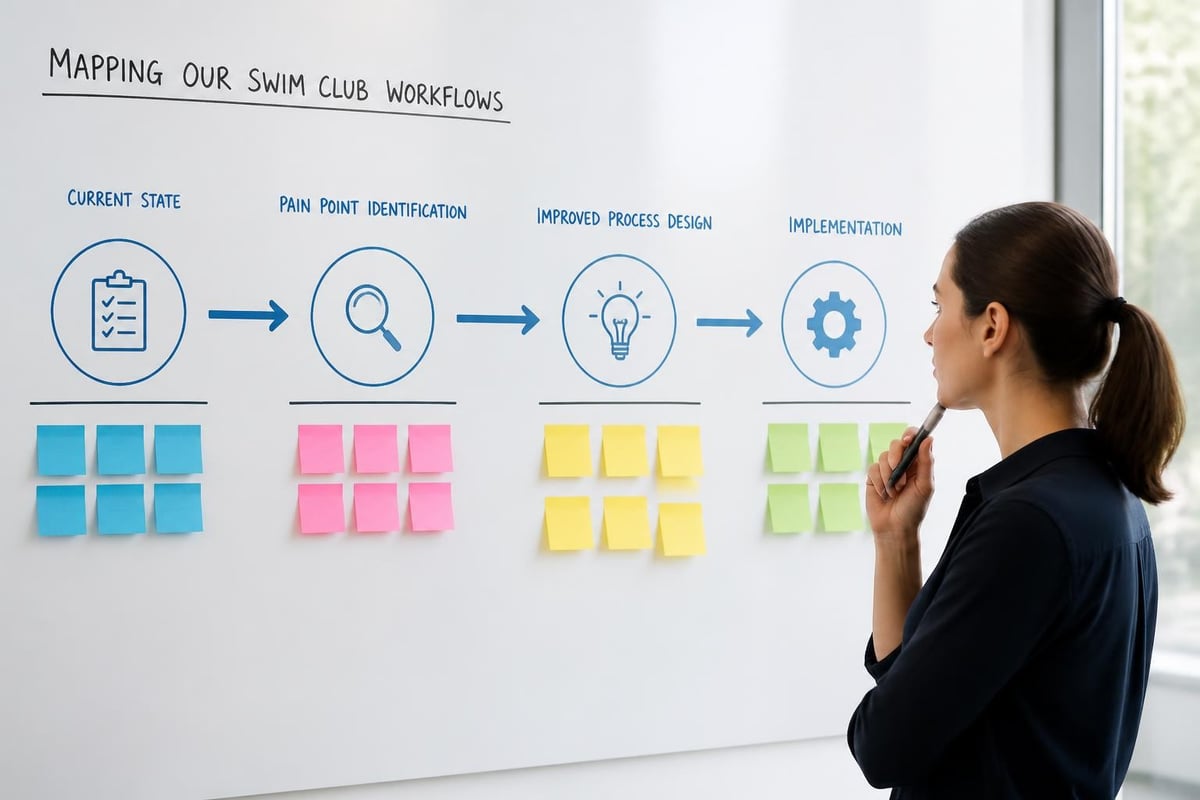
Choose Tools That Match Your Process
Now you can evaluate software. Does it support your ideal process or force you into a different way of working? Can it handle your specific needs, or will you need workarounds?
For swim clubs specifically, PoolPulse features were designed around how clubs actually operate, not generic membership management. That matters when you're dealing with seasonal memberships, family structures, and facility-specific requirements.
Test With Real Data
Don't just set up a system and flip a switch. Run it parallel to your current process for a while. Compare results. Find the gaps. Adjust before you commit.
This testing phase isn't wasted time. It's when you discover that your ideal process didn't account for how you handle corporate memberships, or that your data isn't as clean as you thought, or that you need additional fields for certain membership types.
System and Management as an Ongoing Practice
Here's what a lot of clubs get wrong: they think system improvement is a project. You do it once, and you're done. But effective system and management is continuous.
Your club changes. You add new membership types. You expand your facilities. You start new programs. Each change affects your system requirements.
Regular Review Cycles
Schedule time quarterly to review how things are working. Not just when something breaks, but proactively. Are there new bottlenecks? Have workarounds crept back in? Are there features you're not using that could help?
Get input from everyone who touches the system. Front desk staff see different issues than board members. Coaches have different needs than social committee members.
Documentation and Training
When you update a process, update the documentation. When you bring on new volunteers, train them on the system, not just their specific tasks.
Good documentation isn't a massive manual nobody reads. It's quick reference guides for common tasks. It's video walkthroughs for complex processes. It's accessible when people need it.
The systems approach to management emphasizes interconnected components working together, which applies perfectly to how club operations should function.
Handling Growth and Change
As your club grows, your system and management needs evolve. What worked for 150 families might not work for 300. What made sense for a single pool doesn't scale when you add tennis courts or a fitness center.
Build flexibility into your systems from the start. Choose tools that can grow with you. Design processes that can adapt without complete overhauls.
Technology Considerations for System and Management
Let's talk about the actual tools for a minute, because you can't run a modern club on paper and spreadsheets alone.
What to Look for in Management Software
The right software should make your existing processes easier, not force you into completely new ways of working. It should reduce manual work, not create new tasks.
Essential capabilities include:
- Centralized member database with customizable fields
- Automated billing and payment processing
- Access control integration
- Communication tools with targeting options
- Reporting that answers your actual questions
- Mobile access for staff and members
But here's what really matters: how hard is it to use? If your volunteers need hours of training to do basic tasks, the software isn't helping. If members can't figure out how to update their information, you'll still be doing it manually.
When you're ready to compare swim club management software options , look at how the software handles scenarios specific to your club. Can it manage your membership structure? Does it support your billing model? Will it work with your existing gate system?
Integration and Data Flow
Your management software shouldn't be an island. It needs to connect with other tools you use. Your website for registration. Your accounting system for financial reporting. Your communication platforms.
Poor integration means manual data entry. Manual data entry means errors and wasted time. Make sure your system and management tools can actually talk to each other.
Security and Access Control
You're managing sensitive information. Member contact details. Payment information. Personal data about families and children. Your system needs proper security, not just a shared login that everyone uses.
Different people need different access levels. Front desk staff need to check members in but shouldn't access full financial records. Board members need reports but don't need to process payments. Set this up correctly from the start.
Real-World System and Management Scenarios
Let me walk you through how improved system and management practices solve actual problems clubs face.
Scenario: Renewal Season Chaos
Every spring, you send renewal notices. Some families respond immediately. Others forget. Some think they renewed but didn't. You're manually tracking who's in and who's out, sending reminder emails one by one, checking spreadsheets to see who needs follow-up.
With better system and management, renewal happens automatically. The system knows when each membership expires. It sends reminders at scheduled intervals. It processes payments when families submit them. It updates access permissions based on renewal status.
You can see at a glance who's renewed, who's pending, who hasn't responded. You can send targeted messages to specific groups. You're not chasing information. You're working from accurate, current data.
Scenario: Guest Access Confusion
Your guest policy allows members to bring three guests. But tracking that manually is impossible. Some members abuse it. Others don't understand the rules. Gate staff can't verify on the spot who's exceeded their limit.
An integrated system and management approach tracks every guest check-in against the member who brought them. It enforces limits automatically. It gives gate staff instant verification. It generates reports showing guest usage patterns.
Members can even register guests ahead of time through their portal, making check-in faster. The system does the work. Your staff enforces the policy, not tracks the details.
Scenario: Financial Reporting for the Board
Board meetings roll around, and you need current financials. You're pulling data from your billing system, your bank statements, your payment processor. You're reconciling numbers that don't quite match. You're making educated guesses about some categories.
With proper system and management, financial data lives in one place. Your billing system connects to your accounting. Payments are categorized automatically. Reports pull real-time data, not last month's export.
You can show actual revenue versus projections. You can track payment trends. You can identify where money is coming from and where you might be losing it. The management information system provides structure for making data useful, not just collected.
Advanced System and Management Capabilities
Once you've got the basics working, you can add capabilities that would be impossible with manual processes.
Predictive Analytics and Trend Analysis
When your system collects data consistently over time, you can spot patterns. Which months have the highest usage? Which membership types have the best renewal rates? When do families typically leave, and why?
This isn't about complicated algorithms. It's about having clean data that shows you what's actually happening, not what you think is happening.
You might discover that families who don't check in during the first month rarely renew. That's actionable. You can reach out proactively, offer orientation sessions, or adjust your onboarding process.
Automated Revenue Recovery
Here's something most clubs don't think about: how much revenue are you losing to failed payments and missed renewals? Families don't intend to skip payments. Cards expire. Bank accounts change. Life gets busy.
Modern system and management tools can automatically retry failed payments, send friendly reminders, and escalate only when needed. You recover revenue without awkward conversations or manual follow-up.
Member Self-Service
The best way to reduce your workload is letting members handle things themselves. They can update contact information, view their payment history, register for events, submit maintenance requests, and manage guest lists.
This only works if your system supports it securely and intuitively. Members won't use a clunky portal that requires a manual to navigate. But give them a clean, simple interface, and they'll happily manage their own information.
Getting your system and management structure right isn't about perfect software or complex processes. It's about organizing information so it's useful, connecting functions so they work together, and reducing the friction that makes club administration harder than it needs to be. When you've got the right foundation, you spend less time hunting for answers and fixing mistakes, and more time actually running your club. PoolPulse brings all these capabilities together in software built specifically for how swim clubs operate, with AI-powered insights and flexible configuration that adapts to your unique needs. If you're ready to move beyond spreadsheets and disconnected tools, it's worth seeing how a modern, integrated approach can make your job easier.

When Your Check-In Line Proves Software Is Too Slow
Discover how software timing affects your swim club's daily operations, from check-ins to billing, and why faster response times mean happier members.

What Your Billing and Invoices Are Telling You
Your swim club's billing and invoices reveal hidden patterns about late payments, refund requests, and cash flow. Here's how to read the signals.

The Swim Club Software Test Every Board Should Run
Run this simple test to see if your swim club software actually saves time or creates more work. Real scenarios, honest questions, better tools.
Want to see if PoolPulse is a good fit for your club?
Book a walkthrough and we'll show you exactly how PoolPulse can help based on your club's needs, goals, and current processes.