

Team Check Ins That Actually Work for Swim Clubs
Running a swim club means juggling staff, members, and daily chaos. Here's how regular team check ins keep everyone aligned and problems small.


It's the third Saturday in June, and your pool just opened for the season. The front desk is slammed with new members trying to check in, the swim team coach is asking why three families haven't paid, and your maintenance guy just texted that the pump is making a weird noise. Your seasonal staff started two weeks ago, and you're pretty sure half of them still don't know how to look up member balances. Sound familiar? This is exactly when you realize that those quick team check ins you've been meaning to schedule aren't just nice to have. They're the difference between running a smooth operation and spending your entire summer putting out fires.
Why Most Swim Clubs Skip Team Check Ins (And Regret It)
You're busy. I get it. Between managing memberships, handling billing issues, coordinating with your board, and actually keeping the pool running, sitting down for a meeting feels like one more thing on an impossible list.
But here's what happens when you skip them. Your front desk doesn't know that membership rates changed. Your coaches don't realize that guest policies got stricter. Your evening staff has no idea what chaos unfolded during the morning shift. Everyone's working in their own bubble, and problems that could've been caught early turn into member complaints, billing errors, and staff frustration.
The most successful swim clubs I've worked with? They treat team check ins like they treat water chemistry. You don't skip testing the chlorine just because you're busy. You do it because ignoring it creates bigger problems later.
The Real Cost of Poor Communication
Let me share what this actually looks like in dollars and member satisfaction. When your staff isn't aligned, members notice immediately.
- Members get different answers depending on who they ask
- Billing errors pile up because nobody communicated the rate change
- Guest policies get enforced inconsistently, leading to arguments
- Maintenance issues get reported but never followed up on
- Seasonal staff never learn from last year's mistakes
One club I know lost fifteen member families in a single summer because their front desk and coaching staff were giving conflicting information about practice schedules. Fifteen families. That's thousands in lost revenue because they didn't spend thirty minutes a week getting everyone on the same page.
The Five Types of Team Check Ins Your Club Actually Needs
Not all team check ins serve the same purpose. You need different formats for different situations. Here's how to think about structuring your communication based on what you're actually trying to accomplish.
Daily Shift Handoffs (5-10 Minutes)
This is your fastest, most focused check-in. When the morning shift ends and afternoon staff arrives, you need a quick handoff. What happened today? Who had issues? What needs attention?
Your morning desk person should be able to tell the afternoon person: "Three families asked about swim team tryouts, the Smith account has a payment issue, and locker 47's lock is broken." That's it. Five minutes, maximum.
What to cover in shift handoffs:
- Member issues that need follow-up
- Equipment problems or maintenance requests
- Questions that came up multiple times
- Anything unusual or urgent
The beauty of regular check-ins is that they prevent information from falling through the cracks when staff changes.
Weekly All-Staff Check Ins (30 Minutes)
This is your main team meeting. Get everyone together, even if half your team joins by phone because they work different shifts. Monday morning or Sunday evening works well for most clubs.
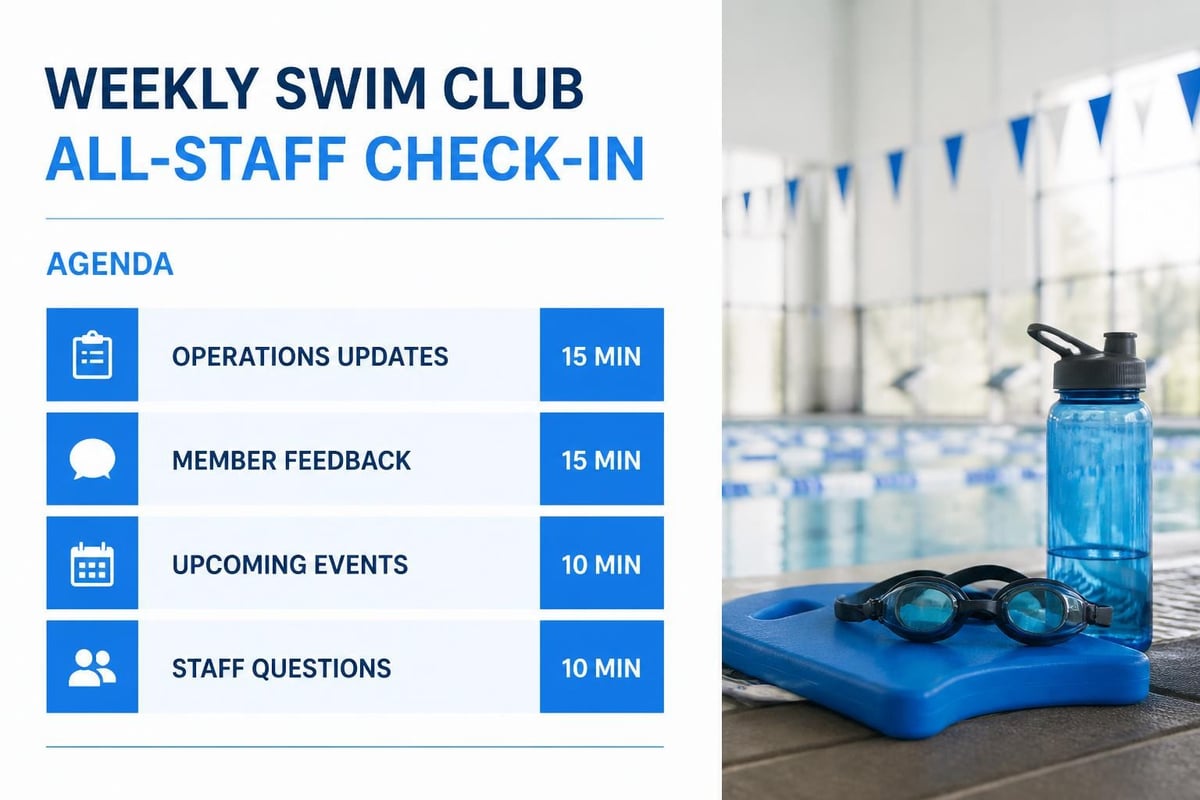
Here's a structure that actually works:
-
Quick wins from last week (5 minutes): What went well? Celebrate it. Did someone handle a difficult member situation perfectly? Did attendance numbers look great? Start positive.
-
Problems that need solving (10 minutes): What's not working? This isn't about blame. It's about fixing things. Maybe the new check-in process is confusing. Maybe members keep asking the same question, which means your signage isn't clear.
-
This week's priorities (10 minutes): What's coming up? Special events, expected busy times, maintenance scheduled, policy changes.
-
Open questions (5 minutes): What does staff need to know? Let them ask anything.
| Meeting Section | Time | Purpose |
|---|---|---|
| Quick Wins | 5 min | Build morale, recognize good work |
| Problem Solving | 10 min | Address issues before they grow |
| Week Ahead | 10 min | Align on priorities and events |
| Open Questions | 5 min | Clear up confusion |
One-on-One Check Ins (15-20 Minutes)
You need individual time with each key staff member at least monthly. Your head lifeguard, front desk lead, and head coach especially. These conversations are different from weekly meetings because people will tell you things privately that they won't say in a group.
Use this time to ask about their workload, challenges they're facing, and ideas they have. Some of your best operational improvements will come from these conversations. Your front desk person knows exactly what questions members ask most often. Your lifeguards know which rules people struggle with.
Effective ongoing check-ins help you catch small issues before they become resignation letters.
Pre-Season Planning Check Ins (60-90 Minutes)
Before your pool opens each season, you need a longer planning session. This is where you review last year's problems, discuss what you're changing, train on new procedures, and make sure everyone understands their responsibilities.
Don't skip this. Seasonal businesses have short memories, and what seemed obvious in September is completely forgotten by May. I've seen clubs make the same mistakes three years running because they never took time to review and learn.
Pre-season check-in agenda:
- Review last season's biggest challenges
- Introduce any new policies or procedures
- Walk through updated technology or systems
- Clarify roles and responsibilities
- Answer questions before the chaos starts
Emergency Check Ins (As Needed)
Sometimes things happen that need immediate team alignment. A member incident, a health department visit, a major equipment failure, a sudden policy change from your board. When something significant happens, gather your team quickly.
Even fifteen minutes over the phone or a group text with clear information prevents rumors, confusion, and mistakes. Don't let your team hear about major changes from members.
How to Run Team Check Ins That Don't Waste Time
You know what kills team check ins? When they feel pointless. People zone out when meetings ramble, repeat information everyone already knows, or turn into one person's monologue. Here's how to keep them focused and useful.
Start and End on Time
Seriously. If you say thirty minutes, mean thirty minutes. When you regularly run over, people start showing up late or half-engaged because they know it doesn't matter. Respect everyone's time by sticking to your schedule.
Set a timer if you need to. When the time's up, wrap up. If something needs more discussion, schedule it separately with the specific people involved.
Have a Clear Agenda
Even for a quick check-in, know what you're covering. Write it down. Share it beforehand if possible. This keeps conversations on track and ensures you don't forget important topics.
Your agenda doesn't need to be fancy. A simple list works:
- Attendance and schedule updates
- Member feedback from last week
- Upcoming events
- Maintenance or facility issues
- Questions and concerns
Create Space for Everyone to Contribute
The loudest person in the room shouldn't dominate every check-in. Explicitly ask quieter team members for their input. "Sarah, you've been on the front desk all week. What are members asking about?" Direct questions ensure everyone participates.
This is especially important if you have experienced staff and new seasonal workers. Newer employees often have great observations because they see things with fresh eyes, but they won't speak up unless you create space for them.
Document Key Points
Someone needs to take notes. Not a formal transcript, just the main decisions and action items. Who's doing what by when? What changed? What do we need to remember?
Share these notes after the meeting. A quick email or message with bullet points ensures everyone has the same information, even if someone missed the check-in. Modern swim club management software can help you track these action items alongside your regular operations.

Follow Up on Action Items
Nothing kills trust faster than discussing problems in every meeting without ever solving them. If you say you'll look into the confusing guest policy, actually do it. If someone volunteers to create better signage, follow up the next week.
Track action items and review them at the start of each check-in. "Last week we said we'd fix X. Here's the update." This shows your team that these meetings actually accomplish things.
Common Team Check In Mistakes (And How to Fix Them)
Even clubs that hold regular team check ins often do them in ways that undermine their effectiveness. Here are the patterns I see most often and what to do instead.
Mistake: Only Talking to Your Core Team
It's easy to have great communication with your year-round staff and completely neglect seasonal workers. But your seasonal front desk person who only works weekends? They need information just as much as your full-time operations manager.
The fix: Create separate check-in rhythms for different groups, but ensure information flows to everyone. A quick weekend staff meeting on Sunday evenings might work better than trying to get weekend staff to a Monday morning meeting.
Mistake: Making It All About Problems
If every team check-in is just a list of complaints and issues, people start dreading them. Yes, you need to address problems, but you also need to acknowledge what's working.
The fix: Always start with wins. Even small ones. "We had great reviews this week." "Nobody had a billing question they couldn't answer." "The pool looked perfect for Saturday's event." Recognition matters.
Mistake: Talking Instead of Listening
I've sat through team check ins where the manager talked for twenty-five minutes and staff got five minutes for questions. That's not a check-in. That's a lecture.
The fix: Flip the ratio. You talk for five to ten minutes with essential updates. The rest of the time is for discussion, questions, and input from your team. Effective team check-ins prioritize two-way communication over top-down information delivery.
Mistake: No Clear Purpose
"We should probably meet" isn't a good enough reason. Each check-in should have a specific purpose. What are you trying to accomplish? Alignment? Problem-solving? Information sharing?
The fix: Define why you're meeting before you schedule it. Share that purpose with your team. "This week's check-in is focused on getting ready for the July 4th weekend" gives people context and helps them come prepared.
Mistake: Forgetting Remote or Off-Shift Staff
Your evening shift never hears what happened in the morning meeting. Your pool maintenance contractor who comes on Wednesdays misses all the Monday check-ins. Pretty soon you have team members operating with completely different information.
The fix: Use technology to bridge gaps. A quick video recording of key points, a shared document with notes, or a group messaging app can keep everyone in the loop regardless of schedule.
Using Technology to Support (Not Replace) Team Check Ins
Let's be clear about something: Technology doesn't replace face-to-face communication. But it can make your team check ins more effective and help information reach everyone.
Shared Communication Platforms
A group messaging app (whether it's Slack, WhatsApp, or something else) lets you share quick updates between formal check-ins. "Pool heater is acting up, technician coming tomorrow at 10" reaches everyone instantly.
Just don't let digital messages replace actual meetings. Text-based communication is great for facts and updates, terrible for nuanced conversations or problem-solving.
Integrated Management Systems
When your team uses a unified system for member management, check-ins, and operations, everyone works from the same information. Your front desk sees the same member notes your coaches see. Nobody's working from outdated spreadsheets or conflicting data.
This is where having modern club management features actually saves time during team check ins. Instead of spending fifteen minutes comparing notes about member statuses or billing issues, everyone can pull up the same real-time information.
Meeting Notes and Action Items
Keep a simple shared document where you track meeting notes and action items. Nothing fancy. Just dates, topics discussed, decisions made, and who's responsible for what.
This creates continuity between check-ins and makes it easy to see patterns. If the same problem comes up in three consecutive meetings, that's a sign you need a different solution.
Scheduling and Reminders
Use calendar invites and reminders so check-ins actually happen. It's too easy to let weekly meetings slide when things get busy, but that's exactly when you need them most.
Block the time, set it recurring, and treat it like any other essential operational task.
Questions That Make Team Check Ins Better
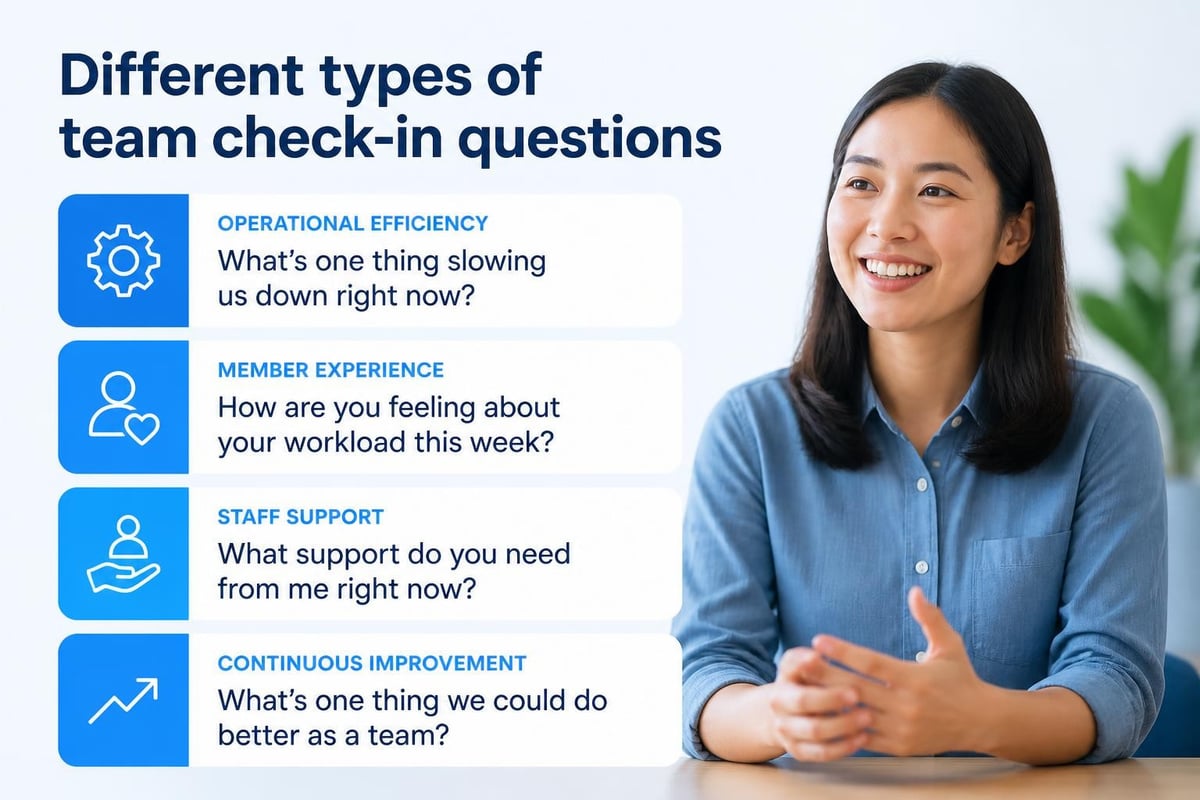
The quality of your team check ins often depends on the questions you ask. Generic "How's everything going?" gets generic "Fine" responses. Specific questions uncover real insights.
For Weekly All-Staff Check Ins
- What's the most common question members asked this week?
- What's one thing that wasted your time that we could fix?
- What went better this week than last week?
- What are you worried about for next week?
- What do you wish members understood better?
For One-on-One Check Ins
- What's taking more time than it should?
- What would make your job easier?
- What questions are you getting that you can't answer?
- What have you noticed that I might not see?
- What do you need from me?
These thoughtful check-in questions help surface issues and ideas that might otherwise stay hidden.
For Pre-Season Planning
- What didn't work well last season?
- What member complaints came up repeatedly?
- What policies confused people?
- What surprised you last year that we should prepare for?
- What made your job harder than necessary?
Making Team Check Ins Work With Limited Staff
Small clubs often tell me they can't do team check ins because they only have a few part-time staff members who never overlap. I get it. But you still need communication, maybe even more than bigger operations because there's less redundancy.
Strategies for Small Teams
Overlap shifts by 30 minutes: Schedule staff so they have a brief overlap for handoffs. Even three times a week makes a huge difference.
Use voice memos or quick videos: Can't meet in person? Record a three-minute update covering key points. It's faster than writing and more personal than text.
Create a simple daily log: A shared notebook (physical or digital) where each person notes important information for the next shift. Saw a leak? Write it down. Member asked about a policy? Note it.
Hold monthly instead of weekly meetings: If your team really can't meet weekly, make monthly meetings count. Make them longer and more comprehensive.
Leverage your management system: When you have effective swim club software , staff can see member notes, billing status, and facility issues without needing constant meetings.
Seasonal Challenges and Team Check Ins
Swim clubs face unique challenges because your staffing changes dramatically with the seasons. Here's how to maintain good communication when your team composition shifts.
Onboarding Seasonal Staff
New seasonal employees need extra check-ins early on. Plan to meet with them more frequently in their first two weeks. Daily five-minute check-ins during training prevent small confusions from becoming big mistakes.
Cover the basics:
- How to use your systems
- Common member questions and correct answers
- Emergency procedures
- Who to ask when they don't know something
Maintaining Continuity Between Seasons
At the end of each season, hold an exit check-in with seasonal staff. What did they learn? What problems came up repeatedly? What would they do differently? Document this feedback so you're not starting from scratch next year.
Managing Mixed Teams
During peak season, you might have experienced year-round staff working alongside brand-new seasonal workers. Your check-ins need to work for both groups.
One approach: Start your weekly meeting with foundational information that newer staff need, then move into more advanced operational topics. Or split into two shorter meetings-one for everyone covering basics, another for experienced staff covering complex issues.
When Team Check Ins Reveal Bigger Problems
Sometimes your team check ins surface issues that can't be solved with better communication. Maybe your systems are genuinely confusing. Maybe your policies don't make sense. Maybe you're asking staff to do things that are unnecessarily complicated.
Pay attention when the same problems come up repeatedly. That's not a communication failure. That's a systems failure.
If three different people struggle with the same task, the problem isn't the people. It's the task. Use your check-ins to identify these patterns, then fix the root cause.
This might mean:
- Updating your membership software to something more intuitive
- Simplifying your guest check-in process
- Clarifying ambiguous policies
- Providing better training materials
- Changing workflows that don't make sense
Sometimes the most valuable outcome of team check ins is realizing you need to change how you operate. Good communication reveals operational problems that you can then actually solve.
Building a Culture Where Check Ins Matter
The mechanics of team check ins are simple. The harder part is building a culture where people actually value them. Where staff show up prepared, participate honestly, and follow through on commitments.
This starts with you demonstrating that these meetings accomplish things. When someone raises an issue and you fix it, that shows check-ins matter. When you consistently implement good ideas from your team, that shows you're listening.
It also means being consistent. Don't cancel check-ins because things are slow (that's when you should plan for busy times) or because you're too busy (that's when you need alignment most). The clubs with the best communication treat these meetings as non-negotiable.
Create psychological safety so people can speak honestly without fear. If someone points out a problem and gets blamed instead of thanked, everyone else learns to stay quiet. If someone admits a mistake and you focus on fixing it rather than punishing them, you build trust.
Encourage questions. Reward honesty. Acknowledge when you don't have answers. Model the kind of open communication you want from your team.
Measuring Whether Your Team Check Ins Are Working
How do you know if your team check ins are actually effective? Look for these signs:
Fewer repeated mistakes: When staff stops making the same errors, it means information is reaching them.
Faster problem resolution: Issues get identified and fixed quickly instead of festering for weeks.
Better member experience: Members get consistent information regardless of who they talk to.
Lower staff frustration: Your team feels supported and informed rather than confused and isolated.
Improved retention: Both members and staff stick around longer when communication is good.
More proactive solutions: Staff brings ideas and suggestions instead of just problems.
If you're not seeing these improvements after a few months of regular check-ins, something's not working. Maybe the format's wrong. Maybe you're not following through on action items. Maybe you need to adjust who attends or how you structure the time.
The goal isn't perfect meetings. It's better operations, happier staff, and smoother member experiences. Keep adjusting until your team check ins deliver those outcomes.
Running a swim club means coordinating many people across different shifts, roles, and seasons, all while keeping members happy and operations running smoothly. Regular team check ins turn isolated individuals into an aligned team that solves problems together instead of creating them separately. If you're looking for systems that support better communication and make it easier to keep everyone working from the same information, PoolPulse provides the unified platform swim clubs need to streamline operations and keep teams connected. Our configurable, AI-powered approach means your staff spends less time hunting for information and more time serving members effectively.

Five Front-Desk Tasks Your Swim POS Should Handle
Your front desk shouldn't need three systems to check in a swimmer. Here's how modern swim POS systems save time and reduce errors.

When Your Check-In Line Proves Software Is Too Slow
Discover how software timing affects your swim club's daily operations, from check-ins to billing, and why faster response times mean happier members.

What Your Billing and Invoices Are Telling You
Your swim club's billing and invoices reveal hidden patterns about late payments, refund requests, and cash flow. Here's how to read the signals.
Want to see if PoolPulse is a good fit for your club?
Book a walkthrough and we'll show you exactly how PoolPulse can help based on your club's needs, goals, and current processes.