

Volunteer-Friendly Club Management: Designing Software Anyone Can Use
Swim clubs rely on volunteers and seasonal staff, which makes usability, role-based access, and mobile support more important than feature sprawl.

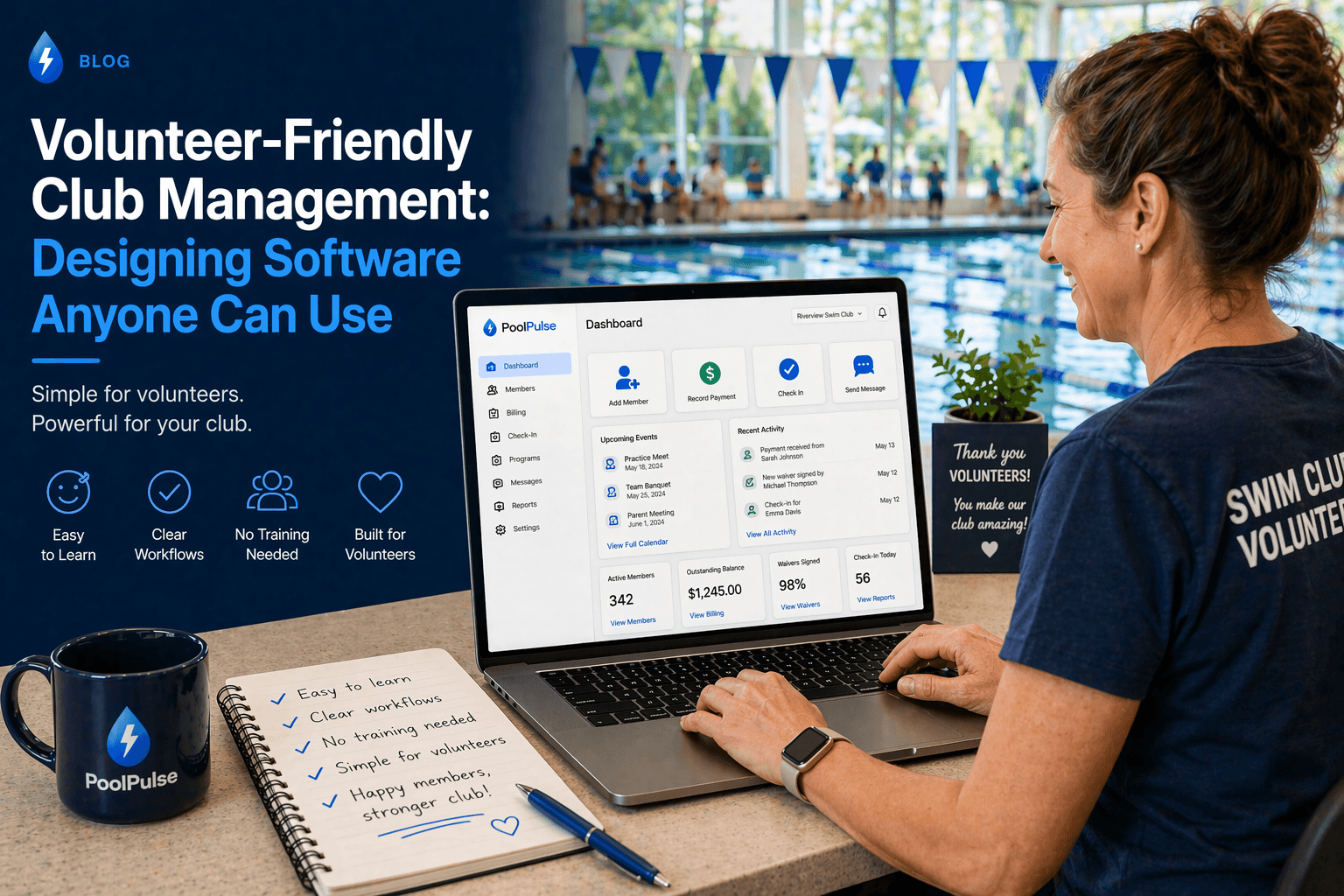
Most swim clubs do not have large full-time operations teams.
They have a board, a treasurer, a membership chair, a few seasonal staff members, and a rotating cast of volunteers who are trying to keep the club running without turning club management into a second full-time job.
That is why "feature-rich" is not enough.
Software also has to be volunteer-friendly.
What volunteer-friendly software actually means
Volunteer-friendly software is not just software with a nice interface.
It means the platform helps the next person step in quickly, understand what matters, and do their job without needing a private training session from the one board member who knows where everything lives.
In practice, that means four things matter more than clubs expect:
1. Simple dashboards
Volunteers do better when the first screen answers obvious questions:
- what needs attention now
- who needs follow-up
- where to go next
If the dashboard is cluttered, the club creates hesitation. People get afraid to click, afraid to miss something, or afraid to break a workflow they do not fully understand.
Good software reduces that anxiety.
2. Role-based permissions
Not everyone in the club needs access to everything.
The front desk does not need full billing admin controls. The treasurer does not need to manage every communications setting. A board member may need reporting access without the ability to edit member records.
That is why role-based permissions matter so much in volunteer-run environments.
PoolPulse handles this through User & Role Management, where the goal is simple: give each person the access they need and nothing they do not.
That helps in two ways:
- it protects sensitive information
- it reduces interface clutter for each role
3. Mobile support for real club moments
Volunteers are not always sitting at a desk. They are at the gate, on deck, at an event table, or answering a question while walking across the facility.
That is why mobile support matters. The best club software should still be useful when the person helping is holding a phone, not opening a laptop.
PoolPulse's Mobile App & Kiosk Mode and Check-Ins & Access Control are designed around that reality.
4. Fewer disconnected tools
Volunteer-friendly software should reduce context switching.
If a volunteer has to open one system for membership status, one for billing, one for notes, and one for communication, the club is multiplying cognitive load for people who are already donating their time.
That is why connected workflows matter:
- Member Management keeps family context together
- Billing & Payments keeps status and money movement visible
- Notes & Notifications keeps important context attached to the member or workflow
Ease of use is not a side issue
Membership-software user research summarized by Member Evolution found that ease of use is one of the most important buying factors, and broader membership-platform messaging increasingly emphasizes "simple," "intuitive," and self-serve experiences.
That matches what clubs already know intuitively:
If the system is hard to learn, fewer people will use it well. If fewer people use it well, knowledge concentrates in one or two people. If knowledge concentrates, burnout gets worse.
Practical examples of volunteer-friendly design
Here is what this can look like in real club life:
Opening day check-in
A seasonal front-desk worker should be able to verify member status, see any relevant notes, and move the line without asking a senior volunteer for help every third family.
Treasurer handoff
A new treasurer should inherit clean billing context and reporting instead of a folder of exports and a verbal explanation of "how we usually do it."
Event day help
A volunteer helping with a social event or fundraiser should be able to confirm registrations and payment status without maintaining their own side spreadsheet.
Board transitions
When board roles rotate, the club should not lose operational memory. That is one of the biggest hidden values of structured software.
The best question to ask during evaluation
When reviewing a platform, do not ask only whether it has the feature.
Ask:
Could a new volunteer learn the basics of this workflow in one season without constant rescue?
That question gets closer to what actually determines software success in a swim-club setting.
The bottom line
Volunteer-friendly software is not "lightweight" software. It is software that respects the fact that clubs depend on people with limited time, changing roles, and uneven technical comfort.
That is exactly why usability, role-based permissions, connected records, and mobile support matter so much. They are not polish. They are operational durability.
Sources referenced
Your Data Made It. Is Your Club Ready?
A successful upload proves that records arrived. This five-part readiness test shows whether household relationships, balances, waivers, access rules and real club workflows survived the move.

The Demo-to-Opening-Day Gap: Nine Questions That Reveal Whether a Vendor Can Actually Get You Live
A polished demo shows what a club platform can do. These nine questions reveal whether the vendor can migrate your records, rebuild your workflows, prepare your team and get you safely through opening day.

Raising the Bar for Swim Club Software
How PoolPulse™ is helping raise expectations for swim club software with connected workflows, stronger operations, better member experiences and more modern tools.
Want to see if PoolPulse is a good fit for your club?
Book a walkthrough and we'll show you exactly how PoolPulse can help based on your club's needs, goals, and current processes.