

The Program Was Cancelled. The Member Account Still Needs an Ending.
Connect the operational cancellation to attendance, communication, refunds, credits, rescheduling, and the member account.


Cancelling the calendar event is the beginning of the work, not the end of the member experience. A family may stop traveling to the club while its account still shows a lesson used, a charge due or a makeup that nobody has reserved.
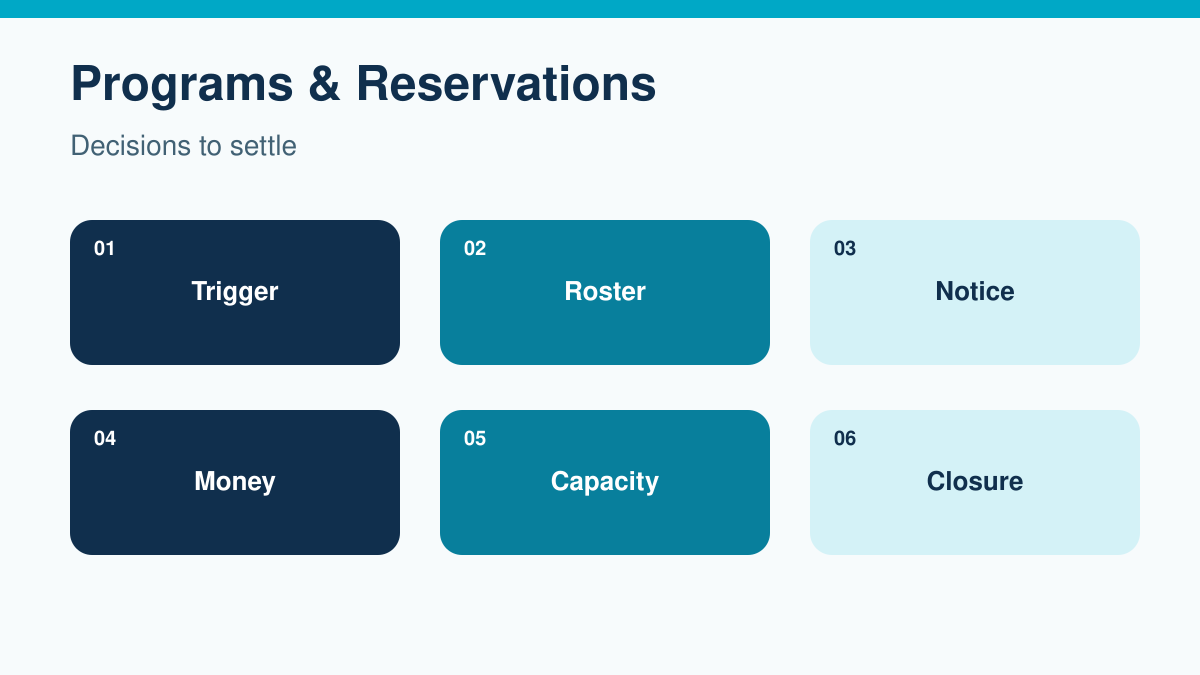
A complete cancellation resolves six connected decisions: trigger, roster, notice, money, capacity and closure. Program directors own the service decision. Finance owns the account treatment. Front-desk staff need enough shared information to explain both without making a new promise.
The practical goal is simple: every affected registration should reach an understandable outcome. That could be a refund, an account credit, a replacement session or another result permitted by the applicable terms and requirements. A calendar status alone cannot establish that outcome.
1. Record the cancellation before changing individual accounts
Create one cancellation record with a unique identifier. Attach the original session date, program, location, decision time and authorized decision maker. State whether the entire session was cancelled or delivery stopped after it began. Keep the reason factual enough for staff to use consistently without sharing unnecessary personnel or medical information.
Separate the operational decision from the financial decision. A lifeguard or duty manager may need authority to stop an activity immediately. That does not automatically give the same employee authority to calculate refunds or waive outstanding balances. The record should show who receives the financial review and when that person will respond.
Do not delete the original session to make the schedule look tidy. Retain its identity and mark its outcome so attendance, charges and messages can still be traced. If a replacement date is created, link it to the cancelled session rather than silently moving the original booking and losing the history.
Define the treatment of partial delivery before a disruption occurs. A lesson cancelled before arrival and a workshop stopped near its end may have different outcomes under the club's terms. Staff need the actual applicable rule, not an improvised calculation based on how disappointed the first caller sounds.
2. Freeze the affected roster, then reconcile it
Save a roster snapshot at the decision time. Include enrolled participants, confirmed drop-ins, transferred registrations and people attending as a makeup. Keep waitlisted people separate unless they had actually received and accepted a place. The person who needs a notice may not be the person who paid.
For each registration, connect the participant to the responsible account and appropriate contact. A grandparent may be taking a child to class while a parent manages payment. Use authorized contact details already held by the club. Avoid distributing a full roster when an individual notice will do.
Compare the roster against check-ins and recent booking changes. Someone promoted from a waitlist shortly before cancellation can be missing from a cached communication list. A member who transferred out yesterday should not receive an entitlement for the old session. Record differences as exceptions rather than forcing the lists to match by deleting entries.
Preserve attendance history while correcting future consequences. A participant who arrived before cancellation did attend the site, but the cancelled activity should not automatically become a no-show or consume a lesson entitlement. Use distinct statuses where possible. When the system has limited fields, add a clear linked explanation that the next employee can find.
3. Send the operational notice without guessing about money
The first notice should identify the affected program, date and time. State whether members should stay home, leave the site or wait for another update. Name the next communication time and a contact route for questions. Put the changed action before the explanation so a caregiver reading on a phone can respond quickly.
If financial treatment is still under review, say so plainly. For example: “Today's 4 p.m. beginner lesson is cancelled because the pool is unavailable. Please do not travel for this session. We will email the account holder by noon tomorrow with the makeup or account adjustment details.” Use that deadline only if an owner can meet it.
Keep a copy of the exact message and the audience selection. A campaign marked sent does not prove every person received it. Review returned email and unsuccessful text delivery. Use an approved alternative contact method for affected families where necessary, especially when the cancellation happens close to arrival time.
Give the desk a short matching explanation. Staff should know which session changed, what has been confirmed and what remains pending. A second employee should not promise an immediate refund merely because the first message said the club would provide an update tomorrow.
4. Choose and document the financial outcome
Use the terms that applied to the registration, together with applicable requirements and authorized exceptions. Do not assume that a published no-refund statement resolves every circumstance or that all cancellations require the same remedy everywhere. Have the appropriate adviser review uncertain policy questions before the club standardizes an answer.
The account record should distinguish four possibilities. A refund returns money through the relevant payment process. A credit leaves a usable balance or entitlement with the club. A makeup provides a replacement service. No adjustment leaves the financial position unchanged and needs a recorded basis. Avoid calling all four a “credit.”
Record the amount or entitlement, calculation basis, approval and original transaction reference. For a discounted package, the value of one cancelled meeting may not equal the current drop-in price. Apply the approved allocation method consistently. Include any related tax or fee handling in finance's review rather than assuming the visible registration price is the entire accounting entry.
If members may choose between outcomes, show the available choices and any genuine conditions. Do not make a credit appear compulsory when another remedy applies. Record the member's selection and the date it was received. A missing response should enter an owned queue, not disappear into an inbox.
Keep refunds separate from refund requests
Submitting a refund is a processing step. It is not always evidence that the customer's bank has completed it. Stripe's refund documentation explains that card refunds can remain pending when the available Stripe balance is insufficient. Its documentation also distinguishes refund requests from the resulting bank-side outcome. Other payment providers have their own states and procedures.
Use the processor's actual status in the internal record. Keep the cancellation approval, refund submission time and processing reference together. Before retrying an apparently missing refund, check whether the first request exists. A second employee should not issue a duplicate adjustment because the member has not yet seen the money.
Member communication should explain what the club has done and what remains outside its control. Give a processing estimate only when supported by the payment method and provider guidance. Never describe a pending request as completed or promise that every bank will display a refund on the same day.
Make credits usable and traceable
An account credit needs more detail than a number. State what it can be used for, whose account holds it and how the member redeems it. If restrictions or an expiry apply, ensure they are permitted and clearly disclosed. Do not add new limitations merely because a cancellation created an administrative inconvenience.
Link the credit to the cancelled registration and preserve the original payment history. If the household has several participants, clarify whether the benefit belongs to one participant or is shared. Otherwise one sibling may redeem it while another receives an incorrect promise that the same value remains available.
Track issuance and use separately. A credit can be correctly issued but remain practically unusable because eligible programs are full or the season has ended. Review those cases before closing the service issue. The account balance may reconcile even though the promised replacement opportunity does not exist.
5. Reserve real capacity for makeups
A makeup promise creates an operational obligation. Confirm instructor availability, space, equipment and the applicable supervision limits before offering a date. Count the replacement participants against the session's actual capacity. A place that exists only in an email is not a reliable reservation.
Decide how members will choose a replacement. An automatic transfer may work when the approved arrangement allows it and the new schedule is acceptable. A choice-based process needs a response deadline, a contact route and a defined treatment for those who cannot attend. Do not treat silence as acceptance without an appropriate basis.
Make entitlement use visible. When a member books a makeup, link the new registration to the original cancellation. If they later change dates, release the old place before reserving another where the booking rules require it. Prevent the original entitlement from being redeemed twice through separate staff channels.
If the replacement is itself cancelled, reopen the linked case rather than creating an unrelated promise. Staff should be able to see both interruptions and the remaining obligation. Repeated rescheduling is also a management signal that the proposed remedy may no longer be practical.
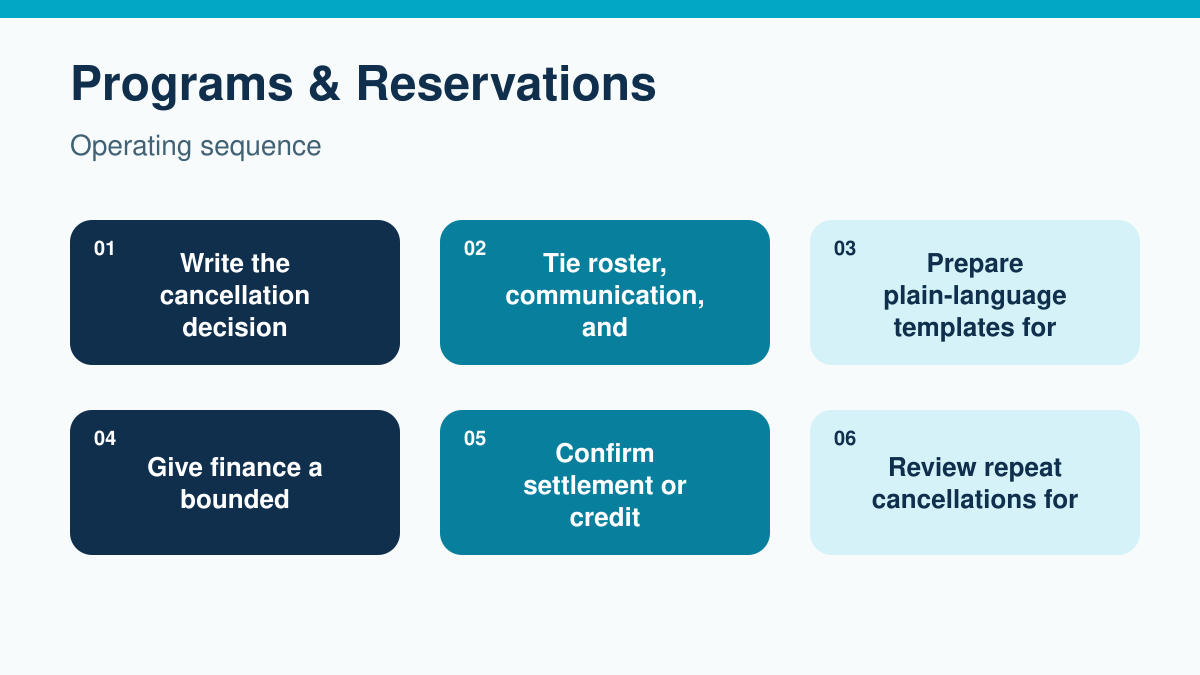
6. Close the event through an exception queue
Give each affected registration an outcome status and an owner. Useful statuses include awaiting policy review, awaiting member choice, refund pending, credit issued, makeup booked and resolved. Keep financial completion separate from communication completion so an issued credit with an undeliverable notice remains visible.
Every unresolved row needs a next action and a due date. “Finance looking into it” is too vague to hand over. “Finance administrator to confirm the processor status before Thursday's account review” gives the next shift something concrete to check. Escalate cases that exceed the club's promised response time.
Reconcile both counts and value. Start with the affected registrations and account for each one. Then compare the approved refund and credit totals with the posted adjustments. Explain differences such as an unpaid registration, a package entitlement or a member who selected a makeup. Equal totals alone can conceal an adjustment posted to the wrong household.
An event can be operationally finished while financial exceptions remain open. If leadership archives the event, preserve a visible link to the outstanding queue and its owner. Do not label every member case resolved just to remove the cancellation from a daily dashboard.
Work through a realistic cancellation test
Imagine a six-session course with twelve registrations. The fourth meeting is cancelled after families have checked in. Ten participants bought the package, one paid for a single session and one was attending a makeup from an earlier cancellation. This is an exercise, not a suggested pricing policy.
The program director records the interruption and preserves the check-ins. Finance applies the approved package treatment to the ten package registrations and reviews the single-session payment separately. The makeup participant retains the unresolved replacement entitlement rather than receiving a second unrelated benefit. Each result links to the same cancellation identifier.
Next introduce two complications: one household's email fails and one refund remains pending. Ask the desk employee to explain each account using the saved record. If the answer requires calling the original manager, improve the handoff. If the employee cannot distinguish an issued adjustment from a proposed one, revise the statuses before using the process live.
Review patterns without burying the team in reports
A weekly review during an active season can focus on a few useful measures: unresolved registrations, aging refund requests, unused cancellation credits and makeups without confirmed space. Compare these with cancellation reasons. Repeated instructor shortages call for a different response from repeated facility closures.
Measure against the commitments the club actually made. If notices promised a response by Friday, count the cases that missed Friday rather than inventing a universal service target. Check a small sample of resolved accounts to confirm that the member-facing message matches the posted result.
When a policy changes, record its effective date and update the dependent registration language, templates and staff guidance. Preserve earlier versions where needed to explain earlier decisions. Restrict access to payment references and personal details according to staff responsibilities and the club's retention practices.
Bring one complete case to the software discussion
If your club is evaluating how this workflow could connect with member administration, book a Clubward demo and bring a realistic cancellation case. Ask to see how the proposed setup would connect a roster, member notice, account adjustment and unresolved exception. Confirm the capabilities and configuration you need rather than assuming that a calendar cancellation performs every downstream action.
Start with the next cancelled session already on your desk. Trace one participant from the original booking to the final account outcome, then repeat the check for the exceptions. The process is ready when another authorized employee can explain what happened, what remains and who will finish it without reconstructing the story from scattered messages.

Stop Guessing at Program Demand: Use the Signals You Already Have
Budget season asks for program counts before members have made next season’s plans, so last year’s enrollment is often treated as a forecast by default. Learn the practical decisions, owners and checks that turn the issue into a controlled club workflow.

Changing Payment Methods? Plan the Member Transition Before the Invoice
A payment change looks technical until the first invoice fails, a member cannot find a receipt or staff cannot explain whether an old authorization still applies. Learn the practical decisions, owners and checks that turn the issue into a controlled club workflow.

A Weather Alert Is Not a Club Communication Plan
Build a weather communication ladder that connects the trigger, authority, affected groups, shelter action, updates, and reopening decision.
Want to see if PoolPulse is a good fit for your club?
Book a walkthrough and we'll show you exactly how PoolPulse can help based on your club's needs, goals, and current processes.