

Stop Guessing at Program Demand: Use the Signals You Already Have
Budget season asks for program counts before members have made next season’s plans, so last year’s enrollment is often treated as a forecast by default. Learn the practical decisions, owners and checks that turn the issue into a controlled club workflow.


The summer program grid often has to be built while families are still deciding about holidays, camps and which child is ready for the next swim level. Meanwhile, instructors want hours, the board wants a budget and someone has already asked whether Tuesday lessons will be offered again.
Last season's registrations are a sensible starting point. They are a poor finishing point. A full beginner class may have turned away another class's worth of swimmers. A lightly attended session may still have sold every place. A long waitlist may contain the same three children asking for several different times.
A useful forecast separates those situations. It estimates how many suitable places families are likely to book, when that demand will become visible and what the club can safely and practically offer. The result should be a range with a few clear decisions attached: which sessions to publish, which instructor hours to reserve and what would justify opening another group.
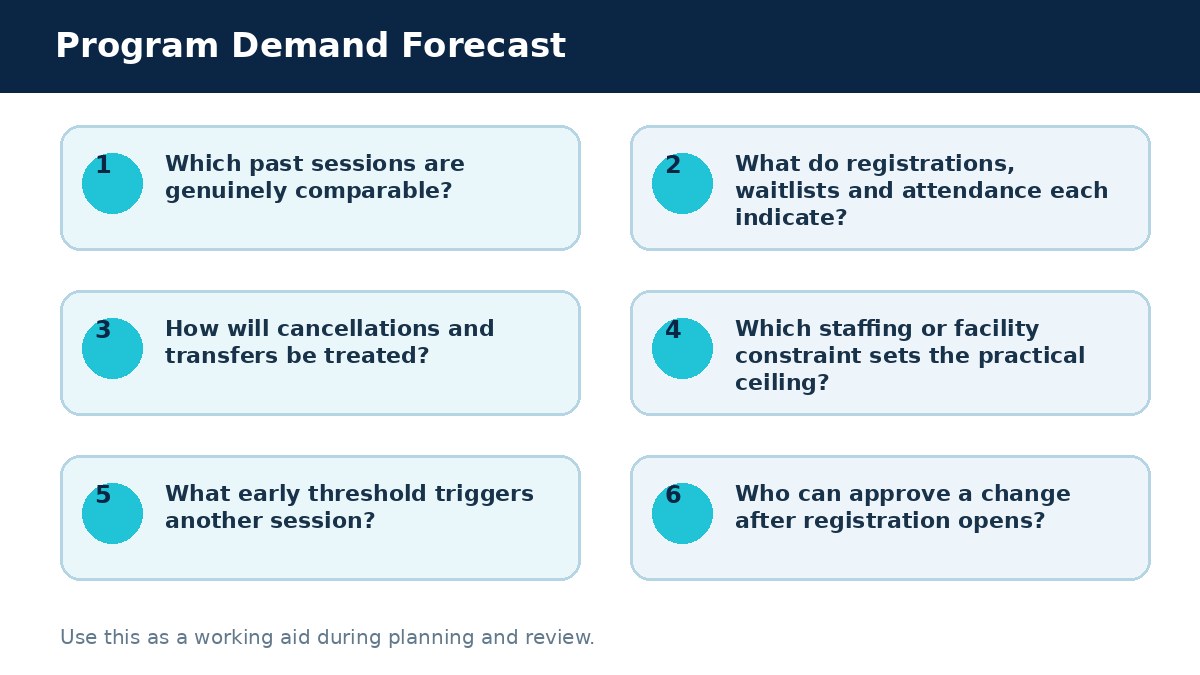
Answer these six control questions first
- Which past sessions are genuinely comparable? Match age or skill level, season, session length, weekday and time. A weekday preschool class and an after-school beginner class serve different families, even if both appear under “swim lessons.” Note changes in price, registration priority, pool availability and competing camps before treating a past total as the baseline.
- What do registrations, waitlists and attendance each indicate? Completed enrollments show places families have committed to under the club's registration rules. Waitlists suggest unmet demand, subject to eligibility and availability. Attendance shows how those booked places were used. Keep all three visible, but do not add them together or use attendance as a substitute for enrollment.
- How will cancellations and transfers be treated? Separate people leaving the program from people moving between sessions. A transfer out reduces one class and increases another without necessarily changing total demand. Record when cancellations happened and why, where known. A cancellation before opening day affects the roster differently from repeated absences after lessons begin.
- Which staffing or facility constraint sets the practical ceiling? Establish usable teaching space, class limits, qualified instructor availability and required supervision under the club's approved arrangements. Include setup time and conflicts with teams, camps and recreational swimming. The number of places in the registration system should reflect the capacity the club can actually deliver.
- What early threshold triggers another session? Decide how many additional eligible swimmers must be willing to take the proposed time, the latest date staffing can be confirmed and whether fees cover the incremental cost. A large waitlist for Saturday morning does not automatically justify a Wednesday afternoon class.
- Who can approve a change after registration opens? Give the program director a clear spending and scheduling boundary. Identify who approves additional instructor hours, changed lane allocations or refunds if a session is withdrawn. Families should receive a firm offer only after those decisions are settled.
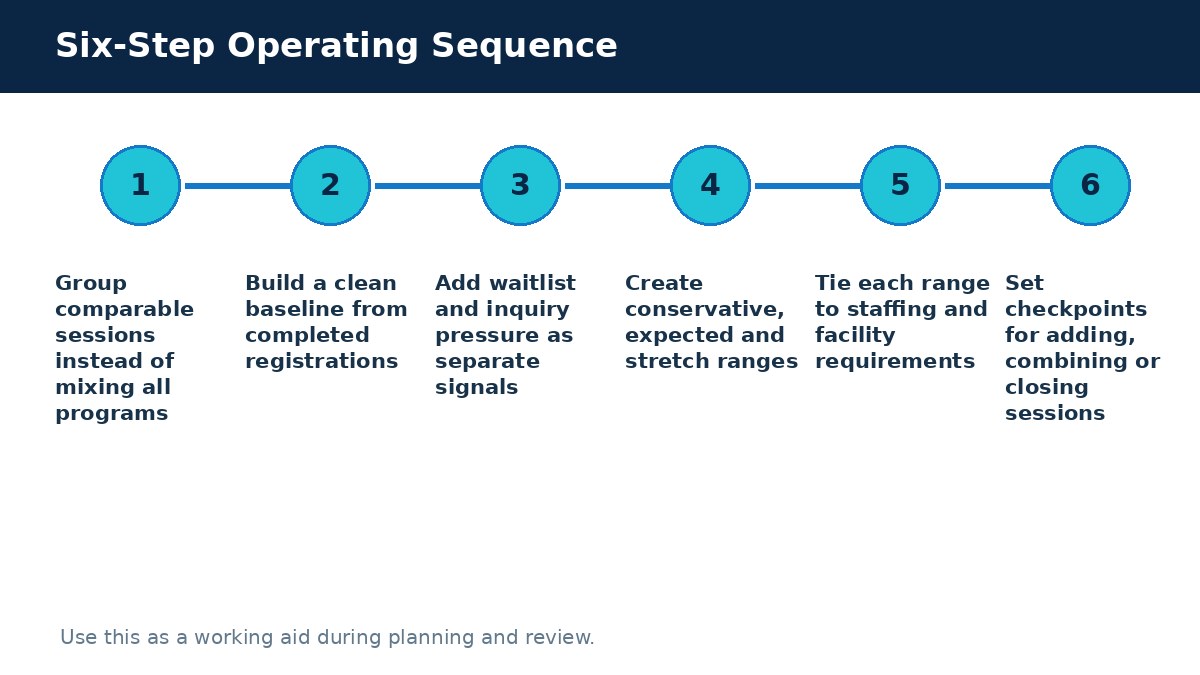
Build the plan in six deliberate steps
1. Group comparable sessions instead of mixing all programs
Start with the decision you need to make. If it is whether to add a Saturday beginner class, compare Saturday beginner classes first. An overall rise in club program enrollment may be driven by adult fitness or a successful holiday camp and tell you very little about beginner swimming.
Use two or three recent comparable seasons when available, keeping each visible rather than immediately averaging them. Label unusual conditions: a shortened season, a pool closure, a new school calendar, a substantial price change or a particularly popular instructor. An unusual year can still teach you something, but it should not quietly set next year's staffing budget.
Watch the progression between levels, too. Last summer's beginner enrollment is not a guaranteed returning beginner cohort. Some children will advance, age out or stop attending. Instructor assessments and the number of eligible returning swimmers help estimate the next level's pool of potential participants. They support the forecast; they do not turn eligibility into a booking commitment.
2. Build a clean baseline from completed registrations
Choose a consistent enrollment snapshot, such as the roster immediately before the first class. Count registrations completed under the club's rules and still active at that point. Keep abandoned forms, canceled bookings, pending places and complimentary participation distinguishable. A complimentary place uses capacity even though it contributes no fee revenue.
Use the right counting unit. One child taking two separate lesson blocks represents two program enrollments but one unique participant. Both measures matter. Enrollments help plan seats and revenue; unique participants help reveal whether growth comes from reaching more families or selling additional sessions to the same swimmers.
Build a simple movement record around that snapshot: opening enrollments, new bookings, cancellations, transfers in and transfers out. At program level, remove internal transfers from growth calculations. Otherwise, a swimmer moving twice can make a quiet registration week look busy.
Retain attendance separately. Low attendance in a fully booked afternoon class might reflect weather, school conflicts or dissatisfaction. It deserves investigation before repeating the schedule. It does not mean the unused places were available for other swimmers, and it should not be used to justify overbooking.
3. Add waitlist and inquiry pressure as separate signals
Clean the waitlist by participant, program level and interchangeable time choices. If a parent lists one child for three equivalent sessions, that is usually one unmet place, not three. Two siblings are two potential places. One child seeking two consecutive holiday blocks may also represent two places, because those blocks are separate purchases rather than alternatives.
Then check eligibility and intent. Is the swimmer at the right level? Are they already enrolled elsewhere in the same group of alternatives? Would the family accept the proposed day and time? Has someone offered a place that was declined or never confirmed? Keep these outcomes visible rather than leaving every name in a single “waiting” total.
Record inquiries as a weaker signal. “Are lessons running this summer?” is useful interest, but it is not equivalent to a completed booking. Where past records allow, compare unique eligible inquiries with eventual enrollments. Avoid adding a family once as an inquiry, again as a waitlist entry and a third time as a new registration.
A full class makes this work especially important. Its enrollment total tells you what the club served, not the upper limit of demand. Unique eligible swimmers who could not obtain a suitable place are evidence of demand hidden by the capacity ceiling.
4. Create conservative, expected and stretch ranges
Give each scenario its own assumptions. The conservative case might allow for more cancellations and fewer late bookings. The expected case should reflect the most credible registration pace and conversion assumptions. The stretch case can represent stronger demand that would require additional capacity. Avoid creating all three by applying arbitrary percentages to last year's total.
Compare registration at the same point in the sales window. Twenty bookings after seven days cannot fairly be compared with twenty bookings after four weeks. Also account for who has been allowed to register. Member-priority week and the first week of guest registration are different stages, even if both fall in March.
A practical checkpoint uses days since opening, days until the program begins and eligibility waves together. If past registrations cluster after school holiday dates are announced, an early slow start may be normal. If the club opened two weeks later this year, calendar-date comparisons can make healthy demand look weak.
Express the forecast as expected retained bookings plus additional likely bookings, with cancellations and outward transfers accounted for once. Keep unmet demand separate from deliverable enrollment. If demand could reach 40 but the club can offer only 32 places, report both numbers instead of treating eight unserved swimmers as expected revenue.
5. Tie each range to staffing and facility requirements
Translate seats into actual groups. Check whether demand is spread across compatible levels and times or concentrated in one awkward corner of the schedule. Six empty intermediate places will not absorb six beginners. An available lane does not solve an instructor shortage, and an instructor's free hour may not overlap with the families' availability.
For each proposed additional group, identify the instructor, teaching area, timetable slot and incremental cost. Include any extra supervision, setup, equipment or administrative time the change genuinely requires. Use the club's approved class limits and operating standards rather than enlarging groups to make the budget balance.
Distinguish a planning option from a commitment. The club might provisionally identify a fifth lesson block and an interested instructor while publishing four confirmed groups. Before promising the fifth, check the instructor's availability and the employment or scheduling arrangements involved. A penciled-in name is not confirmed cover.
6. Set checkpoints for adding, combining or closing sessions
Put review dates where decisions are still reversible. Useful points include the end of member-priority registration, the public registration opening, the staffing commitment deadline and the last practical date to notify families about a change. Check more frequently when places are filling quickly or an instructor decision is imminent.
Write specific thresholds. “Consider another class if interest is strong” leaves too much room for interpretation. “Open the additional group when the families of six eligible, unplaced swimmers confirm that the time works, the instructor is confirmed and the incremental cost is covered” gives the team a decision it can act on.
Set a lower-demand threshold as well. If a group is below the club's minimum viable enrollment at the agreed date, review whether it can remain open, combine with a compatible group or be withdrawn under the club's published terms. Check level, time and family agreement before moving anyone. Two small classes are not automatically one suitable class.
A worked forecast for a summer lesson block
Consider this entirely hypothetical example. A club has four comparable beginner groups with eight places each, giving it 32 available places under its own approved arrangements. At the planning checkpoint, 26 enrollments are complete and active. The families in this example can use the remaining suitable places across those four groups.
The waitlist contains 12 entries. Deduplication reveals eight children, three of whom already have a place and are asking for an alternative time. That leaves five unique, eligible, unplaced swimmers interested in a suitable opening. Inquiry records contain additional families, but anyone already enrolled or waitlisted is excluded from the estimate of new demand.
Comparable registration windows suggest that further bookings are still likely. The director makes the following assumptions about bookings that would remain at opening day, provided enough suitable capacity exists:
- Conservative: 26 current bookings minus 3 expected cancellations, plus 2 waitlist conversions and 3 additional bookings from other families, equals 28 places of demand.
- Expected: 26 minus 2 cancellations, plus 4 waitlist conversions and 6 other additional bookings, equals 34 places of demand.
- Stretch: 26 minus 1 cancellation, plus 5 waitlist conversions and 9 other additional bookings, equals 39 places of demand.
The additional bookings already include any expected conversions from the remaining inquiries. Those inquiries are not added again. Cancellation assumptions apply to the current roster; the added-booking estimates are already net of anticipated losses before opening day.
At current capacity, the scenarios support 28, 32 and 32 delivered places respectively, with zero, two or seven potential places left unserved. A fifth eight-place group would raise capacity to 40. It would operate at two places in the expected case if the original groups filled first, or seven in the stretch case. That difference matters when considering instructor cost.
Suppose the club's financial review sets six paid places as the minimum for that additional group. The director reserves the scheduling option but does not open it simply because the expected demand exceeds 32. The trigger is six additional eligible swimmers beyond existing capacity whose families are willing to book the proposed group, alongside confirmed staffing and pool space.
At the next checkpoint, actual bookings and responses replace assumptions. If only two additional swimmers need places, the director can keep offering suitable cancellations and explain the available choices. If seven confirm, the fifth group has a stronger basis. Either way, the forecast has helped avoid making a staffing promise from an inflated waitlist.
Learn from the forecast before the details disappear
Save each dated forecast rather than overwriting it with the latest roster. After the lesson block begins, compare opening-day enrollment with the prediction made at the same lead time. If the expected case was 34 and actual retained demand was 30, investigate the four-place difference. Did fewer families book late, more cancel, or a proposed time prove unsuitable?
Be careful about what “actual demand” means. When every offered place fills, enrollment alone cannot tell you whether the forecast was high or low. Review unique eligible requests that remained unserved, including whether those families would genuinely have accepted the available option. Record uncertainty where interest was never confirmed.
Review attendance and program feedback after the block as another layer. Strong enrollment followed by repeated absences may suggest a scheduling problem worth testing next season. Strong attendance with a persistent eligible waitlist may support additional capacity. Look for repeated forecast bias across comparable groups before changing assumptions based on one unusual week.
Give the next registration season a better starting point
Keep a short planning sheet for each comparable program group: current enrollments, cleaned unmet demand, registration timing, the three scenarios, deliverable capacity and the next decision date. The program director needs enough detail to explain the recommendation; the board needs to see the capacity and financial consequences.
If your club is reviewing its systems, use the PoolPulse features overview as a starting point, then test your own registration and capacity questions in a demonstration. Bring a duplicate waitlist entry, a transfer and a full class so the discussion stays grounded in the records your forecast depends on.
See PoolPulse program, reservation and waitlist workflows with a real seasonal planning question in mind. The most useful forecast is one the team can update when families' plans become clearer, while there is still time to offer the right classes.

The Program Was Cancelled. The Member Account Still Needs an Ending.
Connect the operational cancellation to attendance, communication, refunds, credits, rescheduling, and the member account.

Your Vendor Contracts Have Deadlines. Build the Calendar Before They Choose for You.
Software, insurance, maintenance, communications and payment vendors often renew on different terms, and the club notices the deadline only when an invoice or automatic renewal arrives. Learn the practical decisions, owners and checks that turn the issue into a controlled club workflow.

Renewal Emails Need an Owner, a Trigger and an Exit Rule
The club has a renewal calendar, but reminders are still assembled from different lists and different interpretations of who needs what. Learn the practical decisions, owners and checks that turn the issue into a controlled club workflow.
Want to see if PoolPulse is a good fit for your club?
Book a walkthrough and we'll show you exactly how PoolPulse can help based on your club's needs, goals, and current processes.