

The Small Club Growth Playbook
A no-nonsense growth guide built for busy swim club admins, board members, and owners. Learn how to boost retention, lock down free local visibility, and build an easy, repeatable growth system without a massive marketing budget.

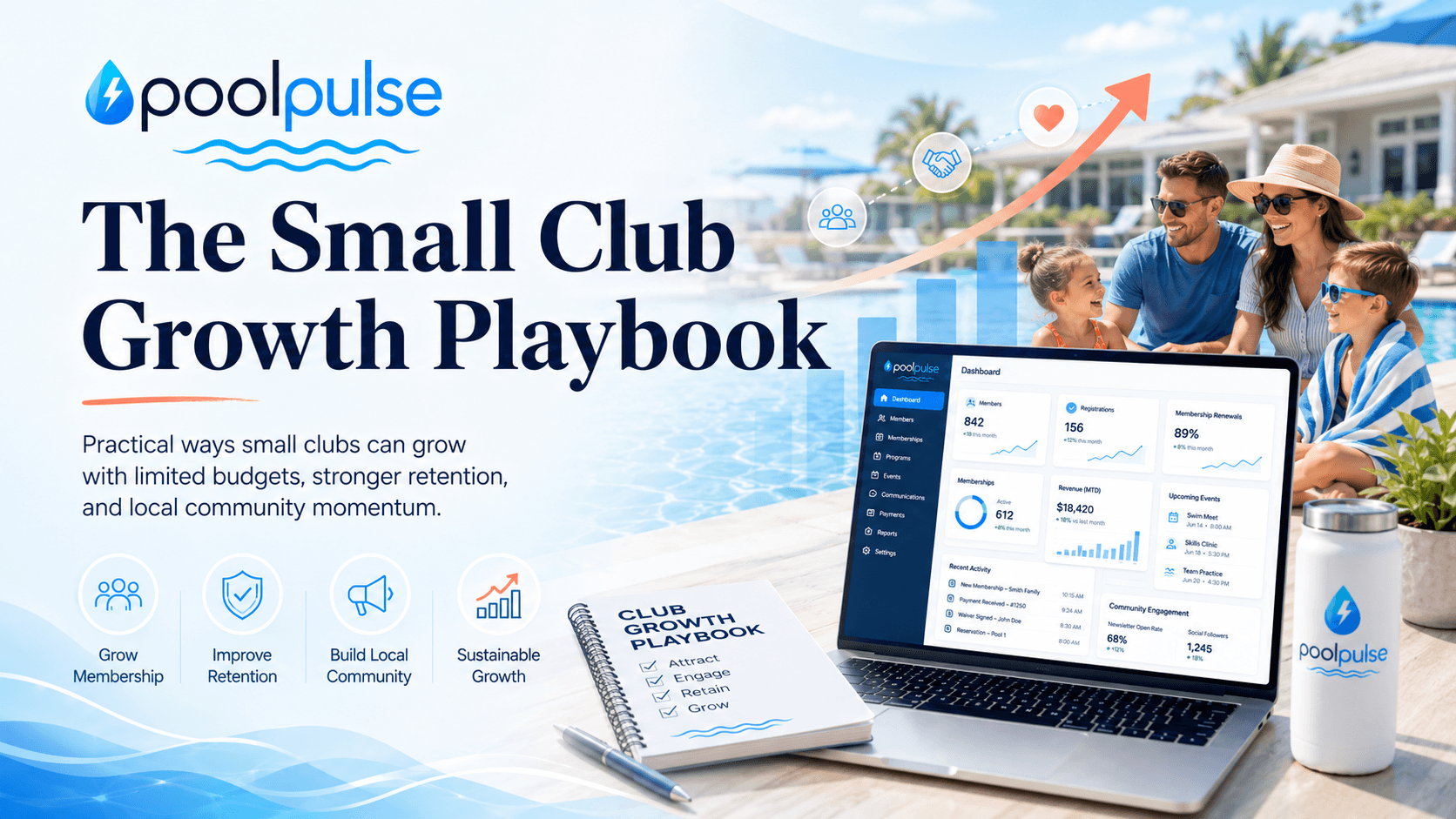
Let’s be honest: running a neighborhood pool, HOA facility, or family-owned swim club means wearing about ten different hats. On any given day, you are the general manager, the compliance officer, the amateur accountant, and occasionally the person tracking down a lifeguard who slept past their shift. You do not have the time—or the budget—for a corporate marketing campaign.
The good news? Small clubs have a massive growth advantage that big commercial fitness chains cannot touch: you are local, personal, and community-driven.
You do not need a "magic trick" to grow your membership. You just need to make your club easier to find online, simpler to join, and a breeze to renew year after year. This playbook is designed for lean operations run by busy owners, volunteer boards, and seasonal staff who need practical strategies that actually fit into a hectic summer schedule.
Step 1: Know your baseline numbers
Before you redesign your website or launch an open house, you need to know exactly what kind of growth your facility can handle. A club with a 2-year waitlist needs a completely different strategy than a pool struggling with a 40% mid-summer drop-off.
You do not need a complex corporate dashboard to run your numbers. The National Recreation and Park Association (NRPA) emphasizes that tracking basic operational metrics is the absolute best way for community agencies to manage resources, compare performance, and better serve local families. [10]
Keep it simple and focus on these four core metrics:
1. Retention Rate
How many households came back?
If 30 families drop off every summer, signing up 30 new families just keeps you stuck in place. Plugging your membership leaks is your fastest path to growth.
2. Lead Source
Where are prospects coming from?
Keep a quick log of how new inquiries found you—whether it was a Google map search, a neighbor's referral, a guest pass visit, or a school flyer.
3. Conversion Rate
How many visitors actually sign up?
Track how many families who take a facility tour, use a trial pass, or join the waitlist ultimately write a check for a full membership.
4. Facility Capacity
What is your safe ceiling?
Always balance growth against physical limits like parking spaces, pool square footage, lifeguard coverage, and snack bar wait times to preserve the member experience.
Once you see these numbers clearly, your team can stop asking vague questions like "How do we get more people?" and start targeting exact goals: "We need 25 neighborhood families to fill our morning lane capacity."
Step 2: Talk to the right families
Lean operations cannot afford to market to everyone in a 15-mile radius. Focus exclusively on the households most likely to love what your club already provides.
This is especially critical right now. According to the Aspen Institute's Project Play research, while youth sports participation has bounced back, the cost to families has skyrocketed—surging 46% since 2019. [5] This gives small, local clubs a massive opening: position your pool as an affordable, high-value, low-stress summer hub right in their backyard, rather than another expensive travel-team commitment.
When communicating with parents, remember what actually drives them. In national surveys, kids rank "having fun and playing with friends" as their absolute top reasons for participating in sports, while elite trophies rank near the bottom. [6] Your marketing message does not need to promise Olympic training; it should promise a safe, active summer where kids make lifelong friends.
| Who you are targeting | What they actually care about | The exact message to use |
|---|---|---|
| Young Families | Water safety, predictable daily routines, convenience | "Your summer home base: where kids build swim confidence and parents can actually relax." |
| Neighborhood Locals | Short drives, familiar faces, community feel | "Skip the crowded public beaches. Run into your neighbors at your local community pool." |
| Alumni & Former Members | Nostalgia, continuing traditions | "Bring the next generation back to the pool that shaped your own childhood summers." |
| Swim Lesson Parents | Clear skill progression, trusted coaches | "Start with swim lessons, stay for the family community, activities, and seasonal events." |
| Value-Conscious Households | Predictable costs, maximizing summer days | "One summer membership that unlocks endless low-stress family activity right down the street." |
Step 3: The no-cost local visibility checklist
Many small clubs are not struggling because neighbors do not like them—they are struggling because neighbors do not know they exist. Use these zero-budget moves to put your pool on the digital map.
1. Claim your free Google Business Profile
A Google Business Profile is completely free and allows your pool to show up instantly on Google Maps and local search queries. You can personalize it with hours, seasonal opening dates, contact information, and photos. [7] If a family moves to town and searches "pools near me," this profile is your first impression.
Make sure to upload real, current photos of your facility. Prospects want to visualize their summer: show a clean pool deck, clear lanes, a shaded seating area, the baby pool, or a lively swim meet. You do not need professional photography; clean, bright smartphone photos work perfectly.
2. Build a reliable review system
Positive online reviews dramatically boost your visibility in local search results. Google explicitly encourages local operators to ask customers for reviews and to reply to them publicly. [8] However, keep it ethical: Google’s strict platform policies prohibit offering discounts, free guest passes, or incentives in exchange for reviews, as well as selectively asking only happy members. [9]
Keep your review requests straightforward and broad:
"If your family loves spending summers at our pool, would you take 60 seconds to leave us an honest Google review? Your feedback helps local families discover our community!"
3. Audit your website for quick answers
Do not let a confusing website scare off potential members. Ensure a visitor can find the answers to these questions within two clicks of landing on your homepage:
- Where exactly is the pool located?
- What are your seasonal dates and daily hours?
- What are the membership tiers and exact prices (or a clear path to request them)?
- Is there a waitlist, and how long is it?
- How do families book a physical tour or attend an open house?
- Do you offer public swim lessons, guest passes, or private party rentals?
4. Launch a formal "Guest-to-Member" path
Guest passes are not just a courtesy—they are a highly effective customer acquisition channel. Train your front-gate staff to give guest families a warm welcome. If a guest asks about joining, your gate team should have a simple flyer with a QR code ready to hand them, ensuring a smooth handoff from a single visit to a membership lead.
Step 4: Keep a simple seasonal communication calendar
As a club admin, your brain is in a completely different mode in February than it is in July. Your communication calendar should mirror that seasonal workflow so you can repurpose your core updates across your website, email newsletters, and social channels without burning out.
| Time of Year | What to tell your current members | What to tell prospective families |
|---|---|---|
| Jan – Feb | Early renewal deadlines, facility improvement updates | Join our early interest list before registration opens |
| Mar – Apr | Last call for renewals, program sign-ups (swim team) | Public open house dates, lesson registration info |
| May | Opening weekend schedule, pool rules, waiver forms | Book a pool tour while summer schedules are forming |
| Jun – Jul | Weekly social events, holiday hours, snack bar deals | See the club in full swing, join the mid-season waitlist |
| August | End-of-season parties, feedback surveys | Lock in your priority spot on the list for next summer |
| Sep – Oct | Thank-you notes, winter maintenance updates | Highlights from the season, what to expect next year |
Focus on proof over polish on social media
Stop stressing about creating ultra-polished, corporate social graphics. Families do not want a generic resort; they want an authentic community pool. Use quick social posts to show your team preparing the facility for opening day, coaches cheering at a swim meet, morning lap swimmers enjoying a quiet pool, or a special weekend theme night. Real, candid moments build trust much faster than a stock photo.
Step 5: Leverage water safety for community goodwill
For a swim club, growth and public service fit together naturally. The CDC notes that drowning is a leading cause of accidental death for young children, with those aged 1–4 facing the highest risk in the country. [2] While constant supervision is always essential, formal swimming lessons significantly reduce drowning risks. [3] National safety initiatives like the CPSC's Pool Safely campaign heavily advocate for community-wide education, layer-of-protection supervision, and clear pool safety guidelines. [4]
By hosting open community safety events, your club positions itself as a trusted neighborhood resource, making it the obvious choice when parents look to invest in a full membership.
Step 6: Smart, small-budget marketing experiments
Once your free digital channels are optimized, you can test small budgets on highly targeted promotions. Never scatter money across broad campaigns; test one clear offer with a specific audience at a time.
| Budget Tier | Best Operational Use | Why it makes sense for admins |
|---|---|---|
| $150 – $300 | High-visibility yard signs and QR-code banners | Drives direct, hyper-local awareness near schools, parks, and neighborhood entrances. |
| $250 – $750 | A professional, local photo/video package | Gives you an entire season's worth of clean, high-quality images for your website and emails. |
| $300 – $1,000 | Geo-targeted social media ads | Allows you to show a direct offer (like an Open House RSVP) only to parents within a 5-mile radius. |
| $1,000 – $3,000 | Website layout and digital registration overhaul | Drastically reduces your administrative overhead by making sign-ups, waivers, and payments automated. |
If you decide to try paid digital channels like Google Ads, always remember that Google frames your free Business Profile and core analytics tracking as your essential, baseline toolkit. [7] Fix your free organic listings and clean up your online registration form first, before spending hard-earned club capital on paid clicks.
Step 7: Build local trust networks
Word-of-mouth recommendations from local businesses can out-perform paid ads every single week. Reach out to local preschool groups, PTAs, youth sports leagues, family dental offices, and neighborhood real estate agents. Keep your partnerships simple: exchange flyers, place a stack of brochures on a counter, or set up a shared community night.
If your club needs extra operational revenue to fund capital improvements or social events, avoid cluttered commercial advertisements on your deck. Instead, use clear, tiered community sponsorship packages that local business owners will value.
| Sponsorship Level | What the business receives | Who it appeals to |
|---|---|---|
| $250 Supporter | Logo placement on your event page and an end-of-season email thank-you. | Local boutiques, independent realtors, and neighborhood service providers. |
| $500 Event Sponsor | Dedicated signage at a family night, a social shout-out, and a promo table. | Family restaurants, pediatric dentists, and local daycares. |
| $1,000 Safety Partner | Co-branded community safety materials and prominent signage at water safety days. | Local insurance agencies, urgent care networks, and civic organizations. |
Step 8: Retention is your best growth driver
Every single family that returns next summer means one less household you have to spend time and energy hunting down next spring. Retention is not an administrative task you handle in April; it is the direct result of how valued, informed, and respected members feel all summer long.
National consumer data from McKinsey shows that 71% of people expect personalized interactions with organizations they support, and 76% get actively frustrated when those experiences feel cold or mechanical. [1] For a swim club admin, "personalization" does not mean a complex tech system—it simply means your members do not feel like a random invoice number. It means their roster details are completely accurate, their billing statements are simple to read, their guest passes work flawlessly at the gate, and their urgent schedule changes or weather cancellations are communicated instantly.
Map out your first-season member journey
New families are your highest risk for dropping out because they have not established a summer routine yet. Keep them close with a simple, high-touch onboarding routine:
- Pre-Season: Send a clean, welcoming email detailing gate check-in rules, parking maps, guest policies, and a direct contact email for help.
- Opening Week: Train gate staff to flag new accounts so they can offer an extra-friendly welcome and a quick physical layout run-down.
- Mid-Season: Send a quick, personal check-in note to see how their kids are liking programs or lessons.
- Late-Season: Give them an early look at next year's calendar and offer a priority window to secure their returning membership.
Step 9: Streamline your operational funnel
A growth playbook is only useful if your seasonal staff and volunteer board can actually manage it during the heat of July. Keep your administrative tracking clean by organizing every single prospective family into one clear pipeline phase:
| Prospect Status | What it actually means | The next immediate admin task |
|---|---|---|
| Inquiry | A parent filled out a web form or emailed asking about rates. | Send a friendly reply within 24 hours with a tour booking link. |
| Tour Scheduled | The family has a locked-in date to visit the facility. | Send a quick text confirmation with parking and gate instructions. |
| Visited / Guest | They physically toured the pool or used a one-day pass. | Send a follow-up email within 48 hours with a direct link to join. |
| Waitlisted | They want to join but your capacity is temporarily maxed out. | Send a monthly update note so they know they haven't been forgotten. |
Modern platforms like PoolPulse were built specifically to bring this entire operational picture—memberships, front-gate check-ins, automated renewal billing, guard scheduling, and point-of-sale tracking—into a single connected workspace. [11] Eliminating messy, disconnected spreadsheets prevents your leads, guest waivers, and renewal invoices from slipping through the cracks during your busiest operational weeks.
Your practical 90-day seasonal growth roadmap
Days 1–14: Audit your current operations
Calculate your exact retention rate, define your open lane capacity, update your summer hours on Google Maps, and ensure your website pricing is easy to find.
Days 15–30: Fire up internal referrals
Send out early membership renewal forms, launch your new family welcome emails, and invite your most loyal members to leave honest online reviews.
Days 31–60: Connect with local partners
Set up an open house event, coordinate with a few local family businesses or schools to swap flyers, and make sure your front gate is tracking how every visitor found you.
Days 61–90: Run a small local promotion
Test a highly targeted, local social media ad promoting a specific open house or swim lesson slot. Track the exact cost per lead to see what works before scaling next year.
Protect what makes your club special
The strongest community swim clubs do not grow by trying to look like high-priced luxury resorts or massive national fitness chains. They grow by double-downing on what they do best: providing a safe, friendly, low-stress summer sanctuary for local families.
You do not need a massive corporate marketing budget to secure your facility's future. Start by looking after your current roster, fixing your local digital visibility, removing administrative friction at the front gate, and keeping your operational tools organized. By making your club simple to find and a joy to belong to, your members will handle your marketing for you—one neighborly referral at a time.
Sources
- McKinsey & Company, "The value of getting personalization right — or wrong — is multiplying"
- CDC, "Drowning Facts"
- CDC, "Preventing Drowning"
- U.S. Consumer Product Safety Commission, Pool Safely
- Aspen Institute Project Play, "State of Play 2025"
- Aspen Institute Project Play, "National Survey of Youth and Sports: 15 Key Findings"
- Google Business Profile
- Google Business Profile Help, "Tips to get more reviews"
- Google Maps User Generated Content Policy, "Prohibited & restricted content"
- National Recreation and Park Association, "NRPA Park Metrics"
- PoolPulse, "Swim Club Management Software"
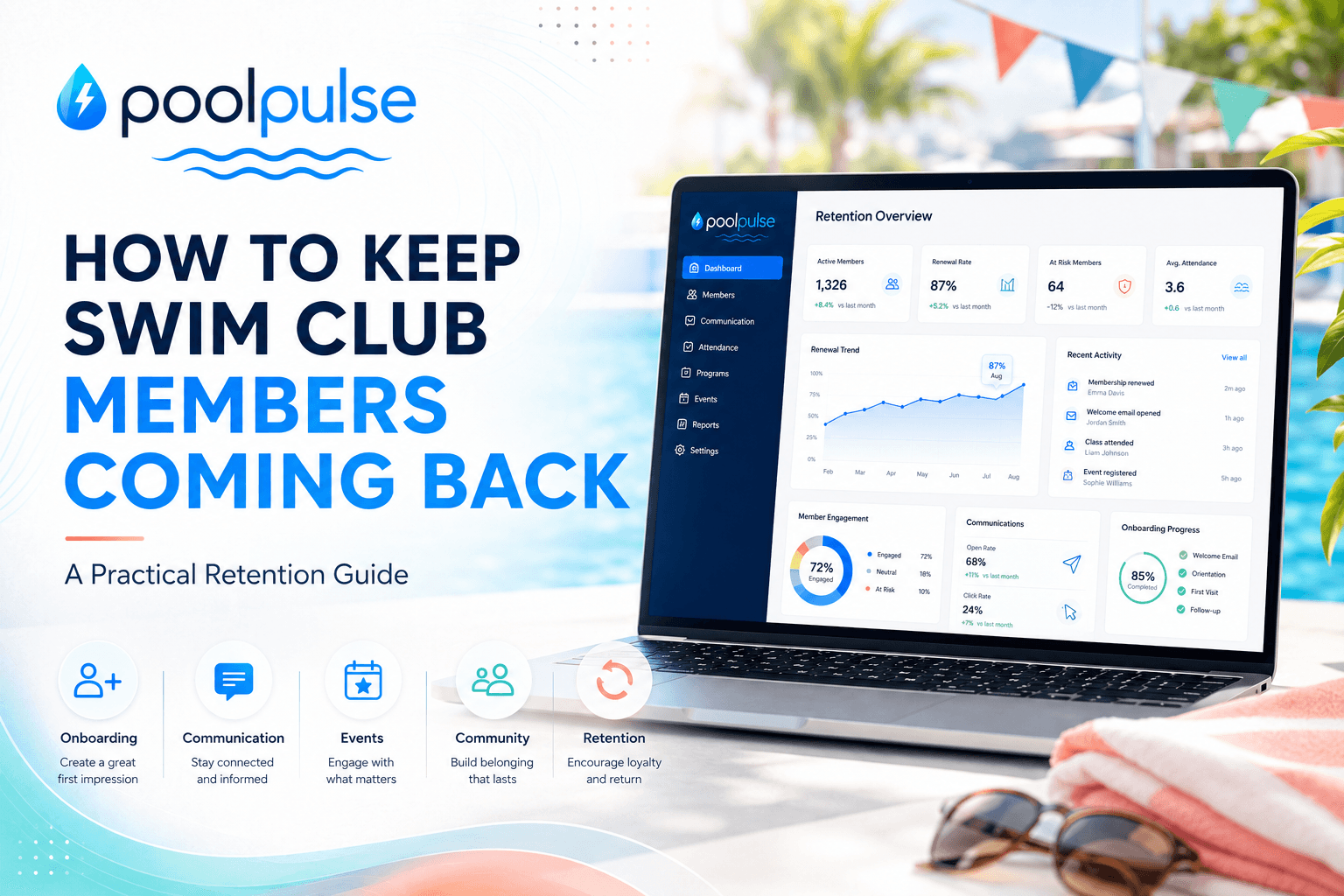
How to Keep Swim Club Members Coming Back: A Practical Retention Guide
A research-backed guide to improving member retention for swim clubs, sports clubs and community facilities with better onboarding, communication, programming, volunteer systems and early churn signals.

Before the Pool Closes: The 60-Minute Season Debrief Every Swim Club Should Run
Before the details of the season fade, use this focused 60-minute swim club debrief to capture operational problems, protect what worked and turn real evidence into priorities for next year.

Raising the Bar for Swim Club Software
How PoolPulse™ is helping raise expectations for swim club software with connected workflows, stronger operations, better member experiences and more modern tools.
Want to see if PoolPulse is a good fit for your club?
Book a walkthrough and we'll show you exactly how PoolPulse can help based on your club's needs, goals, and current processes.