

The Tuesday Morning Team Check In That Saves 6 Hours
A simple weekly team check in framework for swim club managers that catches problems early, keeps staff aligned, and saves hours every week.


You walk into the pool office Tuesday morning, coffee in hand, and half your staff is texting questions about Saturday's swim meet parking plan. Your front desk coordinator doesn't know the guest policy changed last week. Your head coach just discovered the pool heater has been making a weird noise since Friday, but nobody mentioned it. Sound familiar? This is what happens when a swim club skips the weekly team check in. You spend the entire week answering the same questions, fixing avoidable problems, and feeling like you're always one step behind. A solid team check in fixes all of this, and it only takes about fifteen minutes.
Why Your Team Check In Feels Like a Waste
Most swim club managers I know either skip team meetings entirely or dread the ones they schedule. I get it. You're thinking, "We're all here every day anyway, we'll just talk when something comes up." Except that never works. What actually happens is your lifeguards hear different versions of the guest policy, your front desk makes promises about pool rentals that conflict with swim team practice, and your maintenance person fixes things you didn't even know were broken.
Here's the real problem: without a regular team check in, information lives in silos. Your morning staff doesn't know what your evening staff dealt with. Your coaches don't know what your board is worried about. And you're stuck in the middle, answering questions and putting out fires that could have been prevented with one short conversation.
The swim clubs that run smoothly don't have fewer problems. They just catch them earlier, usually during a weekly team check in where everyone shares what's coming up and what needs attention.
The Hidden Cost of Skipping Check Ins
Let's talk numbers for a second. If you spend just thirty minutes each day answering questions that could have been covered in a team meeting, that's two and a half hours per week. Multiply that by the number of people asking those questions, and you're easily burning six hours of staff time on preventable confusion.
Now add the actual mistakes. A lifeguard who doesn't know about the pool closure schedules an extra shift. Your front desk double-books a birthday party. A parent shows up expecting open swim on a day reserved for lessons. Each mistake takes time to fix and damages your club's reputation just a little bit.
A fifteen-minute team check in prevents most of this. It's not about micromanaging your staff or adding another meeting to everyone's calendar. It's about getting everyone on the same page so they can do their jobs without constantly checking in with you.
The Tuesday Morning Framework
I recommend Tuesday morning for your main team check in. Here's why: Monday is chaos. Everyone's dealing with weekend issues and trying to catch up. By Tuesday, things have settled down, but you still have the full week ahead to handle whatever comes up in the meeting.
Pick a time that works for your staff mix. If you have morning and evening teams, you might need two short sessions or one meeting with good notes shared afterward. The format matters less than the consistency. Same day, same time, every week.
What to Cover in 15 Minutes
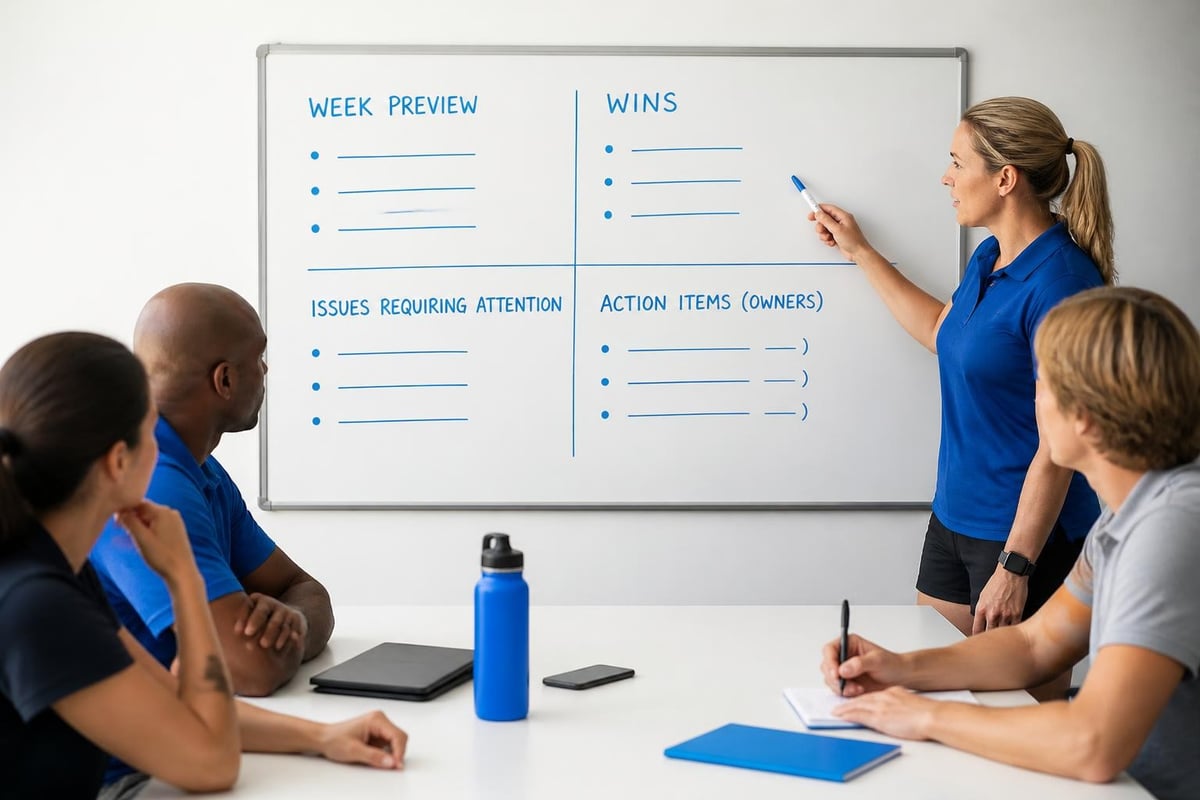
Your team check in should follow a simple pattern. Start with quick wins and updates, move through potential problems, and end with clear action items. Here's the framework I use:
Week at a Glance (3 minutes)
- Major events or schedule changes
- Membership milestones or concerns
- Facility updates or maintenance work
- Weather issues or seasonal adjustments
What's Working (2 minutes)
- Quick shoutouts for things that went well
- Member compliments or positive feedback
- Process improvements someone discovered
What Needs Attention (7 minutes)
- Problems noticed by any team member
- Upcoming challenges or busy periods
- Questions about policies or procedures
- Resource needs or staffing gaps
Action Items (3 minutes)
- Who's doing what by when
- Information that needs to be shared with members
- Follow-up items for the next check in
This structure keeps things moving. You're not solving every problem in the meeting. You're identifying them, assigning ownership, and making sure everyone knows what's happening this week.
Getting Your Team to Actually Participate
The biggest complaint I hear about team check ins is that they turn into one person talking while everyone else zones out. That happens when the meeting becomes a top-down information dump. You tell your team what's happening, they nod, and nothing actually changes.
Flip it around. Start by asking your team what they've noticed. What questions are members asking? What's confusing? What almost went wrong? When you build psychological safety in your team , people share the small problems before they become big ones.
Questions That Get People Talking
Don't ask "Does anyone have any questions?" That gets you silence. Instead, ask specific questions:
- What did members ask about this week that we should address?
- What took longer than it should have? Why?
- What's coming up that might get complicated?
- What do you need from me or from another department this week?
These questions pull out the information you actually need. Your front desk knows which policies confuse members. Your coaches know which parents are frustrated. Your maintenance team knows which equipment is about to fail. A good team check in extracts all that knowledge and puts it to work.
Connecting Check Ins to Daily Operations
Your team check in shouldn't exist in a vacuum. It needs to connect directly to how your club actually operates. This is where swim club management software makes a real difference.
When your team uses a unified platform like PoolPulse , the check in becomes more focused. Instead of asking "Does anyone know if the Johnsons paid their balance?" you can pull up real-time data. Your team discusses actual trends and problems, not speculation.
Using Data to Drive Better Conversations
Here's what I mean. During your team check in, you might review:
| Category | What to Check | Why It Matters |
|---|---|---|
| New Registrations | Memberships this week vs. last year | Spots seasonal trends, adjusts marketing |
| Outstanding Balances | Accounts more than 30 days overdue | Prevents small issues from becoming big problems |
| Guest Check-ins | Peak times and capacity issues | Helps with scheduling and staffing |
| Maintenance Logs | Recent repairs or concerns | Catches patterns before equipment fails |
| Staff Hours | Overtime trends or coverage gaps | Prevents burnout and controls costs |
This turns your team check in from a vague status update into a focused problem-solving session. You're looking at actual patterns in your club's operation and making decisions based on what's really happening, not what you think is happening.
Modern club management software can surface these insights automatically. The AI-powered features in platforms like PoolPulse can even flag issues before your team check in, so you walk in knowing exactly what needs discussion.
The Difference Between Team and Individual Check Ins
Here's a mistake I see all the time: managers try to combine team check ins with individual one-on-ones. These are different conversations with different purposes, and mixing them wastes everyone's time.
Your team check in is about coordination. Everyone needs the same information. You're aligning schedules, clarifying policies, and making sure nobody's working at cross purposes. This happens with the whole team present because the value comes from everyone hearing the same thing at the same time.
Individual check ins are about personal development, performance issues, and career growth. These conversations need privacy and dedicated time. Getting the most out of a one-on-one requires a completely different approach than running an effective team meeting.
Keep your team check in short and focused on operational coordination. Save the coaching conversations for separate one-on-ones, scheduled at whatever frequency makes sense for each team member.

When to Check In More or Less Often
Not every swim club needs the same check in schedule. A small HOA pool with three lifeguards has different needs than a competitive swim club with twenty staff members and year-round programming. Let me break down what works for different situations.
Adjusting for Your Club's Complexity
Small seasonal pools (under 200 members)
- Weekly 10-minute team check in during operating season
- Monthly during off-season
- Daily quick huddles during peak weeks
Mid-size year-round clubs (200-500 members)
- Weekly 15-minute full team check in
- Daily 5-minute shift handoff for front desk and lifeguards
- Monthly extended meeting for planning and training
Large competitive clubs (500+ members)
- Weekly department check ins (coaching, operations, front desk)
- Bi-weekly cross-department coordination meeting
- Daily stand-ups during meets and major events
The key is consistency within your chosen schedule. Random meetings when problems pop up create stress and signal that something's wrong. Regular check ins become routine and catch problems before they escalate.
Research backs this up. According to PMI's Pulse of the Profession® 2024 report , organizations that conduct frequent team standups and check-ins show significantly better project outcomes and team alignment.
Making Check Ins Work for Remote and Hybrid Teams
More swim clubs are using hybrid models now. Your head coach might work mostly from the pool deck, but your membership coordinator works from home three days a week. Your board members are all volunteers with full-time jobs elsewhere. This makes traditional team check ins harder but no less important.
The solution isn't to force everyone into the pool office for a meeting. It's to design check ins that work for the way your team actually operates. Great remote managers approach check-ins differently , focusing on outcomes and clear communication rather than face time.
Synchronous vs. Asynchronous Check Ins
You have two basic options: everyone meets at the same time (synchronous) or people contribute on their own schedule (asynchronous). Both work, but for different purposes.
Synchronous team check ins work best for:
- Time-sensitive coordination (weekend schedule, event planning)
- Complex issues that need discussion
- Building team connection and morale
- Making decisions that require input from multiple people
Asynchronous check ins work better for:
- Status updates that don't require discussion
- Teams with conflicting schedules
- Simple information sharing
- Following up on action items between meetings
Unlocking asynchronous collaboration means setting up systems where team members can share updates, ask questions, and coordinate work without needing everyone online at once.
For most swim clubs, a hybrid approach works best. Do a short live team check in weekly for coordination and connection. Use async updates for routine status sharing and follow-up between meetings.
Common Team Check In Mistakes
Let me share the mistakes I've made and seen other club managers make. Learning from these will save you months of frustration.
Mistake 1: No agenda or structure
You gather your team and say "What's going on?" Twenty minutes later, you've covered everything except what actually matters. Create a simple agenda and stick to it. The framework I shared earlier works because it forces you to cover the important stuff first.
Mistake 2: Trying to solve everything in the meeting
Your team check in should identify problems, not solve them all on the spot. If something needs deep discussion, assign it to the right people and set a separate time. Otherwise, your fifteen-minute check in becomes an hour-long problem-solving session, and everyone dreads the next one.
Mistake 3: Only the manager talks
This isn't a team check in, it's a lecture. If you're doing 80% of the talking, you're missing the whole point. Your team has information you need. Ask questions, listen, and make space for people to share what they're seeing.
Mistake 4: No follow-through on action items
Every team check in should end with clear action items and owners. If those items never get done and you never mention them again, your team learns that check ins don't matter. Start the next meeting by reviewing last week's action items. This creates accountability and shows that the meeting has real impact.
Mistake 5: Skipping during busy times
This is when you need the team check in most. When things get crazy, that's exactly when communication breaks down. Keep the meeting short if you need to, but don't skip it. A five-minute team check in during a hectic week prevents way more problems than it causes.
Adapting Daily Stand-Ups for Pool Operations
If you've worked in tech or project management, you've probably heard of daily stand-ups. The concept comes from agile development, but it translates surprisingly well to swim club operations, especially during busy periods.
A daily stand-up is a quick team sync, usually 5-10 minutes, where everyone shares what they're working on, what's blocking them, and what they need from others. For swim clubs, this format works great for shift handoffs and event coordination.
When Daily Check Ins Make Sense
You don't need daily team check ins year-round. But during these situations, a quick daily sync makes a huge difference:
- Championship swim meets spanning multiple days
- Peak summer weeks with maximum capacity
- Staff transitions or training periods
- Facility renovations or major maintenance
- Special events like swim-a-thons or open houses
Keep it short. Standing up (literally) helps. Each person shares:
- What I'm handling today
- What needs attention from someone else
- Any blockers or concerns
That's it. No problem-solving, no long discussions. This is pure information sharing so everyone knows what's happening today.
Using Technology to Reduce Check In Time
Here's where modern swim club management makes your life easier. The right software doesn't replace team check ins, but it makes them way more efficient. Instead of spending your meeting gathering information, you use it to make decisions based on information everyone already has.
Think about what your team discusses in a typical check in. Most of it is status updates: who registered this week, what balances are outstanding, which equipment needs attention, what events are coming up. If everyone has access to this information before the meeting through a platform like PoolPulse , you can skip the updates and focus on what actually requires discussion.
What Good Software Handles Automatically
Your club management system should provide real-time visibility into:
- Current membership counts and recent registrations
- Payment status and outstanding balances
- Upcoming reservations and event calendar
- Maintenance logs and facility status
- Staff schedules and coverage
When this information lives in a unified platform , your team check in becomes dramatically more productive. You're not asking "Does anyone know if we're full for Saturday lessons?" You're looking at the registration dashboard together and deciding whether to open another class.
This is especially important for clubs managing multiple facilities or programs. Tennis and swim clubs, HOA communities with multiple amenity areas, and pool management companies need visibility across all locations. Modern club management software centralizes this information so your team check in covers real issues, not information gathering.

Measuring Whether Your Check Ins Are Working
You'll know your team check in is effective when specific things start happening. Staff stops asking you the same questions repeatedly. Problems get caught earlier. The number of member complaints about confusion or inconsistency drops. These are the real measures of success.
But let's get more specific. Here are concrete signs your team check in framework is working:
Quantitative indicators:
- Reduced response time to member questions
- Fewer scheduling conflicts or double-bookings
- Lower percentage of past-due balances
- Decreased staff overtime from preventable issues
- Higher member retention and satisfaction scores
Qualitative indicators:
- Staff proactively shares concerns before they become problems
- Team members coordinate directly without always checking with you
- Fewer "Why didn't anyone tell me?" moments
- More consistent member experience across all staff interactions
- Increased staff confidence in handling non-routine situations
Track a couple of these metrics before and after implementing regular team check ins. You'll see the difference in about a month. If you're not seeing improvement, adjust your format, frequency, or participation approach.
Building Your Team Check In Habit
Starting a new meeting cadence feels hard at first. Your staff will be skeptical. Everyone's busy, and adding "another meeting" sounds like the opposite of helpful. Here's how to make it stick.
Start with a pilot. Tell your team you're trying weekly check ins for six weeks, and at the end of that period, you'll evaluate together whether they're valuable. This reduces resistance because it's not a permanent mandate, just an experiment.
Pick your time carefully. Don't schedule your team check in during your busiest operational hours. Tuesday or Wednesday morning works for most pools. Thursday if your weekends are intense and you need the coordination close to peak time.
Send a simple agenda the day before. Three bullets covering what you'll discuss. This primes people to think about issues and questions in advance, making the actual meeting more productive.
End every check in with clear takeaways. Who's doing what by when? What information needs to be shared with members? What's the one thing everyone needs to remember this week? Write this down and share it with the team afterward.
After six weeks, ask your team: Is this helping or hurting? What would make it more useful? Should we continue? Almost every time, teams want to keep going once they've seen the benefits.
Connecting Check Ins to Long-Term Planning
Your weekly team check in shouldn't just handle immediate issues. It's also where you notice patterns that inform bigger decisions. When the same type of question comes up three weeks in a row, that's a sign you need to clarify a policy or improve your communication.
Use your check ins to test ideas before implementing them fully. Planning to change your guest policy? Float it in a team check in first. Your staff will tell you what questions members will ask and what complications might arise. This saves you from rolling out changes that create more problems than they solve.
Similarly, your team check in surfaces trends that help with strategic planning. If your front desk reports increasing interest in adult swim lessons, that's valuable market intelligence. If multiple staff mention the same piece of equipment acting up, you can plan maintenance before it breaks completely.
Keep brief notes from your check ins. Once a quarter, review them to spot patterns. You'll find insights about member needs, operational bottlenecks, and staff development opportunities that aren't obvious week to week but become clear over time.
Adapting Your Check In as Your Club Grows
The team check in format that works for a fifteen-person staff won't work when you've grown to forty people. As your swim club scales, your coordination approach needs to evolve.
Small clubs can get everyone in one room for one weekly meeting. As you grow, you'll need multiple layers:
Department-level check ins for coaching staff, operations team, and front desk separately. These can happen weekly and dive into department-specific issues.
Cross-functional coordination meetings that bring department leads together bi-weekly to align on club-wide initiatives and resolve inter-department issues.
All-hands meetings monthly or quarterly for culture building, major announcements, and strategic updates that affect everyone.
The principle stays the same: regular, structured communication that keeps everyone aligned. The implementation just adapts to your organizational complexity.
For clubs making the switch to modern software , this is often the right time to restructure team check ins as well. New systems create opportunities to change processes that weren't working. Use the transition to build better communication habits from the start.
The Role of AI in Future Team Check Ins
This is where things get interesting. AI-powered club management tools are starting to change how team check ins work, and mostly for the better. Instead of manually pulling reports and gathering information before your meeting, AI can surface insights automatically .
Imagine starting your Tuesday team check in with an AI-generated summary that says: "Registration is down 12% from last week, primarily in youth programs. Three members mentioned pool temperature concerns in feedback. Equipment maintenance is due for two pumps next month." Now your meeting starts with clear focus areas, not information gathering.
This isn't science fiction. Modern swim club platforms like PoolPulse already use AI to identify patterns, flag anomalies, and generate insights from operational data. The technology handles the pattern recognition, freeing your team check in to focus on human judgment and decision-making.
The key is using AI to enhance human collaboration, not replace it. Your team check in will always need the lived experience and judgment that only your staff can provide. But AI can make those fifteen minutes incredibly more productive by doing the analytical heavy lifting beforehand.
Regular team check ins transform how your swim club operates, turning scattered information into coordinated action and catching small problems before they become big headaches. When you establish a consistent rhythm of communication, you spend less time firefighting and more time improving member experience and building your team's capability. PoolPulse supports this kind of operational excellence with AI-powered insights, centralized data, and real-time visibility that makes every team check in more focused and effective, helping your club run smoothly even during the busiest weeks of the season.

When Your Check-In Line Proves Software Is Too Slow
Discover how software timing affects your swim club's daily operations, from check-ins to billing, and why faster response times mean happier members.

What Your Billing and Invoices Are Telling You
Your swim club's billing and invoices reveal hidden patterns about late payments, refund requests, and cash flow. Here's how to read the signals.

The Swim Club Software Test Every Board Should Run
Run this simple test to see if your swim club software actually saves time or creates more work. Real scenarios, honest questions, better tools.
Want to see if PoolPulse is a good fit for your club?
Book a walkthrough and we'll show you exactly how PoolPulse can help based on your club's needs, goals, and current processes.