

How to Choose the Right Software for Your Swim Club
Choosing the right software for your swim club doesn't have to be overwhelming. Learn practical tips to find a system that actually works.


You know that feeling when you're drowning in spreadsheets, sticky notes, and member emails? When renewal season rolls around and you realize your current system is held together with duct tape and prayer? That's when you know it's time to find the right software for your club. But here's the thing: picking software isn't like ordering pool chemicals. You can't just grab what's on sale and hope it works out. The wrong choice costs you time, money, and a whole lot of frustration. The good news? You don't need to be a tech wizard to make a smart decision.
Why Your Current System Probably Isn't Working
Let's be honest. Most swim clubs start with whatever's easiest. Maybe you're using Excel because that's what the previous board president set up in 2015. Or you signed up for some generic membership platform that wasn't built for pools at all.
Here's what usually happens: registration season hits, and suddenly you're manually copying data between three different systems. You're sending payment reminders through your personal email. You're fielding calls from parents who can't figure out how to update their kid's information. Sound familiar?
The problem isn't you. It's that you're trying to run a modern swim club with tools that weren't designed for what you actually do.
The Hidden Costs Nobody Talks About
When you're using the wrong software, the price tag is just the beginning. Think about all those hours you spend:
- Manually entering the same member information in multiple places
- Tracking down missing payments one by one
- Updating your website separately from your member database
- Explaining to volunteers how to use five different logins
- Fixing errors that happen when data doesn't sync
That's your time. That's your board members' time. That's the lifetime you could spend actually improving your facility instead of fighting with technology.
What Makes Software "Right" for a Swim Club
The right software isn't about having every bell and whistle. It's about solving your actual problems without creating new ones.
You need something that handles the daily grind: check-ins at the gate, billing that runs automatically, renewals that don't require a PhD to process. But you also need it to work the way your club works, not force you to completely change your operations.

The Non-Negotiables
Every swim club has different needs, but some features aren't optional:
Member Management You need one place where all your member information lives. Contact details, membership types, family accounts, emergency contacts. When someone calls asking about their account, you should be able to pull it up in seconds, not minutes.
Billing and Payments If you're still manually processing dues, you're working too hard. Automatic billing, payment tracking, and late notices should happen without you lifting a finger. Your treasurer will thank you.
Access Control Whether you're using key fobs, gate codes, or an actual attendant, your software should track who's coming and going. This isn't just about security; it's about understanding how members use your facility.
Communication Tools You need to reach your members without digging through spreadsheets for email addresses. Pool closures, event announcements, policy updates-these should take minutes, not hours.
How to Actually Evaluate Your Options
Shopping for software feels overwhelming because everyone claims to be the perfect solution. Here's how to cut through the noise.
Start by listing your biggest headaches. Not what you think you should want, but what actually drives you crazy right now. Can't track who owes money? Write it down. Spending hours processing registrations? Add it to the list.
Then when you're looking at different options, focus on whether they solve those specific problems. Don't get distracted by fancy features you'll never use.
Questions That Actually Matter
| Question | Why It Matters |
|---|---|
| Can I try it first? | You need to see if it actually works for your workflow |
| What does onboarding look like? | Moving your data shouldn't take six months |
| Can it grow with us? | Your club might add amenities or double in size |
| What happens when something breaks? | You need real support, not a chatbot |
| Does it work with what we already use? | Starting from scratch is expensive and time-consuming |
When evaluating potential solutions, understanding your specific business objectives helps you focus on what truly matters rather than getting distracted by features you'll never use.
The Test Drive
Never, and I mean never, commit to software without testing it first. You wouldn't buy a car without driving it, right?
Set up a demo with real scenarios. Show them your actual membership structure. Ask them to walk you through processing a family registration. See what happens when someone needs to update their payment method.
Pay attention to how many clicks things take. If it requires ten steps to do something you do fifty times a week, that's a problem. The right software should make simple tasks actually simple.
The Real Cost of Making the Wrong Choice
Let's talk money, because that's usually what slows down decisions. You see a monthly price and think, "That's a lot." But what's the cost of not changing?
Calculate how many hours your board spends on administrative work each month. Put a dollar value on that time. Then add up the late payments you're missing because your reminder system is a sticky note. Don't forget the new members who give up halfway through registration because your process is too complicated.
Suddenly that monthly software fee looks different, doesn't it?
The Migration Myth
"We can't switch because moving all our data would be impossible." I hear this constantly, and it's usually not true.
Yes, migration requires planning . But good software companies help you through it. They import your existing data, walk you through setup, and train your team. The actual transition is usually faster and easier than you think.
The clubs that regret switching aren't the ones who picked the wrong software. They're the ones who waited three more years because they were afraid of change.
Common Mistakes Club Administrators Make
You're not the first person to shop for swim club software, which means you can learn from everyone else's mistakes.
Mistake #1: Picking Based on Price Alone
The cheapest option usually costs you more in the long run. When software is missing critical features, you end up paying for add-ons, workarounds, or eventually switching to something better anyway.
Mistake #2: Choosing Something Too Complicated
Enterprise software built for massive corporations with dedicated IT departments? That's not you. You need something your volunteers can figure out without a training manual.
Mistake #3: Ignoring What Your Members Actually Need
Your software isn't just for you; it's for your members too. If parents can't easily update information or view their account, you'll spend all your time helping them instead of letting the system do it.
For clubs considering new technology, common pitfalls in selecting AI-enhanced tools often stem from not understanding how the technology will actually be used day-to-day.
Mistake #4: Not Involving the Right People
Don't make this decision in a vacuum. Talk to your treasurer about billing needs. Ask your front desk what would make check-ins easier. Get input from whoever processes registrations. They know where the current pain points are.
What to Look for in a Modern Solution
Technology has come a long way since 2015. The right software today should do things that seemed impossible just a few years ago.
Smart Features That Actually Help
Modern platforms use AI to spot patterns and solve problems before you even notice them. Imagine getting alerts when a member's payment method is about to expire, or seeing which families are most likely to not renew so you can reach out early.
AI-powered insights can identify revenue recovery opportunities you're missing, like members who should be upgraded to different tiers or families paying for amenities they're not using.
But here's the key: this stuff should work automatically. You shouldn't need to run reports or analyze data yourself. The system should just tell you what you need to know.

Configuration vs. Customization
You want software that adapts to your club, not the other way around. That means being able to set up your specific membership types, pricing tiers, and policies without calling tech support.
Different clubs operate differently. Some charge per person, some per family. Some have seasonal memberships, some are year-round. The right software handles all of this without requiring custom development.
Highly configurable platforms let you adjust settings, create custom fields, and modify workflows to match how you actually operate. You shouldn't have to change your entire business model to fit the software.
Integration: Why It Matters More Than You Think
Your software doesn't exist in isolation. It needs to work with your website, your accounting system, maybe your email marketing platform.
When systems don't talk to each other, you're stuck with double entry. Someone registers on your website, and you have to manually add them to your membership system. A payment comes through, and you update three different places.
Good integration means data flows automatically. A new member signs up online, and everything syncs. Their account is created, billing starts, access permissions are set, and welcome emails go out. No manual work required.
Your Website Connection
Speaking of websites, how your club software integrates with your site determines whether registration is smooth or painful.
Members should be able to sign up, renew, update information, and make payments right from your website. They shouldn't have to click through to some third-party portal that looks nothing like your branding.
This isn't just about convenience. It's about looking professional and making it easy for people to give you money.
The Support Question
When something breaks at 4 PM on a Friday before a holiday weekend, what happens? Can you reach a real person who knows swim clubs, or are you stuck with generic email support?
The quality of customer support matters as much as the software itself. You need people who understand your industry and can solve problems quickly.
What Good Support Looks Like
- Real humans who answer questions: Not just chatbots or ticket systems
- Response times that match your urgency: Critical issues get handled immediately
- Proactive help: They reach out when they notice something wrong
- Training and resources: Documentation, videos, and guides that actually make sense
When comparing options, ask current customers about their support experience. That tells you more than any sales pitch.
Making Your Decision
You've done your research. You've tested a few options. Now you need to actually decide.
Here's a framework that works:
- List your must-haves: These are features you absolutely cannot operate without
- Rank your nice-to-haves: Things that would help but aren't deal-breakers
- Score each option: How well does it meet your must-haves? Your nice-to-haves?
- Calculate total cost: Not just the subscription, but implementation, training, and your time
- Check references: Talk to clubs similar to yours who use the software
| Decision Factor | Weight | Option A | Option B | Option C |
|---|---|---|---|---|
| Core features | High | ⭐⭐⭐ | ⭐⭐⭐⭐ | ⭐⭐ |
| Ease of use | High | ⭐⭐⭐⭐ | ⭐⭐ | ⭐⭐⭐ |
| Cost | Medium | ⭐⭐ | ⭐⭐⭐ | ⭐⭐⭐⭐ |
| Support quality | High | ⭐⭐⭐ | ⭐⭐⭐⭐ | ⭐⭐ |
| Integration | Medium | ⭐⭐⭐⭐ | ⭐⭐ | ⭐⭐⭐ |
Don't overthink it. Trust your gut about which system feels right. If something seems unnecessarily complicated during the demo, it's not going to get easier when you're using it every day.
Getting Board Buy-In
You've found the right software, but now you need to convince your board to approve the budget. This is where a lot of good decisions die.
The key is making your case with numbers, not just features. Show them the time savings. Calculate the revenue recovery from better billing. Point out the member satisfaction improvements.
Building Your Proposal
Your board doesn't want a technical presentation. They want to know:
- What problem are we solving? Be specific about current pain points
- What will this cost? Include everything, not just the monthly fee
- What do we gain? Time saved, revenue increased, errors reduced
- What's the alternative? The cost of continuing with the current system
- What's the risk? Address concerns about switching and implementation
Bring examples from other clubs if you can. Nothing convinces a board faster than hearing success stories from similar organizations.
The Implementation Phase
You've picked your software and got approval. Now comes implementation, which is where theory meets reality.
Good onboarding makes all the difference. You want a structured process that gets you up and running without overwhelming your team.
Week One: Data and Setup
This is when your member data gets imported and your account gets configured. You'll set up membership types, pricing, payment options, and all the basic settings.
Don't try to get everything perfect right away. Focus on getting the core functions working. You can always adjust settings later.
Week Two: Testing and Training
Before you go live, test everything. Process a fake registration. Run through a renewal. Try checking someone in. Make sure your team knows how to handle the daily tasks.
Train in small groups if possible. Show people the specific tasks they'll be doing, not everything the system can do.
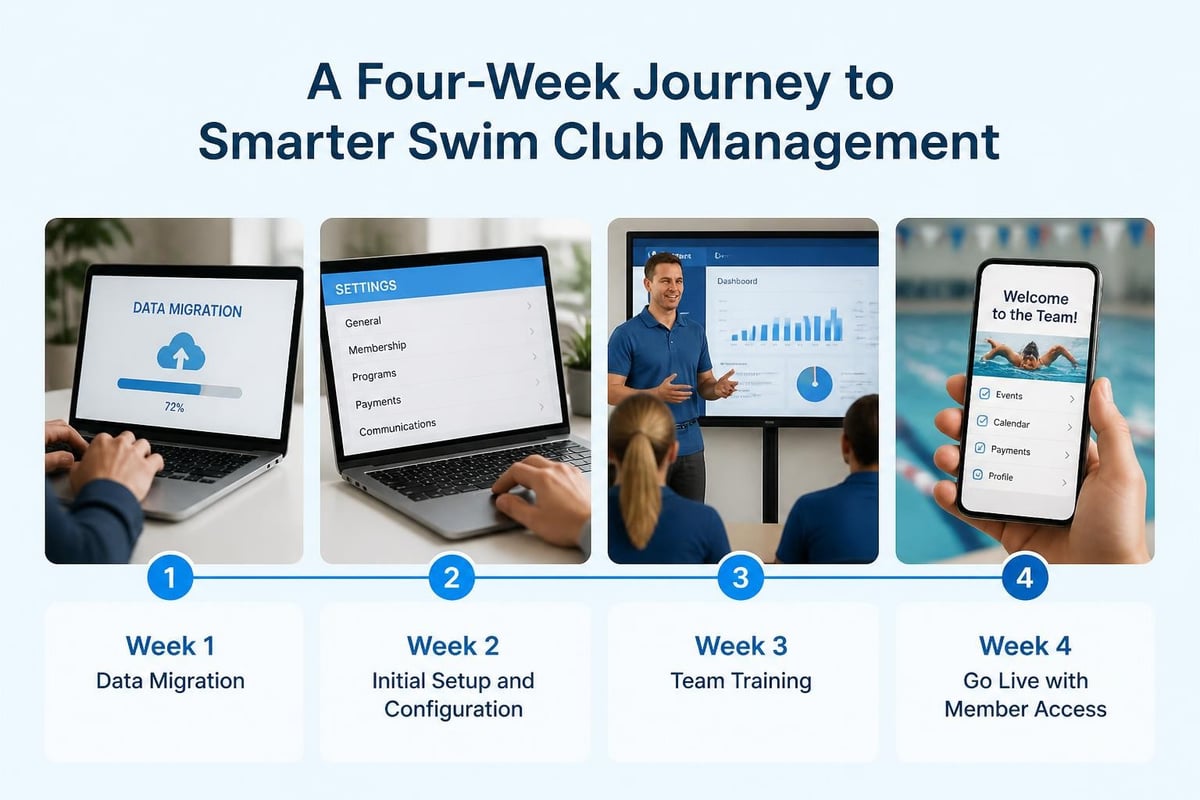
Week Three: Soft Launch
Start using the system for new transactions while keeping your old system as backup. This gives you a safety net while you build confidence.
Pay attention to what's working and what's confusing. Most platforms let you adjust workflows and settings as you learn.
Week Four: Full Transition
Cut over completely. Update your website. Inform your members. Make the new system your single source of truth.
Expect a few bumps. That's normal. What matters is having support to help you through them.
Long-Term Success
Choosing the right software isn't just about the first month. It's about whether it still works for you two years from now.
The best systems grow with your club. Maybe you add tennis courts. Maybe you expand to multiple facilities. Maybe your membership triples. Your software should handle that without starting over.
Staying Current
Technology changes fast. The right software provider keeps improving their platform, adding features, and fixing issues. You want updates to happen automatically, not require manual upgrades.
But updates shouldn't break things or force you to relearn the system. Good software evolves without disrupting your operations.
Measuring Success
How do you know if you made the right choice? Look at these metrics six months in:
- Time savings: Are administrative tasks taking less time?
- Error reduction: Are you making fewer billing or registration mistakes?
- Member satisfaction: Are complaints about the system down?
- Revenue tracking: Can you see your financial picture more clearly?
- Staff adoption: Is your team actually using it, or reverting to old habits?
If you're not seeing improvements in these areas, something's wrong. Either the software isn't right, or you need better training and support.
Industry-Specific Considerations
Generic membership software might work for a yoga studio or a coworking space, but swim clubs have unique needs.
You're dealing with seasonal fluctuations. You have family memberships with complex structures. You need to track guest passes and validate who can bring visitors. You might have swim team integration or lesson scheduling.
Purpose-built swim club software understands these nuances. It handles family accounts properly. It knows that a "junior member" at your club means something specific. It manages seasonal transitions without manual intervention.
When you're comparing options, ask how they handle scenarios unique to pools and swim clubs. Their answers will tell you whether they really understand your business.
Multi-Amenity Facilities
If you're not just a pool, things get more complicated. Tennis and swim clubs need to manage court reservations alongside pool access. HOA communities might have multiple pools, fitness centers, and clubhouses.
The right software handles all of this through one system. Members have a single account that works across all amenities. You don't need separate platforms for different facilities.
Multi-community amenity management requires software that can handle complex access rules, varied pricing structures, and different usage patterns across facilities.
The Role of Modern Technology
Let's talk about what's possible with today's technology. Not the buzzwords and marketing hype, but actual capabilities that make your life easier.
Mobile-First Design Your members expect to do everything from their phones. Registration, payments, account updates, facility check-ins. If your software requires a desktop computer, you're behind the times.
Real-Time Updates When someone updates their credit card or changes their email address, it should work everywhere immediately. No overnight batch processing or manual syncing.
Automated Workflows The system should handle routine tasks without supervision. Renewal reminders, late payment notices, access deactivation for expired memberships. These things should just happen.
Smart Reporting You shouldn't need to be a data analyst to understand your club's performance. The right software shows you what matters in plain English.
When to Consider Switching
Maybe you already have software, but it's not working. How do you know when it's time to switch versus trying to make your current system work?
Here are the signs you've outgrown your platform:
- You're using multiple workarounds to handle basic tasks
- Your team avoids using it because it's too complicated
- Member complaints about the system are increasing
- You can't get new features you need without custom development
- Support is non-existent or takes days to respond
- The cost keeps increasing with hidden fees and add-ons
Switching platforms feels daunting, but staying with the wrong system costs you more every month you wait. The pain of switching is temporary. The pain of bad software is permanent.
Making It Work for Everyone
Your software touches everyone: board members, staff, volunteers, and members. Each group needs something different from the system.
Board Members need financial visibility and reporting. They want to see membership trends, revenue tracking, and overall health metrics without digging through raw data.
Staff and Volunteers need simple, intuitive tools for daily tasks. They shouldn't need training every time they use the system.
Members need self-service options. They should be able to handle routine tasks themselves without calling or emailing you.
The right software serves all these audiences without making anyone jump through hoops. When comparing platforms, think about each user's experience, not just yours.
Final Considerations
Before you make your final decision, sleep on it. Talk to one more reference customer. Make sure you've asked every question that matters.
Some last things to verify:
- Contract terms: Can you cancel if it doesn't work out? What's the commitment?
- Data ownership: Can you export your data if you ever leave?
- Security and privacy: How is member information protected?
- Uptime guarantees: What happens if the system goes down?
- Scalability: What happens as you grow? Do costs increase proportionally?
The right software isn't just about features and price. It's about finding a partner who understands your business and will support your success.
Think about where you want your club to be in five years. Will this software help you get there, or hold you back? That's the question that matters most.
Choosing the right software for your swim club comes down to solving real problems without creating new ones. You need a system that handles member management, billing, and access control while being easy enough that your volunteers can actually use it. The best choice is one that grows with your club and makes everyone's life easier.
The right software transforms how you run your club, giving you time back to focus on what really matters: creating a great experience for your members. PoolPulse was built specifically for swim clubs, tennis facilities, and HOA pools with the features you actually need and none of the complexity you don't. Our AI-powered platform handles everything from automated billing to intelligent insights, all while being configurable enough to match how your club actually operates. Ready to see how much easier club management can be?

What Your Billing and Invoices Are Telling You
Your swim club's billing and invoices reveal hidden patterns about late payments, refund requests, and cash flow. Here's how to read the signals.

The Swim Club Software Test Every Board Should Run
Run this simple test to see if your swim club software actually saves time or creates more work. Real scenarios, honest questions, better tools.

The Seven Signs You've Outgrown Your Club Operations
Your swim club is growing, but your tools aren't keeping up. These seven warning signs reveal when manual processes cost more than solutions.
Want to see if PoolPulse is a good fit for your club?
Book a walkthrough and we'll show you exactly how PoolPulse can help based on your club's needs, goals, and current processes.