

From Spreadsheets to Streamlined: How Modern Swim-Club Software Saves Hours Every Week
Why spreadsheet-heavy club operations create admin drag, and how integrated swim-club software gives boards, treasurers, and staff their time back.

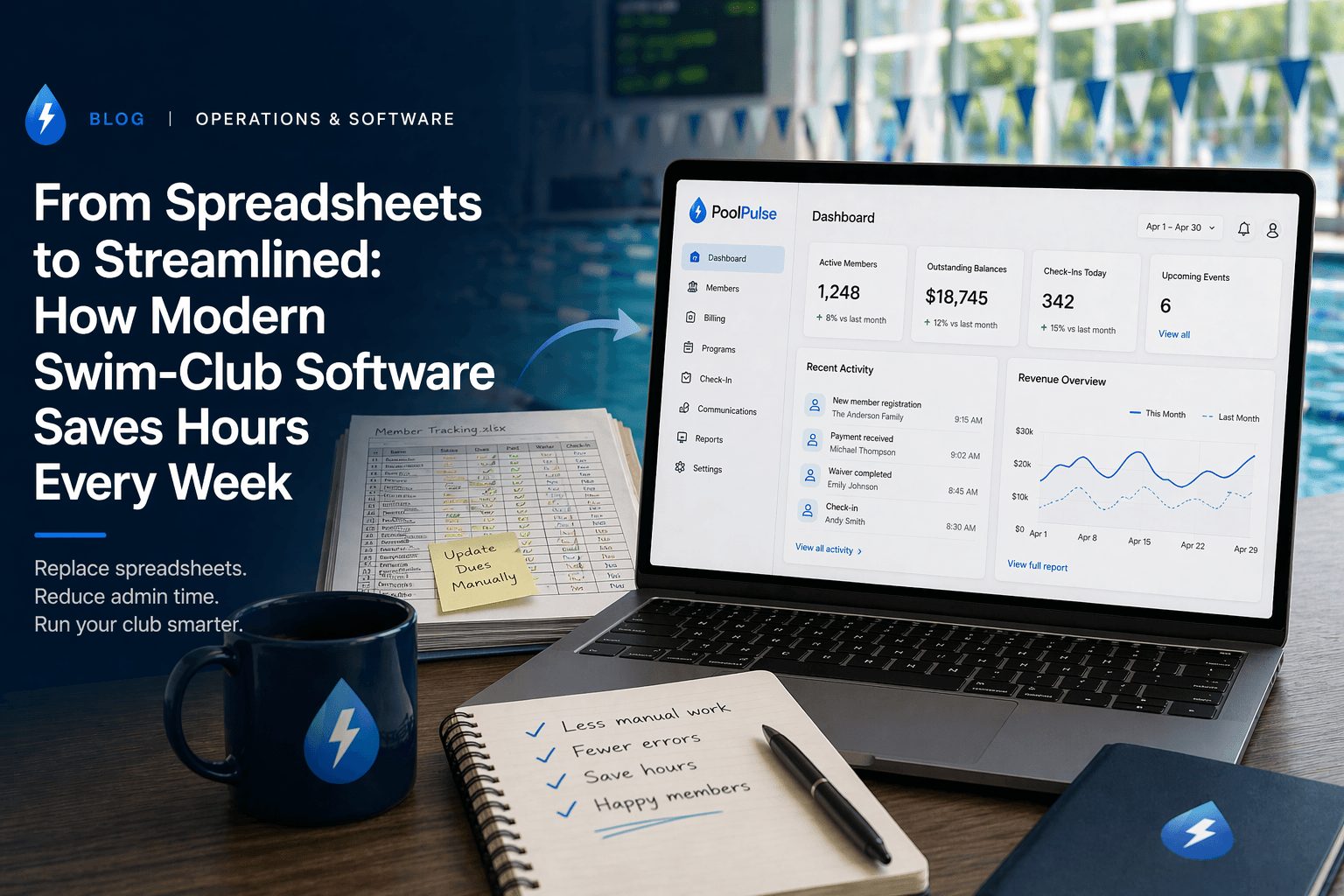
Most swim clubs do not struggle because people stop caring. They struggle because too many caring people are holding the operation together with spreadsheets, inboxes, paper notes, and memory.
The treasurer has one version of the truth. The front desk has another. The membership chair is working from last season's export. The event lead has their own signup sheet. The board keeps asking for a clean answer to a simple question, and someone has to spend an evening stitching the answer together by hand.
That is the real cost of manual operations. It is not just slow. It makes every role harder.
The numbers point in the same direction
The exact benchmark varies by source, but the pattern is consistent: modern membership software can dramatically reduce administrative work compared with spreadsheet-heavy operations.
- Associations Online says integrated membership software can reduce administrative time by 60% to 70%.
- Member Evolution's summary of membership-software user research says 57% of organizations saw a substantial impact on member satisfaction and engagement after adopting dedicated software.
- One swim-club-focused industry roundup uses an even sharper shorthand, saying modern software can cut administrative time by 65% and lift member engagement by 60% compared with manual workflows.
The safest takeaway is not that every club gets the exact same number. It is that clubs moving out of spreadsheets usually reclaim a meaningful chunk of staff and volunteer time, while creating a cleaner experience for members at the same time.
Why spreadsheets collapse under swim-club reality
Spreadsheets can hold data. They are terrible at running live operations.
The moment your club needs to answer questions like these in real time, a spreadsheet stops being enough:
- Is this family paid and eligible to check in today?
- Did they sign the correct waiver?
- Who should receive the renewal reminder?
- Which guest credits are still valid?
- Who registered for the event and who still owes?
- What changed since the board meeting last week?
If each answer lives in a different tab or tool, your team is not managing a system. It is managing handoffs.
That handoff problem is what creates burnout. Volunteers do not quit because one spreadsheet exists. They quit because the spreadsheet is attached to five other manual tasks, and every exception becomes "Can someone just handle this one thing?"
What integrated software changes
Integrated swim-club software reduces friction because the same member record powers the workflows around it.
In PoolPulse, that means your club can keep:
- household history and member context in Member Management
- plan rules and renewal timing in Memberships & Packages
- statements, recurring dues, and balances in Billing & Payments
- gate validation in Check-Ins & Access Control
- internal context and alerts in Notes & Notifications
- lifecycle follow-up in Marketing Automation
The practical effect is simple. Staff no longer have to re-key the same information into multiple tools just to keep the season moving.
Where clubs usually win back time first
1. Renewals stop being a scavenger hunt
When membership status, billing, and reminders stay connected, the club can automate most of the routine chasing. Families get clearer reminders. Treasurers get fewer manual exceptions. Board members get better visibility into who is active, expiring, or lapsed.
2. Front-desk questions get faster
If the check-in team can see eligibility, notes, waiver status, and basic account context in one place, the line moves faster and awkward "hold on while I text someone" moments drop.
3. Event follow-up gets easier
Integrated registrations and billing mean the club does not need one sheet for signups, one export for payments, and another for reminders. That alone removes a surprising amount of seasonal cleanup.
4. Volunteer transitions get less painful
When records live inside a system instead of someone's personal spreadsheet structure, the next volunteer does not have to reverse-engineer how the club works before they can help.
This is not just about efficiency
Families feel the difference when operations are connected.
They renew faster because the process is clearer. They check in faster because status is easier to verify. They miss fewer deadlines because reminders are consistent. They trust the club more because staff can answer questions without visible scrambling.
That is why software adoption often shows up in engagement, not just admin savings. Better systems create fewer broken moments.
A better buying standard
If a platform still expects your club to maintain separate manual workflows for renewals, check-ins, event registration, messaging, or payment follow-up, it has not really replaced spreadsheets. It has only rearranged them.
The better standard is this:
Can one system carry the member record, the money, the communication, and the front-desk decision without requiring your team to rebuild the story manually?
That is the difference between software that looks modern and software that actually saves time.
If you want to review the operational pieces in more detail, start with Member Management, Billing & Payments, and Check-Ins & Access Control.
Sources referenced
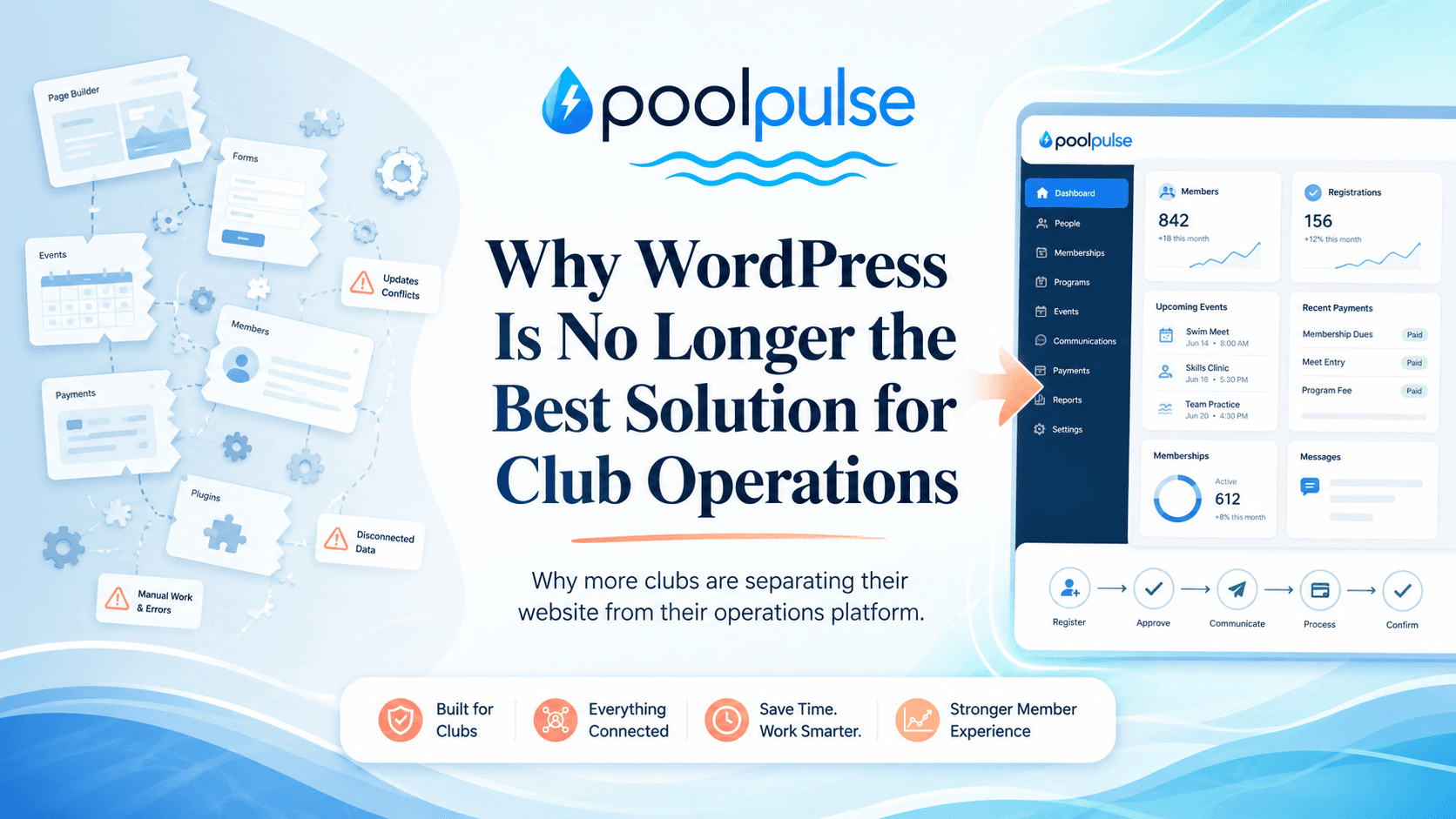
Why WordPress Is No Longer the Best Solution for Running Your Club Operations
A practical look at why growing clubs should keep WordPress focused on marketing and move memberships, billing, waivers, check-ins and reporting into a purpose-built platform.

New Swim and Sports Club Management Software Startup 2026: Meet PoolPulse™
Meet PoolPulse, a new swim and sports club management software startup helping modern clubs simplify operations, connect daily workflows and improve the member experience.
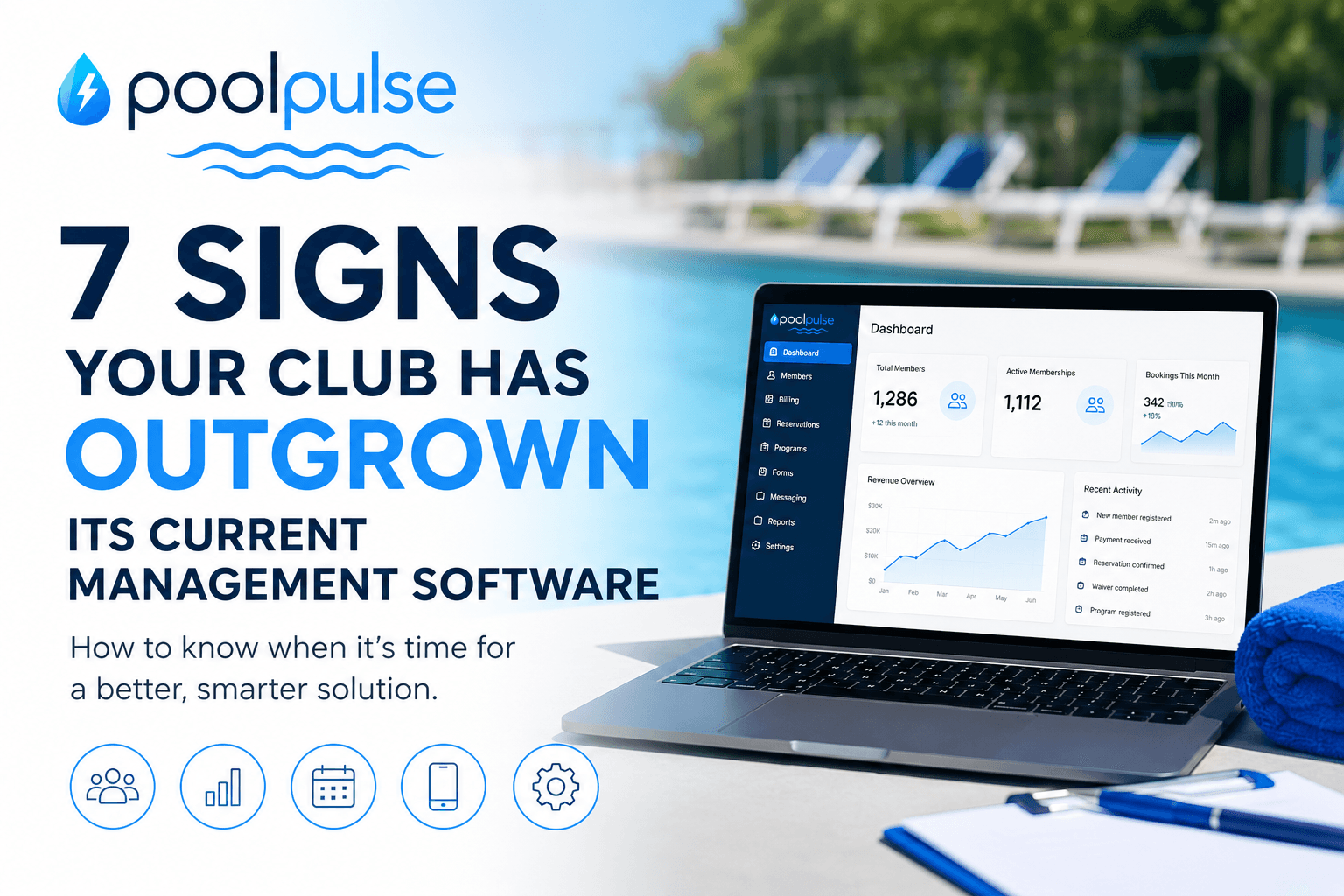
7 Signs Your Club Has Outgrown Its Current Management Software
Seven practical warning signs that your club management software is creating staff workarounds, member friction, slow reporting, and extra admin work.
Want to see if PoolPulse is a good fit for your club?
Book a walkthrough and we'll show you exactly how PoolPulse can help based on your club's needs, goals, and current processes.