

Swim Club Billing Software: What Clubs Should Verify Before They Buy
What clubs should verify before choosing billing software — dues handling, renewals, household balances, payment visibility, and the workflows that matter most.


If your club is searching for swim club billing software, you are probably not looking for a prettier invoice screen.
You are trying to reduce overdue balances, clean up renewal confusion, answer family questions faster, and stop rebuilding the same financial context across spreadsheets, card processors, and front-desk notes.
That is why good billing software has to do more than send charges. It has to help the club operate with less uncertainty.
Quick answer: what should swim club billing software actually handle?
Strong swim club billing software should help your team:
- invoice dues, assessments, guest fees, and member-linked purchases
- show open balances and payment history at the household level
- support renewals without forcing staff to rebuild account context
- surface failed payments, credits, and exceptions clearly
- connect billing decisions to check-ins, waivers, and member eligibility
- make reporting easier for treasurers, managers, and boards
If billing lives in one system while check-in eligibility, waiver status, and household notes live somewhere else, the club still ends up paying the hidden cost in manual follow-up.
Why clubs outgrow basic payment tooling
Many clubs start with a simple payment processor or a lightweight membership tool and only feel the pain later.
The pain usually shows up in familiar ways:
- families ask about balances and staff need two or three screens to answer
- renewals stall because payment status is unclear
- credits and exceptions live in email threads instead of the member record
- board reporting takes longer than it should because the numbers need cleanup first
That is when clubs realize billing is not a side workflow. It is part of the operating system.
The 5 billing workflows worth testing before you buy
1. Household balance visibility
The club should be able to see what a household owes, what they paid, and what changed without reconstructing the story manually.
Look for:
- current balance and statement history
- credits, discounts, and adjustments
- payment method status
- invoice timing and renewal status
This is one reason the Billing & Payments workflow matters so much. Billing gets easier when it stays tied to the same household record staff already use everywhere else.
2. Renewal and membership continuity
Billing software should make renewals easier, not create another reconciliation step.
Test what happens when:
- a card expires before renewal
- a family partially pays
- a late renewal needs follow-up
- a treasurer wants to review who is still at risk
If the system cannot show the renewal state and the billing state together, the club ends up chasing the same issue from two directions.
3. Front-desk context
This is where many billing systems fall short.
When a family arrives, your team may need to know whether they are active, whether anything is missing, and whether a balance issue should trigger a conversation. If billing is disconnected from Check-Ins & Access Control, staff lose time right when the line is longest.
Good swim club billing software does not turn every balance issue into a detective story.
4. Exceptions and edge cases
Every club has them:
- split households
- board-approved credits
- guest fees added after the fact
- family questions about what a charge was for
The real test is not whether the system can process a normal payment. It is whether staff can explain and resolve the messy situations without making the member wait.
5. Board-ready reporting
Billing software should shorten the path to answers like:
- how much is currently outstanding
- how many renewals are still unresolved
- what collections patterns are improving or slipping
- where manual intervention is piling up
If reporting still starts with spreadsheet cleanup, the software is not pulling its weight.
Red flags in swim club billing software
Watch for these issues when you evaluate vendors:
- billing history does not stay close to the member record
- renewal tracking is vague or hard to filter
- credits and exceptions are difficult to explain later
- front-desk staff cannot see enough context to act confidently
- the platform handles dues but not the operational workflows around them
Those red flags usually mean the club will keep paying with staff time even if the software price looks reasonable.
Questions to ask every vendor
Ask these directly:
- Can we see balances, renewal status, and member context in one workflow?
- How do failed payments and expired cards show up for staff?
- Can front-desk or member-service staff answer billing questions without a second system?
- How do credits, discounts, and manual adjustments appear in history?
- What reporting do boards and treasurers get without extra cleanup?
These questions usually reveal whether the platform is built for club operations or only for transaction collection.
Where billing software fits in the bigger buying decision
Billing does not stand alone for long. It affects swim club member management software, renewals, front-desk decisions, and the board case for changing systems in the first place.
That is also why it belongs in the ROI conversation. If your club is trying to quantify overdue balances, missed renewals, or reconciliation drag, use the Revenue Recovery page to model the upside with assumptions your board can actually review.
If you are still comparing platforms at a higher level, the best swim club management software guide is the right next step.
Frequently asked questions
What is swim club billing software?
Swim club billing software is the system a club uses to manage dues, invoices, renewals, household balances, credits, and payment history. The best options keep that billing context connected to the member record and front-desk workflows.
Should billing and member management live in the same system?
Usually yes. Clubs move faster when household records, balances, renewals, waivers, and check-in context stay connected instead of being spread across separate tools.
Can billing software help with renewals too?
Yes, if the platform treats renewal state and billing state as part of the same workflow. That is one of the clearest places weak systems create extra admin work.
The bottom line
The best swim club billing software does not just collect money. It helps the club understand what is owed, what changed, who needs follow-up, and what staff should do next.
If you want to pressure-test that workflow against your current setup, start with Billing & Payments, review Pricing, or use the migration checklist if a switch is already on the table.
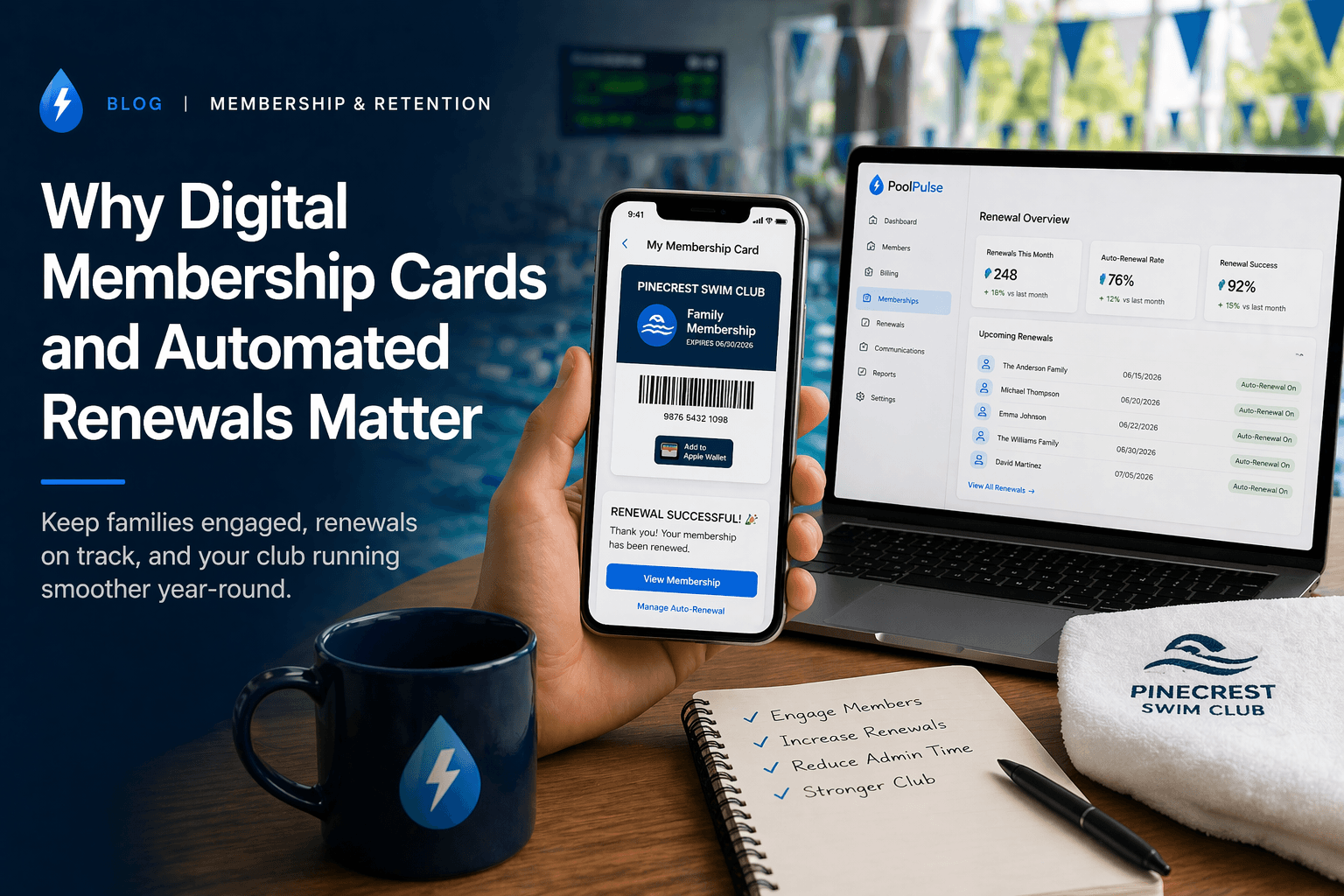
Why Digital Membership Cards and Automated Renewals Matter
Two features do outsized work for modern swim clubs: digital membership cards at check-in and automated renewals behind the scenes.

Swim Club Check-In Software: What Matters at the Front Desk
How clubs improve gate flow, waiver checks, guest rules, and front-desk speed — and what to validate before choosing check-in software.
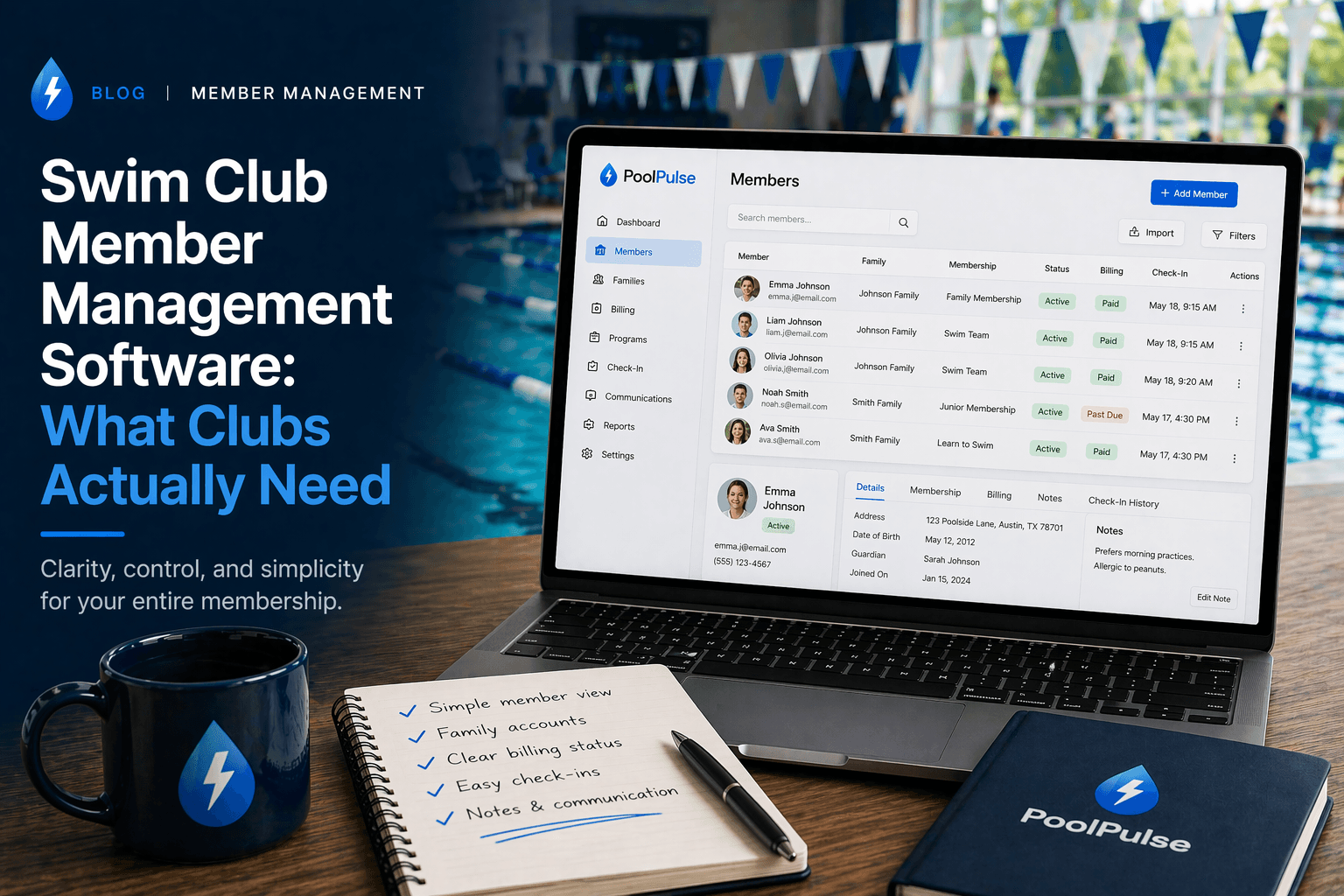
Swim Club Member Management Software: What Clubs Actually Need
What clubs actually need from member management software: billing, renewals, check-ins, waivers, and growth without second-system sprawl.
Want to see if PoolPulse is a good fit for your club?
Book a walkthrough and we'll show you exactly how PoolPulse can help based on your club's needs, goals, and current processes.