

Swim Club Management: A Practical Guide to Running a Smoother Season
Swim club management gets complicated fast once memberships, dues, renewals, waivers, check-ins, guest passes, snack bar sales, staffing, and board reporting start living in different places. Here's how to simplify the season.

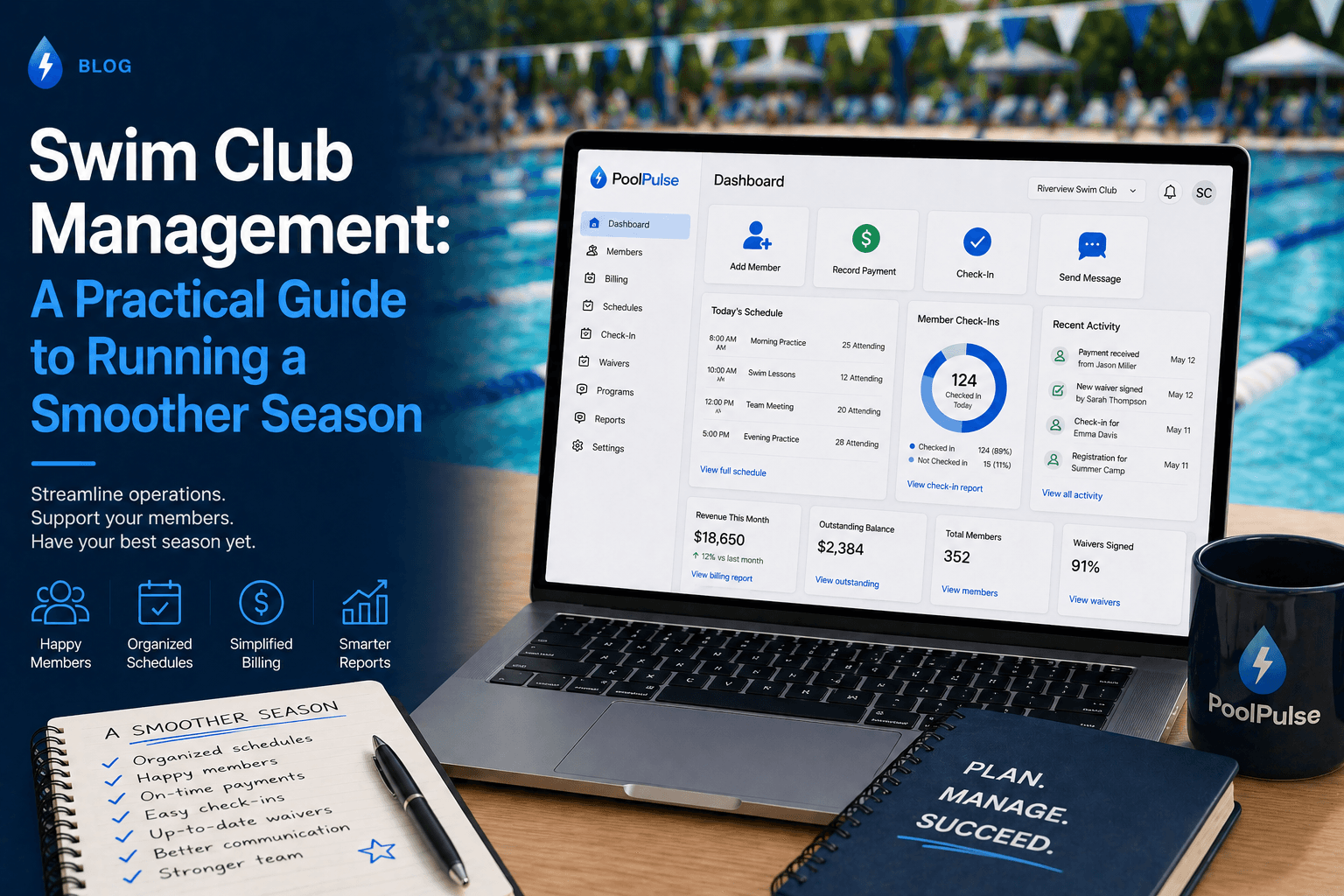
Swim club management sounds simple from the outside.
Families join. Members check in. Kids swim. Guests visit. The snack bar opens. Staff covers shifts. The board wants reports.
But anyone who has actually managed a swim club knows the reality is more complicated.
A smooth season depends on dozens of small workflows working together: member records, dues, renewals, payment status, waivers, guest passes, front-desk check-ins, POS sales, staffing, reservations, communications, and board reporting. When those workflows are split across spreadsheets, email threads, paper forms, payment tools, and staff memory, the busy season exposes every gap.
This guide breaks down what effective swim club management really involves, where clubs usually lose time and money, and how to build a cleaner operating system before the next rush.
What is swim club management?
Swim club management is the process of running the operational, financial, and member-facing parts of a swim club.
That usually includes:
- Managing members and households
- Collecting dues and fees
- Handling renewals
- Tracking waivers and forms
- Checking members and guests into the facility
- Managing guest passes and access rules
- Running snack bar or club POS sales
- Scheduling staff
- Managing reservations, programs, lessons, or events
- Communicating with members
- Reporting to the board
Good swim club management keeps these workflows connected. Poor swim club management forces staff and volunteers to jump between disconnected tools, which leads to missed payments, long check-in lines, unclear member status, and extra work for everyone.
The goal is not just to go digital. The goal is to make the club easier to run.
Why swim club management gets harder during the season
Most clubs can survive messy systems during the quiet months.
The problems show up when the pool gets busy.
Opening weekend, holiday rushes, swim meets, guest-heavy afternoons, and hot-weather spikes all create pressure at the same time. The front desk needs fast answers. Families need to pay balances. Guests need to be approved. Staff need coverage. The snack bar needs clean sales tracking. The board wants visibility.
That is when disconnected workflows start costing real time and money.
Common pain points include:
Unpaid dues
Balances are easy to miss when billing, renewals, and check-in status are handled separately.
Slow check-ins
Staff cannot move the gate line quickly if they have to search for waivers, member status, guest rules, and balances in different places.
Missed renewals
Families fall through the cracks when renewal status is tracked manually.
Snack bar leakage
Sales, prepaid balances, tabs, and member charges become harder to reconcile when POS is disconnected from household records.
Staffing gaps
Busy windows become stressful when managers do not see coverage issues early.
Board reporting headaches
Questions about payments, attendance, renewals, revenue, or member activity take longer to answer when data is scattered.
The busier the club gets, the more important it becomes to manage everything from one connected system.
The core workflows every swim club needs to manage
Every club is different, but most swim clubs need the same operational foundation.
1. Member and household management
At the center of swim club management is the member record.
A club needs to know:
- Who belongs to each household
- What membership type they have
- Whether their account is active
- Which waivers are signed
- Whether they have outstanding balances
- Which guest rules apply
- What notes, restrictions, or incidents staff should see
- Which passes, reservations, or programs are tied to the family
Spreadsheets can work at the beginning, but they break down as soon as information changes frequently. Families move. Children age into different rules. Payment status changes. Waivers expire. Guest privileges vary. Staff need accurate answers in real time.
A strong member management process gives the club one reliable place to understand each household.
2. Billing, dues, and renewals
Billing is one of the biggest swim club management pain points.
Clubs often need to manage:
- Annual dues
- Monthly or seasonal payment plans
- Initiation fees
- Guest passes
- Program fees
- Credits and refunds
- Failed payments
- Renewal reminders
- Receipts
- Outstanding balances
When billing is manual, staff or volunteers spend too much time chasing payments. Even worse, unpaid balances may not be visible during check-in, which means members can continue using the club while dues or fees remain unresolved.
Better billing and renewal workflows should make it easy to see who has paid, who needs a reminder, who has a declined card, and which households need follow-up before the renewal window closes.
3. Front-desk check-in and access control
The front desk is where your swim club management system gets tested every day.
Staff need quick answers:
- Is this member active?
- Is the waiver signed?
- Is there an unpaid balance?
- Are guests allowed?
- How many guest passes remain?
- Is there a reservation?
- Are there any restrictions or notes?
- Does this household have access today?
If staff have to check multiple tools, the line slows down. If they cannot see the full picture, the club risks inconsistent enforcement.
A better front-desk check-in workflow gives staff the full household context from one screen so they can make fast, consistent decisions.
4. Guest passes, waivers, and policy rules
Guest access is a small workflow that can create big confusion.
Clubs need to know:
- Who can bring guests
- How many guests are allowed
- Whether passes are prepaid or billed later
- Whether guest waivers are required
- Whether certain days or events have different rules
- Whether guest use should appear in reports
The same is true for waivers and policy forms. If waivers are stored in paper binders, email attachments, or separate form tools, staff may not know whether a member is actually cleared to enter.
Good swim club management keeps guest pass rules, waiver status, and member access connected.
5. POS and snack bar management
Many swim clubs underestimate how much operational complexity lives in the snack bar.
Snack bar and POS workflows often include:
- Cash and card sales
- Member tabs
- Prepaid balances
- Charge-to-account purchases
- Inventory visibility
- End-of-day totals
- Household-level reporting
- Staff accountability
If POS is separate from member records, the club may spend extra time reconciling sales, tabs, and balances later.
A connected POS and snack bar system keeps purchases tied to the household, making it easier to track revenue, balances, and member activity.
6. Reservations, programs, lessons, and waitlists
Many swim clubs now manage more than open swim.
They may offer:
- Lane reservations
- Court reservations
- Swim lessons
- Camps
- Clinics
- Events
- Party rentals
- Class registrations
- Waitlists
- Capacity limits
When reservations and programs are handled through separate signup tools, staff lose visibility. Members may have a reservation in one system, a balance in another, and a waiver somewhere else.
A cleaner swim club management setup keeps reservations, programs, payments, capacity, and member status connected.
7. Staff scheduling and coverage
Even the best member experience falls apart when the club is understaffed.
Staffing workflows often include:
- Lifeguard schedules
- Front-desk shifts
- Snack bar coverage
- Manager coverage
- Open shifts
- Shift swaps
- Peak-time planning
- Incident visibility
The key is not just creating a schedule. It is seeing where the club may be short before the rush happens.
Managers should be able to identify busy windows, open shifts, and coverage gaps early enough to act. That is where staff scheduling workflows become part of daily operations instead of a separate admin task.
8. Reporting and board visibility
Boards need clear answers.
They may ask:
- How many members renewed?
- How much revenue came in this week?
- Which balances are overdue?
- How many people checked in?
- How much did the snack bar sell?
- Which programs are full?
- Which times are underused?
- What changed since last season?
If the club relies on separate spreadsheets and tools, reporting becomes a manual project. A connected system makes reporting part of daily operations instead of a scramble before the board meeting.
Swim club management checklist
Use this checklist to evaluate how ready your club is for the season.
Membership
- Member and household records are current
- Membership types are clearly defined
- Active, inactive, waitlisted, and former members are easy to identify
- Staff can see the right household information quickly
- Notes, tags, documents, and restrictions are searchable
Billing and renewals
- Dues and fees are clearly assigned
- Renewal status is visible
- Failed payments trigger follow-up
- Receipts and invoices are easy to find
- Outstanding balances are visible before check-in
- Credits, refunds, and adjustments are tracked
Check-in
- Staff can verify member status quickly
- Waiver status is visible
- Guest rules are clear
- Balances are visible
- Incidents or restrictions are easy to see
- Reservations or access rules are connected to the member record
POS and snack bar
- Sales are tracked cleanly
- Member tabs are tied to households
- Prepaid balances are visible
- Charge-to-account workflows are controlled
- End-of-day reports are easy to produce
Reservations and programs
- Capacity limits are clear
- Waitlists are easy to manage
- No-shows are tracked
- Payments connect to registrations
- Staff can see who is expected on site
Staffing
- Schedules are current
- Open shifts are visible
- Managers can see coverage gaps
- Busy windows are planned in advance
- Staff roles and access are controlled
Reporting
- The board can get clean reports
- Revenue, attendance, renewals, and POS data are visible
- Reports do not require spreadsheet cleanup
- Operational trends can be spotted before they become problems
If your club cannot answer most of these questions quickly, your swim club management process is probably creating extra work.
Spreadsheets vs. swim club management software
Spreadsheets are familiar. They are flexible. They are easy to start with.
But they are not designed to run a busy swim club.
A spreadsheet can store names and balances, but it cannot reliably manage real-time check-ins, waiver status, guest passes, failed payments, POS tabs, reservations, staff schedules, and board reports without a lot of manual work.
The issue is not that spreadsheets are bad. The issue is that swim clubs eventually outgrow them.
A connected swim club management software platform should help your club:
- Reduce manual reconciliation
- Keep household records accurate
- Automate billing and renewal follow-up
- Speed up check-ins
- Track guest access and waivers
- Connect POS sales to member accounts
- Manage reservations and waitlists
- See staffing issues earlier
- Give the board clearer reporting
The best system is not the one with the longest feature list. It is the one that matches how your club actually operates.
What to look for in swim club management software
When comparing swim club management software, focus on the workflows that create the most seasonal pressure.
1. Member management built around households
Swim clubs usually operate around families, not just individual contacts. Look for household profiles, membership types, notes, documents, waivers, balances, passes, and member activity in one place.
2. Billing and renewal automation
The system should help with recurring dues, renewal reminders, payment visibility, failed-payment follow-up, credits, receipts, and invoices.
3. Fast front-desk check-in
Staff should be able to see member status, waivers, balances, guest rules, reservations, and restrictions without switching tools.
4. Connected POS
Snack bar sales, tabs, prepaid balances, and charge-to-account purchases should connect back to the member or household record.
5. Reservations and waitlists
If your club manages lanes, courts, lessons, events, rentals, or capacity limits, reservation tools should connect to member status and payments.
6. Staff scheduling and manager visibility
Staffing features should help managers spot open shifts, peak-time gaps, and coverage issues before they affect service.
7. Reporting that does not require cleanup
Look for reports that help boards and operators understand renewals, payments, attendance, POS sales, programs, and operational trends.
8. Member self-service
A good member portal should reduce front-desk work by letting families update information, sign waivers, pay balances, manage reservations, view guest passes, and see club updates.
9. Migration support
Switching systems can feel risky. Look for help importing members, balances, renewals, and workflows so your club does not have to start from scratch.
10. A real demo
Before committing, your team should be able to see how the system works. A guided walkthrough is especially useful because you can ask about your club's current setup, member rules, billing process, and seasonal pain points.
How to improve swim club management this season
You do not have to fix everything at once.
Start with the workflows that create the most friction.
Step 1: Map your current process
Write down every tool your club uses for members, billing, check-ins, waivers, POS, reservations, staffing, and reporting. Include spreadsheets, email inboxes, paper forms, payment tools, and anything staff keep in their heads.
Step 2: Identify the biggest bottleneck
Common bottlenecks include unpaid balances, renewal follow-up, slow check-ins, guest pass confusion, snack bar reconciliation, and board reporting.
Pick the one that costs the most time or creates the most complaints.
Step 3: Connect the member record to the front desk
If the front desk cannot see member status, waivers, balances, and guest rules quickly, everything else becomes harder. This is often the highest-impact place to improve first.
Step 4: Automate payment follow-up
Manual reminders are easy to miss during the season. Automating renewal reminders, failed-payment follow-up, and balance visibility can recover time and revenue.
Step 5: Give the board better visibility
Boards do not need more spreadsheets. They need clear snapshots of membership, payments, attendance, revenue, and operational trends.
Step 6: Choose software around real club workflows
Do not shop from a generic feature checklist. Evaluate software by walking through a real club day: member arrives, waiver check happens, guest is added, balance is reviewed, snack bar purchase is made, shift changes, report is generated.
That is where you will see whether the system actually fits.
See how PoolPulse helps with swim club management
PoolPulse brings the core swim club management workflows into one connected system.
Instead of managing memberships, billing, renewals, check-ins, POS, reservations, staffing, and reporting across disconnected tools, PoolPulse helps clubs run the season from one workspace.
With PoolPulse, clubs can manage:
- Member and household records
- Billing, dues, invoices, and renewals
- Front-desk check-ins
- Waivers and guest rules
- POS and snack bar sales
- Reservations and waitlists
- Staff scheduling
- Member self-service
- Reporting and operational visibility
- PulseSignal insights for renewal risk, staffing gaps, revenue dips, and underused capacity
PoolPulse is built for swim clubs, HOA pools, tennis-and-swim clubs, and member-driven facilities that want cleaner operations without adding another disconnected system.
Want to see how this would work for your club?
Schedule a Walkthrough, open the self-guided demo, or see pricing.
For a deeper look at the platform, explore PoolPulse features, see swim club workflows, or plan your switch.
Swim club management FAQs
What is swim club management?
Swim club management is the process of running the operational, financial, and member-facing parts of a swim club. It includes memberships, billing, renewals, check-ins, waivers, guest passes, POS, reservations, staffing, communications, and reporting.
What is the best way to manage swim club members?
The best way to manage swim club members is to keep household records, membership status, balances, waivers, guest rules, notes, and activity in one connected system. This gives staff and board members accurate information without relying on scattered spreadsheets or email threads.
Why do swim clubs outgrow spreadsheets?
Swim clubs outgrow spreadsheets because member status, payments, waivers, check-ins, reservations, POS sales, and staff schedules change constantly during the season. Spreadsheets can store information, but they do not manage real-time workflows well.
What features should swim club management software include?
Swim club management software should include member and household management, billing, renewals, payment tracking, check-ins, waivers, guest passes, POS, reservations, staffing, member communication, reporting, and member self-service.
Can swim club management software help with renewals?
Yes. Swim club management software can help track renewal status, send reminders, manage invoices, retry failed payments, show outstanding balances, and give staff visibility into which families need follow-up.
How does swim club check-in software help the front desk?
Swim club check-in software helps staff quickly see whether a member is active, whether waivers are signed, whether balances are due, whether guests are allowed, and whether any restrictions or notes apply. This makes gate operations faster and more consistent.
Should swim club POS connect to member accounts?
Yes. Connecting POS to member accounts makes it easier to manage snack bar sales, prepaid balances, member tabs, charge-to-account purchases, and household-level reporting.
How can a swim club switch management systems without disrupting the season?
The safest approach is to migrate in parallel. Keep current operations running while member records, balances, renewals, staff workflows, and training move into the new system. A guided walkthrough can help identify the right launch path before the club switches fully.
Ready to make swim club management easier?
PoolPulse helps swim clubs connect memberships, billing, renewals, check-ins, POS, reservations, staffing, reporting, and member self-service in one system.
Schedule a walkthrough to see how PoolPulse would work for your club's season.
No setup fee. No contracts. Free migration.

HOA Pool Reservation Software: What Communities Should Evaluate
How HOA communities manage booking rules, waitlists, and resident access context — and what to look for in pool reservation software.

Guest Pass Tracking for Swim Clubs: How to Tighten Rules Without Slowing the Gate
How swim clubs tighten guest pass rules, improve front-desk visibility, and reduce enforcement confusion without slowing the gate.

Your Pulse: Peak Season Protection™
Peak season puts every part of club operations under pressure. Your Pulse: Peak Season Protection is PoolPulse’s approach to keeping seasonal clubs stable, familiar, fast and ready when it matters most.
Want to see if PoolPulse is a good fit for your club?
Book a walkthrough and we'll show you exactly how PoolPulse can help based on your club's needs, goals, and current processes.